This is the fifth solo album from Steve Mason, once of The Beta Band – and it is designed as a record to bring people together through art, music and culture, in the face of the uncertain climate in which we currently live.
The spirit of collaboration runs through Mason’s work this time around, with co-producer Tev’n helping Mason oversee a line-up that includes Pakistani singer Javed Bashir, Indian singer Kaviraj Singh, the multi-disciplined Adrian Blake and British gospel singers Jayando Cole, Keshia Smith and Connie McCall.
What’s the music like?
Brothers & Sisters is a protest record of the most uplifting kind. The trademark shuffle is still present in Mason’s beats, but this time around he has added a great deal of purpose and urgency to the songs. Where before in his music a more laidback mood was in evidence, now the music is ignited, a zest for life and human companionship coarsing through his songwriting.
As the album title Brothers & Sisters implies, there is a strong family unity between the songs, a communal pull that reaches out to bring the listener in and on board. This is typified by The People Say, where Mason looks to celebrate our differences rather than pull people apart. All Over Again is redolent of early Primal Scream and sees some of his best vocals yet, with the gospel singers seizing their chance to shine.
No More, meanwhile, has a powerful undercurrent of standing up together for what we believe. Aided by Javed Bashir‘s assertions, its strong resolve is matched by a battery of percussion. “This is the people speaking, we are not the same!” they sing, reaching for the sky.
Pieces Of Me, reveals Mason at his most vulnerable, with spiritual undertones to the deeply felt vocal as he sings of “pieces of me inside, people I know who died”. Then Mason ends the album with a final rallying call, Brothers & Sisters demanding that we “pump up the volume”.
Does it all work?
Yes, emphatically. Mason’s songwriting has moved up a level, responding to adversity and collaboration with lyrics and vocals that reach out to directly to the listener.
Is it recommended?
Yes, enthusiastically. Brothers & Sisters is both a call to arms in the face of adversity and an extremely uplifting album, Steve Mason feels the urgency, the need for us humans to stick together whatever our background – and this career-best effort will get a good many converts to the cause.
Listen
Buy
You can explore buying options for Brothers & Sisters at the Domino website
Esther Abrami (violin), English String Orchestra / Kenneth Woods
Saxton Scenes from the Epic of Gilgamesh (2022-3) [World Premiere] Bruch Scottish Fantasy in E flat (1880) Mendelssohn Symphony no.3 in A minor Op.56 ‘Scottish’ (1841-2)
Sheldonian Theatre, Oxford Friday 10 March 2022
Reviewed by Richard Whitehouse
There cannot be any more historic or atmospheric performance venues than the Sheldonian Theatre in Oxford, which is still going strong after over 350 years and the setting for this latest contribution to the English Symphony Orchestra’s ‘21st-Century Symphony Project’.
Speaking only recently, Robert Saxton stated a reluctance to call his Scenes from the Epic of Gilgamesh a symphony and yet the piece, a result of many years’ thinking about the musical treatment right for one of the oldest written texts, has a formal cohesion and expressive unity comparable to previous instalments in the ESO’s project. Scored for late Classical forces of pairs of woodwind, horns and trumpets with timpani and strings, its textural clarity serves to imbue any illustrative aspect with an abstract focus duly sustained across the five movements.
Charting a deft course over its narrative, the work heads from the fluid motion of a Prologue to The Journey to the Forest of Cedar, whose passacaglia-like evolution finds this composer at its most harmonically alluring, then to From dawn to dusk and a scherzo as tensile as it is evocative. Lament distils a tangible emotional force into its gradual yet inexorable build-up, moving straight into an Apotheosis which opens out the melodic content of earlier ideas and so brings a powerful culmination as the hero is forced to seek his immortality by other means.
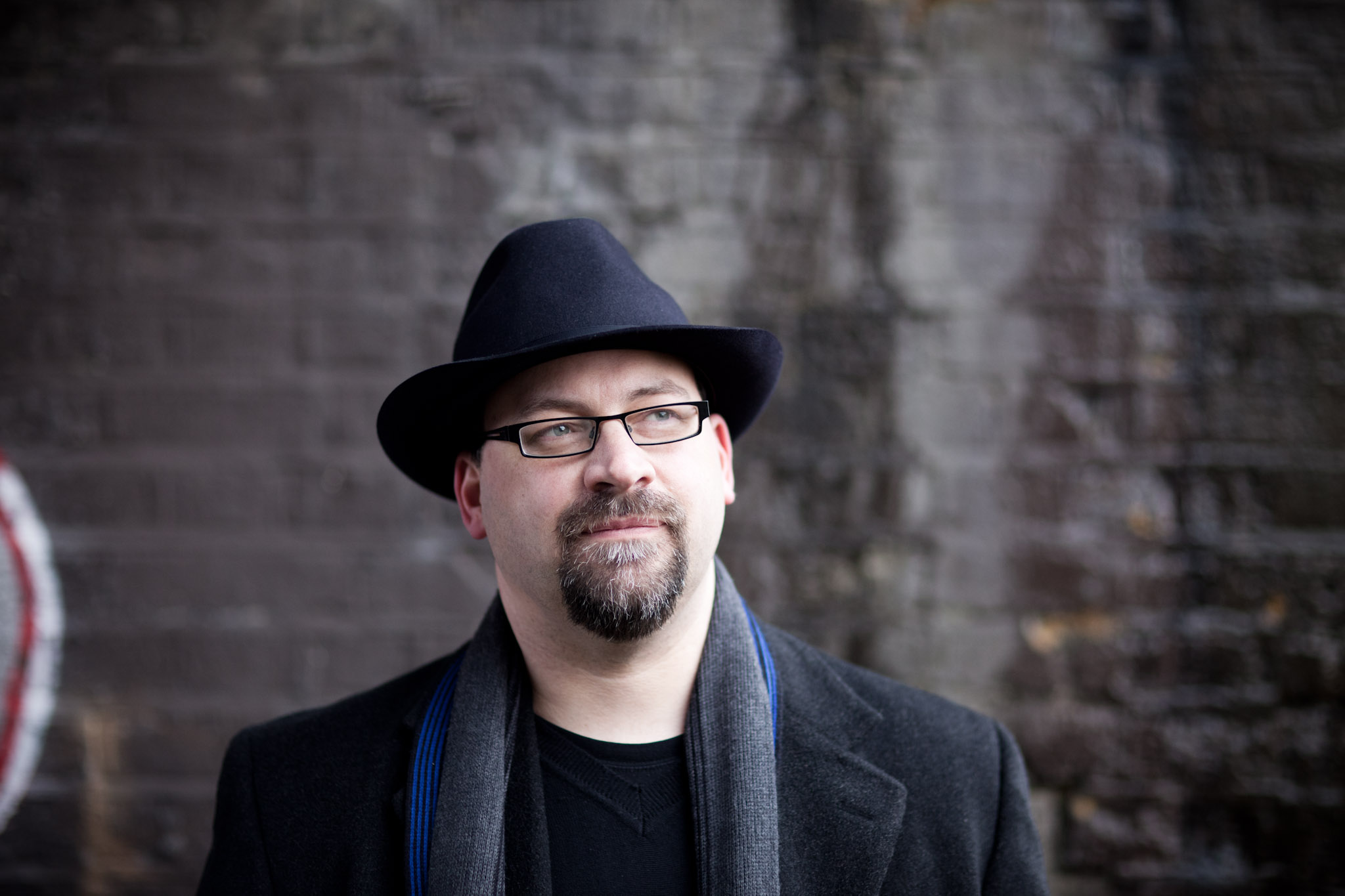
More overtly tonal it may have become, Saxton’s music still presents considerable challenges technical and interpretive. Suffice to add these were met with finesse and no little conviction by Kenneth Woods (above) and the ESO who, having previously recorded this work for future release, were fully conversant with its elusive while always approachable idiom. Almost four decades on from the flamboyant pieces which helped establish his name, Saxton revealed an orchestral mastery that will hopefully find an outlet in further such pieces – whether or not ‘symphonic’.
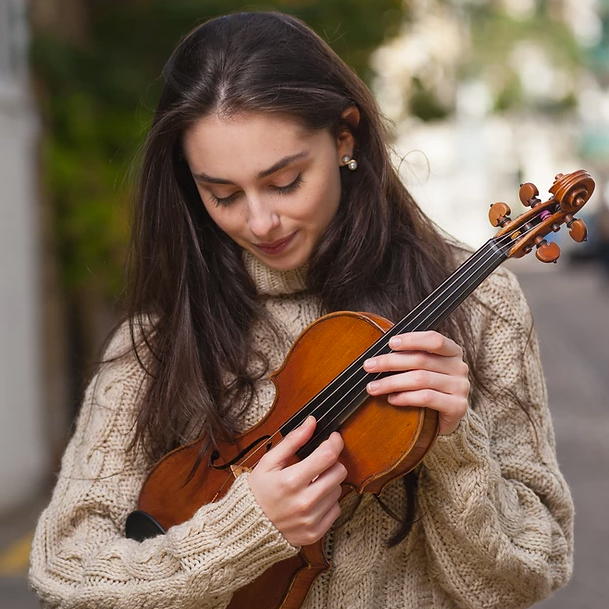
Tonight’s concert was also notable for featuring the ESO’s new Creative Partner and Artist in Residence – violinist Esther Abrami (above), her presence on social media enhanced by the release of her eponymous debut album for Sony. Stylishly attired (with an image that, for older readers, might recall Audrey Hepburn), she gave an account of Bruch’s Scottish Fantasy at its best in the transition from sombreness to eloquence of its Introduction and high-flown sentiments of an Andante in which the composer’s recourse to folk melodies is at its most felicitous. Before it, the Scherzo ideally needed more incisiveness for its engaging humour fully to register, with the final Allegro (given in abbreviated form) rather less than ‘warlike’ – though its mellifluous second theme enabled Abrami to conjure a tonal warmth which was never less than appealing.
After the interval, the ESO came fully into its own with an impressive take on Mendelssohn’s ‘Scottish’ Symphony. Whatever its genesis in his tour of that country when just 20, the work is demonstrably that of a composer who, having reached a creative mid-point, surveys his many successes but also failings. Hence the fatalistic aura such as informs the opening movement’s introduction or the tense agitation of its main Allegro – both of which were palpably brought out by Woods, who then gave the brief if scintillating scherzo its head. The highlight was an Adagio whose constant pivoting between pathos and anguish was graphically stated – aided by an orchestral discipline no less evident in the final Allegro, its martial overtones carrying through to a pause in which the decision to opt for tragedy or triumph is held in the balance.
That the work closes in triumph has often been felt its downfall but, as conveyed by Woods at a swift if not inflexible tempo, such an apotheosis is one of determination or even defiance in the face of whatever is to come. It certainly brought this concert to a memorable conclusion.
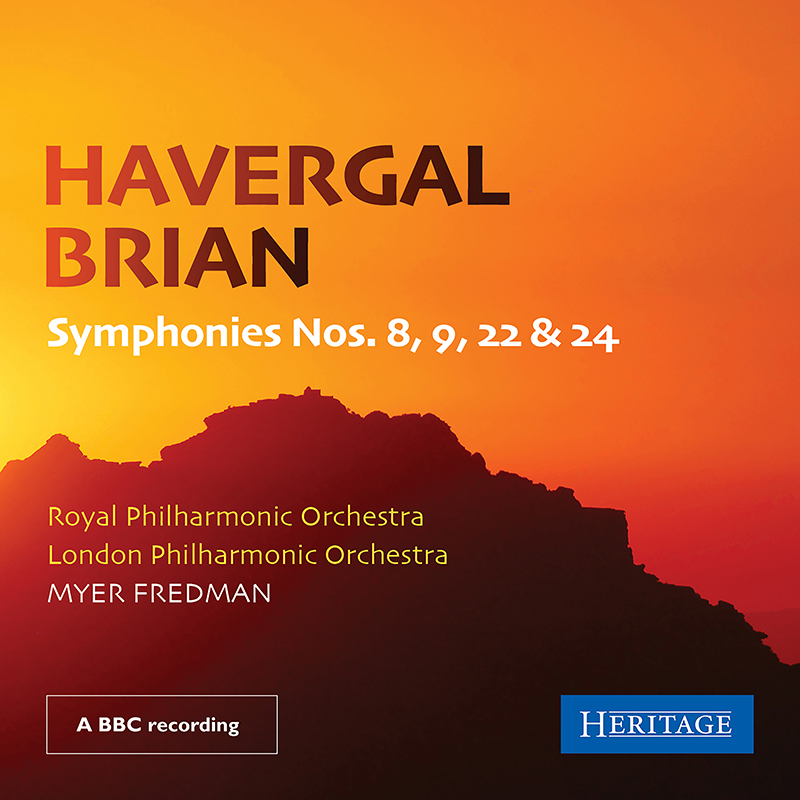
Brian Symphonies – no.8 in B flat minor (1949); no.9 in A minor (1951); no.22 in F minor, ‘Sinfonia Brevis’ (1964-5); no. 24 in D major (1965)
Royal Philharmonic Orchestra (nos.8,9 & 22), London Philharmonic Orchestra (no.24) / Myer Fredman
Heritage HTGCD146 [77’46’’]
Broadcast performances from St John’s, Smith Square, London on 28 March 1971 (nos. 9 & 22) Maida Vale Studios, London on 27 June 1971 (no.8) and 1 April 1973 (no.24)
Reviewed by Richard Whitehouse
What’s the story?
Heritage continues its releases of pioneering symphonic broadcasts by Havergal Brian with this issue of performances from the 1970s conducted by Myer Fredman, two of these being world premieres in what was a productive decade for furthering the music of this composer.
Born in Plymouth and later resident in Australia, Fredman (below) (1932-2014) set down Bax’s first two symphonies, together with Brian’s Sixth and Sixteenth Symphonies (Lyrita) that remain among the finest such recordings. He also made studio broadcasts of the present symphonies which, as John Pickard indicates in his detailed booklet notes, are among the most revealing of Brian performances from the period either side of the composer’s death – making them a natural inclusion for a series such as that now undertaken by the enterprising Heritage label.
What’s the music like?
This was the fourth hearing of the Eighth Symphony, coming after two live broadcasts with Adrian Boult in 1954 and one by Rudolf Schwarz in 1958. In many ways a template for what came after, its single span elides sonata-form and multi-movement design with a cohesion the greater for its overt unpredictability. The initial rhythmic figure (one of Brian’s most striking such openings) is not quite together, but thereafter Fredman exerts firm while never inflexible control over the interplay of martial dynamism and contemplative stasis, building its central climax superbly if losing momentum into the contrasted passacaglias – the second of which brings only a fugitive calm in its wake. Commercially recorded by Charles Groves in 1977 (EMI/Warner) and Alexander Walker (Naxos) in 2016, this work awaits public performance.
Preceded by live broadcasts with Norman del Mar in 1958 and ’59 (the latter now on Dutton), the Ninth Symphony features three continuous movements that outline a Classical framework. Fredman launches the initial Allegro with due impetus and charts a secure course through its quixotic changes of mood – the hushed transition into the reprise especially striking. He is no less focussed in a central Adagio whose musing reverie is constantly undercut by militaristic aggression, a reminder Vaughan Williams’s Sixth had appeared three years before, while the final Allegro tempers its festive cheer with a plaintive interlude which even the jubilant coda only just outfaces. Surprising that since Groves’ public performances in Liverpool and at the Proms in 1976, then his commercial recording a year later, this work has remained unheard.
The remaining performances are both world premieres of works which form outer parts of a symphonic triptych. Lastly barely 10 minutes, the Twenty-Second is (as its subtitle implies) the shortest of Brian’s cycle if hardly the least eventful. More impulsive than Lázsló Heltay with his 1974 recording (CBS/Heritage), let alone Groves in his spacious 1983 performance, Fredman teases out the eloquence of the initial Maestoso through to its fervent culmination, then brings a deft nonchalance to the ensuing Tempo di marcia such as makes contrast with its baleful climax the more telling. Brooding and fatalistic, the coda ranks among the finest passages in post-war symphonic literature and Fredman captures its essence. Walker comes close with his 2012 recording (Naxos), but this account effortlessly transcends its 52 years.
A pity Fredman never tackled No. 23, who three Illinois hearings by Bernard Goodman in October 1973 make it only the Brian symphony premiered outside the UK, but he did give the Twenty-Fourth. After its intense then impetuous predecessors, this one-movement piece feels more expansive for all its methodical ingenuity. The martial opening section is adroitly handled so its breezy extroversion reveals unexpected inwardness towards its centre then at its close; a whimsical and lightly scored interlude making way for the (relatively) extended adagio which, in its searching if often equivocal repose, brings both this work and those two before it to an affirmative end. Walker’s 2012 account (Naxos) enables all three symphonies to be heard in consecutive order, but the insights of this first performance remain undimmed.
Does it all work?
Almost always. Fredman has an audible grasp of Brian’s often elusive thinking, so that these performances unfold with a formal inevitability and expressive focus often lacking elsewhere. The Royal Philharmonic Orchestra betrays passing uncertainty with Brian’s more idiosyncratic touches, whereas the London Philharmonic Orchestra copes ably with what is among his most approachable later symphonies. Heritage has done its customary fine job opening out the sound, and anyone who knows these performances through the pirated Aries LPs will be delighted at the improvement.
Is it recommended?
Indeed. Those familiar with these symphonies from the studio recordings will find Fredman’s interpretations an essential supplement. Hopefully this series will continue apace, ideally with John Poole’s 1974 performance of the Fourth or Harry Newstone’s 1966 take on the Seventh.
For purchase information on this album, and to hear sound clips, visit the Heritage website. For more on the composer, visit the Havergal Brian Society – and for more on Myer Fredman, visit a dedicated page on the Naxos website
Vilde Frang (violin), City of Birmingham Symphony Orchestra / Mirga Gražinytė-Tyla
Elgar Violin Concerto in B minor Op.61 (1909-10) Andrzej & Roxanna Panufnik Five Polish Folk Songs (1940, rec. 1945, rev, 1959, orch. 2022) [CBSO Centenary Commission: World Premiere] Schumann Symphony no.1 in B flat major Op.38 ‘Spring’ (1841)
Symphony Hall, Birmingham Wednesday 8 March 2023
Reviewed by Richard Whitehouse
The relationship between Elgar and Schumann is a fascinating one, aspects of which surfaced in this coupling of the former’s Violin Concerto with the latter’s First Symphony; the City of Birmingham Symphony Orchestra joined by principal guest conductor Mirga Gražinytė-Tyla.
As with Sibelius not long before, Elgar was an able violinist whose solitary concerto for his instrument makes no technical concessions. There is also a symphonic dimension as seemed uppermost in the thoughts of Vilde Frang, her formidable technique (rightly) geared towards the work’s conveying emotions within an expansive while methodical framework. This was evident in the opening Allegro, the impetus of its initial tutti maintained by flexible handling of contrasted themes on to a climactic development whose intricacy was abetted by the clarity of the orchestral playing. Even finer was a central Andante whose main melodies, among the composer’s most affecting, were never indulged across the course of a movement where the expressive profile remains teasingly intangible right through to those soulful concluding bars.
Maybe the balance between display and insight slipped in the final Allegro molto, with Frang losing focus slightly during its more extrovert passages. Once the accompanied cadenza was underway, however, there was no doubting the rapport of soloist and orchestra as earlier ideas are recalled and speculatively transformed in what comes near to being a confession of intent. Nor was the sudden re-emergence of that earlier energy at all underplayed as the coda heads to its affirmative resolution: one whose conviction duly set the seal on a memorable reading.
After the interval, an additional item in the guise of Five Polish Folksongs written by Andrzej Panufnik after the outbreak of war, reconstructed at its close and orchestrated by his daughter Roxanna so the stark originals for children’s or female voices – with pairs of flutes, clarinets and bass clarinet – were cushioned by these richer orchestral textures. The CBSO Youth and Children’s choruses (finely prepared by Julian Wilkins) gave their all in what were appealing yet at times overly diffuse arrangements of settings that are best heard in their original guise.
So to Schumann’s ‘Spring’ Symphony, a piece whose encapsulating mid-Romantic sentiment seemed uppermost in MG-T’s insightful and, for the most part, convincing account. Evocative fanfares launched the opening Allegro in fine style, the often fitful momentum of its lengthy development vividly maintained through to a sparkling coda. Arguably too slow for its ‘song without words’ format, the Larghetto yet exuded undeniable pathos and made a spellbinding transition into the Scherzo. A (too?) leisurely take on its first trio took the listener unawares, but the winsome closing bars prepared well for a final Allegro whose animated progress was enlivened by delectable woodwind and horn playing on the way to its decisive close. Should MG-T return in future seasons, further Schumann symphonies would be more than welcome.
The CBSO returns next week in a rare UK hearing of Weinberg’s First Sinfonietta, alongside Schumann’s Piano Concerto with Kirill Gerstein and an extended selection from Prokofiev’s Romeo and Juliet – this latter and the Elgar also featuring in a Barbican concert the next day.
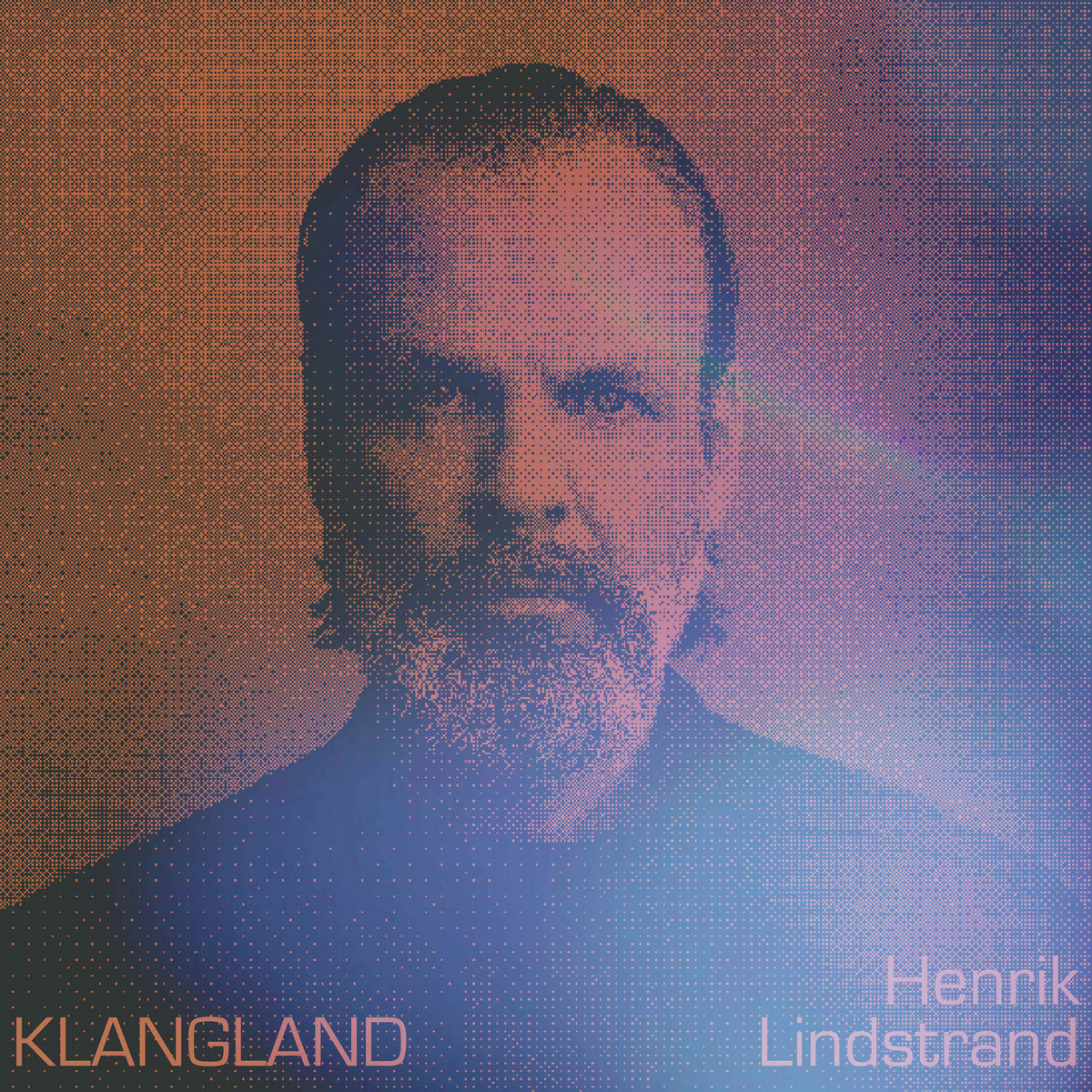
Having completed a solo piano trilogy, Henrik Lindstrand felt the need to expand his musical horizons. He chose a 16-piece string ensemble, who recorded the material for Klangland in Berlin under the direction of conductor Robert Ames and engineer Francesco Donadello.
Lindstrand’s aim in this music is to work with compressed musical ideas but communicate them in a powerful emotional manner. The title of the album, Klangland (translating as Soundland) suggests this will be done in a series of sonic portraits.
What’s the music like?
Both simple and effective. The ‘simple’ observation is not meant as a sleight, rather an observation that Lindstrand is able to work minimal material into something deeply meaningful. You only have to listen to the first piece, Jord, to see the immediate impact this music can make. The string sound is malleable, the strings often playing without vibrato to secure a sound of glassy clarity. This particular track takes in an airy panorama, with silvery violas, slightly gritty cellos and serene violins – and the timely addition of a piano at the end.
Throughout, Lindstrand’s use of strings is a cut above the ‘standard’ usage, using them economically and effectively. Post finds them almost stock still, using harmonics with no vibrato, before warmer thoughts emerge lower in the range, a solo viola added to the mix. The phrasing in pieces such as Tumlare takes the music deeper, with swooping figures towards the end imitating birds on the wing, having helped contribute to a spacious backdrop with rippling piano.
The piano prompts the internal musings of Gammafly and Tuvstarr, the textures crisp and cold, and with the free thoughts of the cello added to the latter. Cellos are key to the success of Millimeter, where the composer explores a more urgent series of melodic lines, spreading out to the wider extremes of the instruments.
Lindstrand’s cinematic abilities are frequently seen, in the opening out of Leva’s melody, or the instrumental doubling and subtle brush work on the drums that help paint such a vivid picture for CPH-ARN. Klangland itself is the crowning glory, rich in colour and enjoying a modal melody from the piano.
Does it all work?
It does. Lindstrand’s concentrated approach means the subtle intensity of his writing never lets up, and closer listening reveals the attention to detail in the orchestration. You can even here the pedals of the piano in closing track Hvid, for instance!
Is it recommended?
It is. In a crowded field, Henrik Lindstrand has a distinctive voice and music of subtle yet deep meaning.




 Arcana.fm