Switched On – XAM Duo: XAM Duo II (Sonic Cathedral)

by Ben Hogwood

What’s the story?

XAM Duo’s second album is a nifty half an hour. Christopher Duffin and Matthew Benn have been working on their second opus for nearly five years, and their efforts pay dividends as they arrive at a structure of six instrumentals that tell a story. Some are beat driven, others not – and all are part of an effort to write what the duo call ‘emotional computer music’.

Duffin has spoken of how the record ‘can be used in a functional way while setting out on your day, doing chores’ – and while it fulfils that function, XAM Duo II deserves more foreground listening for the reasons below.

What’s the music like?

Rather wonderful, and as Duffin hints, ideally structured for a single listen. From the off the colours achieved by the duo are warm and luxurious, with big synthesized textures you can dive into. The first track, the single Blue Comet, would work well as opening credits for a slightly retro TV series, with a probing melodic line. LGOC proves to be the ideal foil, creating a golden glow with its shimmering tones and high register saxophone.

The saxophone is a leading feature of the album, adding richness to the treble lines. Lifeguard At Mohang Beach is particularly attractive, holding still against the breaking waves, though the slight variations in pitch introduce a bit of uneasiness. Cold Stones has a wonderfully wide scope, with those fulsome sax tones above a cavernous drum sound. It is a majestic epilogue, a bigger structure that is beautifully scored.

Does it all work?

Yes – the rich colours are ideal for summer listening.

Is it recommended?

Definitely. If you have a weakness for the more melodic side of Warp Records’ output, to use an example, then XAM Duo will definitely do the job for you.

Listen

Buy

The joy of polls

There are a number of reasons to love Twitter, even now!

There are a number of reasons to love Twitter, even now!

I won’t go into the reasons not to love Twitter, which are all pretty obvious and usually involve politics, trolls and rampant prejudice or discrimination…but for me it remains a place where like minds can hang out and appreciate things they know and love, as well as discovering whole new worlds of culture. The latter is one of the main reasons for me continuing to use the platform. It is continually inspiring to discover and share other people’s love of music, as well as keeping up with news and developments in all musical forms.

There are a good number of polls or questionnaires to be found on Twitter, in which you can engage, spectate or ignore as you see fit. I did want to mention one in particular, from the reliable source that is Michael Irons, which got me thinking. It went like this:

I saw it late, but since reading it my mind has been occupied for several days. Having given it some thought, the ten composers I listen to most of all are probably as follows:

Sibelius, Prokofiev, Schumann, Beethoven, Ravel, Debussy, Haydn, Brahms, Shostakovich and Dvořák

Now, which ten composers’ music would I like to explore further and / or hear more in concert?

This one is trickier, but going on first instinct I would like to take five of each. There are some composers I still think are massively underappreciated, and I would like to hear more of them in concert. Off the top of my head those five are:

Hindemith, Grieg, Franck, Holst (beyond The Planets) and Joan Tower. Oh, and Liszt as a bonus.

Then five composers I would really like to explore further are:

Rameau, John Foulds, Ruth Crawford Seeger, Caroline Shaw and Andrea Tarrodi, whose music I first heard at the Proms back in 2017.

I’m going to throw the question to electronic and pop music, too – with the ten outfits I listen to most being these:

James, Super Furry Animals, Ed Sheeran (not by choice, but through the radio!), Tears For Fears, New Order, Blur, Stereolab, Depeche Mode, Björk and Erland Cooper

Five outfits I would love to hear in concert are Lady Gaga, Depeche Mode (sadly looking less likely with recent events), Def Leppard (I know!), Stevie Wonder and Joni Mitchell (also unlikely). The five acts I want to hear more of, on recent recommendation, are Robert Palmer, The Hollies, Joni Mitchell and Stevie Wonder (reappearances) and Can.

These names, of course, are just the tip of the iceberg. What I wanted to ask, is which composer(s) or pop acts would you like to read more (or less) of on Arcana? I know there is a big Beethoven project ongoing, but generally we try to adopt a complete lack of any policy on the music we cover! Please let me know, on social media (on Twitter we are here or through e-mail (editor@arcana.fm)

by Ben Hogwood

On Record – Ensemble Intercontemporain / George Jackson – Steve Reich: Reich/Richter (Nonesuch)

reviewed by Ben Hogwood

What’s the story?

Reich/Richter was originally written to be performed with German visual artist Gerhard Richter and Corinna Belz’s film Moving Picture (946-3). The film is based on Richter’s book, Patterns, where the author took a photo of one of his abstract paintings and scanned it into a computer. He cut the scan in half, then cut each half in two, and then reversed two of the four resultant quarters into mirror images. This process – ‘divide, mirror, repeat’ – was repeated all the way through from a half to a 4096th.

Belz helpfully described the film in terms of pixels, beginning with two-‘pixel’ stripes, while the music started with a ‘two-sixteenth’ oscillating pattern. The music then shadows the film as it moves to four, eight and sixteen stripes, at which point Reich introduced longer notes, expanding the music in response. As he then describes, the music returns to more rapid movement as the pixel count starts to diminish.

The match of visual artist and composer could hardly be more appropriate, and their resultant work was performed more than one hundred times at The Shed in New York during 2019. This recording, with the Ensemble Intercontemporain under George Jackson, was made in Paris at the Philharmonie.

What’s the music like?

One of Steve Reich’s many endearing qualities as a composer is the ability to take what sounds like a very complicated mathematical process and make it incredibly easy on the ear – and Reich/Richter repeats that trick.

As with the best ‘minimalist’ works it rewards attentive listening greatly, the ear drawing out shorter phrases and colour combinations, which prove to be every bit as vivid as the cover implies. Yet background listening works equally well, the ear and moreover the mind able to appreciate Reich’s hazy, impressionistic shades which recall earlier works such as Music for Mallet Instruments, Voices and Organ from 1973. Here, though, it is possible to appreciate Reich’s mastery of writing for wind instruments, incorporating them into the texture.

Unsurprisingly, Reich/Richter works best when experienced in its unbroken span of 37 minutes. There is some busy activity at all times but Reich’s sustained notes really stand out, giving the piece a broad scope that arches almost overhead. The ever-changing texture benefits from the lines afforded to brightly-toned violins, or crisp clarinets, but when these instruments retreat to make up the broad brushed colours in the middle background, a lovely haze ensues. This makes the piece one of Reich’s easiest to listen to, though by the time we get to the third part, Crossfades, the stretching of the notes introduces a notable tension not dissimilar to that experienced in the early Reich piece Four Organs. As the tempo recovers in Ending, the feeling is strangely exhilarating, like a flower opening out again in the sunlight.

Does it all work?

It does, achieving a very interesting blend of movement and stasis. The performance is excellent too, and intriguing that Ensemble Intercontemporain, the Parisian ensemble founded by Pierre Boulez, should now be recording his music! Boulez, it is safe to say, was not a fan of the so-called ‘minimalists’, and it would be fascinating if we could somehow know his thoughts on the recording.

Is it recommended?

Yes, enthusiastically – a compelling listen. The slightly short running time of the album release means that if you’re a Reich completist, it is worth bearing in mind that Nonesuch plan to release a collection of the composer’s complete works in 2023. Now that is definitely something for the diary!

Listen

Buy

You can explore purchase options for this album at the Nonesuch website

Switched On – Conrad Schnitzler & Wolf Sequenza: Consequenz II (Bureau B)

by Ben Hogwood

What’s the story?

Consequenz was a low-budget collaboration in 1980 between Conrad Schnitzler, once of Kluster and Eruption, and drummer Wolfgang Seidel, aka Wolf Sequenza. Its aim was to liberate music from elitist circles, and it set about this with a refreshing freedom. A sequel was commissioned and recorded in 1983/4, and Seidel takes up the story in the record’s press release:

“Certain ‘secret devices’ had materialized in our ivory tower in the meantime. Conrad Schnitzler had purchased an 8-track recorder with money he had earned from ‘proper’ art. I borrowed various bits of equipment from my band – Populäre Mechanik – including a drum computer, so we could really let rip. The little songs we made sounded much more ‘professional’ than the cheerfully low budget music of the first Consequenz. I’d taken days off work for the sessions and after a week we had enough material to fill one side of an LP.’

He continues. ‘All we needed now was music for the B-side, but our enthusiasm for the borrowed drum computer had waned somewhat. It was always the first track we recorded, which meant that everything else had to follow its lead. The beat itself was singularly unimpressed by what came next. This was an unsatisfactory state of affairs for two players (musicians?) who had begun with free improvisation, with either of the participants able to change the direction of the whole thing. Unsatisfactory, in spite of the fact that I was able to play to the beat with perfect timing, which led Conrad Schnitzler to give me the nickname “Sequenza” (hence the Consequenz title). The natural division of an LP into an A-side and a B-side lends itself to a caesura when the disc is flipped. So we decided to return to free-floating sounds on the B-side and, listening back now, I’m glad we did. Instead of competing with each other, the two sides dovetail perfectly.’

What’s the music like?

A fascinating listen to two musicians playing instinctively, Sequenza II has a fresh and incredibly modern sound. Its division into two sides is surprisingly effective too – side A has the sharp shooters, packed with riffs and incident aplenty, while side B is one track alone, Kastilien evolving over nearly 20 minutes into a work of impressive gravitas.

Before that we have Von Hand, firing on all cylinders, and the ping pong exchanges of Zack Zack. There is a friendly charm to a lot of this music, subtle humour coming through in the generation and exchange of ideas, with some regimented beats that speak of the time they were written. Hommage a Gaudi bucks the trend with its squiggly formations, Windmill operates with obscure riffing, while Erotik has a funky profile dancing around its regimented beat.

España won’t be to all tastes, with its coughed up refrains likely to panic in its Covid associations. Just as well, then, that Kastilien follows. By far the most challenging track on the album it is also one of the most liberating, its freedom expressed through increasingly restless and agile synthesizer music as its 20 minutes progress, dissolving in a wall of noise.

Does it all work?

Largely. You have to be in the right mood for Kastilien, but it works really well as a complement to the first side and its chopped up riffing, which proves to be highly enjoyable.

Is it recommended?

It is – and lovers of Krautrock or German electronic music from the 1970s will want to hear it for sure. Conrad Schnitzler continues to prove his worth more than a decade on from his sad passing, and in Wolfgang Seidel he has the ideal foil.

Listen

Buy

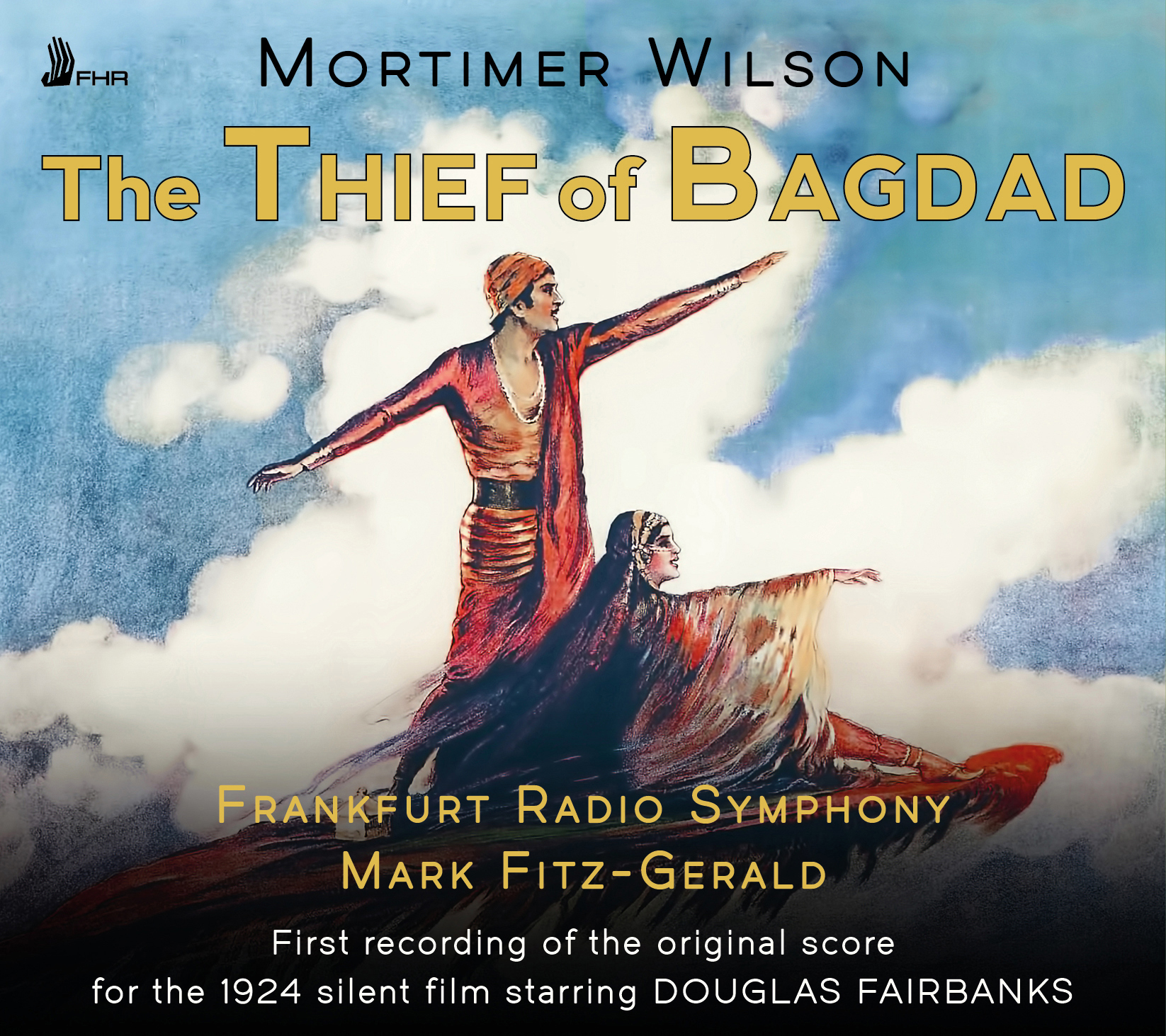
On record – Frankfurt Radio Symphony Orchestra / Mark Fitz-Gerald – Mortimer Wilson: The Thief of Bagdad (First Hand Records)

wilson-baghdad

Frankfurt Radio Symphony Orchestra / Mark Fitz-Gerald

Wilson The Thief of Bagdad Op.74 (1924)

First Hand Records FHR126 [74’45”]

Producer Philipp Knop Engineer Lisa Harnest

Recorded 11 April 2019 at Sendesaal, Hessicher Rundfunk, Frankfurt

Written by Richard Whitehouse

What’s the story?

First Hand Records comes up with another ‘first’ in this recording of the score for the film The Thief of Bagdad starring Douglas Fairbanks – one that set new standards for the ‘epic’   during the silent era, and which originally featured music to match from Mortimer Wilson.

What’s the music like?

Having starred in several major films (The Mark of Zorro, The Three Musketeers and Robin Hood), Fairbanks Sr determined to take matters to another level with The Thief of Baghdad – not least making its score an integral component. For this he turned to Wilson (1876-1932) – who had studied in Leipzig with Reger and later directed the Atlanta Symphony Orchestra, writing numerous compositions and several pedagogical books – encouraging him to create music whose symphonic aspect and panoramic expression were in themselves innovative.

Not all those involved in the project shared Fairbanks’s enthusiasm – among them impresario Morris Gest, who conspired to replace Wilson’s score with one from a higher-profile figure. James C. Bradford’s hurriedly assembled concoction almost immediately fell by the wayside, allowing the film’s highly successful first run to continue with Wilson’s music firmly in situ. Understandable, perhaps, why it had garnered praise but also attracted reservations given an emotional intensity and technical intricacy in advance of those previously attempted within a cinematic context. That said, Wilson was keen to make realization as practicable as possible – using relatively modest forces to facilitate performances in out-of-town venues, limiting the number of tempo or expression markings and even printing its parts in an easy-to-use format.

Nine decades on, its restoration was inevitably a challenge such as Mark Fitz-Gerald, having done comparable work on Shostakovich’s similarly ground-breaking scores for New Babylon (Naxos 8.572824-25) and Alone (Naxos 8.570316), was well equipped to undertake. How the music was initially reassembled and then adjusted to ensure its absolute synchronization with the film is explained in the accompanying booklet, a process which took several months prior to the first present-day showing at the Pordenone Silent Film Festival in October 2016, with the French premiere at Lyon this March. DVD presentation will hopefully be possible in due course; for now, the opportunity to hear Wilson’s superbly crafted score in so sympathetic a performance can only be welcomed by admirers of silent films and early 20th century music.

Does it all work?

Nearly always. Wilson’s music is firmly within the late-Romantic vein of Glière or Respighi, though a pertinent comparison might be Ernesto Halffter’s score for the silent film Carmen released just two years later and on which Fitz-Gerald undertook a similar act of restoration (Naxos 5.572260). In both cases, the music’s panoramic sweep is reinforced by interplay of themes and motifs which sustains dramatic tension across the whole. Moreover, the exclusion of repeated sections makes for a ‘screen symphony’ which fits comfortably onto a single disc.

Is it recommended?

Indeed. The Frankfurt Radio Symphony Orchestra responds ably to Fitz-Gerald’s astute direction, and the sound has clarity as well as presence. The booklet, featuring extensive commentaries by Fitz-Gerald and Patrick Stanbury, sets the seal on this ambitious and worthwhile enterprise.

Listen and Buy

To listen to excerpts from this disc and view purchase options, visit the First Hand Records website. To read more about Mortimer WIlson, this interesting article from the New York Times gives more information, while for more on Douglas Fairbanks click here To read more about the performers, click on the names of Mark Fitz-Gerald and Frankfurt Radio Symphony Orchestra.