
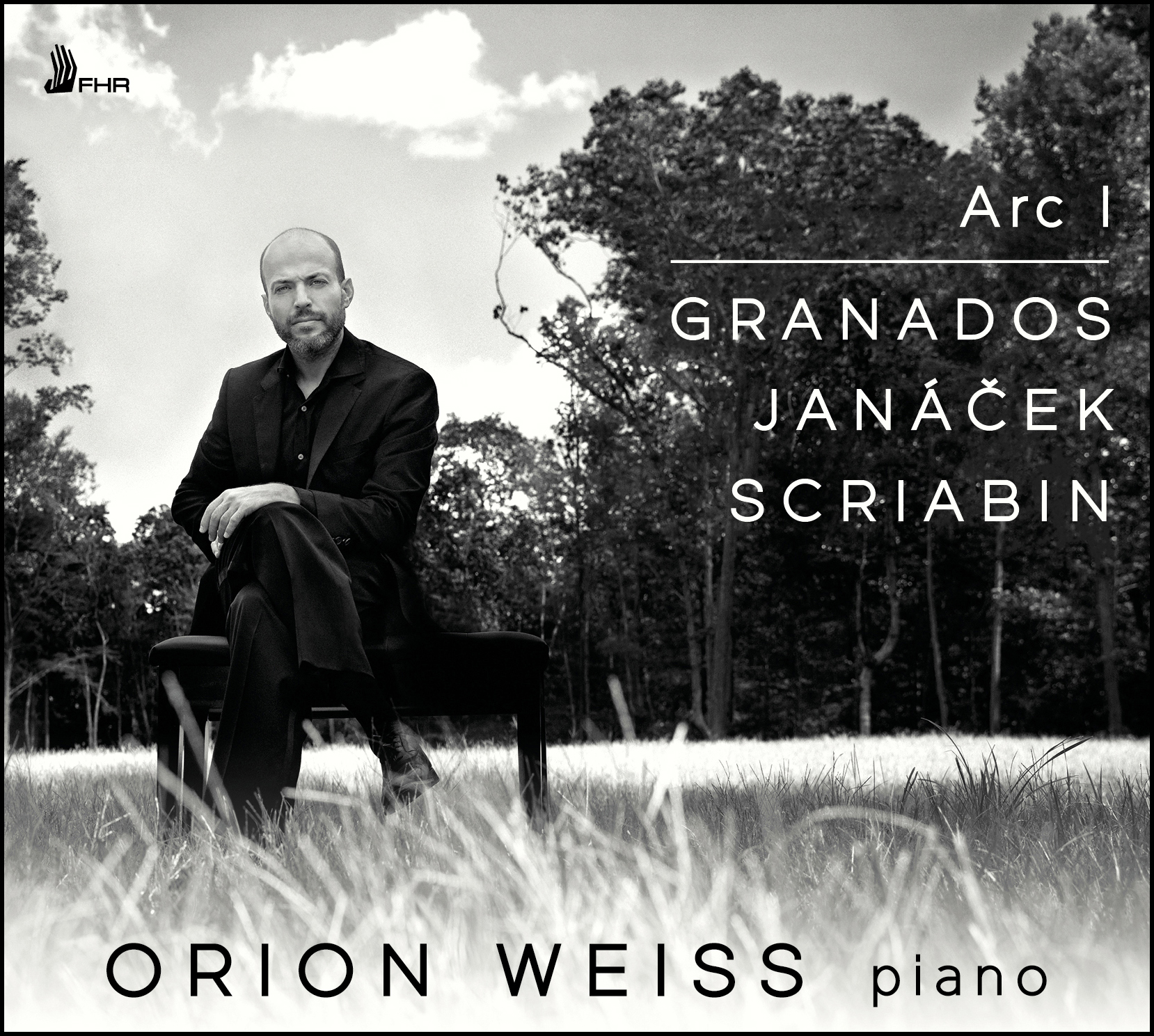
On Record – Orion Weiss: Arc 1: Granados, Janáček & Scriabin (First Hand Records)

Granados Goyescas Op.11 (1911)
Janáček In the Mists (1912)
Scriabin Piano Sonata no.9 in F major Op.68, ‘Black Mass’ (1913)

Orion Weiss (piano)

First Hand Records FHR127 [74’51”]
Producer David Frost; Engineer Silas Brown
Recorded 22-24 May 2014 at SUNY Purchase Performing Arts Center, New York

Reviewed by Richard Whitehouse

What’s the story?

First Hand Records issues the first instalment of another planned trilogy (see also The Future is Female with Sarah Cahill), the Arc series being a traversal by Orion Weiss across a century of piano music with intermittent forays into conceptually related pieces by earlier composers.

What’s the music like?

Focussing on music from before the First World War, this first volume is dominated (at least in terms of length) by Goyescas – the cycle of piano evocations in which Granados both paid homage to the illustrious Spanish artist, while extending the potential for large-scale formal design associated primarily with Liszt. That the composer subsequently transformed this into a one-act opera says much for the original’s motivic interconnections, such as Weiss further emphasizes throughout an interpretation in which characterization and cohesion are as one.

The listener is guided from teasing melodic interplay in Flattery, via the (mostly) confiding intimacy of Conversation at the Window then encroaching fear of separation in Fandango by Candlelight and its pained experiencing in Laments, or The Maiden and the Nightingale. A tragic climax arrives in the ballade Love and Death; after which, Serenade of the Ghost offers an ironic epilogue. Weiss renders this methodical yet visceral sequence with no mean insight, drawing out that pathos seldom far beneath the surface of Granados’s mature music.

If the Spanish composer was realizing his vision despite – or even because of – his success as composer and performer, In the Mists finds Janáček combating those vicissitudes of personal and professional failure. Hence the tonally and expressively oblique nature of its initial three sections, such as Weiss articulates with notable emphasis on their volatile mood-swings and frequent welling-up of emotion. All of this is duly thrown into relief by the final Presto with its gradual yet, as here, inexorable tendency towards ultimate fragmentation and dissolution.

Much has been written over the past century about those occult and even satanic connotations of Scriabin’s Ninth Sonata, whose Black Mass subtitle was only added after the event and at the prompting of another. Once again, it is the harnessing of such fluid and increasingly violent expression to a formal follow-through as precise as it is fastidious which gives this music its uniqueness. Weiss ensures an audibly cumulative build-up that, in the closing stages, achieves a claustrophobic intensity which could be considered liberating or annihilating as one prefers.

Does it all work?

Yes. Although it is not hard to locate alternative recordings for each of these pieces of at least comparable value, their juxtaposition within this context makes for a programme absorbing in its overt contrasts yet satisfying in its overall cohesion. Whether or not Weiss has performed this in recital, the trajectory towards an even greater self-absorption and inward intensity feels as inescapable as the presentiments of world conflict which lie behind much of what is heard here. Future volumes will doubtless offer a changing perspective and maybe a ‘way forward’.

Is it recommended?

It is. The sound has a lucidity and detail ideal for piano music from this period, with Weiss’s annotations succinct but also pertinent to his interpretations. This series is a notable addition to his extensive discography, further information about which can be accessed at his website.

Listen

For further information on this release, head to the First Hand Records website, and for more information on Orion Weiss, head to his website

On Record – Sarah Cahill: The Future is Female, Vol.1: ‘In Nature’

Beglarian Fireside (2001)
Bon Keyboard Sonata in B minor, Op.2/5 (1757)
Carreño Un rêve en mer (1868)
Dillon Birds at Dawn, Op. 20 No. 2 (1917)
Gribbin Unseen (2017)
Jambor Piano Sonata ‘To the Victims of Auschwitz’ (1949)
Kaprálová Dubnová preludia, Op.13/1 & 3 (1937)
Kashperova Au sein de la nature – no.3: Le Murmure des blés (1910)
Mendelssohn-Hensel Lieder Op.8/1 & 3 (1846)
Watkins Summer Days (2020)

Sarah Cahill [piano, voice (‘Fireside’)]

First Hand Records FHR131 [71’32”]
Producer/Engineer Matt Carr
Recorded 15-28 August 2021 at St. Stephen’s Church, Belvedere, California

Reviewed by Richard Whitehouse

What’s the story?

First Hand Records has issued the first instalment in a planned trilogy devoted to piano works by female composers ranging across the past three centuries, played by Sarah Cahill who has made both the reviving and commissioning of this music a mainstay of her performing career.

What’s the music like?

As Cahill relates in an introductory video (below), The Future is Female is a project to record music by women composers from the Baroque era through to the present-day. Loosely based around the theme of nature, this first volume opens with music from the cusp of the Classical era: Anna Bon, Venetian-born and Prussian-educated, whose primary keyboard work is Six Sonatas published as her Op. 2 – the fifth comprising three relatively substantial movements which finds influences from C.P.E. Bach being put to productive use.

The music of Fanny Mendelssohn-Hensel has now started to come into its own, her extensive output for piano well represented by two from a set of Vier Lieder published as her Op. 8 and akin to the Songs without Words of her brother Felix in their respectively limpid and poetic moods. Exerting considerable influence as pianist and administrator, the Caracas-born Teresa Carreño wrote little in later life, making this teenage Étude-méditation the more striking for its suffused intensity. Equally highly regarded as a pianist, Leokadiya Kashperova brings an impressionist deftness to this movement from her piano suite In the Midst of Nature, whereas Fannie Charles Dillon yields an even lighter touch through an extract from Eight Descriptive Pieces with its pioneering though always subtle approach on the notation of various birdsong.

Long remembered through her association with Martinů, the short-lived Vitĕzslava Kaprálová was an able composer whose piano output includes April Preludes – elusive miniatures which pivot around without ever losing a sense of tonality. The sure highlight is the Piano Sonata by Agi Jambour, its recollection of Budapest during the Nazi occupation inspiring a piece whose three movements take in fraught passion, an Epitaph of sombre poise, then a finale of stark resolve. Of the three living composers, Eve Beglarian features the recitation of a poem by the teenage Ruth Crawford-Seeger within the context of an improvisatory piano backdrop. Deidre Gribbin pens a forceful study of London at a time of social and cultural upheaval, then Mary D. Watkins’s capricious evocation of children at play ends the recital on a more hopeful note.

Does it all work?

Yes. Although not all these pieces are of comparable value, the chronological approach such as Cahill favours makes sense in terms of a stylistic evolution in writing for piano; a parallel (rather than alternative) trajectory through 250 years of Western art music. There can be few reservations concerning either the sound, as good as it gets in terms of clarity and perspective, or the pianist’s detailed and informative annotations. At least half of this selection should be featured in the repertoire of pianists, male or female, which says much as to its overall worth.

Is it recommended?

Indeed. The second volume is imminent with the third in preparation, making for a series as inclusive as it is wide-ranging. Cahill has already amassed a significant discography – further information can be found at her website, which also gives details of her forthcoming recitals.

Listen

For further information on this release, head to the First Hand Records website, and for more information on Sarah Cahill, click here. For more information on the composers, click on the names of Leokadiya Kashperova, Vitĕzslava Kaprálová, Agi Jambor, Eve Beglarian, Deidre Gribbin and Mary D. Watkins

On Record – English Symphony Orchestra / Kenneth Woods – Adrian Williams: Symphony no.1, Chamber Concerto (Nimbus Alliance)

Adrian Williams
Symphony no.1 (2020)
Chamber Concerto: Portraits of Ned Kelly (1998)

English Symphony Orchestra / Kenneth Woods

Nimbus Alliance NI6432 [70’31’’]
Producers/Engineers Phil Rowlands, Tim Burton
Recorded 8 April 2021 (Chamber Concerto), 1-2 December 2021 (Symphony) at Wyastone Concert Hall, Monmouth

Reviewed by Richard Whitehouse

What’s the story?

This latest release in the English Symphony Orchestra’s 21st Symphony Project features its most ambitious instalment yet in the First Symphony by Adrian Williams (b1956), coupled with a no less eventful piece by this ‘dark horse’ among British composers of his generation.

What’s the music like?

Although having written various orchestral works, Williams had never tackled the symphonic genre before prior to being the ESO’s John McCabe Composer-in-Association in 2019 (he is currently its Composer Emeritus) but has confronted the challenge head-on. Playing almost 50 minutes and scored for an orchestra including triple woodwind, five horns, four trumpets and four percussionists with harp, piano and celesta, the work is evidently a summation of where its composer felt he had reached over the course of his musical odyssey. Yet for all its textural complexity and its pervasive richness of thought, this is music created out of basic motifs; the initial three notes generating the first movement’s main themes, as well as essentializing that longer term tonal goal as remains a focal point towards which intervening activity is directed.

From its imposing Maestoso epigraph, the opening Stridente unfolds against the background of (without necessarily adhering to) sonata-form design – its motivic components drawn into a continuous and frequently combative evolution purposefully unresolved at the close. There follows a Scherzando that eschews ternary design for a through-composed format proceeding by tension and release to a decisive ending. The expressive crux of the whole work, the Lento evinces a plangent and desolate tone whose sparse textures and elliptical harmonies re-affirm that ‘less is more’ maxim. Despite its Energico marking the finale unfolds with slow-burning momentum, made the more cumulative by channelling its motivic evolution toward a Dolente apotheosis whose outcome proves as inevitable formally as it feels transcendent emotionally.

The artist Sidney Nolan was latterly a neighbour of Williams, his powerfully un-romanticized evocations of famed Australian outlaw Ned Kelly directly influencing this Chamber Concerto. Its pungent opening sets wind quintet against string quartet, with double-bass and harp adding subtle contributions as the piece unfolds. The inward central section builds towards a febrile culmination – after which, wind and strings are drawn into a monody which brings a resigned though hardly serene ending. A purposeful overall trajectory ensures cohesion at every stage.

Does it all work?

Absolutely. These are impressive piece in terms of their ambition but also realization. There are considerable technical challenges on route, but they are met with conviction and no little resourcefulness by an expanded ESO which is often tested but never fazed. Kenneth Woods directs with his customary attention to detail as goes a long way toward clarifying music that is ‘complex and luminous’ in spirit as by design. Williams has evidently been waiting for this opportunity to contribute to the symphonic tradition and his execution rarely, if ever, falters.

Is it recommended?

Indeed. The recording is as focussed and spacious as is necessary, and there are informative notes from composer and conductor. Next from this source is a release of concertos by Philip Sawyers, then one of symphonic works by the current Composer-in-Association Steve Elcock.

This recording is released on Friday 7 October 2022.

You can watch the world premiere of Adrian Williams’ Symphony no.1 on the English Symphony Orchestra website, and you can listen to clips from the recording at the Presto website. For more information on the composer, visit the Adrian Williams website – and for more on Sidney Nolan click here. Click on the names of Kenneth Woods and English Symphony Orchestra for their websites.

Switched On – Daniel Patrick Cohen: We Deliver (Backlash Music)

Reviewed by Ben Hogwood

What’s the story?

When making his new album We Deliver, Daniel Patrick Cohen became obsessed with short tracks whose function would be to act as bridges between album tracks, or introductions to more substantial offerings. As his love of this form grew, he developed a great respect for 20th century hip hop producers and their ability to write focused interludes that became a work in themselves.

Resolving to write an album based on the form, Cohen describes his new release as ‘a lo-fi work entirely made up of these throwaway-type tracks. My intention is explicitly for it to be exactly the sort of weirdo record that an imaginative producer may find a dynamite sample from’.

What’s the music like?

On the evidence of We Deliver, Cohen’s wish may be granted – for this is a fascinating and invigorating set of 32 tracks, with a myriad of guests and a huge range of styles. Cohen’s magpie approach works especially well though, and the well chosen guests bring a great deal of character and humour to proceedings.

A word about those guests – especially vocalist Alice Zawadzki, saxophonist Joe Wright, multi-instrumentalist Dan Berry, violinist Róisín Walters and pianist Alexandra Făgărășan. Zawadzki is the vocalist stopping the listener in their tracks on Wild fig and ginger handwash, while the vocalist on the humourous Shopping With Violence is James Murray, who picks up the amusing track as an answerphone message later on. It is genuinely difficult to pick out highlights from the album but it is certainly worth mentioning the good deal of wah wah funk applied to That’s not how it works in this world I’m afraid, and the really nice, slightly warped play on the vocals of Puteți avea o familie fericită.

The pizzicato strings and the odd jarring noise of Wait your kid here are distinctive, cutting to a flowing piano on Buy priority through security. The hesitant wind instrument choir on Change the sentences so they have the same meaning are rather charming, as is the lovely coarse violin from Walters on the intriguingly titled They are a nuisance and a possible health hazard. Meanwhile the vibrant strings and piano of Repeat, producing a rich lather (!) are also winsome.

Does it all work?

It does – Cohen leaves you wanting more at the end, in spite of 32 tracks! Often the ideas are good enough to support more substantial pieces of work, and occasionally you will be left wishing he had developed his thoughts more. That said, sticking to the rules of duration is crucial in this sort of album, and it works a treat.

Is it recommended?

It is, enthusiastically, as music with a light touch but also a great deal of content. Cohen marshals his troops brilliantly – and as such his playlist for Arcana should also be recommended!

Listen

Buy

In Concert – Soloists, Choir and Orchestra of the Age of Enlightenment / John Butt: Haydn: ‘Nelson’ Mass and ‘Trauer’ Symphony

Haydn
Symphony no.44 in E minor Hob.I:44 ‘Trauer’ (1772)
‘Ganz Erbarmen’ from The Seven Last Words of our Saviour on the Cross Hob.XX:2/2 (1786, choral version 1796)
Missa in angustiis (‘Nelson’ Mass), Hob.XXII:11 (1798)

Sofie Ticciati (soprano), Bethany Horak-Hallett (mezzo-soprano), Hugo Hymas (tenor), Robert Davies (bass), Choir and Orchestra of the Age of Enlightenment / John Butt

Hall One, Kings Place, Friday 30 September 2022

Reviewed by Ben Hogwood

Full marks should go to the OAE and Kings Place planning teams for this concert. Somehow they anticipated that what was required on the last day of September 2022 was a ‘mass in time of fear’ – and in doing so unwitting delivered the ideal response at the end of a week of great political uncertainty. The subtitle was given by Haydn to a substantial work better known as the Nelson Mass, so called because it was performed in the presence of Nelson and Lady Hamilton when they visited the composer at Eisenstadt in 1800.

First, though, we heard a work from the composer’s Sturm und Drang period. His Symphony no.44, the only one of his 104 in the key of E minor, has the nickname Trauer on account of the performance of its slow movement at Haydn’s funeral. It falls in the middle of a particularly rich vein of creativity in the Haydn symphony, where he was exploring less common key centres and instrumental possibilities. This performance was given by just 17 players but they gave a sound that could have been made by an orchestra double the size. They caught the dark undertones of its lean and jagged first movement, reminding us of how dramatic Haydn symphonies can be. John Butt was an embodiment of the vigorous performance, drawing the wit and dance rhythms from the Menuetto but also enjoying the relative sweetness of the trio section, with outstanding high horn playing from Ursula Paludan Monberg. The muted Adagio was beautifully done, finding the serene corners of the major key, while the finale had terrific drive, the strings digging in with gritty staccato.

A curious inclusion followed, the second movement of the choral version of Seven Last Words of our Saviour on the Cross. Concentrating on Christ’s promise to his fellow crucified prisoners that they too would see paradise, Haydn offers a vision of redemption that the four vocal soloists portrayed after a period of initial solemnity. The choir, positioned around the balcony, sang down to the audience and were ideally balanced by Butt, who was always cajoling them on to more.

He did likewise in an outstanding performance of the Nelson Mass, which was compelling from first note to last. Described by no less than Haydn scholar HC Robbins Landon as ‘arguably his greatest composition’, it began with a dramatic Kyrie, laying an immediate sense of occasion. With brass and timpani alongside the 17-strong chorus on the balcony, there was fear and tumult in the music, which reached an apex in the Benedictus, an extraordinary passage of writing for the time. Soprano Sofie Ticciati was a subtly commanding presence, especially in this section, and she had sterling harmonic support from fine mezzo-soprano Bethany Horak-Hallett, who came into her own with a terrific solo at the start of the Agnus Dei. Hugo Hymas and Robert Davies were excellent too, the latter’s burnished bass tones matching the sweet violins in the Qui tollis section of the Gloria.

The choir sang with composure but with great passion, too, mirroring the input of their conductor, who had the measure of the Kings Place acoustic. This gave the big numbers – Gloria, Credo and Agnus Dei especially – the reverberation they needed at the end to follow their emphatic conclusions. By the end of the latter movement the darkness was completely vanquished, Haydn’s firm beliefs given their surest possible foundation. This was an outstanding concert, and a memorable contribution to the Voices Unwrapped series at Kings Place. Here the voices were not just unwrapped, they were ringing in the venue’s recesses long after the audience had departed.