Talking Heads: Kevin Drew aka K.D.A.P.

Arcana has time with Kevin Drew, the Canadian musician best known as frontman for the band Broken Social Scene. This discussion, however, will focus on his new solo album Influences, recorded under the pseudonym K.D.A.P. (Kevin Drew A Picture). As we will find out, it was written in lockdown in England – more specifically in London and the Sussex village Slinfold.

Drew is an invigorating presence. “I guess you’re my first English interview!” he notes, “and you’re not far from the town where I was walking.” Today, however, he is in Toronto. “It’s a good town, but it’s expanding quickly. It’s not tun that well, with bad government and city planning. Things are starting to get on top of each other, but there is still is a great community and great restaurant scene. Art is secondary, but I think that’s how it is everywhere now. I always find it’s artists who fight for the ones that don’t have a voice. We have had such a situation here with encampments in the parks and the homeless, and there is no leadership of how to deal with that situation from our city council. A lot of people take it into their own hands to speak and fight for them, and it’s something that the city is trying to deal with right now.”

Listening to Influences is like seeing another side of Drew’s personality, a more intimate and private aspect. For its composition, he used a single app. “It happened through Endless”, he says, “and through being able to have the time that I did in your lovely country. One of the things that came to me was that I called it a ‘vessel’ record. I didn’t set out to do anything and instead of making anything with my piano or acoustic guitar I was injured for a year, and I was coming out of that. I had achieved what I wanted to musically, and rather than keep Broken Social Scene above water I thought ‘I’m just gonna disappear for a little bit’, as one should. I got into this app and realised I had a studio in my pocket. I started getting up early and walking through the woods, and I started figuring it out in ways it would work for me. I love the sounds and the accessibility, and then I love that it’s based on personal intuition and what you want to do. I sketched out all these things and when I came home I just took them to the studio. We started putting all this piano and acoustic guitar on, and I got my friend Evan Tighe to come in and drum. Charles Spearin came in and played bass lines I couldn’t play because I did them on my thumbs!”

Influences feels like a springtime album, with green shoots and positive energy. “The time of release is interesting, because it’s a year ago that I really started getting into it”, he says. “I think with everything you do, or I do, is about trying to create that spring atmosphere, that idea of growth. It’s also about opening something new, and walking through all this shit to get to the glory and the light, all the things that we all strive for as we keep continuing and creating.”

There is an abundance of melodic ideas on the album, with a patchwork approach to knit them together. “I’m a melody junkie!” he confesses, “and the aspect of being able to tell this tale was strong. You have to understand I haven’t done anything really on my own in seven years. I’ve had quite the life, quite the turnaround, and I’ve lost some people too, people that I love, which always makes you reflect. I’ve said before that I didn’t write this record, those who left me wrote this record. All the friends I’ve had in my life wrote this record, all my partners who have come and gone with this record. The records that I have listened to throughout my life wrote this record. We’re neurologically always consuming, whether we think we are or not. Our subconscious is running at full speed most of the time. Original thought is not something prominent in today’s day and age, and a lot of the times when it is, it just has to revolve around greed. I do still believe that what you are influenced by helps you build your identity and helps you find the melody that you love, and that you raised yourself on.”

In his twenties, Drew listened to a lot of music by Brian Eno, along with the early output of Warp Records. What was his listening before then? “My first record I bought was Supertramp, while my brother bought Blondie’s Parallel Lines The first records we received as gifts were Dirty Deeds Done Dirt Cheap by AC/DC and Sgt. Pepper’s Lonely Hearts Club Band by The Beatles. The first cassette I ever got was Men At Work, Business As Usual, my brother was Loverboy, the one with Workin’ For The Weekend on it (Get Lucky). Within that I was very fortunate. My brother got into the whole 1960s and 1970s music scene, while my parents were 1950s and 1960s all the way. It was everything from Linda Ronstadt and Chuck Berry to the Bee Gees and The Beatles, with James Brown and Nina Simone. I then cut my teeth getting into Prince, New Order, Jesus and Mary Chain and Sigue Sigue Sputnik. I always cited My Bloody Valentine as a game changer for me, then Dinosaur Jr and Jeff Buckley came in. Then it was Tortoise, Touch ‘n’ Go, Warp, Ninja Tune. Music was phenomenal in that time, unbelievable! It was innovative, and though it was coming through influences of jazz and DJs and samples and rap, and even rock, it was unreal. We used to walk out of record stores with stacks of CDs! We would go into Rotate This in Toronto.”

He narrows things down slightly. “My favourite bands are stuff like Dirty Three, Do Make Say Think. I love Stars Of The Lid, people like Julianna Barwick. I can just get lost in Jon Hopkins, and I’m a child of Four Tet and Caribou, I adore them. I always started in the instrumental world, and it’s nice to feel like I’ve come full circle. There is also something interesting about how you put out records these days and it’s all focused on your social media which I was never really, I didn’t keep up with that. It didn’t kind of work for me but I’m really trying things. You can’t force that shit, so you realise you’re just making records for your friends again.”

What took him to Slinfold to make the record? “Love, always. Love takes me everywhere. It’s a wonderful thing, isn’t it? It gives you so much opportunity and I’m such a believer in people, and I believe in, moment to moment as well. I just happened to be lucky enough to meet someone that helped me at a time where we were really good for each other and each other’s lives. I went down and hung with her and her family for a few months. I adore the English countryside, and I know that in about 10-15 years, if I’m still alive, I’m going to live there. I have those ghosts in my blood, it’s my heritage and I always feel at home. Last summer, with everything that was happening with the pandemic and the unknown, we all didn’t have an understanding of what was happening and what was going to happen. That’s a scary place for everyone to be feeling at once. Yeah. So it’s a case of finding your heroes and staying close to them.”

Did the pandemic inspire more intense composition? “I think one of the things that really made me attract myself to Endless was the aspect that the application is right here and it is allowing for another way to express. It’s not limited. We have a lot of issues with art in today’s day and age, but imagine if you could get this into schools and prisons and get this in their hands so people can communicate what this is here, inside of them. I remember when those apps came out with the cameras and all the photographers were shooting things like Super 8! I shot a video like that in Mexico City with a wonderful director Katina Medina Mora, and she used real Super 8. A year later, this thing comes out! It’s still about the individual, and what you bring and express to yourself with these things. I wanted to make it a point to talk about this app. I don’t have any stock in it, I was not getting paid by them, and that doesn’t matter to me. I’m not selling anything here, I’m telling you there’s another way for musicians or art programmes, trying to get kids to express themselves. Funding is getting cut all over the world, you know?”

The resultant music from the app is not lacking in emotion, and ties in with Drew’s earlier comments about loss and inspiration from friends. “Everything’s emotional – everything”, he says pointedly, “and political, and personal. I say this all the time. It’s an emotion, and a lot of people don’t want to deal with that. With social media, LinkedIn changed the dopamine game – it is totally different now. It rfeflects differently on who we are as people. I’m in my mid-40s, and happy to be here – and I don’t really give a fuck much anymore. When I do, I feel a bit embarrassed on a level of personal spiritual growth. But we are in this together, and I’m still finding stuff that gets me excited. Kudos to those who are still out there fighting, using melody as their sword. I just want to be on that train, and I believe that soundtracks are important for all of us. Yeah. You need a soundtrack to be your support system, while going through these times!”

For Drew, then, music is as fundamental as breathing. “I’ve always said to people to choose a mantra. I’ve been down, I’ve lost a decade of just trying to figure out and couldn’t quite get it. I’ve had great times, and bad times, and I was a great person and I wasn’t a great person, but in the grounding of moving on with your life, I’m also realising that so much of the struggle is the reflection of what we’ve been taught neurologically. I’m learning how much we’ve governed ourselves into a box, and how we judge our own selves and others if we’re not following the protocol of that box. The divide that we live in right now, it’s winning.”

“Wait a second”, he says. “I’m pretty sure John Carpenter did a movie based on what’s happening right now! Did we not read that? Nobody wins with a divide – each side ends up being a bully!” His tone lightens. “So, Influences – my instrumental record. My reaction to it all.”

There is humour in Influences too, not least the track titles – one of which is Explosive Lip Balm. There is much room for this in humour. “The great thing too was that I wasn’t singing. My parents don’t like it, and a few friends said that they can’t listen but it’s cool, I get it. I didn’t want to sing. There was a massive uprising happening, as there still is, but I certainly had no place to step up to the mic and sing about it. I had a lot of emotion, as I always do, so it was really easy for me to just chuck this all into a record. The coolest part too was going back to the studio called the Bathhouse here in Ontatio, and a gentleman named Niles Spencer who I’ve been working with since 2019. We’d not seen each other in a couple of years, and it did have that feeling like, “You’re coming home kid!” It did take us a while to figure out how to put everything together inside Pro Tools, and then I had all the songs designed in my head so then we had to place these loops in different parts. It was a lot, but we took four or five days to organise it all and it was just wonderful. We worked on the ‘first thought, best thought’ principle.”

The dynamic was very different to his band. “With Broken Social Scene records they take a while, because there’s a committee, and I love it. What I adore more than anything is doing stuff quickly. It’s the most honest way to react to what is happening around you with sound.”

Drew moves on to recount an incident with a cyclist that had an effect on Influences, and its last track Almost Victory (Keep End Going) “I was at the canal in Islington, on the towpath. First of all, why are there bikes on that?! I got into the flow of it, and was working on a beat, and this cyclist brushed by me. It knocked the beat into a different time signature, and I heard it and thought it was pretty nice! If you hear that track there are different types of pitches going on, and if you listen there is a little bit of a shrug.” Is it an example of how mistakes can work in pop music? “They call it jazz!” He laughs. “We don’t say it was a mistake but you’d better do it twice, so you say to people that was what I was doing.”

His connection with the English countryside is worth exploring further, given the natural wonders on his doorstep in Canada. “I love the Canadian countryside”, he says, “but I think it’s the history for me over there with England. I feel the shadows, you see the children and the war, you know. Two world wars. I never met my grandfathers, and even just walking along the train tracks in England where a lot of the young boys would go and get on these trains and not come home, we would ride our bikes along paths all summer. There was a stillness that I like in the aspect of history. As I get older, I have started thinking about just the education of where I came from. I love the Canadian countryside, a lot, but I just didn’t have the opportunity the last few years to be out in the Canadian countryside and Toronto is a sticky city in the summer. It’s patios with sandals and condos, sun visors, a lot of dudes with tattoos, great bodies, and these really decked out bikes going really fast without a helmet, and an awesome haircut. It gets to you after a while. so I really was blessed that I was able to stay out there, sit in the trees and be with the best kind of people. I had the understanding that life wasn’t perfect, but it was a moment. I miss it, but I’m so grateful that I have had it, and will have it again.”

His creative process has been instinctive throughout. “You’re gathering information that is going to interpret itself in a way that’s either like emotional or just very practical. I didn’t have any desire to make an album, until suddenly, the album was being made through me. People said how it was an opportunity for your dead friends – and most of them are musicians – to come down and play. I’ve always looked at it that way because I have sat in studios and said, “Who’s playing that, where did that melody come from?” There’s a part of me that finds comfort in the idea that my friends are coming back and jamming, so in the Bathhouse I allowed that space.” That’s all just a state of mind.”

Kevin is typically mischievous with his beliefs in family life. “I don’t have children, so I don’t have to deal with the questions about monsters, but I’m the uncle so it’s like, “There could be a monster on the bed, let me go check! It always shocked me that there wasn’t actually any unicorns, not even in Greenland. When people tell me Santa Claus is fake I say the Santa Claus that isn’t real is the one down the mall. Yes, he’s not coming down the chimney with your Sony PlayStation V, but he’s a real dude!”

Interview by Ben Hogwood

Influences, Kevin Drew’s solo album as K.D.A.P., is available now on Arts & Crafts Productions. You can hear the music through the Bandcamp embed below:

Talking Heads: Arandel

It is deepest summer, and Arcana is on an online call with Arandel, live from Burgundy. Taking the music of Johann Sebastian Bach as his inspiration, the anonymous French composer and producer has been discovering a wide range of material that has so far yielded two InBach albums. The second enjoys new perspectives offered in live performance of the first, and it presented the perfect opportunity for Arcana to step in and discuss.

We begin with introductions – especially the one Arandel had with the music of Bach. “I’m not sure, but it was some of the music my father used to play on this turntable when I was a kid. I remember being very impressed by the Toccata and Fugue in D minor, it used to be the soundtrack of the opening credits for a children’s cartoon called Il était une fois… l’homme (Once upon a time…man) My father used to play all kinds of music and Bach was one of those.”

His curiosity grew. “One of the things that attracted me to the music was that I was trying to figure out why it was so present in everyone’s mind. In today’s modern music there are glimpses and traces of Bach, more than any other classical or Baroque composers.” Inspiration took hold, but what was it about Bach that made Arandel realise he could use it for his own music? “It all started with a preposition from someone I worked with at the Paris Philharmonie. He asked me to think about something for a weekend dedicated to Bach, a Bach marathon. I had carte blanche for the end of the evening, and I had 45 minutes to do whatever I wanted on Bach. I had remixed Mozart once, but while I am very impressed with and have a lot of respect for classical music, I’m not a classically trained musician at all. I can’t read or write the music, so I look at classical music with very much respect but also a bit of distance.”

In spite of the lack of experience, Bach’s music took hold. “It was never a career plan of mine to venture into electronic classical music, but I thought it was a great opportunity to work on something different. I felt like there was enough material, diversity in Bach’s music for me to find something I could work on. I think it would have been very different with Mozart or Beethoven, but with Bach there is something that makes it possible to make it your own. From this position, I dived into Bach’s music, and I asked friends and colleagues to give me recommendations on Bach. That’s how I found a lot of material for the first InBach. Every scene has its own little story – I couldn’t answer how I made those tracks in general. One is with a particular instrument, another because of cooperation with another musician. It reflects the different tones of the album.”

One of the musicians collaborating with Arandel is cellist Gaspar Claus, who appears on three tracks on InBach Vol.2, including Fabula (above). “That was a long time ago,” he recalls, “Three years, I guess. It was great. We have known each other for over 10 years now but hadn’t really worked together other than a small jam one night in a small French town. I don’t normally do this kind of improvisation because I don’t feel comfortable, but with Gaspar it was easy to think about something, because he brings so much and frees you to bring something different. I remembered this night when I asked him to if he wanted to join the InBach project. At first it was with his trio, but they were not all available, so it became just Gaspar. At first, I wanted him to play the viola da gamba, and I asked him if he was up for playing an instrument he hadn’t played before. Of course he was, but we had little difficulties with the museum we approached, because of very strict rules about the consideration of the instruments. The rule was that you couldn’t have someone playing the viola da gamba if they were not a professional. In the end he played a historical cello, and they agreed to let us use a facsimile of an old viola da gamba. It was great, very natural.”

Arandel also worked with Myra Davies, who provides vocals on Doxa Notes, the first track on the album. “I was impressed by her in a way that I was almost scared, as I have a lot of admiration for her work. Talking to her was almost challenging, in some ways, because she’s so brilliant and clever! I wasn’t sure I could keep up with her but the level of conversations we had was really interesting, about metaphysics and the meaning of live.”

Are these the sort of discussions Bach’s music could fuel? “Maybe it’s because we had the same feeling about Bach’s music being timeless. The magic of his music could be inherited, and from century to century it will survive us all. That’s probably where the metaphysics came from. When we are not here anymore, where will Bach’s music be?”

Both InBach albums are likely to surprise with the scope of their approach and invention. Was it Bach himself who brought out this creativity? “Yes, of course! To me, it’s not really my music. It’s my take on Bach’s music, and I think it’s because of the way I approached it, which was like what I would do for a remix. It is about finding the find bits of the original piece and maintain something of the original, it has to float somewhere. You have to bring your own creativity or touch. It was a bit challenging at first, because Bach’s music is regarded by some as perfect and sacred. Some of the musicians I approached for the collaborations turned it down because they said, “No, Bach’s music is perfect.” They told me it would be very cocky of me to bring something to Bach’s music. I can understand their point, but I don’t agree! I can try to bring my light touch to it and still think that Bach’s music is great on its own. I’m not trying to make it better! I always say it was like being iconoclastic, and I wanted to do it with respect to what I hear in Bach’s music.”

With such a wide and varied range of responses to Bach in pop music, is it fair to say the best ones are those treating him with great respect, such as Wendy Carlos in Switched On Bach? “Yeah. It’s not easy music to listen to, with all the bleeps – I think it’s very inspiring, but for my own taste it is a little too close to the original, and at the same time a little too ‘bleepy’. After two or three tracks, it gets hard to listen to the whole album.”

Was it an emotional experience writing the two Bach albums? “For the second one, of course – there was the whole thing about the lockdowns, and my brother passed away while I was working on it. I’m not sure how it affects the way I produce though.” I asked as one of the most telling tracks is in fact the Capriccio, subtitled by Bach as ‘on the departure of a beloved brother’, “Agnès Gayraud, a French writer and philosopher, wrote a great book called Dialectic of Pop. She wrote the press release for the album, and we had a long talk about how she felt about the album. It was really the first time I could talk to someone about this subject because I was still very immersed in it. We talked a lot about God, and dramatic apparitions. The music of Bach to her was starting to get more haunting. She really had a point, and it resonated with me very deeply. I don’t know if it’s because I’m getting older – aren’t we all?! – but I feel like I’m becoming more haunted. People who are not here any more are at a place where you can go and look for them, you know where they are.” Is it true that Bach’s music can act as a link between the two worlds? “Yes, because it says something about eternity, and how things keep on enlightening us. Death is not an end in itself.”

Bach’s music continues to inspire, whether in reinterpretations like Arandel’s but also in new recordings from classical musicians. “There is something about the composer that still resonates, but I like that after two volumes I still don’t know why! I’ll probably never know, and that’s fine. I will keep on looking, but I don’t think I will make a third album. I will keep looking at Bach’s music though.”

In spite of the lack of classical training, Arandel agrees this can be a help rather than hindrance when talking of an original approach. “I don’t see things from this perspective, but how can it have any influence on the classical world?” I suggest that it can inspire different approaches to concerts and flexible audiences, who could be pleasantly surprised by electronic musicians and their approach to Bach. “I wouldn’t really know because I don’t have much feedback from the classical world. It was actually those reviews that were interesting. I like to read reviews, and when I read them, I learn about what I did. That’s why I liked your critique, I remember reading it and thinking it was very interesting.”

With no more Bach planned for now, is there other new music on the go? “At the moment I should be working on remixes, but it’s the middle of the holidays and my mind’s not exactly in music right now. I’m in the garden, working with tomatoes and potatoes. It’s different but it’s what I need! The next album is almost ready. It was actually ready before InBach, but this project happened in a very short period of time and the label decided that instead of moving on with my next album I should put it to one side and focus on InBach. I have made some tweaks and adjustments now I have worked on InBach. I feel it might change a few things about how I listen to my own music!”

For now, the man behind Arandel will remain anonymous. “When working on the promotion of InBach we discussed a lot with the label as to how I would have to adjust my communication because it was a different project, but I felt I said everything I could say while still being anonymous and not showing my face and not doing video interviews. For a while I felt that everything that could be said had been said, and I had to do something differently. I was reluctant and still am, to use my real name!”

Interview by Ben Hogwood

Both InBach and InBach Vol.2 are out now on InFiné, with a link to the Bandcamp site for the current album below:

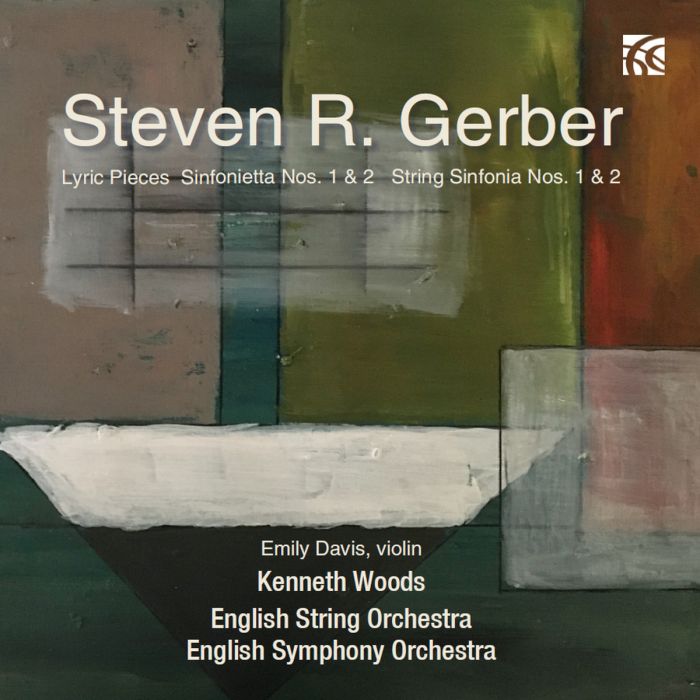
On record – Emily Davis, English String Orchestra, English Symphony Orchestra / Kenneth Woods: Steven R. Gerber: Lyric Pieces, Sinfonietta Nos. 1 & 2, String Sinfonia Nos. 1 & 2 (Nimbus Alliance)

gerber-nimbus

Emily Davis (violin), English String Orchestra, English Symphony Orchestra / Kenneth Woods

Steven R. Gerber
Sinfoniettas – No. 1 (1991, arr. Hagen); No. 2 (2000). String Sinfoniasa – No. 1 (1995); No. 2 (2011, all arr. Williams). Two Lyric Pieces (2005)ab

Nimbus Alliance NI6423 [73’07”]

Producer Phil Rowlands
Engineer Tim Burton

Recorded 7-8 October 2020, Wyastone Concert Hall, Monmouth

Written by Richard Whitehouse

What’s the story?

The English Symphony Orchestra returns with music by American composer Steven R. Gerber (1948-2015). Little known in the UK, it enjoyed wide exposure in the Russia of the immediate post-Soviet era and could well find a new audience through such pieces as those featured here.

What’s the music like?

In common with many composers of his generation, Gerber’s output charts a trajectory from serialism to a direct re-engagement with tonality, but his success in aligning these nominally opposing aesthetics confirms a creative insight matched by (surprisingly?) few of his peers. That four out of the five pieces are arrangements from chamber works should not imply any lack of versatility on the composer’s part; rather, these are all pieces more likely to reach a wider listenership through being reimagined for larger though still relatively modest forces.

This is evident not least in the case of the two Sinfoniettas. The First is an arrangement of the Piano Quintet by Daron Hagen (pupil of David Diamond and Ned Rorem, and a composer of numerous works for the stage) whose five movements evolve from the tensile incisiveness of its preludial first movement, via the capricious then scurrying manner of the Intermezzo and Scherzo that ensue, to a finale whose accrued emotional plangency finds its apogee in a coda whose headlong impetus renders what went before from an appreciably different perspective.

The other arrangements were all undertaken by Adrian Williams, himself a notable composer whose large-scale Symphony the ESO has recently recorded for future release. Derived from Gerber’s Fourth Quartet, the First String Sinfonia is most arresting for the consistent intensity of its central movements – a Lento then a Maestoso that might have functioned as finale had not the composer opted, rightly as it turns out, to let the emotion subside over the course of a brief yet affecting Postlude – one that balances the gentle opening Moderato to potent effect. As derived from Gerber’s Sixth Quartet, the Second String Sinfonia emerges as a much more equivocal work – the angular and ambivalent Allegro followed by the menacing Intermezzo, then a final Theme and Variations which ultimately winds down towards an uncertain repose.

A more elaborate, indeed methodical take on the Variations format is pursued by the second and final movement of Gerber’s Fifth Quartet, here arranged as the Second Sinfonietta which again makes use of fuller instrumentation and exudes more charged expression. Not least the opening Fantasy, whose determined contrasts of mood make for a disjunct overall trajectory such as is countered, though not wholly resolved, through the steady and always inevitable build-up of its finale towards a forceful while by no means decisive or clinching apotheosis.

Does it all work?

Yes. This is engaging music which, if it tends to an unrelieved earnestness, cannot be faulted for emotional sincerity. It was astute programming to include Two Lyric Pieces for violin and strings, the only item in its original guise, whose inward soulfulness finds Gerber at his most approachable – not least when Emily Davis renders the solo part with such fluency and poise.

Is it recommended?

Indeed, directed by Kenneth Woods with unfailing conviction in sound of real clarity. Those who are coming afresh to Gerber should certainly respond positively to what is heard here.

Listen and Buy

You can listen to clips and purchase this disc from the Nimbus website. For more information on Steven R. Gerber, click here. For more on Daron Hagen, click here – and click on the names for more on Adrian Williams, Emily Davis, Kenneth Woods and the English Symphony Orchestra. –

On record – William Wordsworth: Orchestral Music Vol.3 (Toccata Classics)

wordsworth-3

Florian Arnicans (cello), Liepāja Symphony Orchestra / John Gibbons

William Wordsworth
Symphony no.5 in A minor Op.68 (1957-60)
Cello Concerto Op.73 (1963)

Toccata Classics TOCC0600 [65’55”]

Producer Normands Slāva
Engineer Jānis Straume

Recorded 1-5 February 2021, Amber Concert Hall, Liepāja, Latvia

Written by Richard Whitehouse

What’s the story?

Toccata Classics continues its series devoted to the orchestral works of William Wordsworth (1908-88) in a coupling of two pieces from around the turn of the 1960s, when the changing priorities of the British musical establishment meant such music was increasingly overlooked.

What’s the music like?

Although it had to wait over a decade before its first performance in January 1975 (perhaps as it was written with no specific soloist in mind), the Cello Concerto is unerringly conceived for this instrument – not least the substantial opening Allegretto whose brusque initial orchestral tutti hardly prepares one for the wide-ranging if never discursive dialogue that follows. There is a lengthy and developmental cadenza before a reprise which continues the evolution of its pithy ideas prior to the ruminative close. Designated Nocturne, the ensuing Lento is among Wordsworth’s most atmospheric slow movements; the cello’s eloquent main theme provides a focal point thrown into relief by woodwind via a series of haunting asides, without seriously undermining the repose made tangible in the evocative closing bars. The final Allegro vivace is centred on a lively, even nonchalant refrain whose trenchant rhythmic profile comes to the fore in a fugal section whose accrued energy subsides into a musing solo passage – from out of which the earlier repartee continues through to a decisive while not a little sardonic coda.

Although premiered in 1962 and broadcast thereafter, the Fifth Symphony only now receives its first commercial recording – a pity, given this is arguably Wordsworth’s most emotionally involving such piece. A calmly undulating ‘motto’ at the outset is heard in three guises over each of three movements. Thematic in the initial Andante maestoso, its supplicatory writing for strings complemented with plangent woodwind in a discourse where the slowly emergent ‘landscape’ may well be that of the mind – not least its quietly ecstatic writing for solo violin toward the close. Rhythmic in the central Allegro, a scherzo whose spectral writing for tuned percussion and upper woodwind has more than a little malevolence – even with a whimsical trio to provide contrast. Its recalcitrant ebbing away makes the finale’s slow introduction the more striking, strings building to an expressive apex from where the Allegro begins. Here the harmonic aspect of the ‘motto’ is dominant, episodes of tensile fugato alternating with gentler asides on the way to an apotheosis whose affirmation is necessarily tempered by experience.

Does it all work?

Yes, in that both pieces find Wordsworth’s often elusive tonal language at its most searching. Florian Arnicans cannot have known the Cello Concerto before these sessions, but he captures its brooding understatement with undoubted assurance and thereby reinforces its claim to be the deepest and most substantial of this composer’s concertante works. The Fifth Symphony can be heard in a 1979 studio reading by Stewart Robson with the BBC Scottish Symphony (Lyrita), but Gibbons reveals more fully why it is likely the highlight of Wordsworth’s cycle.

Is it recommended?

Indeed. The playing of the Liepāja Symphony Orchestra is on a par with that of the previous two instalments in this series, and Paul Conway contributes his usual thorough booklet notes. Good to hear the fourth volume in this series, featuring the Seventh Symphony, is imminent.

Read, listen and Buy

You can read Richard’s review of the first two volumes in the Wordsworth series on Arcana, clicking here for the first volume and here for the second

You can listen to clips and purchase this disc from the Toccata Classics website. For more information on WIlliam Wordsworth, click here. For more on the performers on this recordings, click on the names for websites devoted to Florian Arnicans, John Gibbons and the Liepāja Symphony Orchestra respectively.

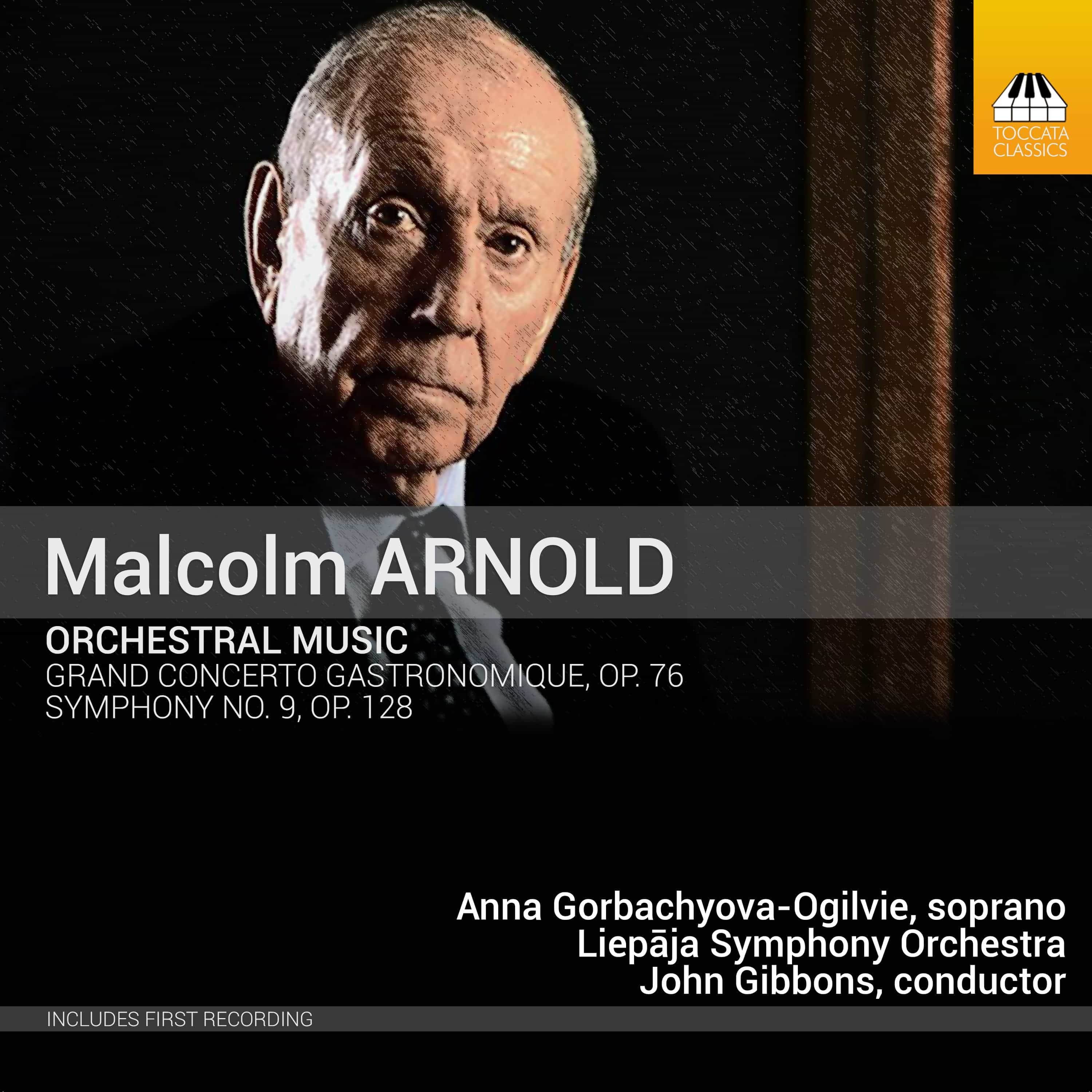
On record – Arnold: Symphony no.9 & Grand Concerto Gastronomique (Liepāja Symphony Orchestra / John Gibbons) (Toccata Classics)

toccata-arnold

Malcolm Arnold
Grand Concerto Gastronomique Op.76 (1961)
Symphony no.9 in D Op.128 (1986)

Anna Gorbachyova-Ogilvie (soprano, Concerto), Liepāja Symphony Orchestra / John Gibbons

Toccata Classics TOCC0613 [57’30”]

Producer Normands Slāva
Engineer Jānis Straume

Recorded 14-16 June 2021 at Great Concert Hall, Liepāja

Written by Richard Whitehouse

What’s the story?

Toccata Classics marks the centenary of Malcolm Arnold’s birth (falling on October 21st) in a pertinent coupling of his final symphonic statement with music finding this composer at his most irreverent and, by so doing, juxtaposes the two sides of his creativity to startling effect.

What’s the music like?

It was the compositional hiatus resulting from emotional breakdown then tortuous recovery as provided the catalyst for the Ninth Symphony, whose superficial simplicity belies the anguish beneath its surface. John Gibbons (who had earlier conducted this work in London, as part of a nine-year Arnold cycle, and Northampton) brings tangible expectancy to the opening Vivace, its arresting initial gestures soon revealing that textural starkness which goes on to define the whole work, with a circuitous evolution even more marked in the Allegretto – an intermezzo whose wistful theme effects less a series of variations than poignant searching for formal and expressive closure. The ensuing Giubiloso is more overtly a scherzo with its headlong motion or trenchant exchanges between wind and strings, yet even here a curious detachment prevails.

Arnold’s eight previous symphonies each concluded in a relatively short and decisive finale, but the Ninth’s final Lento proves anything but – its sustained slowness abetted by restrained dynamics and a sparseness of detail which could have made for unrelieved gloom were it not for those myriad ‘shades of grey’ the composer draws from his reduced palette. An additional factor is Gibbons’s pulse for this movement as a tactus (one-second) rather than crotchet beat, leading to a traversal several minutes less than earlier recordings by Andrew Penny (Naxos), Vernon Handley (BMG) or Rumon Gamba (Chandos) and, as a result, making the cadential chord one of benediction than resignation. Whether or not this approach convinces depends on how one views the symphony overall, but there can be no doubting its sincerity of intent.

Composed for the Astronautical Music Festival – the last of several events inspired by Gerard HoffnungGrand Concerto Gastronomique is Arnold at his most uproarious. Its designation ‘for Eater, Waiter Food and Large Orchestra’ betrays a visual aspect not essential for enjoying this 15-minute consumption of Brown Windsor soup, roast beef, cheese, Peach Melba – with a sensuous cameo by soprano Anna Gorbachyova-Ogilvie – then coffee with brandy; framed by a Prologue and Epilogue of due portentousness, but thankfully no ‘Mr Creosote’ in evidence.

Does it all work?

As a coupling, yes. As to content, the Ninth Symphony will likely always divide opinion as to whether it is what Arnold intended or merely the best that he was able to achieve after the traumas of the preceding decade, but no-one could accuse Gibbons of realizing it as other than a cohesive entity whose formal proportions are as precisely judged as its expressive trajectory is purposefully conveyed. Listeners not convinced by those earlier recordings should certainly hear this new account, lucidly and persuasively rendered by the Liepāja Symphony Orchestra.

Is it recommended?

Yes, enhanced by thought-provoking booklet notes from Timothy Bowers along with realistic sound. Should still-missing orchestral pieces by Arnold (notably the Op. 1 First Divertimento or the Op. 12 Symphonic Suite) come to light, Gibbons will hopefully be asked to record them.

Listen

Buy

You can discover more about this release at the Toccata Classics website, where you can also purchase the recording. You can read more about the Malcolm Arnold society at their website, while for more on each of the performers, click on the names Anna Gorbachyova-Ogilvie, Liepāja Symphony Orchestra and John Gibbons