Violin from Beethoven’s possession, one of four instruments Beethoven received as a gift from Prince Karl von Lichnowsky around 1800 (image from the Beethoven-Haus Bonn)
Romance no.1 in G major Op.40 for violin and orchestra (1800-02, Beethoven aged 31)
Dedication unknown Duration 7′
Listen
Background and Critical Reception
Beethoven’s first published Romance for violin and orchestra was written after the second, which we have already appraised. It is seen by commentators as part of his preparation for a full-scale violin concerto, having attempted such a work ten years previously.
Once again there is a surprising lack of prose written about this piece, which is odd given its popularity on classical music radio. It is written for a ‘classically sized’ orchestra, the violin teamed with strings, flute, oboes, bassoons and horns.
Thoughts
Beethoven starts his Romance with the solo instrument alone, a striking move. It would have been relatively conventional for a piano to start such a piece on its own, but not the violin – which starts here with soft, plaintive chords, like a drone. The mood is slightly folksy.
Gradually the orchestra join the soloist, and as they do the mood becomes more warm-hearted, the theme heard several times and finished off with a decisive cadence. The violin goes on to lead quite an assertive section in the minor key, before returning to sing the main theme in a higher register.
Recordings used and Spotify links
Anne-Sophie Mutter (violin), New York Philharmonic Orchestra / Kurt Masur (Deutsche Grammophon) Thomas Zehetmair (violin), Orchestra of the Eighteenth Century / Frans Brüggen Itzhak Perlman (violin), Berliner Philharmoniker / Daniel Barenboim Arthur Grumiaux (violin), Royal Concertgebouw Orchestra / Sir Colin Davis
Thomas Zehetmair gives an attractive introduction with the Orchestra of the Eighteenth Century under Frans Brüggen, with a fast tempo choice that results in a swift performance time of five and a half minutes. Perhaps not surprisingly Anne-Sophie Mutter lingers longer, hers a luxurious but tender account with Kurt Masur. Arthur Grumiaux has the ideal singing tone for this piece, while Itzhak Perlman also finds great sensitivity.
You can chart the Arcana Beethoven playlist as it grows, with one recommended version of each piece we listen to. Catch up here!
This year in the Summer at Snape series, Britten Pears Arts has been presenting premieres of new arrangements of works by Benjamin Britten. The last in the series will be composer Joseph Phibbs’ arrangement of Britten’s landmark orchestral song cycle Our Hunting Fathers for the chamber forces of the Hebrides Ensemble and soprano Elizabeth Llewellyn. Described by Britten as ‘my real Op.1’, the piece represents the full flowering of his creative relationship with W.H. Auden, who supplied the texts for the three middle poems, writing his own new verse for the Prologue and Epilogue. It is also the first of Britten’s works to explore the theme of humans’ inhumanity, which ran as a thread throughout his life and music. Arcana was able to talk with Joseph about his arrangement, and about the meaningful relationship he has with the music of its composer.
BH: I understand you have a long-standing relationship with Britten’s music. Can you remember the first time you heard anything by him?
JP: I was around 13, and borrowed some cassettes of the String Quartets from my local library. The opening of No.1 immediately captivated me, the violins and viola sustaining a soft cluster of notes at the very top of their registers, with gentle cello pizzicato gestures beneath. The sound world had a disorientating effect, one that was totally alien as well as extraordinarily beautiful. My impressions were of wide landscapes bathed in a glowing, evening light, and it may indeed have been influenced by the impressions Britten had of America around the time he composed it.
A few months later, I heard the Dirge from the Serenade for tenor, horn and strings, which was riveting, and shortly after became obsessed with Peter Grimes, listening to it non-stop, before making a pilgrimage to The Red House when I was about 16.
I was incensed by a documentary that had just been made called J’accuse, which dismissed most of what Britten composed after 1945, and spoke at length to the curator about it, who kindly allowed me look around the Britten-Pears Library (perhaps to calm me down!). I remember picking up a stone from the drive way, in the hope that Britten’s shoe may have graced it 20 years earlier..
It all sounds crazy to me now (it probably was crazy), but my reverence for Britten has never really left me. He strikes me as an extraordinary and mysterious figure, a workaholic who was in some ways compelled to compose because his own irrepressible genius.
When I first heard Our Hunting Fathers it made an incredibly strong impression on me, and I found it emotionally very powerful. How did you respond on first hearing?
Of Britten’s mature works, it was one I knew less well. Having now rediscovered it, I can see how remarkable it is. Britten’s technique was fully formed when he composed it in 1936, at the age of 22, and although it’s his first mature work to include orchestra the scoring is both impeccably judged and extremely imaginative in ways that would have been unusual at the time. He himself regarded it as his first ‘real opus 1’, so clearly felt he had achieved something important. It’s also his first large-scale expression of pacifism. Fascism was on the rise throughout Europe at the time – the Spanish Civil War erupted while the piece was being composed – and Auden’s juxtaposition of ‘German’ and Jew’ (dogs in a hunting pack) at the close of The Dance of Death has a chilling prescience in light of how the world would look ten years later. In some respects it’s an atypical work for Britten, a reason why even some of his detractors have a soft spot for it.
How would you describe Britten’s ability at scoring for orchestra?
As mentioned above, there’s a certain glow to his sound, as well as a clarity and lightness of touch, which I’ve always loved. His music is the opposite of ‘dense’, and he disliked orchestral music that sounded heavy (famously so in the case of Brahms – though also in some Beethoven). He discovered new ways of approaching the orchestra throughout his life; the textures of Peter Grimes, for example, are completely different from those of A Midsummer Night’s Dream or Death in Venice. The melodic and harmonic aspects of his music are always perfectly aligned to his orchestration, and can’t really be divorced from it. For this reason, in this arrangement the original orchestral colour has been kept as possible, and elsewhere I’ve tried to imagine what Britten would have done were he scoring for a small ensemble.
What other Britten works do you particularly admire?
I drift in and out of pieces, and am at the moment re-familiarising myself with Rejoice in the Lamb, another early work. Death in Venice is my favourite opera, and Les Illuminations has always been high on my list. A Boy was Born, which predates Our Hunting Fathers, is to my mind one of the most extraordinary works in the repertoire, and the pinnacle of his choral writing from a technical angle. I discovered the cello suites through the superb Tim Hugh recordings around 15 years ago, and they became a big influence on my work. They are perhaps his most private, intimate pieces.
In recent years I’ve enjoyed getting to know his more obscure works better: Prelude and Fugue, for example, and The Journey of the Magi, both wonderful pieces. Occasionally pieces I haven’t listened to for several years suddenly come alive again through an unfamiliar recording, as with Noseda‘s live LSO recording of War Reqiuem, or Iona Brown‘s riveting take on Variations on a Theme of Frank Bridge.
How did the commission come about?
I was asked last year by Roger Wright at Britten Pears Arts – on Colin Matthew’s recommendation – to make this new arrangement, in part due to COVID restrictions. I discussed the instrumentation with William Conway, Artistic Director of the Hebrides Ensemble, and we decided on a scoring that would be compatible with the Sinfonietta Op.1, in the hope that these two pieces might be programmed together in the future. Boosey and Hawkes, who publish the work, granted permission, and it was then then a matter of gaining an overview of the whole piece, isolating particular sections that might be more challenging than others, and then working from beginning to end.
In Britten’s scoring for Our Hunting Fathers I felt I could detect the influence of in the idea of chamber-like passages in a work set for symphony orchestra. Was this something you were conscious of?
The chamber ensembles that emerge in parts of Mahler were clearly an influence, and his imagination had also been fired by Schoenberg, Berg, and Stravinsky, if not harmonically then in a more transparent, colouristic approach to scoring. It’s an unusual piece for the time in which it was written, when a denser approach to orchestral writing in England would have been more typical. I don’t know a work of Britten’s that is more fastidiously scored; every bar is packed full of instructions, and one has the impression he was setting out the full extent of his orchestral technique for the world to see. It left the audience – including Frank Bridge – fairly baffled after the premiere, and was savaged in most of the press. Though it was performed the following year, under Adrian Boult, it had to wait until 1950 before resurfacing.
Did you refer to other smaller-scale Britten works when you were doing the arrangement? I was thinking of the economical scoring in works like Curlew River or the Nocturne.
The Sinfonietta was my closest reference point, although some of the chamber operas, in particular The Turn of the Screw, were also in my mind. Every one of the 12 instruments were essential to do justice to the piece; without, for example, the strident, brassy quality of the horn, the moments of high drama would have been lost.
It must be quite something having the premiere at Snape, and to have your own work back in the live environment.
To have something of Britten’s performed which I’ve tampered with, in the concert hall he built, feels a bit daunting. I can only hope he’d be pleased that one of his most original and neglected works might reach a wider public, albeit in a new guise.
Has Britten been an influence on your own music? I’m thinking particularly of the string quartets.
His instrumentation and orchestration has probably had the biggest single influence. The way he reinvents old forms, such as the passacaglia – which he used many times – is also intriguing. But more than that, it’s his willingness to be emotionally direct which I find so appealing. His music has a spontaneity which I adore; there’s no struggle in order to enjoy it, since his technique is so impeccable. The music seems to move in a direction that it could only go, and in this sense there’s a mastery of judgement – of effortlessness and inevitability, as in Bach or Mozart – which is extremely seductive. His ability to enthral and yet not confuse is, for me, one of the hallmarks of his genius.
How would you describe your new Cello Sonata?
This is a joint commission between Wigmore Hall and Hatfield House Chamber Music Festival, which will host the premiere by Guy Johnston and Tom Poster at the end of September. I got to know Guy’s playing more intimately while composing the work, and have since become a huge fan. Tom, who I’ve worked with before, is also a superb musician, so I couldn’t hope to be better served. The work is written in memory of someone I’d worked with closely, who passed away in his early 50s, and this lends the piece an elegiac quality at times. It’s in several movements, some linked, and includes an arrangement of a 16th Century pavane, in a movement entitled Ghost Dance, as a link to Hatfield House, where Elizabeth I lived as a child.
Is it important for you to have a friendship / understanding with your performers in the way that Britten had with his?
In a few cases, such as my Clarinet Concerto or Letters from Warsaw, I’ve written for close friends whose playing I know well. In other cases, it’s important for me to have a clear grasp of the technical capabilities of the performers, assuming it’s a commissioned work. Aside from that, it’s a question of trying to ‘ find the right notes’, as Britten put it, and to that extent the process is a personal and sometimes chaotic one, involving a large number of ideas and sketches. I get nervous sharing drafts before the piece is finished, as a player’s response – whether positive, negative, or silent – can divert you from what you intended to do.
What else are you working on at the moment?
I’m writing some guitar miniatures for a superb young player, Alex Hart, as well as a set of pieces for Tom Kimura – a wonderful pianist who I studied with at The Purcell School. After that, I’m starting a string piece for the Britten Sinfonia, and also gathering ideas together for a Violin Concerto.
JosephPhibbs’ arrangement of Britten’s orchestral song cycle Our Hunting Fathers for the chamber forces of the Hebrides Ensemble and soprano Elizabeth Llewellyn receives its world premiere at Snape Maltings on Tuesday 24 August. More information can be found here.
Haydn String Quartet in D major Op.64/5 ‘Lark’ (1790) Simpson String Quartet no.1 (1951-2)
Cadogan Hall, London Monday 16 August 2021 (1pm)
Written by Richard Whitehouse
In his centenary, it was timely to include music by Robert Simpson (who spent three eventful decades at the BBC) at the Proms, and while one might have hoped for one of his symphonies in the evening concerts, his First Quartet at a Cadogan Hall recital was hardly less welcome.
Finished when Simpson was in his early thirties and dedicated to Enescu (who read through and commended the score during his last visit to the UK), the First Quartet fairly typifies the composer’s music at this time in its stealthy take on progressive tonality and methodical yet never pre-ordained design. Thus, the opening Allegro evolves seamlessly from wistful then animated main ideas through an inwardly probing development to a trenchant reprise then a headlong coda; the ensuing Andante unfolding a series of variations on a ruminative theme – structured as a palindrome – that grows in intensity towards a fervent culmination before it touches on the work’s opening theme on route to a limpid final repose. Simpson was to use a two-movement format on subsequent occasions, but never so elegantly or lucidly as here.
In his introductory remarks, Johannes Marmén stated that the Marmen Quartet had not been familiar with Simpson’s music until asked to learn the First Quartet for this recital. Evidently played-in beforehand, this afternoon’s performance was impressive in its formal command and audible feel for a distinctive idiom of far-reaching consequences. Hopefully this group will tackle further Simpson – the Second and Third Quartets, which explore the potential of their predecessor in what effectively becomes a ‘meta-quartet’, are a good place to continue.
A passing allusion to Haydn’s Lark Quartet at the start of the Simpson made the former a natural pairing, of which the Marmen made a virtue with its attentive and insightful account. After an animated reading of the initial Allegro (second half repeat included to make it weightier), the Adagio was notable for its eloquent ensemble and a tentative wit made manifest in the lively Menuetto. Sparkling yet never skittish, the final Vivace rounded off this performance in appealing fashion – leaving little doubt of the Marmen Quartet as an outfit with a future.
You can find more information on the BBC Proms at the festival’s homepage
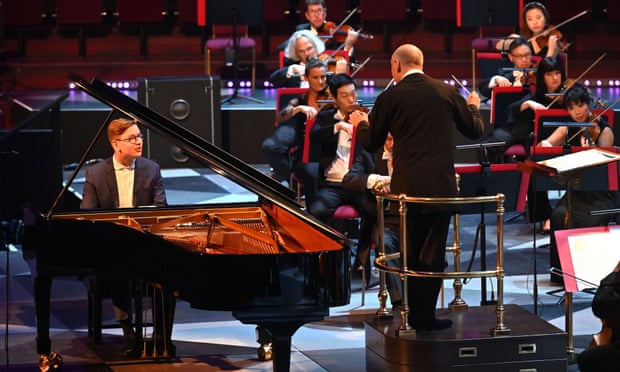
Víkingur Ólafsson (piano), Philharmonia Orchestra / Paavo Järvi
Prokofiev Symphony no.1 in D major Op.25 ‘Classical’ (1916-17) J.S. Bach Keyboard Concerto in F minor BWV1056 (c1738-9) Mozart Piano Concerto no.24 in C minor K491 (1786) Shostakovich Symphony no. 9 in E flat major Op.70 (1945)
Royal Albert Hall, London Saturday 14 August 2021
Written by Richard Whitehouse
Tonight’s Prom brought change of conductor, the always reliable Paavo Järvi stepping in for Santtu-Matias Rouvali in what would have been the latter’s Proms debut, but not of soloist – Icelandic pianist Víkingur Ólafsson duly making his first appearance at these concerts with concertos which, for the most part, played to his strengths.
The number of times that Bach’s keyboard concertos have been heard here on piano in recent decades can be counted on the fingers on one hand (Tatiana Nikolayeva’s D minor resonates in the memory), but that in F minor was a good choice in terms of its succinctness – the outer movements pitting soloist and (sizable body of) strings against each other with a trenchancy as was vividly conveyed here, with the central Andante an oasis of serenity that was not without its plangent asides.
Placing this piece before the interval, however, made for a distinctly short first half – given the relative length of Mozart’s C minor Concerto after the interval. There were many good things in this latter, Ólafsson keeping the first movement on a tight yet never inflexible rein so that its inclination to pathos – if not always its portentous undertones – came through in ample measure; not least in a coda that had been cannily prepared by the soloist’s cadenza. The central Larghetto was none the less the highlight – Ólafsson varying his tone such that piano melded into the woodwind for an early and defining instance of timbral colouration, with its limpid elegance never undersold. Maybe the finale was a little staid in the overall unfolding of its variations, but the coda’s strangely ambiguous poise was tangibly realized.
An auspicious debut, then, for Ólafsson, who underlined his prowess with affecting readings of the slow movement of Bach’s Fourth Organ Sonata (BWV526) in August Stradal’s chaste transcription and Liszt’s not unduly mawkish version of Mozart’s Ave Verum Corpus (K617). These further extended the disparity between each half – the first of which had commenced with Prokofiev’s ‘Classical’ Symphony, not in the least small of scale or mimsyish as Järvi heard it; witness his acerbic and impetuous take on the initial Allegro, trumpets and timpani to the fore, then a Larghetto whose swift underlying tempo left little room for any harmonic piquancy to emerge. The Gavotte was slightly marred by several mannered agogics which tended to impede its rhythmic profile, but the Finale lacked little in sparkle or insouciance.
Among the most travelled and recorded conductors of today, Järvi can seem detached or even aloof in manner – but there was no such reticence evident in Shostakovich’s Ninth Symphony as ended this programme. After a tensile and assertive Allegro, which audibly benefitted from the sizable forces onstage, the Moderato recalled Efrem Kurtz’s classic recording as to overall restraint and a dark-hued introspection rising to anguish in its twin climaxes. Playing without pause, the other movements were of a piece with the foregoing – a driving and almost manic Presto subsiding into a Largo, whose ruminative bassoon soliloquys were eloquently taken by Emily Hultmark, then an Allegretto whose capriciousness was acutely gauged through to its bitingly sardonic climax and breathless final payoff. Undoubtedly a performance to savour.
You can find more information on the BBC Proms at the festival’s homepage
Wooden Elephant [Aiofe Ní Bhriain, Hulda Jónsdóttir (violins), Ian Anderson (viola, arrangements), Stefan Hadjiev (cello), Nikolai Matthews (double bass)
Backlash Music [59’29”]
Reviewed by Richard Whitehouse
What’s the story?
The quintet Wooden Elephant releases its take on Radiohead’s seminal album KidA, second in its reworking of game-changing albums that commenced in 2016 with Björk’s Homogenic then continued in 2018 with Beyoncé’s Lemonade, on the enterprising Backlash Music label.
What’s the music like?
When it appeared in autumn 2000, Kid A not only redefined what even as forward-thinking a rock band as Radiohead was capable of, but also topped the mainstream charts on both sides of the Atlantic. Thus, an album as artistically radical as it is commercially successful such as violist Ian Anderson has made it his mission to reassess. Each of the musicians plays a range of sundry instruments (what improviser Jamie Muir would have deemed ‘allsorts’), yet they are extensions to the already inclusive string sound on which these ‘arrangements’ are based.
After the gradual merging into focus then rhythmic and melodic clarifying of Everything in Its Right Place, the subdued moodiness of Kid A is afforded a ruminative treatment which reveals an unsuspected poise in the melodic line and whimsical twist to the accompaniment. The rhythmic obsessiveness of The National Anthem gives rise to an invigorating textural workout that spills over into mayhem towards the close (who needs an orchestra?) – and to which the video’s Jarmusch-like interplay of drink-stirrers with woodland inhabitants offers an intriguing complement. A siren-song reverb from wine glasses then segues into How to Disappear Completely whose brooding eloquence and lilting gait make it a highlight now as then, while Treefingers is no less arresting given its ethereal emergence and timbral finesse.
The propulsive syncopation of Optimistic effects a vibrant and soulful – if, in this context, relatively straightforward – response, with the hymnic preamble then stealthy integrating of rhythmic and melodic elements across the course of In Limbo satisfying in its immediacy. Nor is there anything predictable about Idioteque with its plaintive unfolding set against a pulsating undertow that drives towards a febrile close, out of which the lucid melodic profile of Morning Bell is maintained from its tentative arrival to its sudden disintegration. It duly remains for the aching pathos of Motion Picture Soundtrack to provide a heartfelt ending; here with its (unintended?) postlude, which is often tracked as Untitled on digital versions of the original album, serenely dissolving into a melange of ricocheting chordal patterns.
Does it all work?
Almost always. Something that was never quite a rock album has provided ideal material for an ensemble that is not quite a string quintet, Wooden Elephant taking full advantage of this stretching of musical and conceptual boundaries to come up with what is an absorbing listen in its own right. Just occasionally the ensemble’s interplay evokes those bluesy harmonies of Quintette de Hot Club de France, but this serves to throw the more experimental aspects of its approach into provocative relief. Nor does the vividly defined sound leave anything to chance.
Is it recommended?
It is. This is an ideal opportunity to reconsider a key album from the turn of the Millennium, finely interpreted by a sympathetic and resourceful ensemble. Wooden Elephant is giving a performance in Potsdam this November, with hopefully further hearings to follow in the UK.
Stream
Buy
Further information
For more on Wooden Elephant, click here, and for more on Backlash Music, click here




 Arcana.fm