Listening to Beethoven #159 – Piano Concerto no.2 in B flat major Op.19

beethoven-393
Beethoven (1987) by Andy Warhol – screenprint on Lenox Museum Board

Piano Concerto no.2 in B flat major Op.19 for piano and orchestra (1787-1800, Beethoven aged 29)

Dedication Karl Nickl von Nickelsberg
Duration 30′

Listen

Background and Critical Reception

Beethoven’s ‘second’ piano concerto has a detailed history, and is actually his first in order of composition, completed some distance before the official no.1.

Thought to have been started in Bonn as far back as 1787, when the composer was just 16, it underwent several revisions, with the first movement the only survivor from the original edition. Beethoven had an original version of the Rondo in B flat major in place for a performance in Prague in 1798, but this was ‘upgraded’ later that year.

When he presented the concerto to his publisher Hoffmeister, on 15 January 1801, Beethoven introduced the second concerto as a piece ‘which I do not claim to be one of my best’. Jan Swafford, while agreeing the first movement is ‘one of the most routine orchestral movements Beethoven ever published’, goes on to note that ‘…beneath a not particularly bold surface, his searching nature can’t help showing itself’. He highlights the ‘startling tonal excursions’ of the first movement, and the ‘more mature, more Viennese’ nature of the second and third. A link is also drawn to ‘the lofty choruses of Mozart’s Die Zauberflöte’ in the Adagio.

Barry Cooper, in his notes for the recent recording by Stephen Hough, Hannu Lintu and the Finnish Radio Symphony Orchestra on Hyperion, describes the ‘strange, off-beat theme’ of the finale, ‘that adds a great sense of humour to the movement – especially when it returns near the end in a remote key (G major), with the rhythm shifted slightly so that the long notes now fall on the beat instead of after it.’

Thoughts

This is Beethoven with bright eyes and a bushy tail, though throughout the Piano Concerto no.2 there is often a sense of politeness, as though the composer is keen to establish himself in the form before doing anything too outlandish.

The first movement is the most expansive, and there are some lovely moments, particularly the way the piano floats in on the back of the orchestral introduction. Soon the keyboard is dominating with flourishes for both hands, exchanging thoughts with the orchestra.

Beethoven enjoys moving into distant keys – thematic material appears in D flat major and then in the beautifully hushed tones of G flat. Other than that he has a lot of fun, and when the movement hints at a soft ending the piano bubbles up to lift the energy and cross the line at a faster pace.

The heart of this piece, however, lies in the second movement Adagio. The breathy introduction from the strings is a magical moment, Beethoven in one of his favourite keys (E flat major) but writing music of an operatic dimension, an aria for piano and orchestra. His studies with Salieri may well have informed this.

As with the first concerto, the best tune is saved for the last movement – and again it is a Rondo, giving concert-goers an earworm for the interval – and just about trumping the original Rondo that Beethoven had written, which now survives as a standalone piece. This one is particularly upbeat, and there are elements of the military march. The third theme, in G minor, has a rustic quality with its ornamentation.

The B flat concerto would surely have been the ideal vehicle for Beethoven as he gradually left his musical mark on Viennese concert life. On occasion it resembles Mozart’s last concerto, in the same key, but there are original elements that could only be by Beethoven, who has fun with virtuosity at the keyboard, unexpected harmonic shifts and a dialogue with the orchestra that is never less than genial. It is a fresh and invigorating piece.

Spotify playlist and Recordings used

Wilhelm Kempff, Berliner Philharmoniker / Ferdinand Leitner (Deutsche Grammophon)
Robert Levin, Orchestre Révolutionnaire et Romantique / Sir John Eliot Gardiner (Arkiv)
Mitsuko Uchida, Bavarian Radio Symphony Orchestra / Kurt Sanderling (Philips)
Rudolf Serkin, Bavarian Radio Symphony Orchestra / Rafael Kubelik (Orfeo)
Claudio Arrau, Royal Concertgebouw Orchestra / Bernard Haitink (Philips)
Martha Argerich, Philharmonia Orchestra / Giuseppe Sinopoli (Deutsche Grammophon)
Ronald Brautigam, Die Kölner Akademie / Michael Alexander Willens (BIS)
Stephen Hough, Finnish Radio Symphony Orchestra / Hannu Lintu (Hyperion)
Stephen Kovacevich, BBC Symphony Orchestra / Sir Colin Davis (Philips)

The B flat concerto is a particularly fresh piece of work in the hands of Stephen Kovacevich, with bright accompaniment from the BBC Symphony Orchestra and Sir Colin Davis. Robert Levin and John Eliot Gardiner’s account is very nicely judged, and there is a magical moment towards the end of the slow movement when the main theme returns in hushed strings. Boris Giltburg has a light touch in the first movement of his recording with the RLPO and Petrenko, and the orchestra respond to his airy approach, making the music sound fresh. The tender slow movement is beautifully poised. Mitsuko Uchida brings balance and a light touch to her recording with the Bavarian Radio Symphony Orchestra and Kurt Sanderling, who are occasionally expansive in their accompaniment.

To listen to clips from Stephen Hough’s new recording on Hyperion, head to their website

You can chart the Arcana Beethoven playlist as it grows, with one recommended version of each piece we listen to. Catch up here!

Also written in 1800 Boieldieu Harp Concerto in C major

Next up Symphony no.1 in C major Op.21

Talking Heads: Colin Matthews

colin-matthews

Interview by Ben Hogwood

The Aldeburgh Festival may not be with us in name this year, but its spirit burns brightly in the form of Summer at Snape, a series of safely distanced concerts to be given over every weekend in June.

As with the festival, these concerts feature imaginative programming, with contemporary music to the fore. Composer Colin Matthews has an illustrious history at Snape and Aldeburgh stretching back to his time as assistant to Benjamin Britten late in the composer’s life. He will be close at hand, with two new works receiving their premiere live performances. Firstly, the Nash Ensemble will feature in the first performance with an audience of Seascapes, setting poetry by Sidney Keyes. Conducted by Martyn Brabbins, the verses will be sung by soprano and dedicatee Claire Booth.

The next day will give audiences a chance to enjoy a new arrangement for string orchestra of the Double Concerto by Britten himself, a work completed at the age of 18 when the composer was still a student. Matthews arranged the original for full orchestra but has now reduced his forces, and the Royal Academy of Music Strings under John Wilson will reveal the new version with soloists Thomas Zehetmair (violin) and Ruth Killius (viola).

Matthews is a generous interviewee, taking time to consider questions from Arcana around both works and the return of live music – not to mention the problem of finding inspiration as a composer during the pandemic. First, however, we started by asking him about the poetry of Sidney Keyes, whose verse forms the bedrock of Seascapes.

“As far as I remember I first came across Sidney Keyes through Tippett’s The Heart’s Assurance”, Matthews recalls, “and I wrote a song cycle to Keyes’ words as long ago as 1968, long since withdrawn. Re-reading Keyes’ complete poems a few years back made me want to make a (hopefully better!) attempt to set him, and one of the poems (Night Estuary) was one I set more than 50 years ago – although I can’t recall it at all. The complexity of his thought doesn’t make for easy setting, but the words have a lyricism and power which calls for music.”

The work was first performed at London’s Wigmore Hall on 30 April, part of a Nash Ensemble program including works by Sir Harrison Birtwistle, Mark-Anthony Turnage, Julian Anderson and Simon Holt (which you can watch above).

What was it like seeing the work finally performed live? “Rather remarkable – only my third experience of live music in about 14 months, and an unusual experience to hear a work for the first time more than a year after it was completed.”

Claire Booth is the ideal singer for this work, and Matthews wrote the vocal line especially with her in mind. “Absolutely. I’ve known Claire since she took part in the Aldeburgh Composition Course in (I think) 2000, and this is the third piece that I’ve written for her. I chose a small ensemble whose colours are relatively subdued: a lot of the music is introspective in mood and is designed very much for the soloist to float over it.”

Moving on to the Britten, we consider the Double Concerto for violin, viola and orchestra, written at the age of 18 – and which Matthews has now reduced to the accompaniment of strings only. Does he detect is a lineage back to Mozart’s Sinfonia Concertante, a work for the same instrumental combination? “Obviously he (Britten) knew the Sinfonia Concertante, and he mentions a performance (with Lionel Tertis) in his 1931 diary, a few months before he started on the Concerto. It was one of the last pieces I heard him conduct. But there’s no influence from Mozart other than the soloists: instead, it follows very much the three-movement form of his Sinfonietta Op.1 which he had just completed, but on a larger scale.”

How much work was required between the 1997 version, made from the fully catalogued work (above), and the version we will hear at Snape? “A great deal! Making the 1997 version was comparatively simple, as Britten had made very detailed indications of instrumentation in his short score. Reducing it to strings alone – which was Thomas Zehetmair’s idea – meant a lot of rethinking and reworking. For instance, there is an important timpani part in the finale which took a lot of work to transfer satisfactorily to the double basses.”

We move on to talk about Britten’s writing for strings, and Matthews pinpoints several passages in his writing that have left a lasting admiration. “This work of course predates the most important of his string pieces, the 1936 Variations on a theme of Frank Bridge, whose string writing is a model of flair and virtuosity. The string writing for the original version of the Concerto is rarely as adventurous, so I was to some extent constrained by what was already there, as well of course as having to adapt music that was written for wind and brass. In many respects it had been easier to emulate Britten’s string writing in my orchestration of the Temporal Variations, originally for oboe and piano, and so starting from scratch.

We move on to discuss the last year, and how it has been for Matthews as a composer. Has he had plenty of material for new works or has it been hard to find inspiration at times? “At first there was a sense of freedom in not writing to commission or deadline”, he says, “and I wrote a fairly large-scale orchestral piece in the summer of last year. Subsequently I’ve been finding it a bit difficult to focus on projects other than small or solo pieces, and this is one of several arrangements I’ve made for the smaller forces that are necessary in these difficult times, which has been a good way to keep up momentum.”

The last question requires the simplest of answers to confirm just how valuable Summer at Snape promises to be. What does it mean to Colin to be part of live music making at Snape once again? “Very special.”

Summer at Snape runs from Friday 4 June until Saturday 11 July. For full details on all the live events, visit the Snape Maltings website. For more on Colin Matthews, you can visit the composer’s website here
.

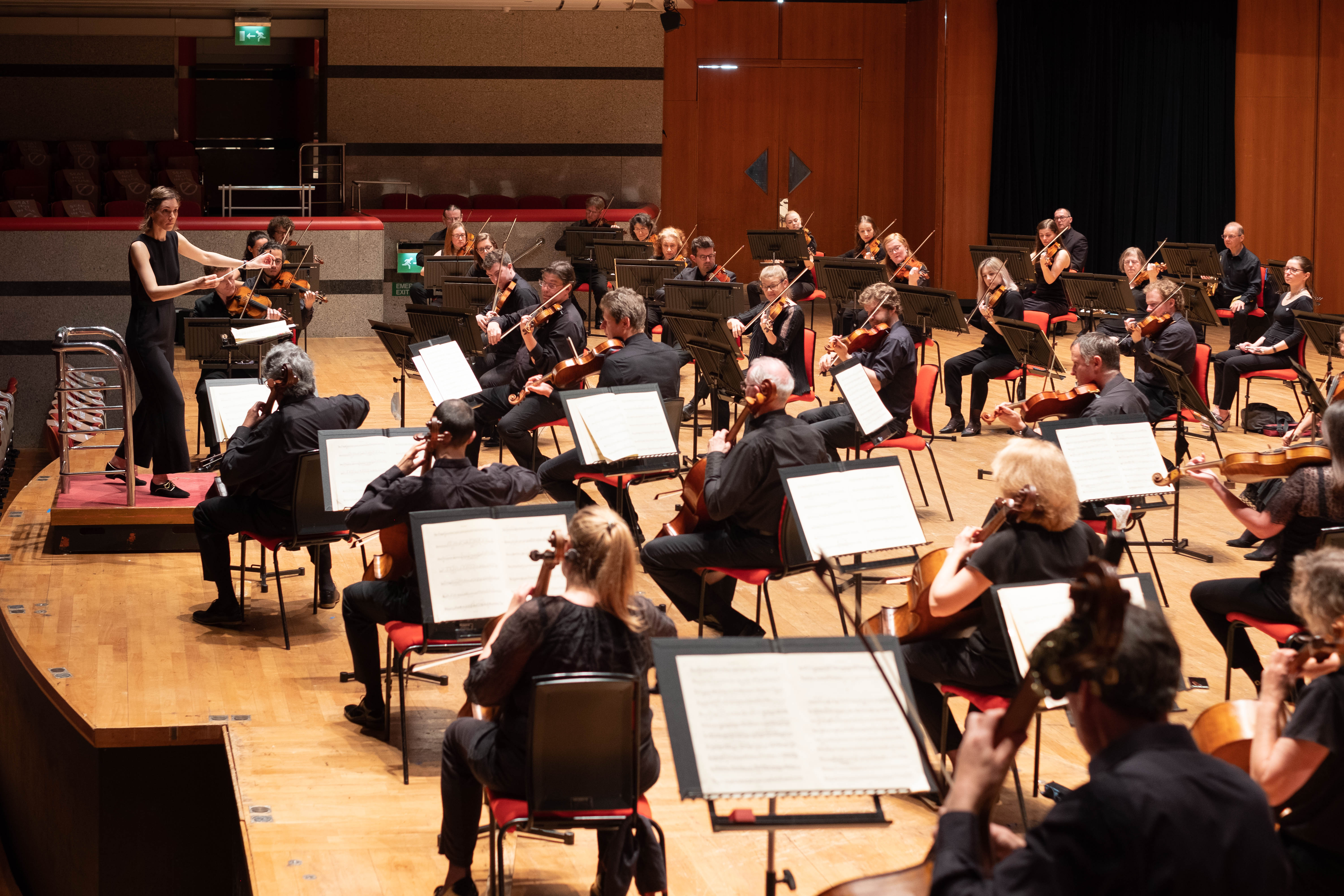
In concert – Paul Lewis, CBSO / Chloé van Soeterstède: Mozart, Beethoven & Mendelssohn

chloe_conductor

Paul Lewis (piano), City of Birmingham Symphony Orchestra / Chloé van Soeterstède (above)

Mozart Don Giovanni K527: Overture (1787)
Beethoven Piano Concerto no.2 in B flat major Op.19 (1787-9, rev. 1795)
Mendelssohn Symphony no.5 in D minor Op.107 ‘Reformation’ (1830)

Symphony Hall, Birmingham
Wednesday 2 June 2pm

Written by Richard Whitehouse

Photos from Symphony Hall by Hannah Blake-Fathers

‘Heaven and Hell’ might have been too histrionic a title for this latest concert by the City of Birmingham Symphony Orchestra, yet it indicated the trajectory of a programme featuring Mozart at his most Romantic, Beethoven at his most Classical then Mendelssohn at his most Baroque.

Making her debut with this orchestra, French conductor Chloé van Soeterstède played down the rhetoric in those indelible opening chords of the overture to Mozart’s Don Giovanni but maintained impetus throughout the deftly modified sonata design as it sets out the tone if not content of what follows. In its theatrical context the music continues directly into the opening scene, but – despite (or even because?) of its emotional terseness – the ‘concert ending’ is by no means un-effective in its propelling the dramatic focus on towards a decisive conclusion.

Paul Lewis then joined the CBSO for Beethoven’s Second Piano Concerto – actually, the first in chronological terms and easy to underestimate in terms of its stylistic antecedents. Yet, as Lewis demonstrated in engaging terms, this is only incrementally less then characteristic and such as the close of the first movement’s initial tutti and transition into the reprise could only be by Beethoven. Lewis now feels the composer’s 1809 cadenza involves too great a stylistic disparity, and his own solution is formally and expressively consistent with what went before.

The highlight of this performance was nonetheless the Adagio (probably the earliest music in what was a lengthy gestation), limpid and poetic while never cloying – the closing interplay between soloist and orchestra unerringly well judged. Lewis then set a swift if not headlong tempo for the ensuing Rondo which gave full rein to the music’s bracing vigour but also its deftly ironic asides. Not least those tonal sideslips near the outset of the coda, with pianist and conductor at one in projecting an ebullience right through to the spirited final pay-off.

Good to see Mendelssohn’s Reformation reasserting its place in the repertoire after decades at the periphery. With controversies over a Jewish-born composer commemorating a Protestant anniversary (and quoting the ‘Dresden Amen’ of Catholic liturgy) now consigned to history, the innate power of the initial Allegro can readily be appreciated and not least in so assured a reading as this. Van Soeterstède brought out its inexorable onward motion in full measure, the scherzo providing an ideal foil in its infectious gaiety and the whimsical guile of its trio.

Eloquently rendered as a soulful ‘song without words’, the third movement thus balanced the work’s introduction as a searching contrast to what follows – here, a finale which unfolds as an extended paraphrase on the Lutheran chorale Ein’ feste Burg ist unser Gott, its heady if sometimes overbearing emotional force adroitly channelled toward a fervent apotheosis. The CBSO woodwind made a felicitous contribution, not least Marie-Christine Zupanic with the flute’s gentle intoning of that chorale – Mendelssohn’s devotion to Bach here made manifest.

An auspicious showing for Van Soeterstède, who will hopefully be returning in due course. Next week sees a very different programme of Britten’s Nocturne and Malcolm Arnold’s Fifth Symphony, doubly welcome in view of his centenary and its close association with the CBSO.

For further information about the CBSO’s current series of concerts, head to the orchestra’s website

For further information about the next concert on Wednesday 2 June, click here, and for more on conductor Chloé van Soeterstède you can visit her website

Switched On – Loscil: Clara (Kranky)

loscil

reviewed by Ben Hogwood

What’s the story?

‘Clara’ is the Latin word for ‘bright’. It is employed by Vancouver’s Scott Morgan to describe his latest album under the Loscil moniker. Morgan is a highly productive musician known for making minimal material stretch a long way, but with Clara he has outdone himself.

Taking a three-minute piece for a 22-piece string orchestra, Morgan recorded the output but then subjected the recording to heavy treatment. The master was purposefully damaged, introducing surface noise to give the impression of recordings made outside in the field, with gravelly scratches and frissons of white noise.

To match this, Morgan took snapshots of the score, stretching them into almost unrecognisable, broad canvases – rather like the detail you would find on a set of micro-models. The effect, as he says, is that “shadows are amplified and bright spots dimmed.”

What’s the music like?

Too often music is described as immersive, but the music of Loscil cannot be seen as anything else. As it unfolds, Clara has the reassuring regularity of a tidal system, its rich colours mixed together in a slowly moving but utterly compelling cycle. The tracks work on their own terms but are best experienced as part of the whole, as material from the original three-minute track stretches out to 70 minutes.

Although this is the first time Loscil has explicitly taken the orchestra for his inspiration, his music has always had suitable dimensions for these large-scale arrangements, and so Clara represents more of a shift in colour than a change in textural depth. With this in mind, Lucida paints pastel shades while a single chime tolls, but while that track has a metronomic regularity, Stella reaches a beautiful stillness, the ebb and flow of just two repeated chords providing the ultimate ambience over a ten-minute structure. From here Loscil naturally segues into Vespera, where a regularly turning mechanism sounds like the onward motion of a boat. Aura exhibits a more remote beauty, looking farther afield after the slowly bubbling Sol. Darker tones are used for the title track, in spite of its Latin meaning, a rich chord building with purpose from the bass strings before we glimpse the light in the violins. Eventually it fades over the horizon like the setting sun.

Does it all work?

Emphatically. Morgan makes ever-more meaningful and powerful music, which remains by turns simple and incredibly pictorial. His music gives the listener a wider perspective, a grasp of the earth’s vast spaces from their own little corner of the world. It reminds us how, in an age of technology that moves faster than ever before, nature has not quickened its pace to follow suit, proceeding where possible with its same sure-footed and inevitable progress.

As Loscil, Morgan gives us the reassurance that despite those supposed human advances, the progress of geology and nature is unlikely to ever be fully checked.

Is it recommended?

Yes. Clara is another very strong addition to the remarkably consistent Loscil canon, which continues to evolve and develop without repeating itself. It provides another reminder of just how far Scott Morgan is able to stretch the barest of musical material, resulting in an album of awesome depth and presence.

Stream

Buy


Switched On – Georgia Anne Muldrow: VWETO III (Foreseen Entertainment / Epistrophik Peach Sound)

georgia-anne-muldrow-3

reviewed by Ben Hogwood

What’s the story?

“VWETO III is intended for movement”, writes Georgia Anne Muldrow on her Bandcamp page. “It’s to be played when you birth yourself back outside after a long introspective period to get the things you need.”

‘Vweto’ is a word in the Congolese Kikongo language meaning ‘gravity’ – and it suits Muldrow’s grounded approach, as she draws on hip hop, jazz, funk and soul for her inspirations.

Most of the album’s 17 tracks are instrumental, but space is allowed for vocals, “like DIY songs that people can have for themselves”, she writes. “I want to see the sisters rapping up a storm.”

What’s the music like?

Very much ‘alive’. Muldrow’s refusal to process her music too much leads right to the human heart of the music, with irregularities welcome in both pitch and rhythm. Just a few seconds of Old Jack Swings are what’s required, the low slung beats and grubby bass line combining in an earthy sound.

Georgia’s music is spaced out but with a firm sense of direction too, so the lovely wide-screen synth trappings and psychedelic loops are given solid, bassbin-bothering beats. Slave Revoltalleyway Boom has a great combination of squelchy bass, cool keyboard and a rhythm purposefully dragging its feet, while throwback baps gets its winding piano into a circular loop.

Meanwhile Slow Drag gives musical signposts towards one of Georgia’s mentors, Alice Coltrane, with its spiritually rich organ sound. Alternatively Grungepiece shreds its guitar against a sprinkling of piano dust.

The vocals are good, too – Love Call Groove has a sultry air, while the rapping on Ayun Vegas Session 1 matches Georgia’s rich alto


It is difficult to know where the analogue stops and the digital starts on VWETO III – proof of Muldrow’s successful fusion of past, present and future.

Does it all work?

Yes. As she did in the previous two volumes of this series, Georgia operates an extremely open musical policy, and the fresh improvisation on a lot of these tracks gives them a freshly minted feel.

Is it recommended?

It is. VWETO III achieves its aim of looking outwards and upwards, celebrating the likely return to the outdoors and positive living. Its freedom is at odds with the closed environments of the last year and a half, and its stylistic blends and inventions are invigorating. More power to her elbows!

Stream & Buy