On Record – Squid: Bright Green Field (Warp Records)

squid

reviewed by Ben Hogwood

What’s the story?

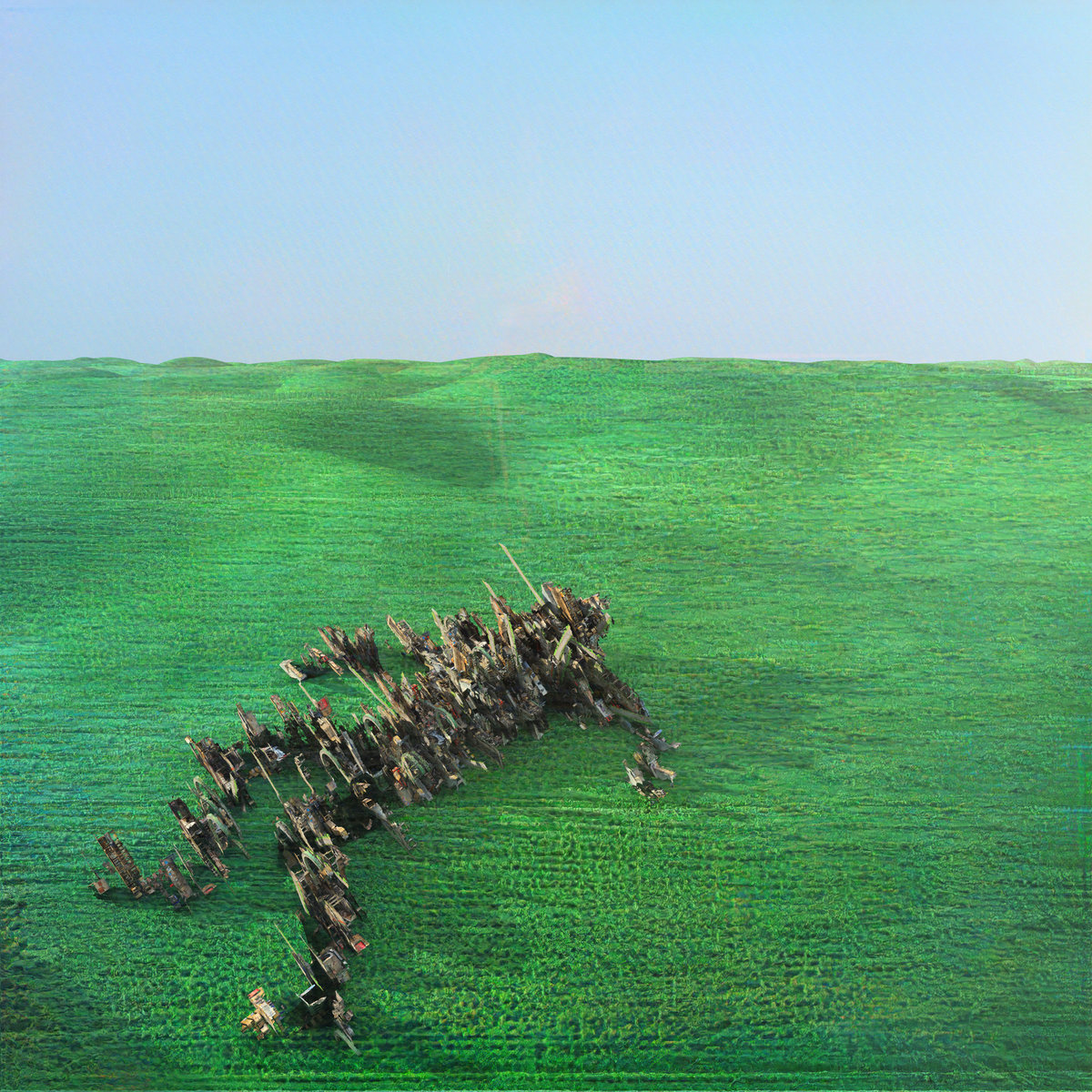
Squid are a fascinating proposition. The cover of Bright Green Field promises much in terms of pastoral beauty and optimistic music, but the reality is often at complete odds with the picture. While there are indeed pastoral moments, found in field recordings of bees and church bells, there are moments of outright anger at the direction in which society, and British society in particular, is going.

This reflects the quintet’s position in Brighton, from where they can see both the attractive and vulgar elements of living in Britain, and the corporate traps too. G.S.K., for instance, details the chemical conglomerate GlaxoSmithKline as being so big you can now tell the time by them.

What’s the music like?

As fascinating and multi-layered as the lyrics. It is not possible to pin Squid down to a single style; rather it is instructive to say what they are capable of doing and how they communicate. What really strikes the listener is how assured it all is, and that no matter what style they use to communicate, they do it with great intensity.

Drummer and vocalist Ollie Judge has a glorious unpredictability, moving from wry observations to excited yelps at the flick of a switch. Several Squid songs change mood like the weather, and the music follows suit – but always in thrall to the lyrics, never for the sake of it. At times they channel the calculated rock of Battles, while the style of Narrator brings reminders of The Rapture, building up into a ritualistic frenzy. Some of the tracks are left as unkempt, but in a good way – and Boy Racers definitely falls into this category, its cheery punk pop grinding to a halt before a woozy interlude starts to blur the senses.

As Bright Green Field progresses, there continues to be a refreshing willingness to disregard the musical rules. Paddling is brilliant, an oblique melody dominating until Judge’s repeated cry of “Don’t push me in!” Rich brass sonorities open up in The Flyover, while Global Groove proves an effective snapshot of the album, building tension with a brass and guitar payoff as Judge gets more and more animated. Finally the lyrical content of Pamphlets emphasises the Britishness of the band in spite of the krautrock influences deployed here, working up a lather as the song progresses.

Does it all work?

Unexpectedly, and in spite of the listener’s expectations. Squid challenge our perceptions of genre on a regular basis, stomping all over the dividing lines. They have such a firm confidence in what they do that their musical workings are instinctive, and their rebellious nature is countered by pastoral asides. There is plenty of seething anger here, too, but none of it is misplaced.

Is it recommended?

Yes, without hesitation. Pretty Green Field contains some of the most original pop music you will hear from a new band in 2021.

Stream

Buy


Listening to Beethoven #161 – 6 Easy Variations on an original theme in G major, WoO 77

Ludwig van Beethoven – portrait by Gandolph Ernst Stainhauser

6 Easy Variations on an original theme in G major WoO 77 for piano (1800, Beethoven aged 29)

Dedication unknown
Duration 7′

Listen

What’s the theme like?

Unusually, the theme appears to be Beethoven’s own. It is an ‘easy to play’ number, simply structured but ripe for development. There is just the hint of a dance round the edges.

Background and Critical Reception

So far in his Viennese career Beethoven has not gone long without dashing off another theme and set of variations – and even with so many important pieces and premieres around him, the year of 1800 was no exception. Despite their title, these ones have meaning though. The educational intent behind the Easy Variations on an original theme,writes Jean-Charles Hoffelé, ‘should not distract the listener from what is daring about the music: the expressive power of the Poco sostenuto creates an astonishing effect at the centre of the set.’

The variation to which he refers is the fourth, set in a minor key and providing a striking contrast to those around it.

Thoughts

These are beautifully crafted variations, and as is suggested they prove far more emotive than the title suggests. They are a good showpiece for a pianist, with elements of soft and loud, delicate and heavy, often within the same variation. After a simple beginning Beethoven puts the pianist through their paces with a terrifically pacy second variation them an ultra-solemn fourth, which really delves deep into the heart. Set in the minor key, the music withdraws to a simple unison statement, the hands one octave apart and trapped further down on the keyboard.

When all seems lost a brighter passage appears on cue, a real ‘darkness to light’ moment where the music looks outwards and upwards. Beethoven can’t then resist a final flourish before the end, signalling his determination to push on.

Recordings used and Spotify links

Olli Mustonen (piano) (Decca)
Cécile Ousset (piano) (Eloquence)
Ronald Brautigam (fortepiano) (BIS)
Alfred Brendel (piano) (Vox)
John Ogdon (piano) (EMI)

Some really fine versions here. Olli Mustonen’s is spring-loaded to begin with but hurtles through a quick fourth variation which is far from anything easy! He is a terrific entertainer, whereas John Ogdon and Alfred Brendel are both superb but have a measured control. The variations transfer well to fortepiano, and are clearly enjoyed by Ronald Brautigam.

You can chart the Arcana Beethoven playlist as it grows, with one recommended version of each piece we listen to. Catch up here!

Also written in 1800 Campagnoli 6 Fugues for Solo Violin Op.10

Next up Piano Sonata no.11 in B flat major Op.22

Listening to Beethoven #160 – Symphony no.1 in C major Op.21

Gustav Klimt, Beethovenfries (Detail): Poesie
Poesie, detail from the Beethoven-Frieze (1902) by Gustav Klimt

Symphony no.1 in C major Op.21 for orchestra (1799-1800, Beethoven aged 29)

Dedication Baron Gottfried van Swieten
Duration 30′

1. Adagio molto – Allegro con brio
2. Andante cantabile con moto
3. Menuetto: Allegro molto e vivace
4. Adagio – Allegro molto e vivace

Listen

Background and Critical Reception

Beethoven took his time before setting down his first symphonic work. Aware of the prowess already shown by Haydn and Mozart, he wanted to be on a sure footing with his first contribution to the form, and used a big concert in Vienna to make his move. The concert contained a major Mozart symphony – thought to be the Prague or the Jupiter – an aria from Haydn’s The Creation, and three major Beethoven works. The first was the Septet, fresh off the page, thought to have been followed by the First Piano Concerto and, finally, this new Symphony.

Reaction was favourable, the only slight criticism an observation that the wind section enjoyed a much higher profile than previously. Beethoven’s other formal inventions were subtle enough to ease the audience into the first part of a transition – with the most inventive tactic deployed early on. The very first chord is the key – C major, but with an added B flat – the seventh – pointing the music towards F major. It may not seem a massive switch but listen to the first chord and you will hear just how different its emphasis is, the first time a composer had tried such a trick in a symphony.

Having pointed this out Jan Swafford is keen to emphasise the traditional aspects of the symphony, the first movement proceeding with ‘a vigorous, military-toned Allegro con brio, its phrasing foursquare, its modulations modest, its development and coda not excessively long’. Similar observations are made on the cautious aspects of the other three movements, though the Minuetto is noted to be a ‘dashing’ scherzo. Overall, for Swafford, ‘as a composer of symphonies and concertos he would rest patiently in the shadow of Haydn and Mozart and experiment with voices while he waited for his muse to show him a more adventurous path.’

Daniel Heartz is more complimentary, though also notes how ‘the symphony as a whole does not reach the level of Haydn and Mozart at their best. All praise to Beethoven, nevertheless, for having the courage to essay a genre that did not come easily to him, and to persevere over four or five years until he was ready to brave public appearance as a symphonist.

A final word to Brahms. ‘I also see that Beethoven’s First Symphony seemed so colossal to its first audiences. It has indeed a new viewpoint. But the last three Mozart symphonies are much more significant. Now and then people realise that this is so’.

Thoughts

While all the critical observations note Beethoven’s caution and respect of tradition in the First Symphony, it is still a remarkable work for its time. It also has great invention, and in a sense Beethoven’s work as an original thinker was already done by the time the first chord had been intoned. Using that particular chord, the C major seventh, would have been a real eyeopener for anybody of the time, a tactic not yet tried that suggested a composer ready to take risks.

As it proceeds the first movement is full of vigorous debate and fulsome writing for wind, an enjoyable dialogue with bags of positive energy. Beethoven writes with great assurance, the dynamic is often loud and the mood upbeat throughout.

In the second movement a tender side is revealed, along with a little wit resembling Haydn – it has a similar profile to the slow movement of his teacher’s Symphony no.100, the ‘Clock’. It also slips into the distant key of D flat major, wholly typical of Beethoven to be thinking further afield with his harmonies, but from here he fashions an effortless return ‘home’.

It may be marked ‘Minuetto’ but there is no way the third movement is anything other than a scherzo. It has a very simple profile – an upwardly rising scale – but Beethoven typically works it into something meaningful. Only 25 seconds in and he’s back in D flat major, showing once again the skill with which he can move between keys. With syncopations and catchy exchanges this is a compact marvel. The trio section is also incredibly straightforward, a series of repeated chords from the woodwind, but once again very effective.

The way Beethoven introduces his main tune in the finale is also very clever, stepping up a ladder one step at a time, returning to earth, then rushing up to the top for the full tune. It generates a good deal of momentum to power this substantial movement, which as Daniel Heartz says represents a desire on the part of the composer to give his works more impetus at the end rather than the beginning. As the symphonies progress we will see this more and more.

Spotify playlist and Recordings used

NBC Symphony Orchestra / Arturo Toscanini (RCA)
Cleveland Orchestra / George Szell (Sony Classical)
Orchestra of the Eighteenth Century / Frans Brüggen (Philips)
Berliner Philharmoniker / Herbert von Karajan (Deutsche Grammophon)
Vienna Philharmonic Orchestra / Claudio Abbado (Deutsche Grammophon)
Danish Chamber Orchestra / Ádám Fischer (Naxos)
Minnesota Orchestra / Osmo Vänskä (BIS)

To listen to clips from the recording from the Scottish Chamber Orchestra conducted by Sir Charles Mackerras on Hyperion, head to their website

You can chart the Arcana Beethoven playlist as it grows, with one recommended version of each piece we listen to. Catch up here!

Also written in 1800 Weber Das stumme Waldmädchen

Next up 6 Easy Variations on an Original Theme WoO 77

Listening to Beethoven #159 – Piano Concerto no.2 in B flat major Op.19

beethoven-393
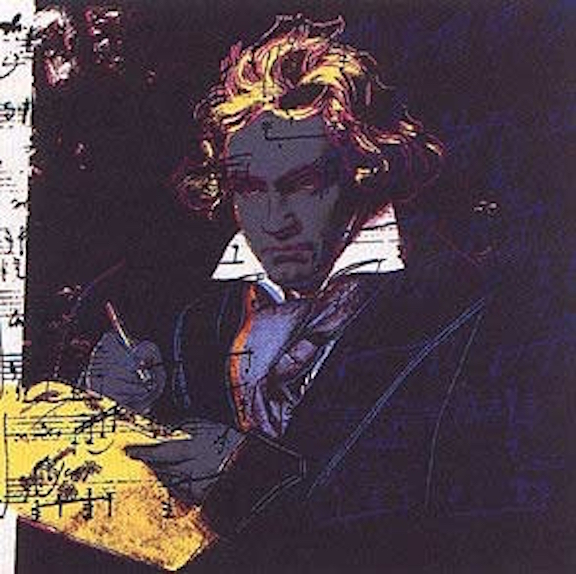
Beethoven (1987) by Andy Warhol – screenprint on Lenox Museum Board

Piano Concerto no.2 in B flat major Op.19 for piano and orchestra (1787-1800, Beethoven aged 29)

Dedication Karl Nickl von Nickelsberg
Duration 30′

Listen

Background and Critical Reception

Beethoven’s ‘second’ piano concerto has a detailed history, and is actually his first in order of composition, completed some distance before the official no.1.

Thought to have been started in Bonn as far back as 1787, when the composer was just 16, it underwent several revisions, with the first movement the only survivor from the original edition. Beethoven had an original version of the Rondo in B flat major in place for a performance in Prague in 1798, but this was ‘upgraded’ later that year.

When he presented the concerto to his publisher Hoffmeister, on 15 January 1801, Beethoven introduced the second concerto as a piece ‘which I do not claim to be one of my best’. Jan Swafford, while agreeing the first movement is ‘one of the most routine orchestral movements Beethoven ever published’, goes on to note that ‘…beneath a not particularly bold surface, his searching nature can’t help showing itself’. He highlights the ‘startling tonal excursions’ of the first movement, and the ‘more mature, more Viennese’ nature of the second and third. A link is also drawn to ‘the lofty choruses of Mozart’s Die Zauberflöte’ in the Adagio.

Barry Cooper, in his notes for the recent recording by Stephen Hough, Hannu Lintu and the Finnish Radio Symphony Orchestra on Hyperion, describes the ‘strange, off-beat theme’ of the finale, ‘that adds a great sense of humour to the movement – especially when it returns near the end in a remote key (G major), with the rhythm shifted slightly so that the long notes now fall on the beat instead of after it.’

Thoughts

This is Beethoven with bright eyes and a bushy tail, though throughout the Piano Concerto no.2 there is often a sense of politeness, as though the composer is keen to establish himself in the form before doing anything too outlandish.

The first movement is the most expansive, and there are some lovely moments, particularly the way the piano floats in on the back of the orchestral introduction. Soon the keyboard is dominating with flourishes for both hands, exchanging thoughts with the orchestra.

Beethoven enjoys moving into distant keys – thematic material appears in D flat major and then in the beautifully hushed tones of G flat. Other than that he has a lot of fun, and when the movement hints at a soft ending the piano bubbles up to lift the energy and cross the line at a faster pace.

The heart of this piece, however, lies in the second movement Adagio. The breathy introduction from the strings is a magical moment, Beethoven in one of his favourite keys (E flat major) but writing music of an operatic dimension, an aria for piano and orchestra. His studies with Salieri may well have informed this.

As with the first concerto, the best tune is saved for the last movement – and again it is a Rondo, giving concert-goers an earworm for the interval – and just about trumping the original Rondo that Beethoven had written, which now survives as a standalone piece. This one is particularly upbeat, and there are elements of the military march. The third theme, in G minor, has a rustic quality with its ornamentation.

The B flat concerto would surely have been the ideal vehicle for Beethoven as he gradually left his musical mark on Viennese concert life. On occasion it resembles Mozart’s last concerto, in the same key, but there are original elements that could only be by Beethoven, who has fun with virtuosity at the keyboard, unexpected harmonic shifts and a dialogue with the orchestra that is never less than genial. It is a fresh and invigorating piece.

Spotify playlist and Recordings used

Wilhelm Kempff, Berliner Philharmoniker / Ferdinand Leitner (Deutsche Grammophon)
Robert Levin, Orchestre Révolutionnaire et Romantique / Sir John Eliot Gardiner (Arkiv)
Mitsuko Uchida, Bavarian Radio Symphony Orchestra / Kurt Sanderling (Philips)
Rudolf Serkin, Bavarian Radio Symphony Orchestra / Rafael Kubelik (Orfeo)
Claudio Arrau, Royal Concertgebouw Orchestra / Bernard Haitink (Philips)
Martha Argerich, Philharmonia Orchestra / Giuseppe Sinopoli (Deutsche Grammophon)
Ronald Brautigam, Die Kölner Akademie / Michael Alexander Willens (BIS)
Stephen Hough, Finnish Radio Symphony Orchestra / Hannu Lintu (Hyperion)
Stephen Kovacevich, BBC Symphony Orchestra / Sir Colin Davis (Philips)

The B flat concerto is a particularly fresh piece of work in the hands of Stephen Kovacevich, with bright accompaniment from the BBC Symphony Orchestra and Sir Colin Davis. Robert Levin and John Eliot Gardiner’s account is very nicely judged, and there is a magical moment towards the end of the slow movement when the main theme returns in hushed strings. Boris Giltburg has a light touch in the first movement of his recording with the RLPO and Petrenko, and the orchestra respond to his airy approach, making the music sound fresh. The tender slow movement is beautifully poised. Mitsuko Uchida brings balance and a light touch to her recording with the Bavarian Radio Symphony Orchestra and Kurt Sanderling, who are occasionally expansive in their accompaniment.

To listen to clips from Stephen Hough’s new recording on Hyperion, head to their website

You can chart the Arcana Beethoven playlist as it grows, with one recommended version of each piece we listen to. Catch up here!

Also written in 1800 Boieldieu Harp Concerto in C major

Next up Symphony no.1 in C major Op.21

Talking Heads: Colin Matthews

colin-matthews

Interview by Ben Hogwood

The Aldeburgh Festival may not be with us in name this year, but its spirit burns brightly in the form of Summer at Snape, a series of safely distanced concerts to be given over every weekend in June.

As with the festival, these concerts feature imaginative programming, with contemporary music to the fore. Composer Colin Matthews has an illustrious history at Snape and Aldeburgh stretching back to his time as assistant to Benjamin Britten late in the composer’s life. He will be close at hand, with two new works receiving their premiere live performances. Firstly, the Nash Ensemble will feature in the first performance with an audience of Seascapes, setting poetry by Sidney Keyes. Conducted by Martyn Brabbins, the verses will be sung by soprano and dedicatee Claire Booth.

The next day will give audiences a chance to enjoy a new arrangement for string orchestra of the Double Concerto by Britten himself, a work completed at the age of 18 when the composer was still a student. Matthews arranged the original for full orchestra but has now reduced his forces, and the Royal Academy of Music Strings under John Wilson will reveal the new version with soloists Thomas Zehetmair (violin) and Ruth Killius (viola).

Matthews is a generous interviewee, taking time to consider questions from Arcana around both works and the return of live music – not to mention the problem of finding inspiration as a composer during the pandemic. First, however, we started by asking him about the poetry of Sidney Keyes, whose verse forms the bedrock of Seascapes.

“As far as I remember I first came across Sidney Keyes through Tippett’s The Heart’s Assurance”, Matthews recalls, “and I wrote a song cycle to Keyes’ words as long ago as 1968, long since withdrawn. Re-reading Keyes’ complete poems a few years back made me want to make a (hopefully better!) attempt to set him, and one of the poems (Night Estuary) was one I set more than 50 years ago – although I can’t recall it at all. The complexity of his thought doesn’t make for easy setting, but the words have a lyricism and power which calls for music.”

The work was first performed at London’s Wigmore Hall on 30 April, part of a Nash Ensemble program including works by Sir Harrison Birtwistle, Mark-Anthony Turnage, Julian Anderson and Simon Holt (which you can watch above).

What was it like seeing the work finally performed live? “Rather remarkable – only my third experience of live music in about 14 months, and an unusual experience to hear a work for the first time more than a year after it was completed.”

Claire Booth is the ideal singer for this work, and Matthews wrote the vocal line especially with her in mind. “Absolutely. I’ve known Claire since she took part in the Aldeburgh Composition Course in (I think) 2000, and this is the third piece that I’ve written for her. I chose a small ensemble whose colours are relatively subdued: a lot of the music is introspective in mood and is designed very much for the soloist to float over it.”

Moving on to the Britten, we consider the Double Concerto for violin, viola and orchestra, written at the age of 18 – and which Matthews has now reduced to the accompaniment of strings only. Does he detect is a lineage back to Mozart’s Sinfonia Concertante, a work for the same instrumental combination? “Obviously he (Britten) knew the Sinfonia Concertante, and he mentions a performance (with Lionel Tertis) in his 1931 diary, a few months before he started on the Concerto. It was one of the last pieces I heard him conduct. But there’s no influence from Mozart other than the soloists: instead, it follows very much the three-movement form of his Sinfonietta Op.1 which he had just completed, but on a larger scale.”

How much work was required between the 1997 version, made from the fully catalogued work (above), and the version we will hear at Snape? “A great deal! Making the 1997 version was comparatively simple, as Britten had made very detailed indications of instrumentation in his short score. Reducing it to strings alone – which was Thomas Zehetmair’s idea – meant a lot of rethinking and reworking. For instance, there is an important timpani part in the finale which took a lot of work to transfer satisfactorily to the double basses.”

We move on to talk about Britten’s writing for strings, and Matthews pinpoints several passages in his writing that have left a lasting admiration. “This work of course predates the most important of his string pieces, the 1936 Variations on a theme of Frank Bridge, whose string writing is a model of flair and virtuosity. The string writing for the original version of the Concerto is rarely as adventurous, so I was to some extent constrained by what was already there, as well of course as having to adapt music that was written for wind and brass. In many respects it had been easier to emulate Britten’s string writing in my orchestration of the Temporal Variations, originally for oboe and piano, and so starting from scratch.

We move on to discuss the last year, and how it has been for Matthews as a composer. Has he had plenty of material for new works or has it been hard to find inspiration at times? “At first there was a sense of freedom in not writing to commission or deadline”, he says, “and I wrote a fairly large-scale orchestral piece in the summer of last year. Subsequently I’ve been finding it a bit difficult to focus on projects other than small or solo pieces, and this is one of several arrangements I’ve made for the smaller forces that are necessary in these difficult times, which has been a good way to keep up momentum.”

The last question requires the simplest of answers to confirm just how valuable Summer at Snape promises to be. What does it mean to Colin to be part of live music making at Snape once again? “Very special.”

Summer at Snape runs from Friday 4 June until Saturday 11 July. For full details on all the live events, visit the Snape Maltings website. For more on Colin Matthews, you can visit the composer’s website here
.