On record: BBC Philharmonic Orchestra / Jac van Steen – David Matthews: A Vision of the Sea (Signum Classics)

BBC Philharmonic Orchestra / Jac van Steen

David Matthews
Toward Sunrise Op.117 (2012)
Symphony no.8 Op.131 (2014)
Sinfonietta Op.67 (1995)
A Vision of the Sea Op.125 (2015)

Signum Classics SIGCD647 [67’42”]
Producer Michael George
Engineer Stephen Rinker

Recorded 7 November & 6 December 2017, BBC Studios, Mediacity, Salford, UK

Reviewed by Ben Hogwood

What’s the story?

This album is billed as an approachable route in to the music of David Matthews, one of the most prominent living British symphonic composers. Matthews has nine symphonies under his belt already, and we hear the Eighth as part of this programme, but he has a wealth of orchestral music alongside, from which Jac van Steen and the BBC Philharmonic Orchestra draw three works.

What’s the music like?

Matthews’ Symphony no.8 forms the centrepiece of the program, a substantial three-movement work completed in 2014. Its taut musical arguments suggest the influence of Sibelius, the harmonic language appears to build on late Vaughan Williams, and there are references to Debussy and Stravinsky in the orchestral colours used by the composer.

Yet this is by no means a derivative work. Matthews writes in the booklet note that he no longer feels the need to defend writing tonal music, and this argument gets the strongest possible endorsement from the music itself. From the opening chord, rich in woodwind, the musical exchanges are compelling, the harmonies often bewitching, and the form instinctive, written as it is by a hand of symphonic experience.

Too many newer symphonies are let down by their faster music, but not in this case. The first movement unfolds with powerful statements from brass and strings, their energetic arguments punctuated by rolling timpani. The bracing energy is complemented by a reflective Adagio, whose soft chords achieve contemplation in the context of a surrounding, uneasy mood. The music builds, reaching an impressive apex with full-bodied string sound before returning to its original state.

Matthews finishes with an uplifting set of four dances, inspired in part by vapour trails on the Kent coast. The bright colours and persuasive triple time rhythms add a lightness of touch to the full orchestra passages, resembling the profile of the second movement Sibelius’ Fifth Symphony…in a good way! The lightness of touch Matthews achieves at the final resolution is both unexpected and charming.

After the Eighth Symphony we hear the Sinfonietta from nearly 20 years earlier. A tightly compressed piece, its leaner textures generate a good deal of tension, as does the jousting between instrumental sections of the orchestra. The piece is in effect a short concerto for orchestra, culminating with thunderous timpani and short but probing melodies. It is convincing in its outcome, but less accessible with its more oblique melodies.

The accompanying pieces show Matthews’ ability to paint pictures with an orchestra. His tone poem Toward Sunrise begins the album. It is a response to the sun’s ability to make its own music through magnetic loops coiling away from its outer atmosphere, captured in sound by students at Sheffield University. Matthews takes two notes heard in that recording and transfers the motif to the depths of the lower strings, conveying the passing shadows of the night from which the sun will emerge. As the sunrise itself begins the orchestra tingle with anticipation, a volley of timpani rings out and the first rays poke through as the piece ends. It is the ideal piece with which to start.

The hiss of waves on the beach is immediately audible in A Vision of the Sea, a four-part tone poem completed in 2013. British composers have long written effective pictures of the sea, notably Vaughan Williams, Britten and Bridge, and Matthews can be added to that list. His first-hand account of English Channel vistas, punctuated by herring gulls, gets into the minds’ eye of the listener, painted with the help of ghostly piano and an expert use of the percussion section. The vision ends with another sunrise, and the crash of the waves on the shore.

Does it all work?

It does. The program is ideally judged, each work succeeding on its own terms but working as part of the bigger whole. The clinching factor is these authoritative performances from the BBC Philharmonic Orchestra, who have a very strong relationship with Matthews’ music. They appreciate his credentials as a fine symphonist, and his ability to create pictures in an instant.

Is it recommended?

Yes, with great enthusiasm. So many works premiered in this century are not followed up with second performances or recordings, which can be frustrating for concert goers, so it is wholly satisfying to see Signum and the BBC Philharmonic investing so much in this release. Their efforts are handsomely rewarded.

For further information on this release, visit the Signum Classics website.
Perfect Songs – Patrick Watson: Into Giants

by Steven Johnson

Over the last twenty years Canadian singer Patrick Watson has made a name for himself as a writer of keenly felt and sensitively delivered songs. His eight albums to date have all contained episodes to savour and, while he may have sung on higher profile songs along the way, it’s hard not to see Into Giants as arguably his finest moment. A lot of his songs might have a melancholic, introspective feel but Into Giants, taken from his 2012 Adventures In Your Own Backyard album, is in many ways the exact opposite.

Why is it a perfect song?

In short, it has all necessary elements in place and is over-brimming with positive qualities. There’s just so much to love about it.

The heart-warming storyline relayed throughout the song might have been enough on its own but the clever, subtly considered musical arrangements further elevate and enrich its message. Essentially, it tells the story of two people embarking on a journey through life, their relationship evolving and blossoming as they proceed. If you’re worried that sounds a little too saccharine, set any concerns aside – the song generates so much goodwill that you’ll soon find yourself rooting for the contented pair.

It’s not just Watson that sings on Into Giants – he duets with Swedish singer Erika Angell. Together they make sure we’re swept along in the narrative. “Started as lovers, don’t know where it’s gonna end” they repeat over the course over the four minutes. As a refrain it might leave the ending to the story tantalisingly open but there’s no doubting that, right now, things are looking up.

The video directed by Brigitte Henry brings the song even further to life (and is essential viewing in itself). It begins in a way that will be familiar to most these days, with Watson and Angell singing to each other remotely, connected only via the screens of their computers. Soon, they’re united in real life however, dressed up and theatrically tap dancing their way through a colourful set. They sing of how they “grew so tall our heads hit ceilings” and “turned into a crowd of smiles, jumping over all the bad times” and it’s hard not to submit to it in full. There are so many lovely details – from the way Watson wears his hat early on to how they’re showered in confetti towards the end (the allusion to a wedding is apt given the feeling of windswept romance the song portrays). The behind the scenes video provides some nice additional footage (and shows just how much work went into its creation).

There’s much in the way of ornate, decorative instrumentation across the song but when the celebratory trumpets kick in late on it feels especially exultant. Soon after, we’re transported through a door into a venue where a gig is taking place and the pair resume their original positions on stage to deliver their final, moving lines. The central yet understated percussion that runs through the song signs off for one last time. It caps a life affirming and joyous few minutes that never gets old, very much a perfect song.

Perfect Songs is a new occasional series from Arcana. If you have any suggestions for the series, or would like to contribute to it, get in touch – editor@arcana.fm


Listening to Beethoven #108 – 12 Variations on ‘Ein Mädchen oder Weibchen’ Op.66

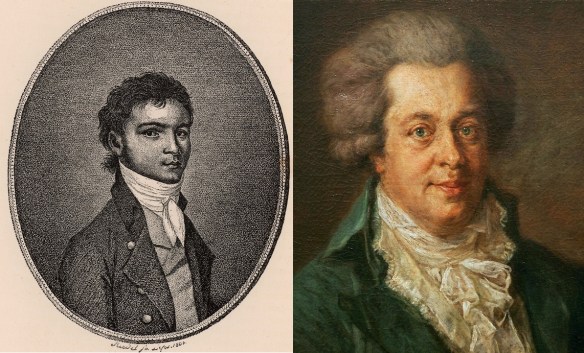
Ludwig van Beethoven and Wolfgang Amadeus Mozart (right, in a portrait by Johann Georg Edlinger)
12 Variations on ‘Ein Mädchen oder Weibchen’ from Mozart’s Die Zauberflöte Op.66 for piano and cello (1796, Beethoven aged 26)

Dedication thought to be Friedrich Wilhelm II, King of Prussia
Duration 10′

Listen

What’s the theme like?

The theme is Papageno’s aria, from Mozart’s opera Die Zauberflöte (The Magic Flute), where he expresses his desire for a wife over a glass of wine:

Background and Critical Reception

Beethoven’s flurry of activity writing for the piano and cello in 1796 yielded four works. Alongside the two groundbreaking sonatas published as Op.5 came two sets of unpublished variations, seemingly inspired by the same dedicatee and performers. The first set had fun with music by Handel, yet – as the excellent Beethoven’s Cello book reveals – this one has slightly more serious origins.

‘In all likelihood Beethoven finished these variations after his return to Vienna’, says the book. They were not published until 1819, when they were assigned the opus number 66 – overlooked when the Fifth Symphony was published ten years earlier. The book suggests Beethoven encountered The Magic Flute in Berlin, thanks to Frederick William II’s promotion. The roots of the piece, however, appear to lie in Beethoven’s competitive edge. They may have been designed in response to Abbé Gelinek, a pupil of Beethoven’s teacher Albrechtsberger and a popular piano teacher in Vienna.

Gelinek had already completed a set of ‘frivolous piano variations’ on Ein Mädchen oder Weibchen three years earlier. ‘Beethoven seems to have taken his lead from Gelinek’s six variations by producing twelve’, says the book, ‘starting in the same manner so he could eventually ‘out-compose’ his rival’. Gelinek’s is entertaining and pleasing, but not musically adventurous; Beethoven’s more assertively tests the limits of the theme and probes the possibilities for constructing a little musical drama around it. A contemporary review questioned Beethoven’s potential as a composer, for he was guilty of unusual tonal movements and ‘harmonic harshness’.

Thoughts

Beethoven has a lot of fun here. A perky introduction of the theme sees piano and cello in level partnership, with straightforward musical punctuation. Then, as the variations proceed, both instruments really start to express themselves. The piano offers a nicely weighted variation before the cello shows off its prowess in the higher register. This is Steven Isserlis’ ‘nightmarish’ second variation, the most difficult – and it’s easy to see why, with a high register and some very tricky jumps.

Once that’s over there is a lot for the cello to enjoy in rich, expressive exchanges with the piano, Beethoven’s bubbling stream of ideas showing no sign of letting up. Some are quickfire and virtuosic, others slow and profound, showing off the expressive tone of the cellist. There are also a couple of brisk marches, the second with block chords from the piano. As often seems to be the case with these pieces, the minor-key variation (the tenth) proves pivotal, a plaintive start growing into a substantial and emotional duet with unusual, questioning harmonies. Coming out of this, the two instruments have renewed energy and finish with a flourish.

Recordings used and Spotify links

Adrian Brendel (cello), Alfred Brendel (piano) (Decca)
Mischa Maisky (cello), Martha Argerich (piano) (Deutsche Grammophon)
Miklós Perényi (cello), András Schiff (piano) (ECM)
Steven Isserlis (cello), Robert Levin (fortepiano) (Hyperion)
Nicolas Altstaedt (cello), Alexandre Lonquich (piano) (Alpha)

The Spotify playlist below includes all but one of the versions listed above – with the opportunity to hear a clip from Steven Isserlis and Robert Levin’s version on the Hyperion website

Again it is Robert Levin and Steven Isserlis who get the measure of the piece, from its light hearted moments to the deep and questioning minor key variation.

Also written in 1796 Haydn Saper vorrei se m’ami, Hob.XXVa:2

Next up Ah! Perfido Op.65

Listening to Beethoven #107 – 12 Variations on ‘See The Conquering Hero Comes’ from Handel’s Judas Maccabaeus WoO 45

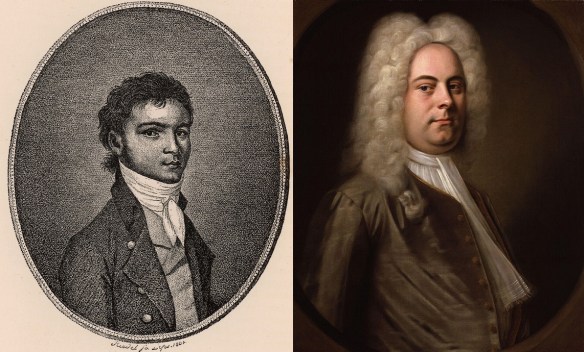
Ludwig van Beethoven and George Frideric Handel (right)

12 Variations on ‘See The Conquering Hero Comes’ from Handel’s Judas Maccabaeus WoO45 for piano and cello (1796, Beethoven aged 26)

Dedication thought to be Friedrich Wilhelm II, King of Prussia
Duration 12′

Listen

What’s the theme like?

Handel’s theme is a chorus from his oratorio Judas Maccabaeus. It is a popular tune which has been turned into a popular Christian hymn, Thine be the glory.

Background and Critical Reception

Soon after the success of his two Op.5 sonatas for piano and cello, Beethoven wrote a couple of sets of variations for the same instrumental combination. The dedicatee appears once again to have been Friedrich Wilhelm II, King of Prussia, with the cello-playing Duport brothers seemingly closely involved.

As Arcana discovered in a previous article, Beethoven’s love of the music of Handel ran deep. Later in his life he was to acquire Samuel Arnold’s first collected edition of Handel’s music (1787-97). Beethoven’s Cello – an excellent and compelling study of his music for the instrument by Marc D. Moskovitz and R. Larry Todd – has an engaging account of the work’s genesis.

It seems likely Beethoven attended a concert of Handel’s oratorio Judas Maccabaeus in Vienna in April 1794, but that his decision to use the ‘conquering hero’ theme came later. There are accounts of a concert in Berlin in 1796, when he improvised on the theme and, as Beethoven’s Cello recounts, ‘his listeners were so moved that they crowded around him and wept’. The decision to include cello ‘is not clear, but perhaps Duport played some role’, says the book.

There are twelve variations, beginning with keyboard-led music but gradually giving greater prominence to the cello. The seventh variation features a challenging display of tumbling triplets in the cello, noted by Moskovitz and Todd as having an affinity with Duport’s sixth etude. This variation is described by Steven Isserlis as the ‘one hideously difficult’ variation of the twelve.

Thoughts

Beethoven’s inspiration flows freely in this immediately likable work. The theme is memorable, one of Handel’s best tunes, and its triumphal air makes an early impact. The two instruments have an enjoyable and lightly spiced interplay, briefly turning baleful in the fourth, minor key variation but resuming its infectious optimism immediately afterwards.

The seventh variation is indeed a nasty one for the cellist, with skittish figures dancing all over the place, but then it’s the pianist’s turn, with a thundering statement. The two resume their ‘dance’, with a triumphant tenth variation – more bravura from the piano – and a substantial coda, with some slower thoughts, which leads to a subtly joyful finish.

Recordings used and Spotify links

Adrian Brendel (cello), Alfred Brendel (piano) (Decca)
Mischa Maisky (cello), Martha Argerich (piano) (Deutsche Grammophon)
Miklós Perényi (cello), András Schiff (piano) (ECM)
Steven Isserlis (cello), Robert Levin (fortepiano) (Hyperion)
Nicolas Altstaedt (cello), Alexandre Lonquich (piano) (Alpha)

The Spotify playlist below includes all but one of the versions listed above – with the opportunity to hear a clip from Steven Isserlis and Robert Levin’s version on the Hyperion website

There are some starry accounts of these variations, from father and son pairing Alfred and Adrian Brendel, from Martha Argerich and Mischa Maisky, and András Schiff with Miklós Perényi to name just three excellent versions. However it may not surprise you to learn that Steven Isserlis and Robert Levin pip them at the post with a thoroughly enjoyable account, recreating something of the air in the concert hall after Beethoven’s instinctive improvising in Berlin. Also highly commended is a new version from Alexander Lonquich and Nicolas Altstaedt.

Also written in 1796 Haydn Guarda qui, che lo vedrai Hob.XXVa:1

Next up 12 Variations on ‘Ein Mädchen oder Weibchen’ Op.66

Live review – April Fredrick, Zoë Beyers, English Symphony Orchestra / Kenneth Woods: Inspired by Mahler

April Fredrick (soprano, above), Zoë Beyers (violin), English Symphony Orchestra / Kenneth Woods

Mahler (arr. Stein) Das irdische Leben (1892/1900)
Weinberg Concertino for Violin and Strings, Op. 42 (1948)
Schulhoff Suite for Chamber Orchestra, Op. 37 (1921)
Ullmann (arr. Woods) Chamber Symphony op 46a (1943/1999)

Wyastone Concert Hall, Monmouth
Recorded in 2020 for online broadcast, Wednesday 27 January 2021

Written by Richard Whitehouse

The Holocaust Memorial Day is a timely opportunity to hear music anticipatory of, inspired by or stemming from events that have defaced human history on all too many occasions, and which provided the basis for this latest online concert from the English Symphony Orchestra.

The underlying tone for this programme was set by Mahler, with one of his settings of texts from the folk collection Des knaben Wunderhorn. In pivoting between the child’s supplication and his mother’s entreaties, over the fateful strains of a ceaseless ‘treadmill’ accompaniment, The Earthly Life is one of the composer’s most evocative songs – not least its portrayal of the child’s existence running out as though this were grains of sand. April Fredrick accordingly invested the vocal part with just the right combination of ominous dread and lingering pathos.

ESO leader Zoë Beyers then took centre-stage for Weinberg‘s Violin Concertino, the product of late-1940s Soviet culture when accessibility was not just desired but prescribed. Modest in expressive scope next to those chamber works that preceded it, this work is highly appealing – not least in the deftness and subtlety with which the composer unfolds his ideas across an ingratiating Allegretto, ruminative Adagio (whose cadenza-like introduction brings the most arresting music in the whole work), then a final Allegro whose thematic interplay is nothing if not resourceful. Beyers rendered it with unfailing eloquence, making it clear just why this attractive piece – which had to wait almost half a century for a first public hearing – should now have established itself among the most often performed of Weinberg’s orchestral works.

In telling contrast, Erwin Schulhoff’s Suite for Chamber Orchestra was a pert reminder of the composer’s usage of jazz as part of a lifelong and tragically curtailed stylistic odyssey. While the faster numbers recall the wit of Poulenc’s earlier chamber music and irony of Stravinsky’s suites for theatre orchestra, the Valse Boston (its soulful violin solos hauntingly rendered by David Juritz) and Tango admit of a searching introspection to the fore in those works from Schulhoff’s last years. Qualities which are pointedly side-lined by the uproarious final Jazz.

The final work provided the culmination in every respect. Written during internment at the transit camp of Terezin (aka Theresienstadt), the Third String Quartet is Viktor Ullmann’s likely instrumental masterpiece – in terms both of its formal unity and expressive diversity – and whose transcription onto the larger canvas has been persuasively achieved by Kenneth Woods. Chamber Symphony makes a not inappropriate title, this single span drawing the contrasted movements into a seamless and finely-balanced whole – the initial theme acting as a soulful refrain between the angular scherzo with its waltz-like undertow then, after the terse development, a fugal Largo whose accrued intensity carries over into the final Rondo with its striving towards a fervent restatement of the ultimately transfigured ‘motto’ theme’.

An imposing work, given a committed reading by this orchestra under its arranger in what was an appropriate tribute for the day. The ESO’s online series is scheduled to continue on the 26th of February, with a portrait concert of the American composer Steven R. Gerber.

You can watch the concert on the English Symphony Orchestra website from 7.30pm on Wednesday 27 January 2021 here

For more information on the English Symphony Orchestra you can visit their website here