Online music recommendations – Chamber Music Scotland, City of London Sinfonia & Sandy Burnett’s Listening Club

The online options for music lovers continue to grow – but here at Arcana we wanted to highlight three in particular.

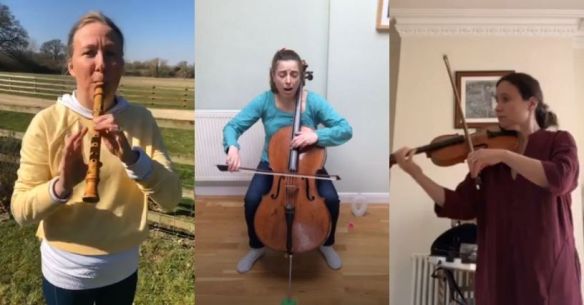
First is a rolling recommendation, for the City of London Sinfonia and their Comfortable Classical at Home series (pictured above). This has been a really excellent series of discovery, catering for all levels of knowledge including beginners, the musically curious and those looking for fresh insight into familiar pieces.

Members of the orchestra are clearly at home in front of the camera, and the next instalments – from principal clarinet Katherine ‘Waffy’ Spencer (Thursday 21 May) and cellist Becky Knight (Tuesday 2 June) are set to be every bit as enjoyable as the series so far – which can be seen on the orchestra’s Facebook channel. It is well worth considering a donation to the orchestra through that page too, recognising the problems musicians are having finding work in lockdown.

Also well worth exploring is Chamber Music Scotland, who are offering a weekly series of streamed concerts and lectures. Future appearances are scheduled from guitarist Sasha Savaloni and a trio of flautist Georgia Browne, violinist Tuomo Suni and harpsichordist Tom Foster.

The next online event from Chamber Music of Scotland is tonight, Wednesday 20 May. It will be presented by cellist David Watkin, who will be looking for meaning from the solo cello works of J.S. Bach in quarantine. Bach’s music is proving particularly popular in lockdown, presumably due to its suitability for one performer, who can take on the rich part writing to sound like several people at once. You can watch this on the organisation’s YouTube channel, where you can also catch up on previous episodes:

Finally a nod in the direction of Sandy Burnett, who is running a summer-long online Listening Club. Every Tuesday at 11am Sandy, a highly respected broadcaster and musician, will offer his own insights into a chosen classical work in his typically engaging and informative style. The next, on Tuesday 26 May, will focus on Bach and his Sonata for Solo Violin in G minor – while future instalments will include works by Weill, Mozart, Monteverdi, Messiaen and Beethoven. You can join the Listening Club here


Switched on – GAS: Oktember (Kompakt)

What’s the story?

This second EP from Wolfgang Voigt‘s GAS project actually dates from 1999, when it was released on Mille Plateaux, but now it has been ‘transferred’ to his home Kompakt label. There are only two tracks but half an hour of music, released in part to offer some comfort in isolation.

What’s the music like?

This is music for mindfulness. Tal 90, the first track, feels like it is played on vinyl, with the reassuring clicks and scratches serving as a background to Voigt’s fuzzy overall sound. His concept is orchestral, with serene violins high in the mix and a soft but majestic line for horn. There are no drums but the music floats in suspension, resulting in a comforting feeling for the listener.

The second track Oktember is much darker and denser, and has an immediately subtle menace to its sound. The steady tread of a four to the floor rhythm underpins thick, brooding chords, which are still strangely comforting despite their straight-faced approach.

Does it all work?

It does. GAS is an incredibly well-revered project and in all recent ambient music it remains one of the most recognisable styles. Time really does stand still when Voigt finds the right level of musical hypnosis, and Oktember finds him towards top form.

Is it recommended?

Yes – and if fans don’t already have it they will want to snap up these two recordings. They work particularly well as early morning or late night balm.

Listen

Buy

Online recommendations – Living Room Live

Today’s nudge in the direction of an online concerts brings us to Living Room Live.

This is an exciting new initiative from a group of musicians keen to make a difference to those in isolation, led by violinist Tamsin Waley-Cohen and her composer sister Freya, together with pianist George Fu, consultant Daniel Ross and viola player Ann Beilby.

Living Room Live started just two months back but is already hosting three concerts a week through Facebook live, each concert starting at 6pm BST.

This week you can catch Zoë Martlew‘s cabaret alter-ego Nefari on Monday 18 May, then up and coming cellist Laura van der Heijden playing Bach‘s wonderful Solo Cello Suite no.4 on Wednesday 20 May. Meanwhile Friday’s concert, from violinist Amalia Hall, will feature the virtuosity of Ysaÿe, channelled through two sonatas for solo violin.

All concerts can be viewed in real time and in catch-up mode through Living Room Live’s Facebook page here

2020 Beethoven – Firing the starting gun

PEANUTS (c) United Feature Syndicate Inc. Drawn by Charles M. Schulz

I’m ready – as I’ll ever be! – to start listening to Beethoven’s music from start to finish.

This is Arcana’s 2020 Beethoven project, where we are taking on the task of listening to everything the composer wrote that exists in recorded form. The object of the exercise has always been to explore the full output of one of my favourite composers, and to share it with you, the reader. It will continue to be that way, with the help of fellow listeners – such as you! – and musicians, too.

If you want to get involved, we’d love you to. All you need to do is send a message to editor@arcana.fm and I’ll send you a Beethoven piece to listen to. You can get to know it and let us know what you think.

I can’t help but feel a bit daunted by this task. So much has been written about Beethoven’s works in the past, more eloquently than I could hope to achieve here. So why another attempt at Everest? The reason is simple – because Beethoven is a favourite composer, a changer of the game in so many different forms of music. In these times especially there is more room than ever for the music that we love. Before we begin, then, here are a few thoughts and a bit of housekeeping for the curious.

The aim – as much as possible – is to listen to Beethoven’s compositions in the order in which they were composed. There is a good deal of confusion around this, as they were not always published in the same order – so there will be moments where we jump about between the numbers of Beethoven’s catalogue in an illogical order. I don’t want to get too bogged down in this area though!

There are also works, such as the Piano Concerto no.2, that Beethoven composed over a number of years. In this case it was between 1788 and 1801 – so we’ll pick it up in 1801, the year it was published.

There are so many available versions of some of Beethoven’s works that we cannot possibly cover them all in this sitting. I will try however to include old and new, modern instruments and ‘historical’ – that is, the instruments and especially pianos that Beethoven might have been more familiar with. We will enjoy a few sidewalks, too – such as Liszt’s transcriptions of the nine symphonies, and a few pop songs based on Beethoven’s music.

There will also – we hope! – be time to appraise Beethoven’s colleagues and contemporaries too – less familiar names like Cramer, Ries, Spohr and Czerny deserve their moments in the sun, as do some of the better-known composers such as Hummel and Weber. This is all to try and give a flavour of the musical climate of the time.

Speaking of climate, some of the pictures used will reflect artists of the time such as Caspar Friedrich – and there will be room to explore the Beethoven cartoons of Charles M. Schulz as well as paintings from Andy Warhol and Gustav Klimt.

This week we will start with the 9 Variations on a March by Dressler for piano, completed by the young composer before his teens in 1782. It will be the start of quite a voyage of discovery!

Ben Hogwood editor, Arcana

Switched on – I Break Horses: Warning (Bella Union)

What’s the story?

It may have been a while since we last heard from Swedish duo I Break Horses, but they have used the time productively, despite several obstacles in their way.

Principle songwriter and singer Maria Lindén was working in cinematic accompaniments to her own favourite films when she realised the instrumentals were well on the way to becoming the basis for a new I Break Horses album.

The band’s plans were thwarted, however, by crashed hardware – two years of work lost – and collaborations that didn’t quite work, meaning Warnings took a while to break cover. It does however include the fruits of Lindén’s film scoring, with three instrumental interludes to complement the broad canvas of the songs.

What’s the music like?

The first since 2014’s well received Chiaroscuro, Warnings is another winner – and draws on the styles used in that long player. The band are at ease working in larger song structures, and as the epic nine-minute opening track Turn unfolds in its deceptively languid triple time there is an exquisite tension between the well-crafted production and Lindén’s glacial vocals.

The musical secret to their success lies in the heart-shifting changes of harmony that plumb the emotional depths. The macabre I’ll Be The Death Of You has these in abundance, despite its premonition, while Baby You Have Travelled For Miles Without Love In Your Eyes also moves in mysterious ways, the slow and stately shifts in harmony matched by a full bodied percussion section. Lindén’s vocals here are a little reminiscent of Lana del Rey, while the production often brings Cocteau Twins to mind – and label mates Beach House, whose producer Chris Coady is utilised here.

Elsewhere the glittering synths and quickfire drums of Neon Lights rush by, in complete contrast to the stately vocals, while Death Engine is a thing of wonder. Again utilising a big drum track, and enough reverb for an aircraft hangar, it has beautiful vocals to fit its grand designs, but moves up a level when a softly undulating riff emerges just over halfway through.

The instrumental interludes are short mood pieces, the last one leading to a similarly short coda, Depression Tourist a block of vocoded thoughts to sign off on.

Does it all work?

Yes. Although I Break Horses have an established way of writing it is very distinctive, so they are far from one-trick ponies. There is a lot of emotion here, too, despite the sometimes deadpan nature of Lindén’s vocals. She holds a note with husky beauty, part of the overall sound which the listener can easily dive into. Final track Depression Tourist feels tagged on, but by then the album has already made its impact.

Is it recommended?

It is. Warnings may be a deeply serious, even moody album – but it is an ultimately uplifting one too. Despite its ominous titles and subject matter the dreamscapes this pair can create leave the listener in elevation.

Listen

Buy