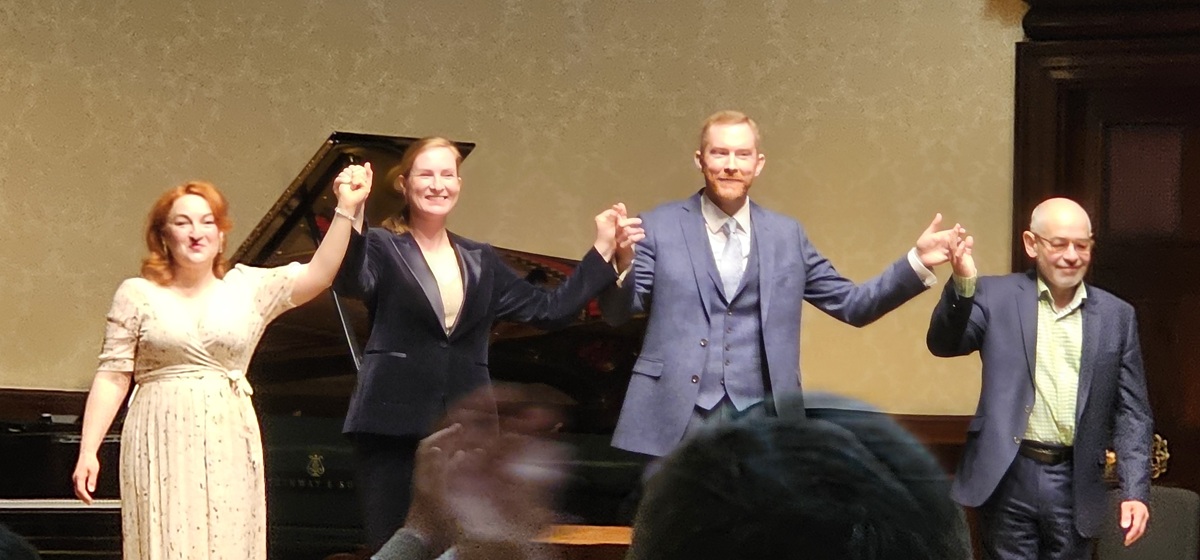
New music – Dudok Quartet: Terra Memoria (Rubicon Classics)

adapted from the press release by Ben Hogwood

TERRA MEMORIA
Kaija Saariaho String Quartet
Shostakovich String Quartet No 3 in F, Op. 73
plus a selection from 24 Preludes Op 34
Rubicon Classics RCD1218  Release date: 31 October 2025

I feel when writing for a string quartet that I’m entering into the intimate core of musical communication.
Kaija Saariaho 

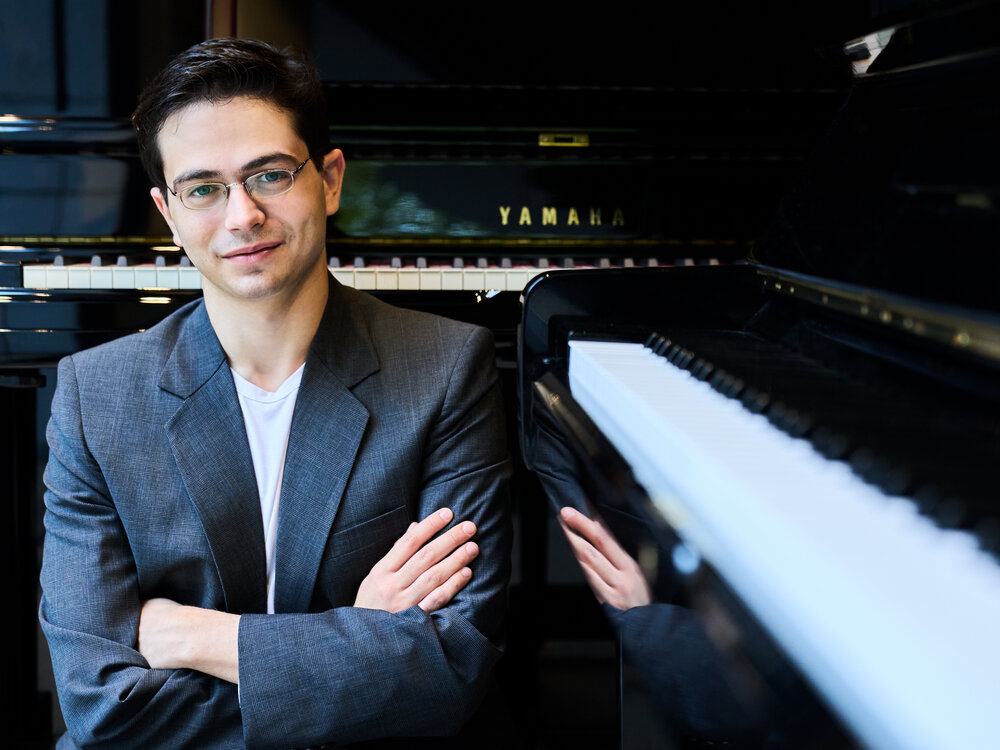
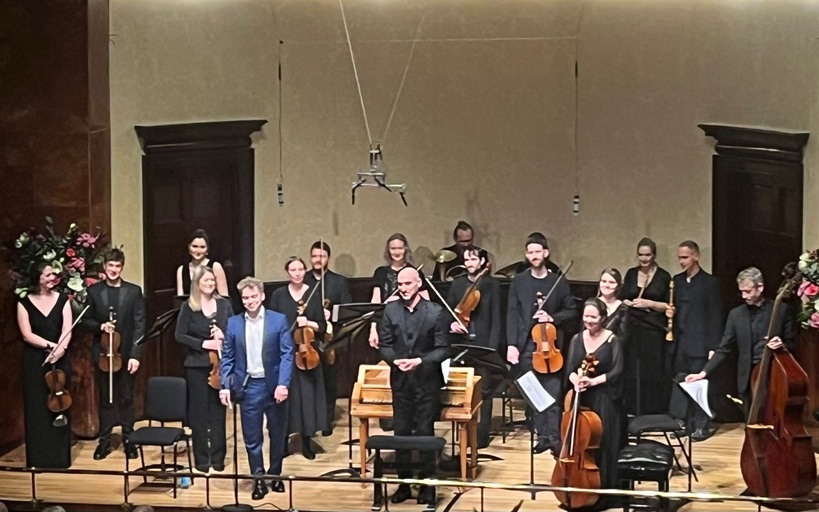
Following two highly acclaimed composer-led volumes of Tchaikovsky’s string quartets last year, Dudok Quartet Amsterdam returns to another of its signature concept albums with a mix of thought-provoking repertoire.  Terra Memoria is the Quartet’s sixth album on the Rubicon Classics label and features Shostakovich’s third string quartet, from 1946, paired with Kaija Saariaho’s second String Quartet Terra Memoria from 2007. It is something of a partner to their 2022 album, Reflections, which paired Shostakovich’s String Quartet No 5 Op 92 with Grażyna Bacewicz’s String Quartet No 4and also featured other of the Quartet’s transcriptions of Shostakovich’s Preludes Op 34.
 
As a result of the Dudok Quartet’s inimitable and deeply inquisitive approach to understanding and expressing what they discover in these scores, they find that although Shostakovich and Saariaho are very different in their compositional approach, the outcome is similar; both possess unmistakeable musical signatures which empower their communication of imagination and emotion to performers and listeners alike.
 
Initially, Shostakovich gave titles to the five movements of his quartet No. 3, referencing a range of feelings and responses to the threat and ultimately the destruction and desolation of war.  If these titles intended any kind of narrative or explanation, the composer gave no reason for soon withdrawing them and, as Dudok violinist Judith van Driel explains, the force of the music cancels out any need for words; “Playing or listening to the third movement [for example] gives an infinitely more accurate meaning, by making adrenaline rush through your body causing your ears to ring from an unrelenting pounding. Its meaning is manifest in your sense of terror, fear and anger, whether or not you have ever experienced war up close.”
 
Throughout the quartet Shostakovich uses various compositional techniques to provoke immediate and reactive personal responses that are sometimes ambiguous and sometimes at odds – yet co-existing with each other. From the pastoral opening to the meandering melody searching for meaning in the fifth movement, it is the music that elicits inexplicable – in the most literal sense – and instinctive feelings.
 
Saariaho expressed a love for the richness and sensitivity of the string quartet sound, although she only composed two works in the genre. The second, Terra Memoria, captivated the Dudoks from the outset when they worked on it with her in 2011 (they were enchanted further by her music when they  collaborated in the world premiere of her penultimate opera, Only the Sound Remains, in 2016). Saariaho references the work as being ‘for those departed’, those whose lives are over, with nothing to be added, while those left behind are haunted by dreams and memories and find that the shape of remembrance can change as time passes.
 
But this explanation is only a starting point for the listener or player to make personal associations through experience of the composer’s sound world. Familiarising itself with her unique musical vocabulary was an absorbing and rewarding journey for the Dudok Quartet as they encountered a variety of unusual playing techniques and inventive musical mutations that include experimental threads of electronic music, minimalist-type repetition and operatic styles. For them, Saariaho’s music evokes a kind of intermediate zone between the known and the unknown, the living and the dead.
 
The Dudok Quartet is also known for its own transcriptions of works not originally composed for string quartet and rounds off the album with a selection from Shostakovich’s Preludes Op. 34 written for piano, all of them tiny gems which elicit personal stories and associations in the listener and player.

We aim to show that music affects people; that music can lead us to profundity and connection especially when it provokes friction. The true meaning of music reveals itself in a shared experience in which you, as a listener, play a vital role.
Dudok Quartet Amsterdam
 
The Dudok regularly performs in the UK and will feature Saariaho’s Terra Memoria in recital with Schubert’s Death and the Maiden in Portsmouth, Sheffield, Macclesfield and Hastings in November 2025, and Shostakovich’s String Quartet No 3 on tour in early 2026 – to the US in January and Scotland in February. Click here for further information.
 
Terra Memoria
Dudok Quartet Amsterdam 
Rubicon Classics RCD1218   Release date: 31 October 2025
 
Dmitri Shostakovich – String Quartet No. 3 in F, Op. 73 (1946)
I. Allegretto
II. Moderato con moto
III. Allegro non troppo
IV. Adagio (attacca)
V. Moderato
 
Kaija Saariaho – Terra Memoria (2007) for String Quartet
Shostakovich – 24 Preludes, Op. 34
No. 1 in C major – Moderato
No. 2 in A minor – Allegretto
No. 4 in E minor – Moderato
No. 6 in B minor – Allegretto
No. 12 in G sharp minor – Allegro non troppo
No. 22 in G minor – Adagio
 
DUDOK QUARTET AMSTERDAM 
dudokquartet.com

Published post no.2,668 – Thursday 25 September 2025

On Record – Baxter Dury: Allbarone (Heavenly Recordings)

by Ben Hogwood

What’s the story?

Baxter Dury appears to be in an imperial phase of his artist development. Each album has presented vivid portraits or stories in his own very distinctive, and very direct voice, capturing nuggets of English and international life – and snippets from life on the road or in the studio.

Allbarone can sound like an exotic destination – Mexico, perhaps – or a chain of bars in the UK, depending on how you pronounce it! The double meaning appears to be intentional, as it also frames the humour Dury brings to his work, not to mention the music.

What’s the music like?

For this album at least, Dury is a fully fledged dance music artist – and he goes for the jugular with a set of powerful grooves that have hard hitting vocals to boot. Some – Schadenfreude, or Return Of The Sharp Heads, for instance – hit particularly hard, the former with a brilliant, brooding groove and a nugget of storytelling, the latter with hilarious consequences of bad language as Dury and guest vocalist JGrrey take down the Shoreditch loafers.

Paul Epworth is a great choice of producer, the foil to Dury’s humour, which ranges from scathing to lightly scabrous – and is compelling to a fault.

Other highlights include the vibrant Mockingjay, Kubla Khan, the prowling beats of Hapsburg and the winsome portrait Mr W4.

Does it all work?

It does. Dury doesn’t hang around, the album over in a flash, but its high points are many and the music is a winning mixture of euphoric and slightly manic.

Is it recommended?

It certainly is. Allbarone is a triumph of plain speaking, both lyrically and musically. Safe to say that Dury has long shaken off the ‘son of Ian’ label, for his own personality is incredibly charismatic, his voice consistently compelling. As a result, the music punches with impressive weight, a remedy for our times.

For fans of… The Streets, Audio Bullys, BC Camplight, Underworld

Listen / Buy

Published post no.2,667 – Wednesday 24 September 2025

On Record – Saint Etienne: International (Heavenly Recordings)

by Ben Hogwood

What’s the story?

After 35 years as a successful pop trio, Saint EtienneSarah Cracknell, Bob Stanley and Pete Wiggs – are finally calling time on their career as a group.

International is the last of their thirteen studio albums, and also the most collaborative, with spots for Tom Rowlands of The Chemical Brothers, Confidence Man, Vince Clarke, Paul Hartnoll, and – strikingly – Nick Heyward.

What’s the music like?

Late summer is the perfect time to be releasing an album like this. Perhaps inevitably there is a rich element of nostalgia, but there is no sitting on laurels or wallowing in sadness – though it has to be said the final few tracks leave a tear in the eye.

Rather, it is more of the same – slightly arty pop but with really rewarding diversions in league with the guests. The breezy Brand New Me, with Confidence Man, is a treat, Cracknell at her most winsome in the vocal. Glad is of a similar vintage, pointing towards the club in Tom Rowlands’ production. Already at the venue are Paul Hartnoll and Vince Clarke, with the former’s work on Take Me To The Pilot creating visions of a 1990s basement. Clarke’s work on Two Lovers is more reflective, but again ideally suited to Cracknell’s versatile voice, which has many more tones than we often give it credit for.

The Nick Heyward collaboration Gobetweens is a lyrical and musical treat, rhyming ‘Letraset’ with ‘internet’ to emphasise the contrast between the late 1980s of the band’s forming and the technology now. Facebook also falls under the microscope, a subtly dismissive take in the closing The Last Time. This is where everything comes to a head and a tear comes to the eye, Saint Etienne’s final statement leaving us all a bit emotional.

Does it all work?

It does – for one last time. This is a winsome collection, the band playing to their strengths, and clearly having fun right up to the end.

Is it recommended?

It is essential for Saint Etienne devotees to have the band’s final album as a keepsake; all the more so when it is revealed to be an ideal summing up of their achievements. Equal parts tenderness and attitude, it does exactly what they promised, delivering bittersweet pop winners that cover nostalgia and the future with panache. A wholly appropriate signing-off.

For fans of… Goldfrapp, Happy Mondays, The Cardigans, Divine Comedy

Listen / Buy

Published post no.2,666 – Tuesday 23 September 2025

On Record – MahlerFest XXXVII: Kenneth Woods conducts Richard Strauss: Eine Alpensinfonie

Colorado MahlerFest Orchestra / Kenneth Woods

Richard Strauss Eine Alpensinfonie Op.64 (1911-15)

Colorado MahlerFest 195269359249 [49’47”]
Producer Jonathan Galle Engineer Tim Burton
Live performance at Macky Auditorium, Boulder, Colorado, 18 May 2024

Reviewed by Richard Whitehouse

What’s the story?

With its underlying concept that of Mahler and the Mountains, this 37th edition of Colorado MahlerFest was probably the most ambitious yet. As was reflected in those works featured at its main orchestral concerts, and not least this performance of Richard Strauss’s An Alpine Symphony.

What’s the music like?

This being its composer’s final large-scale orchestral piece is not fortuitous, as it concludes a sequence of symphonic works stretching back some 35 years to his Symphony in D minor. Strauss may subsequently have abandoned the symphony for the tone poem, but these latter became increasingly symphonic in formal scope or expressive density with the present work bringing full circle a process as could hardly be resumed given the tonal retrenchment of his idiom henceforth. An Alpine Symphony represents an impressive and a defining culmination.

Although it nominally outlines a day’s ascent then descent in the Bavarian Alps (actually the Heimgarten), this work is equally the ‘journey of a life’ duly articulated through an extended sonata-form design. It is this latter aspect which emerges at the forefront of Kenneth Woods’ interpretation – one which unfolds cohesively and, most important of all, organically out of then back to its evoking of Night. The crescendo of activity through to Sunrise then The Ascent is keenly maintained, with those expository episodes that follow not lacking scenic immediacy or formal impetus. Neither is the ensuing developmental sequence underplayed on route to the emotional crux of On the Summit then Vision: music, it might be added, whose grandiloquent expression is shot through with a knowledge of its imminent demise.

What goes up must inevitably come down: the transition into the reprise is finely handled in terms of its encroaching Elegy, though momentum does falter slightly in the recapitulatory phase of Storm and Descent. Not that the Colorado MahlerFest Orchestra is found wanting as regards its commitment; more likely, the clear if somewhat confined acoustic of Boulder’s Macky Auditorium is not able to encompass the sheer volume of sound effected in this phase. Woods nevertheless heads into Sunset with requisite poise and if the coda that is Ausklang – a term more or less untranslatable but which approximates to ‘catharsis’ – is just a little too passive, its rapt recollections of Wagner and Mahler are eloquently inferred. As is the return to Night, audibly linking into that from the opening for what becomes an indissoluble unity.

Does it all work?

Pretty much throughout. Once a piece reserved for special occasions, An Alpine Symphony is now among the most often recorded of Strauss’s orchestral works but while this performance cedes to others in terms of tonal opulence and visceral impact, it has relatively few peers as regards its symphonic credentials. A pity, incidentally, the performance of Schubert’s Death and the Maiden quartet from the first half, which Woods has elaborated from Mahler’s often sketchy arrangement for strings, could not have been included as to make this a two-disc set.

Is it recommended?

It is. The CD comes with a full listing of personnel on its rear inlay, and you can scan the QR code or click here for Kelly Dean Hansen’s detailed notes. Mahler’s Fourth Symphony from this edition will be issued separately.

Listen / Buy

For further purchase options, visit the MahlerFest website – and for more information on the festival itself, click here. Click on the name for further information on conductor Kenneth Woods

Published post no.2,665 – Monday 22 September 2025

In concert – BBC Singers / Martyn Brabbins @ St Paul’s Knightsbridge – Holst, Britten, Garrard, Elgar & Pickard

BBC Singers, Elizabeth Bass (harp), Richard Pearce (piano), Andrew Barclay (percussion) / Martyn Brabbins

Holst Choral Hymns from the Rig Veda – Group 3, H90 (1910)
Britten The Ballad of Little Musgrave and Lady Barnard (1943)
Garrard Missa Brevis (2017-18)
Elgar Five Part-Songs from the Greek Anthology Op.45 (1902)
Pickard Elemental (2024-25) (BBC commission: World premiere)

St Paul’s, Knightsbridge, London
Friday 19 September 2025

Reviewed by Richard Whitehouse

The upsurge of interest in and performances by the BBC Singers in the wake of its intended demise shows little sign of abating, and there could be few vocal ensembles able to put on a programme as stylistically inclusive or as technically demanding as that heard this afternoon.

Nowhere more so than Elemental by John Pickard, its first performance occupying the second half. Never absent from the composer’s output, choral music came into own with the powerful Mass in Troubles Times (premiered nearby at St Peter’s, Eaton Square in 2019) and the present work can be heard as a continuation in terms of its underlying concept. A further collaboration with author and theologian Gavin D’Costa, its form is of a journey through the elements such as Pickard had favoured earlier in his output but here with its emphasis firmly on the spiritual arising out of human concerns. Whether individually or collectively, the writing for 18 voices could hardly be more varied and imaginative, while the obbligato roles for harp plus a single percussionist playing across the spectrum of instruments enhances these settings accordingly.

After the evocative Prologue with its Paracelsian take on living matter, Earth draws on the recollections of those in the Tham Luang Cave Rescue – notably teenagers of the Wild Boars football team – in music whose initial bravado gradually assumes a near metaphysical import. Fire integrates its Shakespeare quotations into consideration of this most transformative and cathartic of elements. Air centres on Bessie Coleman with her ambition, racially rather than personally motivated, to become the first professional pilot from African-American ancestry – her combative and ultimately ill-fated career depicted with often graphic immediacy. Water then illustrates the Biblical flood narrative from an oblique and even ambivalent perspective, before Epilogue returns to evocation of the numinous as it builds with a frisson of emotion.

Not that the first half was any mere preparation. Most intimate and alluring of four such sets, the third group of Holst’s Choral Hymns from the Rig Veda traverses the ethereal, the limpid, the hieratic then the questing in the company of female voices and harp. The former were no less attuned to the greater astringency of Sara Garrard’s Missa Brevis – its bracing inclusion of traditional Estonian music offset by the greater introspection elsewhere; these contrasted aspects finding at least a degree of release with the emotional immediacy of the Agnus Dei.

Heard in alternation, the male voices duly came into their own with Britten’s The Ballad of Little Musgrave and Lady Barnard – its folk melody (Matty Groves) stretched through this plangent wartime setting with piano of illicit love, innocent betrayal, desperate revenge and stark lament. Facets that barely feature in Elgar’s Five Part-Songs from the Greek Anthology yet these brief if characterful treatments of translations by Alma Strettell, no less typical than his major choral and orchestral works from this period, were dispatched here with due relish.

Whatever else, this showcase with substance was conducted with unfailing insight by Martyn Brabbins, whose prowess in choral repertoire needs hardly more reiterating than his advocacy of Pickard, and is absolutely worth hearing when broadcast by BBC Radio 3 this Wednesday.

You can hear the BBC Radio 3 broadcast on Wednesday 24 September by clicking here

For more information on the artists, click on the names: BBC Singers, Martyn Brabbins, Elizabeth Bass, Richard Pearce and Andrew Barclay, and composers John Pickard and Sara Garrard

Published post no.2,664 – Sunday 21 September 2025