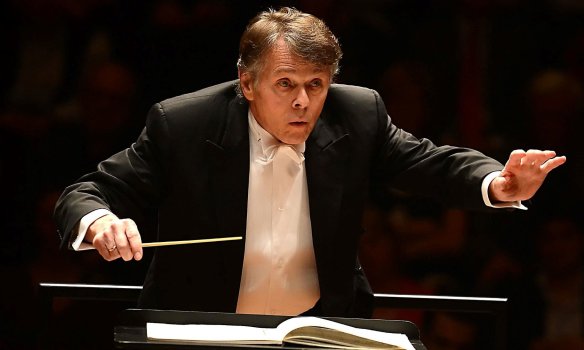
Like many lovers of classical music, Arcana was sad to learn of the death of Latvian-Russian conductor Mariss Jansons last weekend, at the age of 76.
Jansons was a great conductor, and I was fortunate enough to see him in a number of concerts. Particularly memorable was a Prom with the Royal Concertgebouw Orchestra in Lutosławski‘s ConcertoforOrchestra and Brahms‘ Symphonyno.1 – and several years later another outing at the Royal Albert Hall with the Bavarian Radio Symphony Orchestra in RichardStrauss‘s Also Sprach Zarathustra and Sibelius‘ Symphony no.2.
Jansons leaves an extremely strong and varied recorded legacy, from which the playlist below draws a few excerpts. The Lutosławski is included, along with two excellent recordings he made when chief conductor of the Oslo Philharmonic Orchestra, Honegger‘s Symphony no.3 and Tchaikovsky‘s Symphony no.1 (Winter Daydreams).
However a personal favourite, and one I reviewed for Arcana, was his stellar recording of Tchaikovsky‘s Queen of Spades opera, a superb and dramatic account:
These are just hints of what Jansons could do – but show him on his best form. He will be greatly missed.
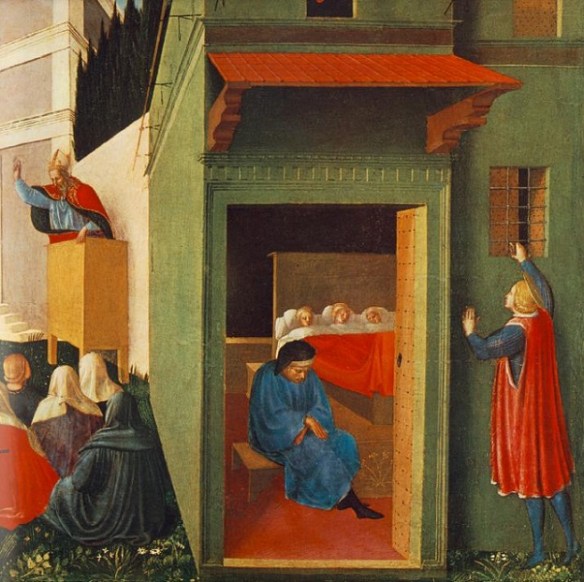
Today is a celebration of the feast of St Nicholas, the early Christian bishop who died on this day all the way back in the year 343. Nicholas is the model for the modern Santa Claus / Father Christmas, but he is also the inspiration behind a major piece of classical music, completed by Benjamin Britten in 1948.
Arcana’s sister site, Good Morning Britten, has this to say about the cantata:
St Nicolas is scored for tenor solo, chorus, semi-chorus, four boy singers and string orchestra, piano duet, percussion and organ. It was written to text by Eric Crozier, for performance at the centenary celebrations of Lancing College, Sussex, on 24 July 1948.
Background and Critical Reception
Britten’s honouring of the Christmas saint was timed for the centenary of Peter Pears’ old school, Lancing College in Sussex. Yet Saint Nicolas did not receive his first performance there – in fact it opened the very first Aldeburgh Festival in June 1948. Critics were requested not to write about the piece until its primary function at the school had been performed. The highly acclaimed libretto is from Eric Crozier, with whom Britten wrote Albert Herring.
Donald Mitchell, in his biography of the composer, observes that ‘for a year his music continued in the blithe spirit that Albert Herring had engendered’. He also notes how the work combines professional and amateur, Britten seeking not to exclude anybody on the grounds of musical talent. ‘There are testing but rewarding parts for the amateur singers and instrumentalists; congregational hymns, and one of the catchiest of his tunes for The Birth of Nicolas.’
This gives the strong sense Britten was writing for all ages and beliefs, and is reinforced by Stephen Arthur Allen. Writing in The Cambridge Companion to Benjamin Britten, he declares it as ‘not purely a work for religious digest’. Furthermore, ‘A duality of narrative may be perceived through the dilemma between Nicolas’s public and private world:
“Our eyes are blinded by the holiness you bear,
The bishop’s robe, the mitre and the cross of gold.
Obscure the simple man within the Saint.
Strip off your glory, Nicolas, Nicolas, and speak! Speak!”
He warms to his theme. ‘The transparent nescience of The Birth of Nicolas is reinforced by its A major setting. The presence of the tritone, governing the stepwise movement of the sequence in each phrase, demonstrates that Britten is able to write music that children can engage with and sing easily, while embodying sophisticated intervals and a symbolic dimension that offsets generic expectations otherwise associated with such material.’
After that, perhaps the words of Michael Kennedy are key: ‘There is little need to examine this cantata in detail; it is best experienced whole and without analytical preparation.’
Thoughts
The advice from Michael Kennedy to refrain from analysing Saint Nicolas too much is sound indeed, for this is a dramatic piece that works best taken on face value.
Once again it is possible to witness Britten’s ability to write dramatic sacred music, and as in The Company of Heaven he bolsters that with sympathetically set hymn tunes. There is a strong sense of progression through the life of Saint Nicolas, too, and at his birth he gets a really catchy tune, written for the boys’ choir in a joyous A major. As he journeys to Palestine Britten colours his relatively small orchestral forces with a glassy, oscillating line for the two pianos and wispy held strings.
Meanwhile the tenor soloist – Pears, of course – gets frequent opportunities to exploit his talent for legato singing, with some extremely lyrical writing that would seem to me to have a strong Italianate flavour, that of Verdi perhaps.
The hymn quotations invite the involvement of a congregation, another element in common with The Company of Heaven. However Britten cannot resist the odd piece of harmonic mischief, and All People That on Earth do dwell, so beloved of Vaughan Williams, gets some unexpected minor chords. I couldn’t help but think that was a deliberate thumbing of the nose!
There is, however, a certain amount of homage being paid here, deliberate or otherwise. I was sure in places I could detect hints of Elgar’s The Dream of Gerontius – especially in the way the two works end, alike in key in harmony, while there are passing elements of Handel and Bach, via Mendelssohn.
Once again Britten uses the performing spaces to his advantage, positioning the children’s choir a distance away from the main action. This is especially effective after the swell of the choir towards the end of His piety and marvellous works, which cuts to the trebles singing ‘Alleluia’ in the distance. It is a magical moment.
Equally fine are the climactic closing pages, the death of the saint marked by the singing of the Nunc Dimittis chant, Lord, now lettest Thou Thy servant depart in piece, which seals the deal on a very fine and enjoyable work.
Watch and listen
Below you can hear the late Sir Stephen Cleobury talking about the work, and how he went about the 2013 album he made with King’s College Cambridge Choir to mark Britten’s centenary:
On the Spotify link below you can listen to the album Cleobury conducted, which also includes the unaccompanied choral masterpiece Hymn to Saint Cecilia and the celebratory anthem Rejoice in the Lamb, again under the direction of Cleobury.
It gives us great pleasure to welcome Courier Sounds to Arcana’s steadily growing playlist section.
Courier Sounds, whose Silhouette Cameo 3 LP was released in October, also did a mix to celebrate their ninth year as a label. It’s compiled by Stuart Bowditch who has previously contributed to the Essex Sound and Video Archive (which can be found here, The British Library, Cities and Memory and The Field Recording Archive.
Begins with the space-style intercom of Eumig’s The Cassegrain but soon broadens out into the sonorous, held notes of Lunar’s Oscillate that waver very slightly – and very pleasantly – in pitch. Lachrylic’s Ellipse is more noise based, with sharp tones that have a sinister undertone, but Bowditch flips the switch, changing the outlook dramatically with ambient but penetrating midrange tones.
I won’t tell you what happens from there on, but safe to say this is a mix that evolves like one continuous note, changing its sonorities in really interesting ways throughout. An intense form of ambience, which really focuses the mind.
The tracklisting is:
Eumig – The Cassegrain
Hybernation – Ptolemy Cluster
Lunar – Oscillate
Lachrylic – Ellipse
Bowditch & Kipps – Proscenium
Silences – (Everyone) Turns To The Wall
Viridian – Cathedral Speech
Belly Full Of Stars – skipandwow
Bowditch – Being
Isnaj Dui – Sunspot Loop 4
Furrows – The Disappearance Of The Things We Loved
Gagarin – Holmbury Hillfort
Wil Bolton – Anguk
((((((PALINDROMES)))))) – Shy
Eumig – F = 2.0 x
Sonicslice – HR2491
Eumig – Eugon A
Diacritical Mark – Lozenge
Graham Dunning – Bulkhead
Rainbow Valley – First Light
Alien – Perimeter (Live 28/11/2017)
Bowditch – Saturday
Baek Afturundirgero Blak Alvarann; Bohmerlands Dronning Debess Variations Rasmussen Echoes of the Past
TUTL FHR90 [52’25”]
Producer Rupert Marshall-Luck
Engineer Theodor Kapnas
Recorded 2-3 April 2019
Written by Richard Whitehouse
What’s the story?
The violinist Rupert Marshall-Luck takes time out from his extensive commitment to British music (and no less extensive schedule for the EM Records label) for this revealing collection of unaccompanied pieces by composers who were born or are resident in the Faroe Islands.
What’s the music like?
Although a self-governing region of Denmark across more than seven decades, classical or art music was slow in taking root in the Faroes, its music-making almost entirely vocal until the 1960s. As with its northerly neighbour Iceland, the creative scene has subsequently been transformed to the extent that these islands currently enjoy a profile out of all proportion to their population in terms of its range and diversity. Soul may only scratch the surface of this musical wealth, but it also underlines the potential of what might appear a restricted medium.
This disc sets off unequivocally with Echoes of the Past by Sunleif Rasmussen (b1961), an eventful sequence of episodes such as makes full use of the violin’s potential for heightened expression and meaningful display; all the while given focus by a trajectory as unfolds from combative unease towards a searching if tenuous repose. Quite a contrast with Variations for Solo Violin by Edvard Nyholm Debess (b1960), its traditional Faroese hymn-tune providing the basis for six variations which draw on a range of textural and emotional shading, without losing sight of the intrinsic character of the theme before its affecting return. More discursive in its content is Afturundirgero by Kari Baek (b1950), evoking a seascape in which turbulent cross-currents are vividly conveyed through harmonic clashes by turns soulful and astringent.
The remaining two pieces are both by Kristian Black (b1947), born in Denmark but resident over many years in Torshavn where he has been a prime mover in the emergence as well as dissemination of Faroese classical music – not least via his enterprising label TUTL Records. Inspired by a ballad about the Danish queen, Bohmerlands Dronning unfolds as a rhapsody in which various aspects of the ballad can be heard to permeate the content and influence the direction of what is eloquent and ultimately fatalistic music. Blak’s Alvarann also takes its cue from a Faroese ballad, though here progress is audibly more quixotic as the violin charts a course from subdued anticipation, via the steady accumulation of energy, to an impetuous culmination whose unbridled virtuosity leaves no mean drama and even anguish in its wake.
Does it all work?
Yes, not least in that these five pieces amount to a programme the sum of which is greater than its parts and which – given the relatively short playing-time – is best experienced as a whole. A tribute, then, to the resourcefulness of the composers as well as to Marshall-Luck, who renders each work with that combination of interpretative insight and technical finesse familiar from his performances and recordings of British music. More pieces for violin solo, or with piano accompaniment, would be worth encountering – maybe as a follow-up disc?
Is it recommended?
Indeed. The Faroes are a nexus of creativity within the European cultural framework, as this disc makes plain.
Readers can check out the Summartonar Festival of Contemporary Music here, and the TUTL website by clicking here
Stream
Buy
For more information on Rupert Marshall-Luck and on this release, visit his artist website
Pavel Kolesnikov and Samson Tsoy (pianos), Colin Currie and Sam Walton (percussion) (pictured above in rehearsal, credit unknown)
Wigmore Hall, Monday 2 December 2019 (lunchtime)
You can listen to this concert on the BBC Sounds app here (opens in a new window)
Review and guide by Ben Hogwood
A truly memorable concert with many more instruments than performers! The Wigmore Hall stage was straining at the seams for this concert, with a daunting battery of percussion positioned behind two lidless Steinway pianos.
As BBC Radio 3 presenter Fiona Talkington confirmed, the two pianists and their percussion counterparts had only met the previous week. This is where music making can be so thrilling, for chemistry had been established and all four performers clearly enjoyed the concert experience.
That much was clear from the first, atmospheric notes of Ravel’s Rapsodie espagnole, given in an arrangement that seems to have been the composer’s own, retaining percussion parts from the orchestral original. The Prélude à la nuit (1:49 on the broadcast link below) immediately evokes the heady Mediterranean scene, laced with a background tension that was occasionally released in faster music, thrumming like an ensemble of guitars. Ravel’s orchestral concepts are easily discerned here, with the players very closely attuned. The Malagueña (6:02) is suitably enchanting, while the Habanera (8:05), with lovely detail on castanets and xylophone, wears its Carmen influences on its sleeve. Finally the dazzling Feria (10:52), brilliantly performed, wraps up our colourful Spanish sojourn with a flourish.
The percussionists then had a break while Pavel Kolesnikov and Samson Tsoy gave us a rarity in the form of Britten’s Two Lullabies. Written for a concert with South African pianist Adolph Hallis, they are barely known – but carry a number of the 22-year old composer’s musical trademarks. The first lullaby is as you would expect, gently rocking like a boat as the listener’s head nods towards sleep (19:07) but the second, Lullaby for a retired colonel (23:20), is an ‘anti-lullaby’, seemingly written to annoy its subject into wakefulness with renditions of The British Grenadiers, Men of Harlech, the Marseillaise and the Last Post. This performance caught the gracefulness and cheek respectively.
The main act, if you like, was an extraordinary performance of an extraordinary piece. Even now, 82 years on from its Swiss premiere, there are few pieces as original as Bartók’s Sonata for two pianos and percussion, one of the standout pieces of 20th century repertoire but one of the least performed in that class, due to its unusual scoring.
This performance gave us the chance to appreciate Bartók’s unique sound world, from unhinged Allegros to daringly slow night music where nobody dare move a sinew. It begins in the depths (28:10) with the ominous rumbling of timpani and cold piano octaves. This is the small cell from which the piece grows, angular lines on the piano complemented by strident timpani. As always in Bartók the music is incredibly atmospheric, and when it breaks out into the faster music (from 31:30) an almost primal energy is released. Terrific playing from all four, who had only started playing this music together the previous week – with a stunning ending in pure C major.
The second music (42:13) is a classic example of Bartók’s night music. The brushes on the snare drum bring the cooler evening air into sharp focus, with an even colder unison on piano in response. This performance brings out these incredibly descriptive aspects of the writing, each detail carefully observed and pointed until – as in many slow movements from the Hungarian composer – the ground suddenly falls away and the music tears off at a pace. Soon enough a peace of sorts is restored, though again there is an eye left open just in case.
The third and final movement is the sound of unbridled joy, heralded by a rapid shift to C major and a terrific burst of energy. The xylophone (Sam Walton in this performance) has terrific clarity in its theme, which has sardonic overtones Shostakovich would have enjoyed, while the interplay between the pianos is superbly balanced. The percussion includes a driving part for both bass drum and timpani, where Bartók uses glissando to create an evocative twang, often in quieter passages. These were superbly judged by Colin Currie. The piece ends in unexpected quiet, the purity of C major ensuring it has the ideal place to rest after considerable exertions.
A truly great performance, this, one borne of musical instinct and chemistry that found all four performers going hell for leather in the quick music but exercising the utmost restraint to bring Bartók’s vivid colours through when all was quiet. Make sure you listen to it!
Repertoire
This concert contained the following music (with timings on the BBC Sounds broadcast in brackets):
Ravel Rapsodie espagnole (1907-8) (1:49) Britten Two Lullabies (1936) (19:07) Bartók Sonata for two pianos and percussion (1937)
Further listening
The music from this concert can be heard in leading available versions on Spotify below:
Colin Currie and Sam Walton have recorded the Bartók previously, with pianists Cédric Tiberghien and François-Frédéric Guy. Details on that recording can be found together with soundbites at the Hyperionwebsite:
Bartók wrote three pieces for Paul Sacher while in Switzerland – the Sonata as heard here, the remarkable Music for Strings Percussion and Celesta and the more rustic, folksy Divertimento for string orchestra. Both those pieces can be heard below as part of an album from Ádám Fischer and the Hungarian State Symphony Orchestra, which also includes the ballet suite from The Wooden Prince:




 Arcana.fm