Let’s Dance – Mike Dunn: My House From All Angles (Classic)

reviewed by Ben Hogwood

What’s the story?

Mike Dunn is a highly respected name in house music. The Chicago figurehead is already responsible for original house classics God Made Me Phunky, Face The Nation and Let It Be House, but as his many and varied pseudonyms indicate he is capable of an extremely versatile approach to house music.

The title of his first album since 1990 recognises that, the fourteen tracks including solo instrumentals and a few guest slots. My House From All Angles has been out since the summer, but Arcana wanted to recognise its existence and worth!

What’s the music like?

If someone asks you to play them some classic house music, Mike Dunn will never let you down. Because of the rich heritage he has in Chicago, he is capable of making music that recognises how house music sounded at the beginning, but brings it up to date in execution and variety.

He also has at his disposal another weapon – his voice. You don’t forget the Dunn tones in a hurry, his smoother than silk lower range used to cheeky effect on tracks like Phreaky MF or on the top notch track Move It Or Work It.

Classic house is not the only order of the day either. Modulation gets closer to techno, a brilliant instrumental whose closest cousin could be Kerri Chandler’s Bar A Thym. On the other side, The Wake Up Call, featuring Deejay Alicia, is darkly lit – as is You R, an acid tinged celebration.

Does it all work?

Yes. Dunn’s experience works so well here – he knows how to make a great house track but also the elements that keep it sounding fresh. That means that nothing is over-produced, nothing is too calculated – and that leaves room for a bit of instinct and a chance to tap into the party vibe, which after all is where house music works at its very best.

Is it recommended?

Yes. Mike Dunn is still full of ideas, and each of these tracks brims with creativity and a wish to have a good time. My House From All Angles is a show home definitely worth buying.

Stream

Buy

Switched On – BUNKR: The Initiation Well (VLSI)

reviewed by Ben Hogwood

What’s the story?

BUNKR is the operating name by which Brighton’s James Dean operates. Before we even hear his music a strong impression is created by the bold cover, which promises discovery, scope and bright light amid dark clouds, not to mention a hint of danger.

The Initiation Well, as Dean puts it, ‘provides the listener with an intrepid exploration of the BUNKR sound world. It’s melodic, pretty atmospheric and a little bit woozy’.

What’s the music like?

As BUNKR describes. Headphones are the best means of discovery here, allowing the listener to take in the widescreen sonic views BUNKR creates on substantial tracks like Docking Procedure, The Initiation Well and Rheasvilian Lakes.

East Of Eden would seem to represent the star at the centre of the album cover. Try listening as the sun comes up and you are in for a magical experience, as it also acts as an upbeat for the kick drum of Docking Procedure, where a lumbering groove and slightly cosmic treble work really well together, and the layers of different textures and loops build up beautifully.

Left For Dust picks up speed and adds a lovely fuzzy bass to go with its busy drum track, and then Rheasvilian Lakes is a lovely floaty number, stretched out as our view disappears into the distance.

Does it all work?

Yes – the tracks work individually but the album works even better as a whole. If anything James Dean’s work here could be compared to that of his label heads, Echaskech – finely crafted pictures where the imagination is left open, though his beats are a little more dub-weighted and a bit slower.

Is it recommended?

Absolutely. This is a versatile album that works on the morning commute and during work but also as a body of work to admire and – in the faster tracks – throw a shape or two. The Initiation Well is an intriguing title that draws you in – and once initiated you’ll want to be submerged again!

Stream

Buy

Wigmore Mondays – Boris Giltburg plays Rachmaninov Preludes

Boris Giltburg (piano, below)

Wigmore Hall, Monday 30 September 2019 (lunchtime)

You can listen to this concert on the BBC Sounds app here

Review and guide by Ben Hogwood

When Bach finished the first set of his celebrated Well-Tempered Clavier in 1722, he set in motion an approach to writing for the keyboard that has captured the imagination of several other composers through the centuries, writing a prelude and / or a fugue in each of the 24 keys and having them performed as a collection.

Sergei Rachmaninov was one of those composers so influenced, though he didn’t approach it as a collection initially. In fact he began with just one piece, the Prelude in C sharp minor, which sat in the middle of the 5 Morçeaux de Fantaisie for piano when published in 1892. With the composer still in his late teens, this Prelude shot him to stardom – and so he was only too happy to revisit the form with another 23 pieces, delivered in two installments in the years 1903 and 1910.

The prelude became one of Rachmaninov’s primary methods of expression in his solo piano music, and the pieces are much loved. Boris Giltburg’s selection here did not however include the two most famous examples – the C sharp minor piece, nor the famous G minor prelude from the Op.23 set, Boris Giltburg preferring instead to show that the other 22 are absolutely not to be overlooked! From these he picked a selection of 14, arranged chronologically but also logically in their key groups.

Rachmaninov’s writing for piano is almost instantly recognisable, and only a few seconds of the Prelude in B flat major Op.23/2 (1:27) are needed to confirm his authorship. The ready and natural flow of notes, the power of the right hand, working in octaves on this occasion, and an outpouring of passion. Giltburg kept a fine measure of expression and control.

He complemented this heady start with the soft yet ardent Prelude in D major Op.23/4, and then another stream of consciousness from the Prelude in C minor Op.23/7, carrying all before it to an emphatic end. Giltburg’s phrasing was ideal here, knowing when to ‘breathe’ in the longer phrases.

The Prelude in A flat major Op.23/8 shows something of the influence of Chopin, and this one too flowed nicely under Giltburg’s direction. Shifting the base to the Prelude in E flat minor Op.23/9 brought a more worrisome outlook, the right hand more agitated and becoming relatively sombre in its closing statement. The last of this set, the Prelude in G flat major Op.23/10, negotiated calmer waters, Giltburg lost in thought and the music.

The Op.32 selection begins in the ‘purest’ key, C major, so named as all its notes are the white keys on the piano – yet from Rachmaninov this is his shortest prelude, powered here by Giltburg’s weighty left hand opening. It formed a nice gateway to the Prelude in B flat minor Op.32/2, from which we were led to the heroic Prelude in E minor, the fourth in the set. This was brilliantly characterised and paced by Giltburg, a darkly dramatic performance.

The serenity of the Prelude in G major Op.23/5 was beautifully observed, as was the stark contrast to the following Prelude in F minor Op.32/6, which erupted out of the blocks. Most impressive of all, perhaps, was the substantial Prelude in B minor Op.32/10, a response to Arnold Böcklin’s painting Die Heimkehr (The Homecoming, above), a piece of genuine, bittersweet emotion, especially at the end where Rachmaninov struggles to choose between the minor and the major key.

After this the penultimate Prelude in G sharp minor Op.32/12 had a touch of the Mediterranean in its tremolo passages, and here Giltburg again gave the music plenty of room to breathe, his virtuosity extremely impressive. The final, substantial Prelude in D flat major Op.32/13 had a keen sense of homecoming, given a regal air in this performance.

Repertoire

Boris Giltburg played the following Rachmaninov Preludes (with timings on the BBC Sounds broadcast in brackets):

Rachmaninov
10 Preludes Op.23 (1902-03) – excerpts: in B flat Op.23/2 (1:27); in D Op 23/4 (5:09); in C minor Op 23/7 (9:27); in A flat Op 23/8 (12:04); in E flat minor Op 23/9 (15:56); in G flat Op 23/10 (18:15)
13 Preludes Op.32 (1910) – excerpts: in C Op 32/1 (23:05); in B flat minor Op 32/2 (24:34); in E minor Op 32/4 (27:31); in G Op 32/5 (33:03); in F minor Op 32/6 (36:18); in B minor Op 32/10 (37:50); in G sharp minor Op 32/12 (43:17); in D flat Op 32/13 (45:48)

He also played Schumann’s Arabeske in C major Op.18 (52:00) as an encore:

Further listening

All the preludes in this concert can be heard on this playlist in the order they were performed, using Giltburg’s own recently issued recording:

Giltburg proclaims Rachmaninov to be a favourite composer, and his recent recording of the composer’s Piano Concerto no.3 gives the listener little doubt in that respect! It’s coupled with the solo Variations on a Theme of Corelli:

Meanwhile this earlier release for Naxos gives a welcome coupling for the second set of Rachmaninov’s Études-Tableaux Op.39 – one of his best achievements for solo piano – and the impressive 6 Moments musicaux Op.16, which between them last around half an hour and contain some deeply expressive music:

Switched On – Dominik Eulberg: Mannigfaltig (!K7)

reviewed by Ben Hogwood

What’s the story?

Few musicians can claim to have received an ‘Outstanding Contribution’ award from the UN Decade of Biodiversity.

Yet as you soon find out from the packaging around this release, Dominik Eulberg’s Mannigfaltig is not just any other project.

It is a musical and artistic plea for recognition. Recognition that although we are custodians of some weird and wonderful species here on earth, we might not be for too much longer if things don’t change.

A multi media release, Mannigfaltig (meaning manifold, diverse) combines twelve musical portraits of colourful species with a pack of cards featuring a pair of each of those animals, and an intricate video – another award winner – paying homage to the colourful mayfly on the single Eintagsfliege. The cover art is beautifully realised too, the animal portraits laid out in the shape of a ‘play’ symbol. Eulberg may have been eight years away from the albums game, but he has clearly given his return some thought.

What’s the music like?

Eulberg’s work is of intricate construction but colourful output, rather like the species he portrays.

If you were listening without any knowledge of the album’s subject, you would pick out the opening Eintagsfliege, the Mayfly, as a sublime sunrise moment. Eulberg uses the rich timbre of the lower register of the piano to make a piece of music that stops the listener in their tracks, especially once the clipped beats kick in.

As the album progresses, and Eulberg profiles moths, butterflies, birds and dormice, the little twists and turns make for a really substantial set of tracks. After the beautiful mayfly, Zweibrütiger Scheckenfalter (Meadow Fritillary) has a wavy profile with a glockenspiel at the top end, a tactic Eulberg often employs. Fünffleck-Widderchen (New Forest burnet-moth) plays subtly with the pulse, using some darker shades, while another moth, Sechslinien-Bodeneule, puts its foot down. Siebenschläfer (Dormouse) comes out as a persuasive anthem in waiting, a feel good moment, while Goldene Acht, a pale-clouded yellow butterfly builds its layers to a rich swathe of colour.

As the album moves on the music gets weightier. Neuntöter, a Red-backed shrike, brings out the heavier gear, and then the really substantial Zehnpunkt-Marienkäfer, at 11 minutes, its blissful, warm chords backing another clipped beat glockenspiel, ending in suspension with the delicacy of the chimes.

Does it all work?

Yes, and despite the album’s length it has enough light and shade, fast and slow, to work. The craft behind the music is considerable, but so is the emotion, Eulberg using harmonies that pull gently but insistently at the heartstrings. Throwing in a few genuine anthemic moments at the end with tougher beats completes the deal.

Is it recommended?

Yes – another very fine addition to the Dominik Eulberg discography, Mannigfaltig is his most meaningful album yet, and contains some genuinely memorable music.

Stream

Buy

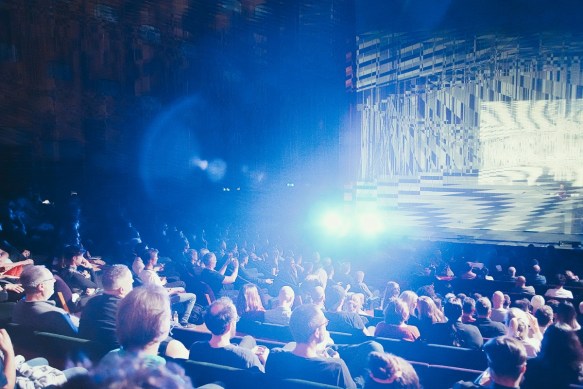
In concert – Max Cooper: Yearning for the Infinite

Max Cooper: Yearning for the Infinite

Part of the Barbican’s 2019 season, Life Rewired, which explores what it means to be human when technology is changing everything.

Barbican Hall, London, Saturday 28 September 2019

Written by Ben Hogwood
Images courtesy of the Barbican: Alex Kozobolis

How do you capture the infinite in music? Composers through the ages have come close – Bruckner, Mahler, Wagner and Messiaen come to mind, as does Morton Feldman and, more recently, the Indian classical music greats.

That may be a relatively casual list of ‘big dimension’ composers, but it gives an idea of the task facing Max Cooper, responding to the Barbican’s commission to ‘capture the overwhelming vastness of infinity within the spaces of the Barbican Hall’.

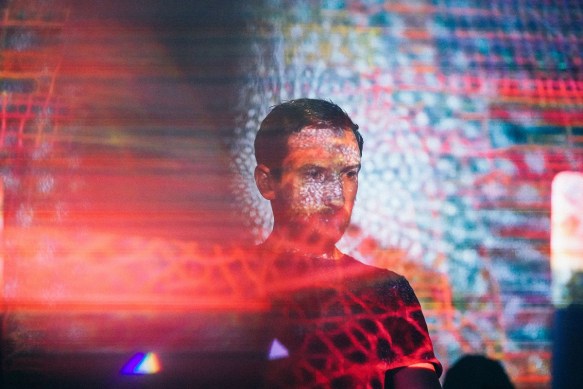
Incredibly, Cooper succeeded. His means were clever, too, exploring the infinite possibilities of data and science through tiny building blocks that combined to make cavernous structures to which we could easily have listened all night. For this he drew on his experience and knowledge of computational biology, for which he has a PhD, and made this potentially tricky area of science wholly approachable to the more casual Saturday night concert goer. To do this he added genuine emotion to the more calculated cells, drawing on historical religious traits which added even greater weight to the concept.

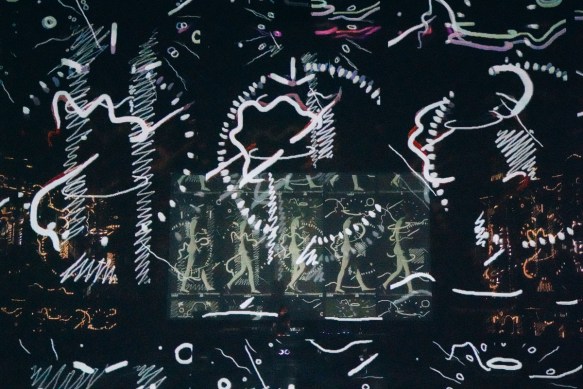
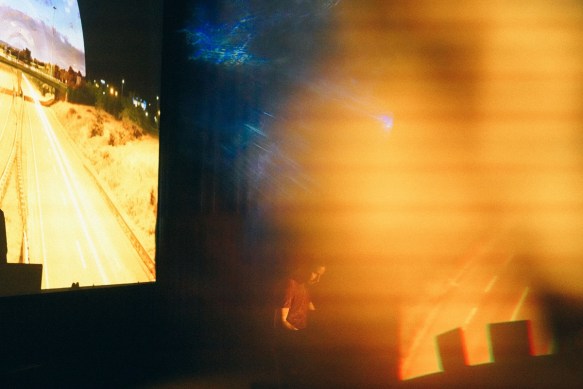
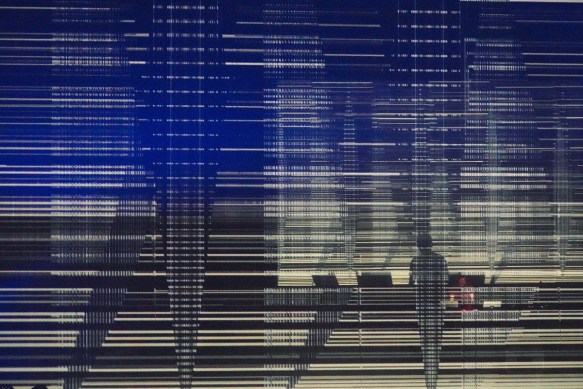
The music would not have made such an impact without the visual counterpoint, whose impact could not be overestimated. Jessica In (channeling Roger Penrose), Andy Lomas and Memo Atken all achieved the admirable balance of covering their brief, complementing the music and taking the breath away with the originality of their projections, which used two-thirds of the Barbican Hall walls and ceiling, creating a true 3D experience. Nor was the music lacking in emotional substance, Cooper having created a score of vast possibilities but also, in its quieter moments, of great intimacy.

This was borne partly of thick, semi-ambient chords with consonant harmonies but also melodic cells that grew outwards in tandem with the images, sweeping towards a conclusion where it felt as though all the positive energy in the hall was heading towards the feet. When the music did cut loose with powerful four to the floor rhythms it was all we could do not to get up and dance – a few did – though the complexity of the following breakbeat section would soon have placed us out of our collective depth!

It was that sort of evening, awe-inspiring, intimate, emotive and powerfully primal by turn. The modesty of Cooper’s bow at the end spoke volumes, showing that he sees himself as a channel through which this breathtaking art can flow. Yearning for the Infinite is due for an album release in November, and if it replicates this night then it will be essential listening. For now this evening was another feather in Cooper’s increasingly colourful cap.