Wigmore Mondays – Jess Gillam & Zeynep Özsuca

Jess Gillam (soprano and alto saxophones, above), Zeynep Özsuca (piano, below)

Wigmore Hall, Monday 7 October 2019 (lunchtime)

You can listen to this concert on the BBC Sounds app here

Review and guide by Ben Hogwood

Saxophonist Jess Gillam is proving to be a breath of fresh air for BBC Radio 3 and for classical music in general. Her combination of passionate artistry, technical flair and down to earth presentation is ideal, and brought colour to a dull Monday in October. Her spoken introductions between the pieces in this concert had a nicely judged patter, showing someone at ease with an audience and enthusiastic about the music she plays. The refreshing lack of pretence fed into the inspiring performances too. Gillam was helped by a very well chosen programme of music showing off the versatility of her instrument, in doing so covering a rich variety from the last 300 years.

The Pequeña Czarda of Pedro Iturralde was an ebullient first piece and a sign of things to come, placing the first earworm as well as showing off Gillam’s technique and Zeynep Özsuca’s colourful accompaniment. It draws the odd parallel to Midnight In Moscow in its slow passages, and both performers caught the contrast between these and the helter-skelter faster music.

The Marcello Oboe Concerto in D minor, transposed down a tone into C, illustrated how well works for oboe can transcribe for the saxophone, especially when played with as much control as there was from Gillam and Özusca here. The saxophone is a much louder instrument but Gillam really enjoyed the subtle colours available, and this worked especially well in the famous Adagio (11:08 on the broadcast link). In the outer movements Özusca found great clarity to bring the part writing to life.

Anna Clyne’s new piece Snake and Ladder introduced electronics to the equation, reminding us how the saxophone is one of the most versatile instruments between classical and rock music. Written for saxophone and distortion pedal, it was an effective and enjoyable piece, though sat at the back of the hall we had what sounded like wow and flutter from the breathing.

This led through a bit of a stylistic jolt to Poulenc’s Oboe Sonata, which appeared to be presented in original form without an arrangement – certainly none was credited. Gillam clearly loves this piece and played it beautifully, though the more plaintive oboe tone from which the third movement especially benefits was understandably more difficult to find (from 30:06). This movement, an elegy to Poulenc’s great friend Prokofiev, is effectively the last music he wrote and as such is very profound. Gillam did however do a brilliant job with the fast central movement (25:56 on the broadcast), with spiky counter thrust from Özsuca, while the first movement had established the mood.

We then heard from composer Rudy Wiedoeft, an American composer who raised the profile of the saxophone worldwide. His Valse Vanite, an original piece, drew on his love of transcribing other composers, and it was as though Chopin had taken a vacation in Harlem. Both musicians clearly have a lot of affection for this piece, and Gillam’s ornamentation was exquisitely done.

A reduced version for saxophone and piano of John Harle’s RANT! followed, this enjoyable and tuneful piece drawing on folk tunes from Gillam’s native Ullswater. That the composer, also Gillam’s teacher, was in the audience said much for the bond and mutual respect the two enjoy.

A soulful Pièce en forme de habanera followed, Ravel leading nicely into Gillam’s party piece. Milhaud‘s Scaramouche is the work she played in orchestral form at the Last Night of the BBC Proms in 2018, though it is arguably more effective in partnership with piano. Özsuca was a little far back in the mix to begin with but the fast movement was still hugely enjoyable, followed by a thoughtful slow movement and perky Brazileira (58:48), Gillam breaking into a grin once more as she played the catchy tune.

The audience would have been happy with this as the final earworm with which to leave, but a bonus was in store in the form of Duke Ellington’s In a Sentimental Mood (not on the broadcast), the encore showing off Gillam’s remarkable breath control in slower music.

This was a really enjoyable concert, and it was so refreshing to see another younger artist throwing off any shackles that classical music might present, and offering it out as music, pure and simple. Proof if it were ever needed that music should be there for everyone to enjoy!

Repertoire

Jess Gillam and Zeynep Özsuca played the following music (with timings on the BBC Sounds broadcast in brackets)::

Iturralde Pequeña Czarda (2:03)
Marcello Oboe Concerto in D minor (7:34)
Clyne (Snake and Ladder) for saxophone and electronics (19:27)
Poulenc Sonata for oboe and piano (21:05)
Wiedoeft Valse Vanité (35:00)
Harle RANT! (40:27)
Ravel Pièce en forme de habanera (47:53)
Milhaud Scaramouche Op. 165b (51:13)

Further listening

Some of the music played in this concert can be heard on Gillam’s debut album Rise. This includes the orchestral version of John Harle’s RANT!, and the works by Iturralde, Marcello and Wiedoeft – and of course the finale of the Milhaud:

Gillam’s teacher John Harle has a very impressive recorded legacy, raising the profile of the classical saxophone in contemporary classical music. The Sax Drive album (one in a series of PR own goals when it comes to saxophone album titles!) is well worth exploring for the three concertos it holds from Stanley Myers, Richard Rodney Bennett (his Concerto for Stan Getz) and Michael Torke:

Meanwhile if you liked the music of Milhaud you will find this hugely attractive collection from EMI to be very much your thing:

Switched On – Kompakt: Total 19

reviewed by Ben Hogwood

What’s the story?

Cologne label Kompakt is one of the cornerstones of electronic music and techno. Around this time every year they dip in to the catalogue for a Total collection of exclusives, an annual occurrence for nearly two decades now – and as important as it ever has been for main man Michael Mayer, who oversees this selection.

He goes for a mixture of old and new, established and just setting out – all offering a rich variety of nearly three hours’ music. The aim, as Mayer says, it to ‘reinforce the bond between artists and listeners. They’re like your favourite restaurant round the corner’.

What’s the music like?

Mayer serves up plenty on the Kompakt menu. The first act of the double concentrates on the label’s staple acts, the likes of Jürgen Paape, Jörg Burger and Voigt & Voigt, the brothers delivering reliably strong techno.

Perhaps the two best tracks of the first part are Tom Demac’s Serenade, a really broad and lovely piece of piano-led, richly textured electronica – and the Albert Luxus track In Den Arm Bitte!, remixed with warm colours by Julian Stetter. DJ Balduin’s expansive E.W.B.A. is a fine piece of work, broken beats and big textures. Rex The Dog’s Vortex makes a strong impression too, as does Jonathan Kaspar’s fluid effort Renard.

Arguably it is the second part of newer material that makes the stronger impression, though it does get a bit more samey with its monotone minimal tracks towards the end. Fahrland makes an especially good contribution with Yesterday, darkly dramatic and with elements of Chicago house from Mz Sunday Luv, while the growling lower end bass of Extrawelt’s Pink Panzer gets the complement of some extra acidic tweaking up top. Patrice Baumel gives attitude with Grace, ANNA lets loose at the sharp end of techno with Remembrance, while Raxon proves a driving force with Dark Light.

Does it all work?

In the majority, yes. From the warmth and vulnerability of Weval’s opening track Are You Even Real to the final flourish of Gui Boratto’s 618, via the Kölsch mixing desk, this is a set of tracks that Mayer has clearly spent some time over. The high level watermark remains.

Is it recommended?

Yes – Kompakt are still on their game on this release, and the appearance of Total in the calendar is a reassuring reminder that their high quality thresholds are unlikely to dip any time soon.

Stream

Buy

Playlist – Kit Downes

It gives us great pleasure to welcome Kit Downes to Arcana’s playlist section.

In the space of just under 40 minutes Kit introduces us to some fascinating sound worlds that will doubtless be new to a lot of listeners out there. They certainly were to me!

Philipp Gropper‘s Philm begins the sequence with the dappled shades of Sun Ship, Pt. 2 from the 2017 album of the same name. We move from there to the ghostly outlines of Lucy Railton‘s For J.R., with its combination of solemn organ and slightly warped field recordings. Disasterpeace‘s otherworldly Vignette: Visions is next, followed by an excerpt from Messiaen‘s La Nativité du Seigneur, Desseins eternels (Eternal Purposes), played here by Kevin Bowyer.

Shimmering textures abound in Stian Westerhus‘ Don’t Tell Me This Is Home, then the mellow, minimalist overtones of Robert Stillman‘s Ruthie In May bring some Autumnal colours to the mix. Garoto‘s Improviso at once sounds older, a lovely interlude of South American guitar, before Jan Johansson shifts the attention to the piano for his Baroque-like Leksands skänklåt. Finally an excerpt from this year’s Mokum in Hi-Fi album, Palace, bring saxophone and guitar together from Ben van Gelder and Reinier Baas.

Our thanks to Kit for opening our ears! Listen on Spotify below…

Switched On – Carter Tutti Void: Triumvirate (Conspiracy International)

reviewed by Ben Hogwood

What’s the story?

This is the third and sadly final volume in which the trio of Chris Carter, Cosey Fanni Tutti and Nik Colk Void join forces – Carter and Tutti being half of Throbbing Gristle, and Void from Factory Floor. The interchangeable trio can operate as solo artists in their own right, but when they unite improvisation is the watchword of the day.

There is a distinct lack of ceremony to their work together, the six tracks on this collaboration referred to as simply T 3.1 and so on. They are not quite presented in order, suggesting the improvisation runs to the album sequence as well as the music itself.

What’s the music like?

Dark and propulsive, like a lumbering machine. With rolling bass and low slung rhythms T 3.2 comes in like the machine cranking into life, sporting a mid-tempo and slightly dubby profile that sounds superbly moody. It sets a guide for the rest of the album, which proceeds with similarly dark colours but is a compelling listen.

T 3.5 is the sort of track that would benefit from visuals, like the soundtrack to a game or movie yet to be written. Again there is a dark presence in the music, but the effects, disembodied voice of Cosey and fulsome beats combine to make an incredibly descriptive piece of work.

T 3.3 is slightly more acidic and industrial, powered again by an insistent rhythm, the machine now in fine form – and it continues to work well in T 3.1 through a chugging beat that sounds a little like mid-period Orb. The foreground features all kinds of metallic flashes and flickers, as though the trio are welding their music live, and the longer the track goes the more mischievous the interventions become.

Finally T 3.6, monotone like many of the others, plays effective games with its sonic perspective and builds rich layers of sounds that are slate-like in colour.

Does it all work?

Yes, Triumvirate offers an incredibly solid counterpoint to the first two releases, and goes about its business in a refreshingly direct way. There is something thrilling about the music’s construction, its industrial sounds that love to reference the thrill of early dub-infused house as their metallic profiles take shape. It would doubtless be brilliant live.

Is it recommended?

Yes. Heavy and brooding it may be, but the construction of Triumvirate is fascinating to take in, glinting in the darkness and working its magic to great effect on headphones.

Stream

Switched On – Joe Armon Jones: Turn To Clear View (Brownswood)

reviewed by Ben Hogwood

What’s the story?

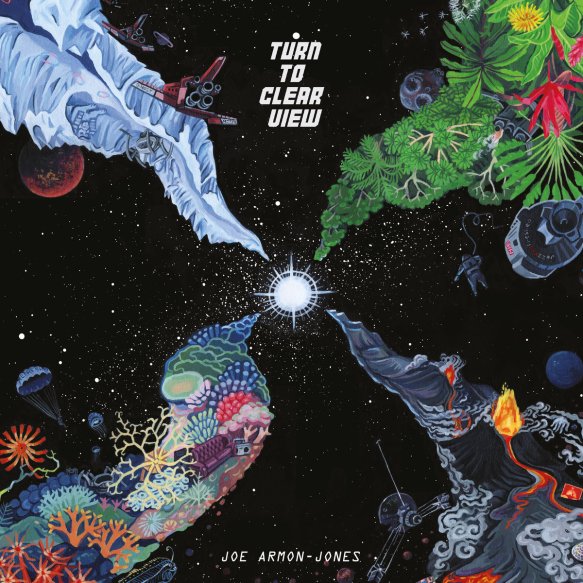
Joe Armon Jones is a man with a vivid imagination and a thirst for collaboration, so it is hardly surprising that he fits into the world of jazz with such refreshing ease. Yet that is not the only world with which he rubs shoulders, as his second album for Brownswood deftly shows. With guests including Georgia Anne Muldrow and fellow Ezra Collective members Oscar Jerome, Moses Boyd and Nubya Garcia, Turn To Clear View promises musical exploration, a feeling furthered by its P-funk style album cover.

What’s the music like?

Turn To Clear View builds on the promise of instinctive music that Jones’ first album for Brownswood, Starting Today, showed. The fact he has followed up that album in less than a year and a half, with other projects on the go, shows the rich vein of creativity he is currently mining.

Crucially, Turn To Clear View is accessible from almost every entry point. If you come to this from the P-Funk of Funkadelic or more outright jazz leanings, or even slower disco and hip hop, there will be something for you here.

Perhaps the most obvious and appealing groove is Icy Roads, a nice syncopated number that works up a light-headed euphoria. Asheber’s vocal on Try Walk With Me is part of a warm welcome to the album, with the telling lyrics ‘time to let go’, while the Muldrow-fronted Yellow Dandelion is a treat, full of colour and expression and with a great keyboard solo from Jones himself.

Gnawa Sweet shows off a lovely, burnished trumpet sound from the Ezra Collective’s Dylan Jones, while (To) Know Where You’re Coming From has a nice breezy ensemble melody with trumpet and sax. Jehst’s vocal on The Leo & Aquarius dovetails beautifully with another sensitive contribution from Jones, before an energetic rap towards the end, while Nubya Garcia delivers a passionate saxophone solo on You Didn’t Care.

Finally on Self:Love the entreaty to ‘be yourself’ from Obongjayar is perfectly timed, effectively bringing the mood of the album full circle.

Does it all work?

It does. Turn To Clear View is a well-crafted yet instinctive piece of work, musically fluid and enjoying the rich colours and individual styles of those involved. Jones is very sensitive to the guests on the album, but is clearly a force to be reckoned with when he comes to the fore.

Is it recommended?

Very much so. Joe Armon Jones has a stellar career ahead of him on this evidence, and the speed of thought he currently has with his musical projects is enviable. It won’t be long until his next move, for sure!

Stream

Buy