London Philharmonic Orchestra / Vladimir Jurowski – An Autumn Symphony

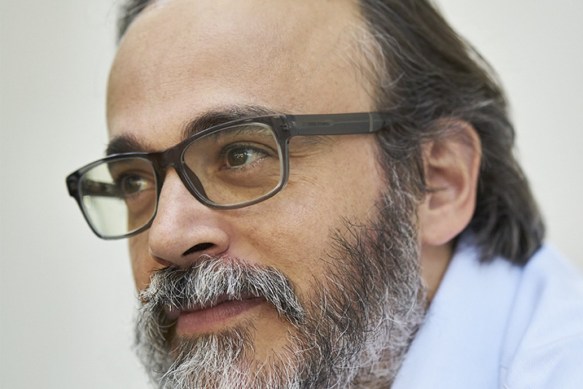
Julia Fischer (violin, below), London Philharmonic Orchestra / Vladimir Jurowski (above)

Royal Festival Hall, London, Wednesday 29 November 2017

Chausson Poème, Op. 25 (1896)

Respighi Poema autunnale, P146 (1925)

Marx Eine Herbstsymphonie (1921) [UK premiere]

Reviewed by Richard Whitehouse

Vladimir Jurowski continues to ring the changes in terms of repertoire, with this evening’s concert by the London Philharmonic Orchestra no exception in featuring the UK premiere of Eine Herbstsymphonie, the most ambitious undertaking from Austrian composer Joseph Marx.

Although best remembered for his substantial output of songs, Marx (1882-1964) spent the decade after the First World War essaying large-scale orchestral works – chief among them being this Autumn Symphony premiered (by Felix Weingartner) in Vienna during 1922 but which went unheard as a complete entity for eight decades after its 1925 revival. Marrying impressionistic harmonies to a Mahlerian formal expansiveness, this is an evocation of its season both in descriptive and philosophical terms – in music as opulent as it is engulfing.

What it lacks is any sense of a cumulative or even over-arching momentum. Sizable forces are deployed expertly if amorphously in terms of the dense yet unvarying texture – though this was hardly the fault of the LPO, which responded to Jurowski’s incisive direction with assurance. Not least in the radiant Autumn Song – less a movement then a prelude to what follows and segueing into Dance of the Noon Spirits, an extensive intermezzo that suffers from its overly uniform waltz-time measure and corresponding lack of rhythmic contrast.

This latter failing is hardly an issue in Autumn Thoughts, a slow movement where serenely unfolding paragraphs and taciturn solos for wind and strings effect a yearning regret such as draws in the listener whatever its lack of defined melodies. After which, An Autumn Poem provides a finale of Dionysian import – the full orchestra (nine percussionists in addition to timpani and keyboards) moving through a series of increasingly heady climaxes before the music subsides into a postlude suffused with eloquent resignation though tinged by regret.

A significant work historically, then, but hardly a neglected masterpiece that warrants regular revival. Jurowski can only be commended for instigating this performance, as for encouraging so committed an orchestral response as will hopefully find its way onto the LPO’s own label.
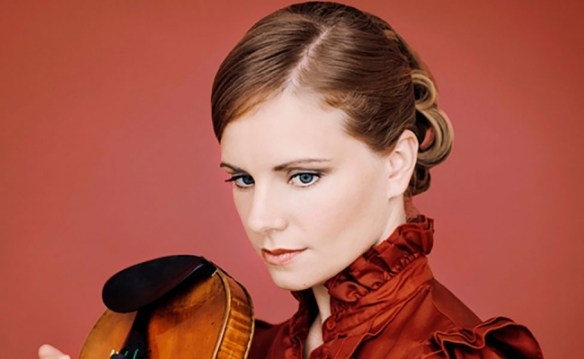
Even so, it was the first half that brought greater rewards. With its inspiration in a typically melodramatic story from Ivan Turgenev and breathing an aura of fatalistic dread, Chausson’s Poème has made a welcome return to the repertoire and has also found its ideal exponent in Julia Fischer – her warm and caressing though never over-wrought tone teasing out those expressive nuances which lurk beneath the surface of this emotionally all-enveloping score. Whatever else, its composer experienced the essential qualities of his music in graphic terms.

Latter-day revivals have tended to pair this piece with Ravel’s jarringly contrasted Tzigane, but Fischer choice was far more apposite. Even more overlooked, Respighi’s Autumn Poem itself pursues a full-circle trajectory such as takes in reflection and animation, though one whose overall conciseness proves its own justification. Fischer duly spun the deftest of solo lines through the diaphanous and modally-inflected orchestral texture, in which Jurowski’s accompaniment was astute and affecting in equal measure. Sometimes, less really is more.

Wigmore Mondays: Andrei Ioniţă & Itamar Golan – Bach, Shostakovich & Bartók

Andrei Ioniţă (cello, above – picture Daniel Delang), Itamar Golan (piano, below)

J.S. Bach Cello Suite no.1 in G major BWV1006 (c1720)
Shostakovich Cello Sonata in D minor, Op.40 (1934)

Wigmore Hall, London; Monday 27 November 2017

Written by Ben Hogwood

The broadcast can be heard on the BBC iPlayer by clicking here

There is a frustrating lack of information around J.S. Bach’s music for solo cello. Frustrating because the music itself is so good, a cornerstone of the instrument’s repertoire that satisfies experienced players and novices alike. In an interesting program note for this concert Richard Bratby outlined how Bach’s Six Suites for solo cello could indeed have a biblical theme running through them, a conviction that the cellist Steven Isserlis holds, though as he is the first to admit there is no hard and fast evidence for this.

The Suites are beautifully structured, with a Prelude giving way to five different dances – two relatively quick (in this case Allemande and Courante) – then one slow (always a Sarabande) and then two more quick (here two Bourrées) and always ending with a triple time Gigue.

The first cello suite has music you may recognise from Master and Commander among many other film and TV uses.

The Shostakovich is one of the most-played works for cello and piano from the 20th century, and it is easy to see why when you hear it – packed full of incident and tunes. It was written at the start of a new era for the composer, his wife having just moved out – and found him in a particularly rich vein of creativity, completing the half-hour work in just over a month in 1934. It was written for the cellist Viktor Kubatsky, who with the Stradivarius Quartet had taken part in the premiere of the composer’s 2 Pieces for String Octet in 1925. Shostakovich had yet to write any of his 15 string quartets, or his concerti for violin and cello, so this marks his first large scale writing for a stringed instrument. It received a mixed reception, some of its critics branding it too simplistic, but its lyricism and humour have given it a wide audience.

Follow the music

The times used relate to the broadcast link above.

J.S. Bach Cello Suite no.1 in G major BWV1006 (c1720) (1:47) (16 minutes)

The suite follows the outline described above, beginning with an expansive Prelude (1:47) that uses a series of arpeggios to plot its harmonic and melodic course. The dance movements begin with a fairly relaxed Allemande (4:02), where the steps are relatively slow, but steps up in pace with a Courante (7:52).

A slow and gorgeous Sarabande follows (10:20) where the cello uses a lot of ‘multiple stopping’ – playing more than one note with the bow simultaneously – before we move to a pair of Bourrées. The first one (13:14) is boisterous, the second (14:22) more withdrawn – but the first is repeated (15:32) to reclaim the upbeat mood. Then the distinctive triple time of the Gigue (16:09) closes out the suite.

Shostakovich Cello Sonata in D minor Op.40 (from 20:20) (28 minutes)

The Sonata begins in relatively genial mood, with a legato approach to the cello, as lyrical as anything Shostakovich has written. Soon, however, the clouds begin to form – though they are not visible anywhere when the cello gives out the second main theme of the first movement (22:35), a beautiful moment where it sounds suspended in mid-air. The movement ends deep in thought, but with a little frisson of worry around the edges.

That worry is emphatically thrown off in the bold as brass second movement (32:20) where both instruments go at it hammer and tongs. After that outburst we return to quiet and an introspective slow movement (from 35:45), where Shostakovich captures that exquisitely private intimacy only he can in a chamber setting.

When we emerge from deep thought the piano gives out a witty theme (44:06) to signal the start of the finale, where both players duck and dive through a set of highly enjoyable tunes and countermelodies. This is Shostakovich having fun – but even then there is a note of caution in the background.

Thoughts on the concert

Andrei Ioniţă gave a thoughtful performance of the Bach First Cello Suite, though could perhaps have shown us more of the sunnier side of the music, which can come through in the Courante, first Bourrée and Gigue especially. The Courante felt too fast – certainly something you’d have trouble dancing to! – though it did show off his quickfire technique, of which more later. The Sarabande could perhaps have been more outwardly expressive too, though the Gigue had a nice rustic feel.

The Shostakovich was a different story, Ioniţă and Itamar Golan straight to the heart of the work with an intimate yet wholly involving performance. The cellist’s tone was ideal, and so was the balance struck with the piano, who intervened in crushing style where necessary but drew back in the quieter moments. The bracing second movement was powerfully wrought, both players sparring with the gloves off, but the slow movement was especially affecting, helped by Ioniţă’s control of the high melodic line. The finale was brilliantly done, bringing just the right measure of humour and introspection to the performance.

With some time left Ioniţă and Golan gave a generous encore, an arrangement of Bartók’s Six Romanian Folk Dances for cello and piano (from 49:43 on the broadcast). This had all the flair and pizazz you would expect from a native Romanian, brilliantly played and with all the melodic inflections beautifully realised. The accuracy of the harmonics in the third dance (51:41) had to be seen to be believed!

All in all an excellent concert from a prodigious talent, who can only benefit from having someone as experienced as Golan – who has in his time accompanied Mischa Maisky and Maxim Vengerov – alongside him.

Further listening and reading

You can watch Ionita in the final of the 2015 Tchaikovsky competition below, where he plays more Shostakovich:

Meanwhile the pieces making up the concert are grouped in the following Spotify playlist

Wigmore Mondays: Meccore String Quartet – Szymanowski & Sibelius

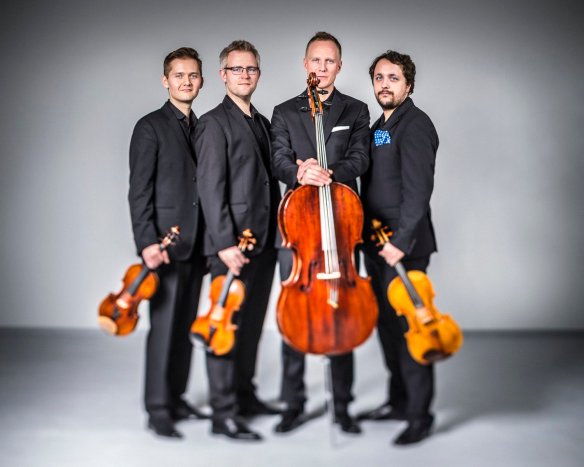
Meccore String Quartet (above – Jarosław Nadrzycki, Wojciech Koprowski (violins), Michał Bryła (viola), Karol Marianowski (cello)

Szymanowski String Quartet no.1 in C major, Op.37 (1917)
Sibelius String Quartet in D minor, Op.56 ‘Voces intimae’ (1909)

Wigmore Hall, London; Monday 20 November 2017

Written by Ben Hogwood

The broadcast can be heard on the BBC iPlayer by clicking here

Szymanowski’s two String Quartets took a while to establish themselves in the string quartet repertory, but certainly not on grounds of quality. The first anticipates the composer’s biggest stage work, King Roger, and has music of great depth with a relatively exotic harmonic language.

Sibelius wrote his only published string quartet – there are three other unpublished works – at his new home of Ainola, where he moved with his wife in 1903. At this point the composer was suffering from the effects of alcoholism and debt, and needed to move away from Helsinki and temptation. Ultimately this did not provide full relief, but he was at least able to move on with composition, and the Symphony no.3, written just before the quartet, offers more optimism. The quartet however is dark and unforgiving.

Follow the music

The times used relate to the broadcast link above.

Szymanowski String Quartet no.1 in C major, Op.37 (from 1:51) (17 minutes)

At 1:51 the quartet begins as though in a time warp, the soft harmonies in a chorale from the four instruments harking back to a much earlier time. Gradually the music establishes its rich harmonies, helped by added notes from the instruments using double stopping (playing more than one note at once), which gives added density to the music.

The added note harmonies are a big part of the composer’s newer style, where he does still on occasion imitate Debussy but where he now has one foot planted relatively firmly in the explorer’s camp. The music goes through some unexpected harmonic shifts towards the end, but then from 9:27 feels on firm grounds once more with the luxurious beginning to the slow movement.

This features soaring melodies from the first violin and higher playing from the rest of the instruments towards the end, where the listener feels suspended in the air.

A different air altogether hangs in the third movement (15:07) where the music is quick, urgent and full of smaller phrases passed between the instruments. At 17:19 a dance section gives cut and thrust, before the quartet wraps up with surprising haste.

Sibelius String Quartet in D minor, Op.56 ‘Voces intimae’ (from 21:24) (28 minutes)

The theme from the violin (21:24), answered by the cello, is the melodic material on which the first movement is based. The phrases are restless, passed between the instruments and often overlapping with little pause for breath. There is a sense of the wide open countryside in which Sibelius now finds himself, but also of the dark days. This comes to a head around 26:48, a sparse cadence played by the quartet, before they move on to the second movement with flitting motifs from each instruments, creating a vision of circling birds.

The slow movement (29:36, marked Adagio di molto) is the centre of the work both emotionally and musically, deeply emotional but also offering resolution. Here the quartet are closely together, and the main theme, which comes back several times, has a deep yearning.

From 39:00 the fourth movement begins, and here the quartet digs in as though searching for strength and resolve. Gradually the individual lines become restless again, the melodies increasingly fractured, and the textures are heavy. Leading on from this is an even faster movement (44:35), where the instruments become even more reckless and desperation sets in (especially from 46:17). There are fleeting glimpses of folk melodies but the momentum carries all before it to a dazzling flurry of semiquavers at the end.

Thoughts on the concert

A powerful concert from the Meccore String Quartet. Their Syzmanowski felt utterly authentic, played with style and feeling, and with the quartet full in voice. They took a standing position for the concert (except the cellist of course) and this suited their freedom of expression.

The quartet tended to take the fast music at daringly fast tempi, especially in the Sibelius, where the second and fifth movements seemed to be gone in a flash of breakneck speed. Despite the technical brilliance this did mean a few musical statements were swept up in the sheer momentum of it all. However the quartet were more measured for the slow movement, where emotion was concentrated and intonation wonderfully secure. There was a feeling throughout that the interpretations from the quartet were singular in voice, and watching them in person made the experience much more meaningful.

As a substantial encore it was nice to hear the second movement (a Romanze) from Grieg‘s String Quartet in G minor, Op.27 (51:00), which the quartet have recently recorded, and which here provided a reminder of the melodic gifts of the Norwegian composer, whose music seems to have fallen off the radar a little bit of late. The cello is particularly beautiful in its melody here.

Further listening and reading

Here is the first movement of the Grieg String Quartet, performed by the Meccore String Quartet live from the Polish Radio in 2015.

For a further taster of their Szymanowski, here is the third movement of the String Quartet no.2, part of a disc of the composer’s quartets recently released on Warner Classics:

Meanwhile for further listening on Spotify, in the absence of the Meccore versions, here are the Emerson String Quartet in a winning combination of the Sibelius and Grieg Quartets, with a little Nielsen for good measure:

Meanwhile both Szymanowski Quartets can be found here, in a version from the Goldner String Quartet:

BBC SSO / Ilan Volkov – Miller, Sciarrino, Croft & Beethoven ‘Eroica’

Ilya Gringolts (violin), Juliet Fraser (soprano), Sound Intermedia (Ian Dearden and David Sheppard, sound design), BBC Scottish Symphony Orchestra / Ilan Volkov (above, picture James Mollison)

Symphony Hall, Birmingham, Friday 17 November 2017

Miller Round (2016)

Sciarrino Allegoria della notte (1985)

Croft Lost Songs (2017) [World premiere]

Beethoven Symphony No. 3 in E flat, Op. 55, ‘Eroica’ (1804)

Reviewed by Richard Whitehouse

Tonight’s Symphony Hall concert was hardly likely to muster a large audience, though those braving inclement weather and the chaos of redevelopment in the Centenary Square environs were rewarded with this strikingly contrasted programme from the BBC Scottish Symphony.

The first half consisted wholly of music by living composers. Canadian-born Cassandra Miller (b1976) may not yet be widely recognized in the UK, but Round demonstrated a sure feeling for orchestral sonority – drawing on a lesser known Tchaikovsky melody (rendered by cellist Gaspar Cassadó) as a ‘cantus firmus’ around which the texture gradually opens-out; taking in antiphonal trumpets and off-stage tubular bells, while maintaining its hushed aura through to the rapturous culmination. Ilan Volkov secured a committed response in this absorbing piece.

Such was no less true in Salvatore Sciarrino’s Allegoria della notte, yet the work itself was a disappointment. Sciarrino (b1947) has a knack for finding the ‘biting point’ between sardonic and ominous, but this homage to and deconstruction of Mendelssohn’s Violin Concerto (near-quotations from which inform the opening and close) was for the most part an exercise in his trademark glassy textures and frozen gestures. Ilya Gringolts handled some stratospheric solo writing with aplomb, but this remained music appreciably longer on technique than substance.

A pity that the orchestra’s absence from the next piece prompted an exodus from the hall in expectation of an interval (though the programme could have been clearer on this), as many failed to return for the highlight of this contemporary triptych. New Zealand-born John Croft (b1971) is a further composer gaining in profile, and Lost Songs should do his reputation no harm at all. These settings of ancient Greek poets (three by Sappho, two by Alcaeus and one anonymous) for solo voice conjured a remote though never arid or uninvolving sound-world, enhanced by the evocation of lyres and reed instruments through the adept manipulation of live electronics – against which Juliet Fraser was a focal-point of eloquent poise. If any ‘note of reconciliation’ rather failed to emerge, this remained an assured and involving experience.

Was a point being made by the introspection of this first half when compared to the combative presence of Beethoven’s Eroica after the interval? Such thoughts came readily to mind during Volkov’s impressive account of a work as wears its two centuries and more lightly, not least in an opening Allegro (exposition repeat excluded) that unfolded intently yet never hectically via a far-reaching development and on to a coda that brought tangible fulfilment. The Adagio then marshalled its funereal essence with equal purpose, building to an anguished fugato and finally subsiding into a numbed acceptance – countered in the scherzo with its incisive energy and its trio’s horn-led jollity. The finale’s initial stages were ideally paced, and if the broader tempo of what ensued risked momentum, the coda duly surged forth with uninhibited resolve.

Overall, a fine showing for Volkov and BBCSSO alike. Were they to give a first UK hearing for Jorge E. López’s seismic Fourth Symphony (as premiered by Volkov in Luxembourg late last year), this would be worth braving the elements and urban redevelopment alike to attend.

For more information on the BBC Scottish Symphony Orchestra, head to their website, and for Ilan Volkov, his artist website

ECM – A Stream of Consciousness

The news that ECM have returned their catalogue to streaming services is a cause for celebration…especially if you like the sort of music we at Arcana enjoy talking about.

So good is the news in fact that we’ve decided to celebrate with an ECM Spotify playlist. The only trouble with doing this is deciding what to leave out, while accepting there are corners of the label’s output that we have not yet explored.

Yet there is some amazing music in these two hours, with artists of the quality of the Hilliard Ensemble, Jan Garbarek, the cellists of the Berlin Philharmonic and Pat Metheny ready to bring it to you. Yet if there is just one musical item to take from this playlist, it’s the last one – Christopher Bowers-Broadbent raising Philip Glass‘s Dance IV to the heights. Enjoy – and tell us what you think!