

Gabriela Montero (above, piano)
Schumann Kinderszenen (Scenes from Childhood), Op.15 (1838)
Shostakovich Piano Sonata no.2 in B minor, Op.61 (1943)
Gabriela Montero Improvisations (2017)
Wigmore Hall, London; Monday 13 November 2017
Written by Ben Hogwood
The broadcast can be heard on the BBC iPlayer by clicking here
Schumann’s piano pieces were written for his beloved Clara to play, in the early stages of their courtship – when he was far from flavour of the month in the Wieck household. They are reminiscences of childhood life and were not intended for children to play as such. Happily some of them are a bit easier, but they are viewed through adult frames.
Shostakovich, meanwhile, wrote his Piano Sonata no.2 in memory of his former Leonid Nikolayev, at a time of particular hardship with World War II at its height. The substantial work a much more mature piece than his First Sonata, set in one movement, and it sits between two massive symphonies in the Seventh (Leningrad) and Eighth. Perhaps because of the enormous dimensions of those pieces the Sonata is a thoughtful and almost fiercely intimate work that has the listener subconsciously leaning in to listen to the quieter moments.
Gabriela Montero is one of the few classical pianists to actively practise the art of improvisation in concert, and as she told the booklet writer Jessica Duchen she finds a ‘different state of consciousness…like an open vessel’.
Follow the music
The times used relate to the broadcast link above.
Schumann Kinderszenen, Op.15 (from 1:52) (20 minutes)
Rather than describe each piece for you, I have elected simply to list the titles Schumann assigns the pieces and the time at which they appear in the broadcast. His writing is so descriptive it will conjure all sorts of pictures in the imagination! The movements are:
- Von fremden Ländern und Menschen (Of Foreign Lands and Peoples) (from 1:52)
- Kuriose Geschichte (A Curious Story) (3:49)
- Hasche-Mann (Blind Man’s Bluff) (4:56)
- Bittendes Kind (Pleading Child) (6:21)
- Glückes genug (Happy Enough)
- Wichtige Begebenheit (An Important Event) (7:32)
- Träumerei (Dreaming) (8:32)
- Am Kamin (At the Fireside) (11:30)
- Ritter vom Steckenpferd (Knight of the Hobbyhorse) (12:26)
- Fast zu Ernst (Almost Too Serious) (13:03)
- Fürchtenmachen (Frightening) (15:17)
- Kind im Einschlummern (Child Falling Asleep) (16:53)
- Der Dichter spricht (The Poet Speaks) (19:22)
Shostakovich Piano Sonata no.2 in B minor, Op.61 (1943)
The sonata starts like a cold wind blowing into the concert hall, with rapid figurations in the left hand, but soon develops into a driving march (around 24:00) with the right hand of the piano striking notes an octave apart. At 26:53 it comes back to an emphatic statement of the main tune, now lower in the left hand, before an introspective passage of thought and then an emphatic finish
The second movement, marked Largo (29:47) is one of Shostakovich’s characteristically intimate elegies, notable for its slow tempo and recurring pulse. The performer here is lulled into quiet thought.
In the third movement Shostakovich delivers one of those nagging themes in which he excels, given out by the right hand alone (from 36:27). Once heard it dominates proceedings, no matter what other music Shostakovich introduces – it all comes back to that theme, blurring the boundaries between minor and major keys and wavering uncertainly whenever it appears. The melodic material is made up of variants on that tune, the music becoming increasingly twisted and anguished before burning out, spending time in downcast thought and then recovering for a final, furtive statement of the theme.
Gabriela Montero Improvisations (from 50:34) (4 minutes)
In a spoken introduction, Venezuelan pianist Montero describes the improvisation offered here as a reaction to ‘my broken country’. It adopts the same tonality of the Shostakovich, B minor, and sets out its thoughts in a way that the Russian composer would surely recognise. The fluid and heartfelt musical progressions are all the more meaningful for being of the moment.
Thoughts on the concert
A recital of contrasts from Gabriela Montero. Schumann’s Kinderszenen provided the audience with a lot of fun through its wistful reminiscences, though at times Montero did stretch out the tempo rather, especially in the opening number. The characterisations were very enjoyable though, and Wichtige Begebenheit had a proud step, while Träumerei was appropriately dreamy. Montero also captured the melancholy that can come with rose-tinted recollections such as these, especially in Schumann, and the final Der Dichter spricht was ideally pitched.
Shostakovich’s Second Sonata crackled with atmosphere, and the presence of an unnamed menace that marks his most private works was here throughout. The bluster of the first movement was fooling nobody with its resolve, for the heart of Shostakovich’s music here lay in the bare outlines of the finale, where Montero excelled, and in the unexpected ghostly chord that arrives just before the end.
It was refreshing to hear an improvisation from Montero that seemed to take its lead from this work in professing its despair at the political and economical state of her home country, and this music was made all the more memorable by her relative restraint in its execution. More performers would do well to follow her lead.
Further listening and reading
You can read more about Gabriela Montero at her website, while the Spotify album below couples her interpretation of Rachmaninov‘s Piano Concerto no.2 with three of her Improvisations:
Montero has not recorded the Shostakovich sonata, but you can hear a new album from Peter Donohoe that brings both concertos and sonatas together in one collection:
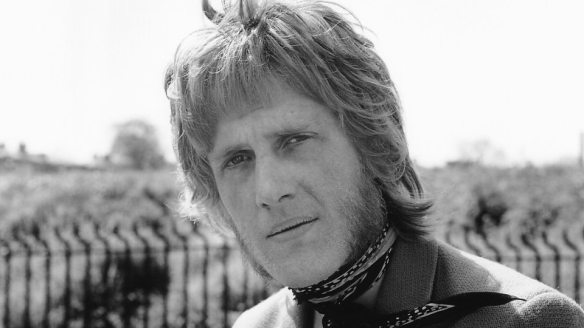
 Before the interval, Tippett was joined by Matthew Bourne (above) – himself a pianist who has built up a formidable reputation for essaying the unexpected – for a half-set in which these pianists engaged in what might passably be described as a ‘call and response’ session of far-reaching possibilities. The past century has seen a rich legacy of music for two pianos, and it was hard not to discern echoes of such seminal works – ‘classical’ in designation while not necessarily conception – as Debussy’s En blanc et noir and Bernd Alois Zimmermann’s Monologe in the alternately stealthy and quixotic interplay of these musicians.
 All the instrumentalists were allotted solos or at the very least spotlights, during which their different personalities (irrespective of instrument) came to the fore. Then followed what was billed as a ‘coda’, in which the penultimate The Dance Of Her Returning was reprised but with lyrics by Julie Tippetts (above) and sung with her customary understated eloquence. The octet played out with Tippett’s arrangement of the Irish traditional tune The Last Rose Of Summer – by turns pensive and plangent, and bringing to an end this memorable and affecting recital.
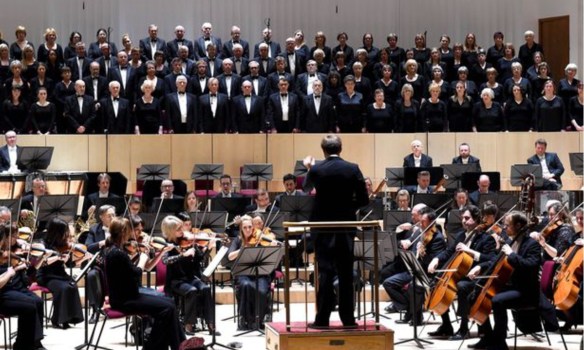 The Royal Liverpool Philharmonic Choir – over 100–strong in this performance – were on superb form, sharply rehearsed and clear in diction, meaning there was no need for the accompanying words. They found the swell of the waves with unerring confidence and passion. Manze clearly loves this music, and brought the Scherzo to a half with shattering precision before grasping the last movement’s ebb and flow to great satisfaction, making good sense of what can be a long movement in the wrong hands.
 Perhaps this was because it followed a rapt and incredibly restful performance of Vaughan Williams’ A Lark Ascending, his famous response to the George Meredith poem of the same name. Under the spell of James Ehnes‘ violin, we climbed effortlessly into the sky, ending the ascent in barely audible song as the bird disappeared from earshot. It was proof that despite the ubiquity of the ‘Lark’, Vaughan Williams still holds the ability to stop the listener in their tracks.
 This was followed by an extremely tasteful reading of Mozart’s Symphony no.34. This is a work that doesn’t get to poke its head above the parapet as much as its neighbouring ‘named’ symphonies in the composer’s output such as the Haffner and Linz. Wigglesworth chose his speeds well, so that the lovely Viennese textures were just the right density for Mozart’s lighter (but not lightweight) melodies. The energetic Hallé strings went well with the more graceful woodwind, particularly in the joyful finale, while the serene slow movement was also a highlight.
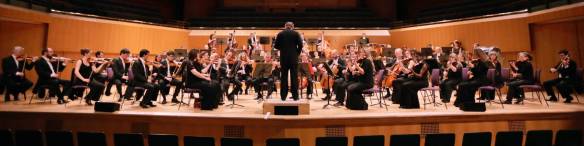 Mahler’s Symphony no.4 is, on face value, his most ‘classical’, following traditions established by Schubert and the like, innovatively adding a soprano for the final movement, a child’s vision of heaven. Wigglesworth’s interpretation was carefully thought out and extremely well played, the woodwind of the Hallé rising to the considerable challenges posed by this deceptively difficult symphony.
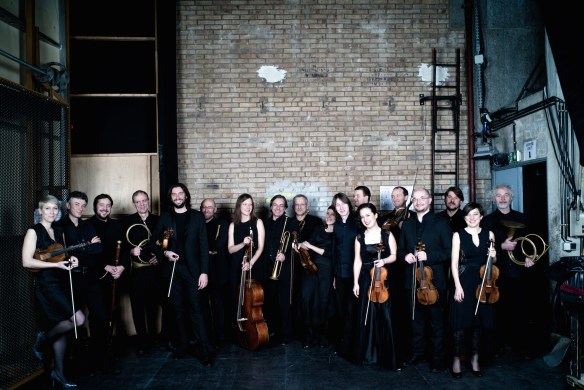 Providing a rather lovely contrast was the Violin Concerto in G major from Michael Haydn, Franz Joseph’s older brother. Often the poor musical relation of the family, he nonetheless wrote some fine works himself, particularly in the choral field, with memory recalling a fine Requiem performed relatively recently by the King’s Consort at the BBC Proms.
