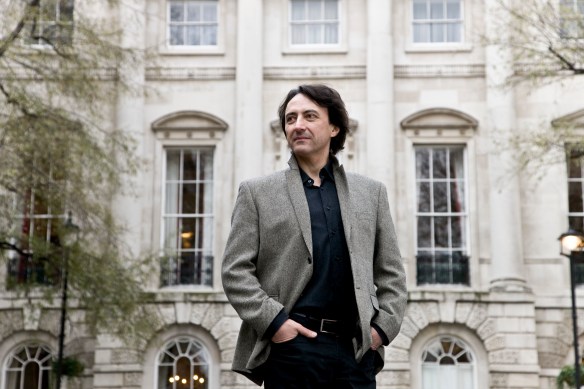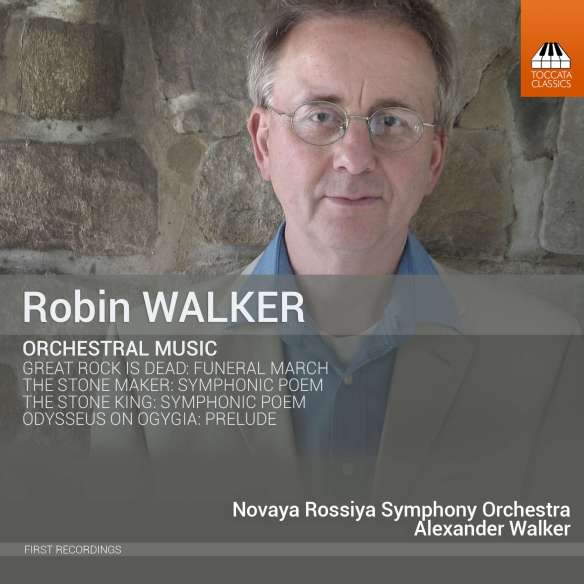
On record: Robin Walker: Orchestral Music (Toccata)

Walker Great Rock Is Dead; Odysseus on Ogygia; The Stone King; The Stone Maker

Novaya Rossiya Symphony Orchestra / Alexander Walker

Toccata Classics TOCC0283 58’13”

Producer Pavel Lavrenenkov Engineers Gennady Tarabantov and Alexander Karasev Recorded September 2nd-5th at Studio 5, Russian State TV and Radio Company Kultura, Moscow

Reviewed by Richard Whitehouse

Summary

The first disc devoted to the orchestral music of Robin Walker (b1953), whose idiom evolved over several decades before arriving at the singular and uncompromising music featured here, in what is another venture facilitated by the redoubtable Martin Anderson of Toccata Classics.

What’s the music like?

Readers with longer memories may recall certain pieces by Walker which attracted attention during the 1980s, not least the ensemble piece Dance/Still and the plangent Seven Last Words for electric guitar and percussion. Several of his chamber and instrumental works were issued by Riverrun Records (RVRCD66) at the turn of the century, yet anyone familiar with that disc will likely be surprised with what they find here. Interesting, too, that Walker (to judge by his website) is intent on covering his tracks, Ustvolskaya-like, regarding most of his earlier music.

Much the longest work is The Stone Maker, completed in 1995 after an eight-year gestation and described as a symphonic poem, though it could be assessed in terms of a one-movement symphony. The composer’s booklet note avoids any concrete programme, focussing instead on its modification of symphonic archetypes (notably Beethoven’s Fifth and Brahms’s First) in the light of his own aesthetic. This is worth bearing in mind because, unlike numerous of his contemporaries, Walker has not repudiated Modernism per se but reintegrated it into his highly individual take on the musical past. Tippett and Birtwistle are mentioned as guiding presences, and the more visceral passages of this work do indeed recall the latter composer (notably his Earth Dances), but there is equally a modally-inflected tonal underpinning such as sustains its 32 minutes with demonstrable purpose. No less striking are those stretches of more inward expression, notably that before the inexorable final build-up – while the tailing-off that ensues, and the suspenseful concluding bars are both realized with exquisite finesse.

None of the shorter pieces that emerged a decade on suggest a notable broadening or opening -out of Walker’s approach. The Stone King (2005) is another symphonic poem, though here the overall duration (barely a third of the earlier piece) militates against the emotional force shoe-horned into this music with its elemental ground-plan of equilibrium lost then regained. Great Rock is Dead (2007) is a funeral march inspired by the death of the composer’s father, implacable in its forward motion though any sense of emerging triumph is tenuous at best – not helped by the Bruckner-cum-Sibelius bathos of a coda that fails to convince. Best is the Prelude to Odysseus on Ogygia (2011), as adapted from the eponymous opera Walker wrote after 1995 and whose simmering intensity bodes well for this 90-minute ‘staged symphony’.

Does it all work?

Not always (as detailed above), but when it does come together this is impressive music – imbued with that sense of naturally accruing momentum which readily holds the attention. Anyone responsive to the tradition within which Walker is working needs to hear this disc.

Is it recommended?

Indeed, especially given these performances are so attuned to its essence. Alexander Walker secures a committed response from the Novaya Rossiya Symphony Orchestra, which is heard to advantage in a recorded ambience that amply brings out the filmic opulence of this music.
To listen to clips from this release and for further information visit the Toccata Classics website, while for more on Robin Walker you can visit the composer’s website
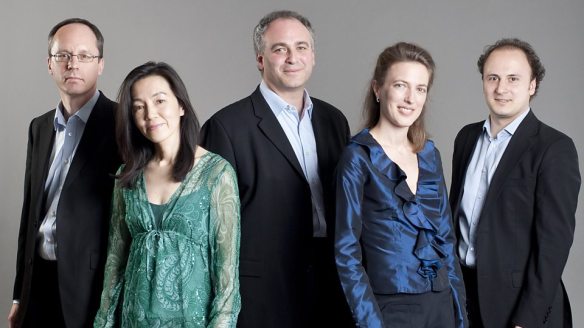
Wigmore Mondays: Florilegium visit Paris and Germany

Florilegium (Ashley Solomon (flute, director), Bojan Čičić (violin), Reiko Ichise (viola da gamba), Stephen Devine (harpsichord)

Telemann Paris Quartet No.4 in B minor, TWV43:h2 (1738)
J.S. Bach Trio Sonata in G major, BWV1038 (1732-35)
Rameau Pièces de clavecin en concerts – Suite No.5 in D minor (1741)
Rebel Les caractères de la danse (1715)

Wigmore Hall, London; Monday 30 October 2017

Written by Ben Hogwood

The broadcast can be heard on the BBC iPlayer by clicking here

This year marks the 250th anniversary of the death of Georg Philipp Telemann. If that name doesn’t mean anything to you, then perhaps it should – especially if you are a follower of the music of Bach or Handel. Telemann, so the concert note for this recital informed us, wrote more than the two composers combined – an extraordinary feat when you think that he wrote a number of large scale stage and sacred works.

Some of his most admired works are on a smaller scale however, such as the collection of Paris Quartets he published in two parts, in 1730 and 1738. They are intimate works for flute, violin, viola da gamba and continuo (usually harpsichord) that allow a great deal of flexibility for the performers, subtly pushing the boundaries Baroque chamber music was exploring at the time.

Complementing the Telemann in this concert are works by J.S. Bach – a Trio Sonata co-written with son Carl Philipp Emanuel – and works by the Frenchmen Rameau and Rebel, each bringing the spirit of the dance to an intimate grouping of musicians.

Follow the music

Telemann Paris Quartet No.4 in B minor, TWV43:h2 (from 1:41) (19 minutes)

A bright and brisk Prelude gives a good illustration of how Telemann writes so well for strings and wind, but the performers often have difficult lines to play, as in the passage from 5:09 where the tempo quickens. After the Prelude the quartet moves into a series of dances, with an elegant Coulant led by the flute (7:26), then movements entitled Gai, Vite (11:18), Triste (a sombre, melancholy dance from 13:19) and finally a Menuet (15:55) that proves to be much lighter on its feet, especially in its quick middle section.

J.S. Bach Trio Sonata in G major, BWV1038 (from 23:32, 7 minutes)

Bach was always aware of musical developments in his age, and with this particular Trio Sonata it appears he only wrote one part of the three, delegating the other two for son Carl Philippe Emmanuel to complete. Although there are three parts, typically with Baroque instrumental pieces there are actually four instruments taking part – the harpsichord and viola da gamba (an early form of cello without a spike, and in this case with five strings) share the bass / harmony roles.

This piece starts with an attractive, languid line on the flute that the violin shadows. The mood is – perhaps for Bach – surprisingly relaxed. A quick movement, marked Vivace (lively) follows from 26:42, but it’s gone in a flash – and a much slower Adagio movement begins at 27:38, with thoughtful interplay between flute and violin. Then at 29:40 a more substantial quicker movement, marked Presto, features typical Bach figures passed between each of the four instruments.

Rameau Pièces de clavecin en concerts – Suite No.5 in D minor (from 32:31, 13 minutes)

Rameau named the three movements of this suite after his fellow composers, although it doesn’t suggest in the concert note if he was painting a character portrait of each. If he was, then Forqueray, the first subject, would be a genial sort with a memorable hook – in this case introduced by the harpsichord from 32:31. Cupis (from 37:10) would be a thoughtful, deep kind of person, prone to a few bouts of melancholy, while Marais (42:34) would be a bright, energetic figure, again with a catchy tune with frequent and highly enjoyable repeats!

Rebel Les caractères de la danse (from 46:00, 8 minutes)

An early medley, if you like – a collection of short dances all rolled up into one. In the course of a fun-packed eight minutes, Rebel fills the music with eleven different dance forms, both slow and fast, giving his ensemble plenty to do. The harpsichord provides the crisp rhythmic emphasis, along with the viola da gamba, but is also given the tune at times, and invited to show off. The piece ends with a rapid dance with which only the quickest of feet could keep up!

Encore

A Bolivian dance from one of Florilegium’s three albums of Bolivian Baroque music (55:10), with some lively lines for violin and flute – and Reiko Ichise ditching the viola da gamba for shakers!

Thoughts on the concert

This was a very stylish and enjoyable concert. Florilegium have been together since 1991, and their performing style shows them totally at ease with the music of the Baroque period. Here they flourished especially in the Rameau and Rebel dance-based works, where harpsichordist Stephen Devine prompted and probed with tasteful, rhythmic playing.

The Telemann was a charming performance, the seriousness of its home key of B minor given a lift in the dance movements, while the Bach was unusually lyrical for the trio sonata form. A concert played with good humour and considerable panache, topped off by the exoticism of the Bolivian encore.

Further listening and reading

You can hear Florilegium’s recordings of the complete Telemann Paris Quartets in three volumes on Spotify. The third volume includes the quartet heard in this concert:

Meanwhile their explorations of the Bolivian Baroque can also be heard here, a first disc of three:

Telemann’s Water Music is one of his best loved works, and makes an excellent companion piece to the Handel. From experience I can say it is a thrilling work to be part of, as this performance from the Musica Antiqua Köln and Reinhard Goebel illustrates!

Steven Isserlis & Olli Mustonen at the Wigmore Hall – A Revolutionary cello recital

Steven Isserlis (cello) and Olli Mustonen (piano)

Prokofiev Ballade, Op.15 (1912)
Mustonen Chanson russe & Danse Oriental (1995)
Kabalevsky Cello Sonata in B flat major Op.71 (1962)

Wigmore Hall, London; Sunday 29 October 2017

Written by Ben Hogwood

A chamber concert with revolution in the air. This carefully chosen recital was short and to the point, but contained some deeply meaningful music lying just outside of the normal repertoire for cello and piano. Just before Steven Isserlis and Olli Mustonen played an early Sibelius Waltz as their encore, the cellist explained the programme’s themes of revolution, both in Russia and Finland.

They began with a startling performance of Prokofiev’s Ballade in C minor, startling in the sense that this music was brought to life with an intensity rarely experienced in this or any of the composer’s music. Isserlis was at his probing best, particularly in the pizzicato sections, but Mustonen took the lead, bringing out the composer’s phrasing as only he can, with heavily weighted emphasis on the most important harmonic notes. Thus the piece became a Ballade in the truest sense of the word – dark, passionate and stormy.

Mustonen’s joining of links between his own Finland and Russia was next, the Chanson russe surprising in its simplicity, which was touchingly effective, before a whirlwind Danse Oriental that could have been contemporaneous with the Prokofiev. It made a highly effective concert piece, and both performers clearly enjoyed it.

The most substantial piece was Kabalevsky’s Cello Sonata, written perhaps inevitably for the great cellist Mstislav Rostropovich in 1962. With some of the Rostropovich dedications the cellist’s spirit hangs heavily over the music, and it was easy to imagine his larger than life projections of the melodies. While Isserlis may not have the sheer volume of the late Russian (who does?!) he has sensitive phrasing and a lovely tone at his disposal, and, at the beginning of the second movement, produced a feather-light touch on the tremolos that sent a shiver down the spine.

Again it was satisfying to experience a piece packed full of melody, and with more harmonic sleights that Mustonen inevitably brought to the fore. The style could be viewed as a hybrid of Prokofiev and Shostakovich – no bad thing, certainly! – and the main melody, which reappeared at the end, had a harmonic twist and simplicity that pulled subtly at the heartstrings.

The major-minor subtleties of the writing were fully explored, and while Mustonen often took the lead rhythmically this felt wholly appropriate. Kabalevsky is a composer whose music works well in the concert hall, with memorable tunes, a sense of humour and pockets of unexpected poignancy. It is less obviously weighted than Prokofiev but extremely enjoyable on its own terms.

Gratifyingly, Isserlis and Mustonen explored those qualities to the full, and with their virtuosity and drive they gave the composer the best possible advocacy. The Sibelius waltz, known as the Lulu Waltz, was economy itself, over in a minute – but leaving a strong impression.

Further listening and reading

Unfortunately this concert is not available online, but you can hear the premiere recording, made by cellist Mstislav Rostropovich with the composer at the piano, on the Spotify link below:

In addition the Kabalevsky Cello Concertos are highly recommended – and they can be heard in these recent recordings by Torleif Thedéen and the Hannover Radio Philharmonic Orchestra, conducted by Eiji Oue:

Jean-Efflam Bavouzet, BBC SO / Sakari Oramo – Schmitt, Franck, Ravel & Sibelius Symphony no.3

Jean-Efflam Bavouzet (piano), BBC Symphony Orchestra / Sakari Oramo (above)

Barbican Hall, London; Friday 27 October 2017

Schmitt Symphony No.2 in E flat major, Op.137 (1957)

Franck Variations symphoniques (1885)

Ravel Piano Concerto in D ‘for the Left Hand’ (1930)

Sibelius Symphony No. 3 in C major, Op.52 (1907)

You can listen to the broadcast on BBC Radio 3 by clicking here (available until 26 November)

Reviewed by Richard Whitehouse

Sakari Oramo‘s Sibelius cycle continued as part of a judiciously balanced programme which opened with a rare revival of the Second Symphony by Florent Schmitt. This continues the French symphonism of Roussel and Honegger; albeit with a quirkiness of melodic thought and virtuoso handling of sizable forces to confirm Schmitt as no mere epigone. Indeed, the angular wit of the first movement suggests his willingness to confront post-war modernism head on, and if the central Lent admits warmer and even tender emotion, the finale resumes the assaultive mood with an unremitting intent through to its scabrous close. Oramo and the BBC Symphony Orchestra had the measure of this unsettling piece throughout; their responsiveness underlining that Schmitt was not one to accept the passing of his own era with even a hint of good grace.

Jean-Efflam Bavouzet (below) then joined the orchestra for two staples from the French concertante repertoire, separated in time by almost half a century. Good to see that Franck‘s Variations symphoniques has now re-established itself in UK concert programmes, as this unlikely yet successful hybrid of elements from symphony and concerto, as drawn into the pithiest of its composer’s cyclical designs, has a substance more than equal to its entertainment. Bavouzet and Oramo were especially fine in the expressive contrasts of its opening minutes, and if the rhapsodic musing at its centre seemed a little inflexible, then the effervescence of its final section too forcefully projected, there was no doubting the coherence and the ingeniousness of its composer’s response to a piano-virtuoso tradition he spent much of his life despising.

That the Franck outlines a ‘three movements in one’ formal design makes it a more than likely precursor to Ravel‘s Piano Concerto in D major, the most enduring of those left-hand works written for the redoubtable (if frequently wrong-headed) Paul Wittgenstein. Not the least attraction of tonight’s performance was its emphasizing the canniness of the balance between soloist and orchestra, such that the former was never less than audible in the context of what is the most overtly rhetorical and combative of all Ravel’s works. Add to this Bavouzet’s limpidity in the eloquent theme which returns intensified in the cadenza, not to mention Oramo’s control of momentum in the jazz-inflected animation of the scherzo, and what resulted was a reading attentive to every aspect of this masterpiece: one that justifiably brought the house down.

Sibelius’s Third Symphony is easy to underestimate as a transitional work poised between overt romanticism and renewed classicism. It was to Oramo’s credit that elements of both aesthetics were not only evident but also reconciled – not least in an opening Allegro which moved between fervency and incisiveness with no mean purpose. The highlight came with a central Andantino whose quasi allegretto marking may have been minimal, but whose opening-up of emotional space made for a riveting listen. The final movement was hardly less impressive in its purposeful equivocation between scherzo and finale, Oramo teasing resolve out of uncertainty so the hymn-like theme that eventually emerges built to a powerful apotheosis. A gripping performance, reinforced by the conviction of the BBCSO’s response.

For more concert information on the BBC Symphony Orchestra, head to their website

You can hear a recording of the Florent Schmitt made by Leif Segerstam on Spotify below:

On record: The Flautadors – Bavardage (First Hand Records)

The Flautadors (Catherine Fleming, Merlin Harrison, Celia Ireland, Ian Wilson, recorders)

First Hand Records FHR55 Playing time: 60’24”

Reviewed by Richard Whitehouse

Summary

Since its formation in 1997, The Flautadors has been at the forefront of recorder consorts in Europe and this latest disc, its fifth, features a selection of modern pieces, interlaced with arrangements of Scottish traditional songs, celebrating its 20th anniversary in fine fashion.

What’s the music like?

Two works by Japanese composers offer contrasting takes on aspects of Occident and Orient. Black Intention IV (1980) has Making Ishii exploiting microtonal tuning and extended playing techniques as akin to those of the European avant-garde – whereas in Idyll 1 (1976), Ryohei Hirose draws on Indian harmonic procedures to overly sensuous effect. With its combination of recorders and triangles, Arbos (1977) is a microcosm of the interplay between incremental melodic growth and relative harmonic stasis that Arvo Pärt pursued henceforth.

Two pieces by younger British composers underline the virtuosic potential of the recorder consort today. Bavardage (2002) finds David Murphy exploring the idea of gossip as springboard to quick-fire exchanges and emergence of a volatile momentum, whereas the calmer exterior of Leo Chadburn‘s De la Salle (2001) belies the intervallic intricacy (and the number of recorders) in what is atmospheric if at times unsettling music. Which leaves Terry Riley‘s In C (1964), that blueprint for American minimalism whose equably insistent pattern-making responds tellingly to the unity-within-diversity afforded by seven recorder players and 25 recorders.

As arranged by Ian Wilson, the Scottish traditional songs emphasize the lyrical aspect of recorder playing. Thus, the limpid poignancy of Ca the yowes and robust gaiety of Dandy Dancer, the virile impetus of Bose and Butter and reel-driven energy of The Deil Among the Tailors. Neil Gow’s Lament immortalised the 18th-century fiddler’s second wife in warmly elegiac terms effortlessly conveyed here, and though it may be less than four decades old, Sir Peter Maxwell Davies‘s Farewell to Stromness is a timeless classic whose pensiveness (and greater fervency of its central section) comes through unabated in this artless transcription.

Does it all work?

Yes. The Flautadors has long excelled right across the board when it comes to the recorder repertoire and such diversity is in evidence throughout this disc – which is recorded with an ideal blend of space and clarity, and informatively annotated by members of the ensemble.

Is it recommended?

Indeed. Those who still hold to antiquated notions of what recorder music is should find this disc stimulating and enjoyable in equal measure. Note that The Flautadors will be playing some of these pieces in their 20th anniversary concert at Milton Court on 26th November.

To listen to clips from this release and for further information visit the Flautadors website, while ticket information for the Milton Court concert can be found here