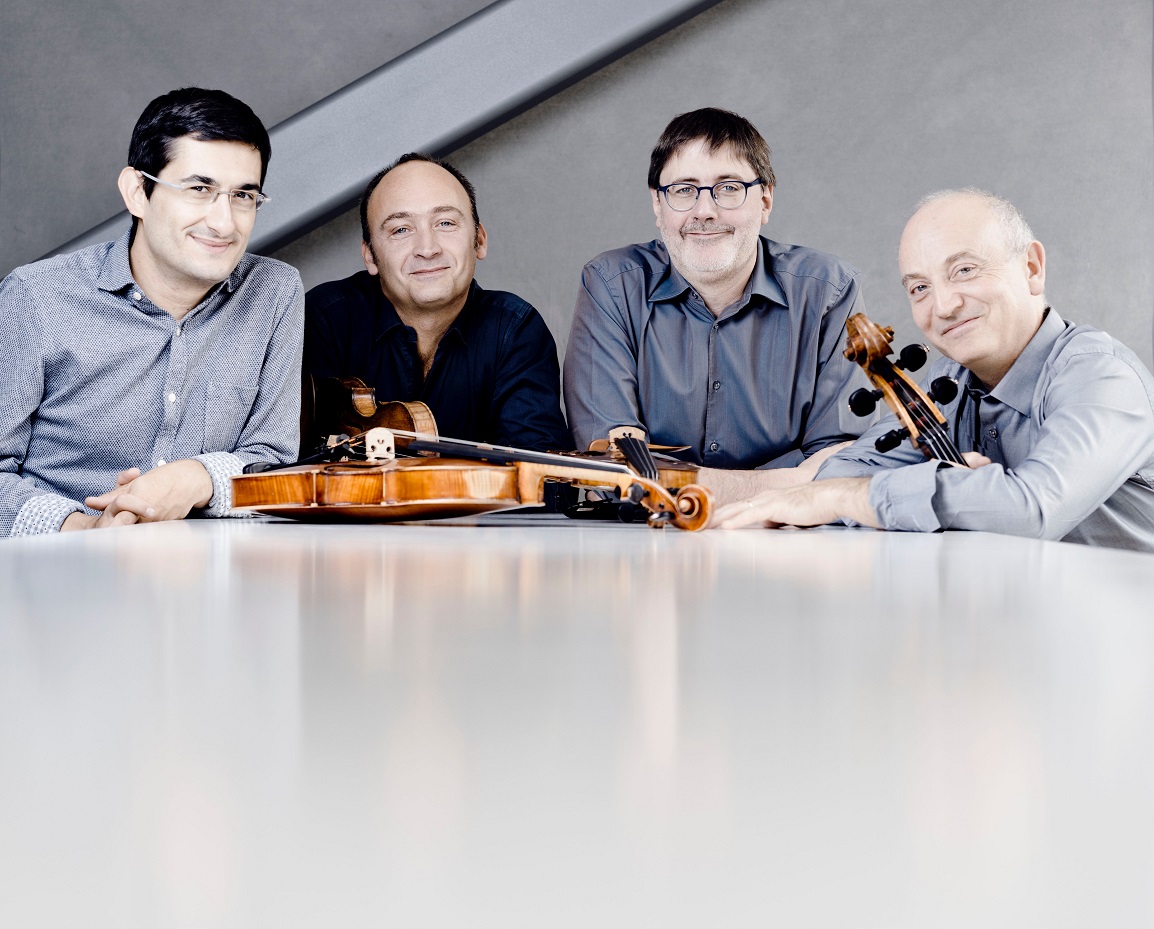
Quatuor Danel [Marc Danel & Gilles Millet (violins), Vlad Bogdanas (viola), Yovan Markovitch (cello)]
Weinberg String Quartet no.16 in A flat minor Op.130 (1981)
Weinberg String Quartet no.17 Op.146 (1986(
Shostakovich String Quartet no.15 in E flat minor Op.144
Wigmore Hall, London
Friday 27 June 2025
by Ben Hogwood Photo (c) Marco Borggreve
After giving fresh insight and context to the 32 string quartets and two piano quintets of Shostakovich and Weinberg, Quatuor Danel finally brought their Wigmore Hall cycle of both composers to a close. The journey began just before the COVID pandemic but was necessarily aborted. However on the series resumption in 2023 Wigmore Hall artistic and executive director John Gilhooly generously suggested the quartet begin the concerts afresh, a gesture acknowledged by Quatuor Danel first violinist Marc Danel before the group’s encore.
Danel admitted it had been difficult deciding which work should close the combined cycle, yet this concert proved the group had made the right decision, closing with some of Shostakovich’s final musical thoughts. Before that we heard the two very contrasting last quartets by Weinberg. His String Quartet no.16 was completed in 1981, the year in which his sister would have reached her sixtieth birthday had she not been murdered, along with the composer’s parents, in the Holocaust. Bearing her dedication, the quartet is a work of conflicting emotions, with an underlying tension trumped by a strong and lasting resolve.
Stylistically, Weinberg’s writing reflects his reacquaintance with the music of Bartók. This was evident from the heavy-set bow strokes of the first movement, where Danel led with power and precision. Weinberg allows time for calmer thoughts, but there was a guarded watchfulness that the Quatuor Danel conveyed most vividly here. The contrast between Scherzo and Trio in the second movement was striking, the emphatic gestures of the former upturned by the ghostly outlines of the otherworldly trio, which hinted at an alarm going off in the distance. The climax of the Lento felt like the culmination of a unified protest from all four instruments, its dissonant cries living long in the memory, before the waltz of the finale. Cold to the touch, the four instruments were muted but not silenced, and a period of moving stillness in the music held the attention before the waltz returned for the thoughtful closing bars.
With the String Quartet no.17, completed five years later, the mood changed completely. With a more explicit tonal language, this piece started in high spirits, Weinberg relishing the opportunity to revisit and quote from his earlier works, doing so in the spirit of pure musical enjoyment. A rustic first theme was brilliantly played here, as was the richly voiced chorale proving such an effective counterpart. This single movement work falls into four distinct sections, and eloquent solos from Danel and cellist Yovan Markovitch were memorable, before the feathery textures that began the finale, after which the chorale theme returning in an even brighter light. The positive disposition of the quartet gave it a youthful appearance beyond the references to early works, the composer enjoying childhood recollections through the viewpoint of relative seniority. The Danel ensured we were aligned in that viewpoint, too.
Shostakovich’s String Quartet no.15, however, is indisputably the work of a man in the twilight of his life. Written in six slow movements, it is one of the most distinctive utterances in the repertoire both of Shostakovich and the string quartet, and no performance should leave its audience unmoved. In the course of 40 minutes, Shostakovich leaves us with music that in terms of speed never really gets out of first gear, but whose intensity is unrelenting from its very first bars.
The Danel found that intensity with unerring accuracy, right from the first drawn-out melodies. Musically we seemed to have travelled back several centuries, the work unfolding with almost painful slowness, Shostakovich’s frailty made clear through music. And yet there is a spiritual quality looking ahead to the music of Arvo Pärt and Silvestrov, a kind of minimalism conveyed in searching, long-phrased melodies.
The Quatuor Danel were sparing in their use of vibrato, which made for an even more effective expressive tool when used, while their intonation was commendably flawless in such a difficult key for strings. In the second movement, ironically titled Serenade, the music felt inverted, its distinctive outcries made through crescendos reaching for the very soul. Marc Danel gave a searing solo at the beginning of the central Intermezzo, after which he sat, head bowed, listening to his three colleagues, while the viola solo from Vlad Bogdanas for the Funeral March was similarly charged. The Epilogue returned to the remarkable stillness present for much of this work, after which there was an equally moving silence.
It would be difficult to suggest an encore for music with such finality, but the quartet found an answer – in the shape of the first movement of Shostakovich’s String Quartet no.1. This might be thought an odd choice, but, as Danel explained, its music was a timely reminder for the world in which we live that the sun would come back. Hearing Shostakovich’s first and last statements for quartet in such proximity, it was hard not to agree with him – and so – with huge credit to the players for some memorable performances – this wonderful cycle concluded in the best possible way.
You can hear the music from the concert below, in recordings made by Quatuor Danel -including their most recent cycle of the Shostakovich quartets on Accentus:
For more information, click on the names for more on composer Mieczysław Weinberg and Quatuor Danel themselves.
Published post no.2,580 – Sunday 29 June 2025