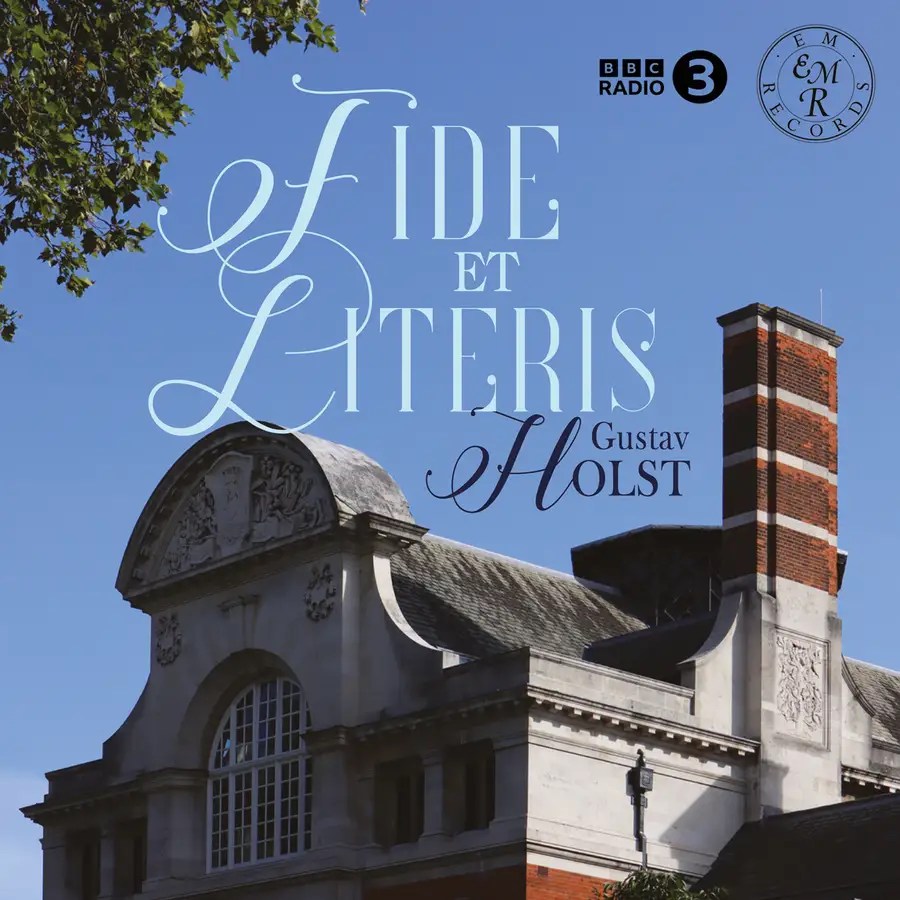
On Record – Em Marshall-Luck, Paulina Voices, BBC Concert Orchestra / Leigh O’Hara: Fide et Literis – Gustav Holst

Holst
St Paul’s Suite H118 (1912-13)
Brook Green Suite H190 (1933)
Gavotte H190a (1933)
Seven Choruses from the Alcestis of Euripides, H146 (1920)
Playground Song H118a (1911)
The Vision of Dame Christian, H101 (1909)

Em Marshall-Luck (reciter), Paulina Voices / Heidi Pegler, BBC Concert Orchestra / Leigh O’Hara

EM Records EMRCD090 [69’48”]
Producer Neil Varley Engineer Christopher Rouse

Recorded 4-5 November 2023 in the Great Hall, St. Paul’s Girls’ School, Brook Green, London

Reviewed by Richard Whitehouse

What’s the story?

EM Records further extends the Holst discography in the 150th anniversary year of his birth (and 90th anniversary year of his death) with this collection of works written at and intended for pupils of St Paul’s Girls’ School, where the composer taught for 29 years until his death.

What’s the music like?

For all his interest in matters spiritual and arcane, Gustav Holst was an eminently practical musician whose educational pieces were tailored to the situation at hand. Not least his Seven Choruses from the Alcestis of Euripides, written for a production of this drama at St Paul’s. Its scoring for unison female voices, three flutes and harp recalls those diaphanous settings in the Third Group of Choral Hymns from the Rig Veda – not least its sixth chorus ‘I have sojourned in the Muse’s Land’ that, in its fusion of yearning with sensuousness, is ideal for such a text as this.

Most substantial here is The Vision of Dame Christian – aka The Masque – written for the play by Frances Gray, who was the first headmistress (then High Mistress) at St Paul’s. The ‘Dame Christian’ in question is Christian Colet, mother of John Colet who had founded the original St Paul’s School 400 years before. Set in 1523, the sequence comprises three choruses with a prelude, interlude and finale – the scoring, for female voices with small orchestra, conveying a pathos devoid of sentimentality which is typical of Holst’s music for this school. Revived at decade-long intervals until 1958, it was heard again in 1973 (and issued privately on LP) then given a full production in 2013, but this first professional recording captures its deftness and eloquence in ample measure. Perhaps future performances would be feasible in other venues?

The two suites for strings long ago took their place within a lineage of compositions for this medium to which British artists have contributed so extensively throughout some 150 years. Certainly, the St Paul’s Suite is a classic of its genre – what with its rumbustious initial Jig, its animated Ostinato, its alternately soulful then playful Intermezzo, or a Finale which revisits Holst’s Second Suite for Military Band by combining traditional tunes The Dargason and Greensleeves in a fantasia ingenious and affecting. The Brook Green Suite is simpler in design – which is not to deny the appeal of its homely Prelude, its wistful Air or its lively Dance. Recorded for the first time is the Gavotte which Holst omitted at the premiere, its brusque charm enhancing the whole when heard in its original context as second movement.

Does it all work?

It does. This project was evidently a labour of love for St Paul’s Girls’ School, whose Paulina Voices duly rise to the challenge of continuing their venerable tradition under the admirable direction of Heidi Pegler, not least in the Playground Song with its ‘Henry Newbolt meets St Trinian’s’ text. The passages of recitation are rendered with clarity and elegance by Em Marshall-Luck (herself a Paulinian), while Leigh O’Hara secures a spirited response from the BBC Concert Orchestra in music whose sheer directness and accessibility are never for a moment naïve or simplistic.

Is it recommended?

It is. The presentation is well up to EMR’s customary standards, with detailed annotations by Em Marshall-Luck and school archivist Howard Bailes. Clearly the Great Hall of St Pauls’ Girls’ School is as ideal for recording as ‘Mr Holst’s Room’ in the Music Wing proved to be for his composing.

Listen & Buy

For further information visit the EM Records website, and for purchase information visit the Presto website. Click on the names for more on conductor Leigh O’Hara, Paulina Voices, the BBC Concert Orchestra and for more on The Holst Society

Published post no.2,382 – Wednesday 4 December 2024

On Record – Early Stereo Recordings Vol. 6: Sibelius – Finlandia, Pohjola’s Daughter, String Quartet etc (First Hand Records)

Sibelius
Finlandia Op.26 (1899)(a)
Finlandia – Hymn (1938)(b)
Song of My Heart Op.18/6 (1900)(b)
The Origin of Fire Op.32 (1902, rev, 1910)(c)
Pohjola’s Daughter Op.49 (1906)(d)
Valse triste Op.44/1 (1904)(a)
String Quartet in D minor Op. 56 ‘Voces intimae’(e)
Finlandia Op.26 (1899)(f)

cSulo Saarits (baritone); eQuatuor Pascal [Jacques Dumond, Maurice Crut (violins), Léon Pascal (viola), Robert Salles (cello)]; bcHelsinki University Chorus / Martti Turunen; cdCincinnati Symphony Orchestra / Thor Johnson; aOrchestra del Maggio Musicale Fiorentino / Vittorio Gui; fPhilharmonia Orchestra / George Weldon

First Hand Records FHR85 [82’37”]
Producer and Engineer Raphaël Mouterde

Recorded aOctober 9th and b10th 1953, November bd20th and c21st 1953, fMarch 12th 1956, ebefore July 1957. Transfers and Remastering Paul Baily
Detailed production credits at the First Hand Records website

Reviewed by Richard Whitehouse

What’s the story?

First Hand Records continues its valuable Early Stereo Recordings series with this volume devoted to Sibelius, mostly featuring performances that had little wider availability on their initial release and which have seldom, if at all, been reissued in their original stereo format.

What are the recordings like?

First issued on two Livingston Audiosphere binaural tapes, Vittorio Gui’s Sibelius confirms this conductor’s wide-ranging sympathies as to repertoire. Finlandia is accorded a forthright and impulsive reading which is brooding and even ominous in its earlier stages, then with its hymnic melody elegantly while unaffectedly rendered. Valse triste feels arguably even more persuasive as Gui secures playing of poise and finesse from the strings of Maggio Musicale Fiorentino, building up to a culmination of sustained intensity prior to its elegiac conclusion.

George Weldon’s Finlandia affords instructive comparison. First issued on an EMI Columbia stereosonic tape, it exudes no mean spontaneity and panache with the Philharmonia sounding as idiomatic as on the Sibelius recordings made with Herbert von Karajan during this period.

Most valuable are those remaining items. What was initially issued as an A-V Tape Libraries binaural tape is a fascinating collection, not least for this first studio recording of the cantata The Origin of Fire which is overall the best of Sibelius’s Kalevala-derived choral works, and combatively rendered here by Sulo Saarits with the Helsinki University Chorus – which latter contributes respectively stirring then evocative accounts of the indelible Finlandia Hymn and delectable Song of My Heart under Martti Turunen. The Cincinnati Symphony Orchestra comes into its own with Pohjola’s Daughter, the symphonic fantasia that straddles its composer’s nationalist and more classical phases – duly endowed with often irresistible momentum by Thor Johnson (1913-1975), the American conductor who made numerous important recordings at this time.

Surely the highlight, though, is Quatuor Pascal’s reading of Voces intimae. First issued as a Concert Hall Society stereophonic tape, this was only the work’s fourth recording (after those (two) by the Budapest and Griller quartets) and demonstrates acute appreciation of Sibelius’s idiom as shared by few French musicians at this time. From the powerfully wrought opening Allegro with its pulsing Vivace continuation, via the inwardly eloquent Adagio then trenchant Allegretto, to the impetuous final Allegro – this is an interpretation to rank with the very best.

Does it all work?

Yes it does, remembering these recordings were made in Sibelius’s lifetime (just two months before his death in the case of the String Quartet) and can lay claim to pioneering status. The transfers have been expertly managed, conveying the dynamic range and tonal range of those original masters without unwarranted intervention. Tully Potter pens informative annotations, and Peter Bromley invaluable context, though the timing for Weldon’s Finlandia should read 9’17” rather than 8’31” hence is faster than Gui by mere seconds rather than almost a minute.

Is it recommended?

Indeed it is, and it could well be regarded as the most significant release in this FHR series so far. Coming in the wake of groundbreaking inter-war projects from the Sibelius Society, these issues are a vital chapter in the history of Sibelius recording and an indispensable acquisition.

Listen & Buy

For further information and purchase information visit the First Hand Records website. Additional details on (most of) these recordings can be found on the Discogs website

Published post no.2,381 – Tuesday 3 December 2024

Switched On – Lia Bosch: Polar Code (Glacial Movements)

by Ben Hogwood

What’s the story?

Story, visuals and music come together in the work of Italian Lia Bosch, the first woman to record on the Glacial Movements label in its history. Described as ‘a multi-dimensional work that encourages deep reflection on existential and social themes’, Polar Code unfolds with the following plot:

Polar Code unfolds through a story set in an abandoned alien base in Antarctica, a remote and mysterious location where ancient human experiments once took place.

The protagonist, a researcher sent by a secret government agency, is tasked with investigating unusual activity detected in the region. Upon arrival, he encounters a desolate, eerie landscape filled with darkness and secrets, where every corner hides traces of a vanished alien presence that still feels ominously close. As the researcher explores the facility, he comes across the symbol of infinity, a glowing, pulsating portal that seems to be the key to understanding the connection between all life forms in the universe. This symbol becomes the focal point of the narrative, conveying a profound message about interconnection: every human action, every choice, has repercussions that extend beyond time and space.

The researcher is thus plunged into a deep existential reflection on his own existence and humanity’s role in a vast, intricate cosmos. The symbol of infinity, laden with meaning, is not merely a scientific discovery but an ethical and philosophical call. It embodies a profound truth: no matter how separate or superior humans may believe themselves to be, they are an integral part of a universal, interconnected system. The information contained within the symbol offers humanity a chance for redemption and salvation, but it also demands an acknowledgment of human fragility and the oppressive structures that underpin society.

The protagonist faces a crucial decision: to accept the revelation of the symbol and risk disrupting the global order, or to turn away from the opportunity to change humanity’s fate. This choice presents a profound moral dilemma, in which the potential to reform society—currently rooted in exploitation and conflict—collides with the risk of unleashing further destruction. Bosch delves into the tension between the need for renewal and the dangers inherent in transformation. Polar Code stands out as a work that transcends simple storytelling, weaving together sound, images, and words to provoke reflection on power dynamics, human fragility, and cosmic.

What’s the music like?

Compelling – and not a little eerie.

Polar Code opens with thick ambience, the remoteness of the location described by music that is simultaneously comforting and a little oppressive, the audio equivalent of lying under a thick duvet.

Gradually the sonic perspective widens and Bosch reveals her descriptive powers. Secret Frequencies pulses with activity, while the frequencies reach higher in Resonance. Stepping Beyond caries with it the danger of exploring hidden places and dark corners, the thickness of the sound closing in. Unknown System and Alien Circuit provide a little relief from this but presents mysterious vistas, created through subtle harmonic implications.

As the explorations continue so Bosch’s noise spectrum broadens still further, with long notes of New Parameters ushering in the striking scenes of Unveiling, where single notes in shrill timbres paint vivid pictures. Infinity has a sprawling, semi-industrial outlook, still cold but with various machine workings spotlit. Gradually the sound retreats, with Insight offering a reflection then a sonorous blast of ambient noise.

Does it all work?

Yes, but is all the more effective if the listener has the story close by. Then the full range of Lia Bosch’s painting in sound can be fully appreciated.

Is it recommended?

It is indeed. Polar Code presents a cold outlook and is often bleak in its canvas, but there is real storytelling afoot here, and for Bosch to achieve that in a small number of meaningfully deployed notes is most impressive.

For fans of… Loscil, Autechre, Cabaret Voltaire, Tim Hecker, Biosphere

Listen & Buy

Polar Code is released on Friday 5 December – at which point you will be able to listen to it via Bandcamp here:

Published post no.2,381 – Monday 2 December 2024

In concert – King Creosote @ Union Chapel, London

Union Chapel, London, 29 November 2024

by John Earls. Photo credit (c) John Earls

I fell in love with King Creosote (real name Kenny Anderson) in 2006 with the release of the special edition of KC Rules OK (which included superb sleeve notes by author Ian Rankin) and have been smitten ever since. He is a great singer-songwriter.

I first saw him live at London’s 100 Club in 2009 playing to about 100 people and then again at Union Chapel in 2011 where he performed the masterpiece Diamond Mine album with Jon Hopkins.

As an aside, I also met him on a bus in London in 2013. I was going to a concert at the Barbican and he hopped on with crutches and his ankle in a cast. He was utterly charming and it says something about him that he was on his way to play a gig (yes, on a bus and on crutches).

Needless to say I was looking forward to seeing him again at Union Chapel which is a stunningly beautiful venue. So let me get a couple of gripes out of the way.

Firstly, the sound system. Kenny Anderson is not just a superb singer – he is also a consummate wordsmith. It was therefore particularly disappointing that his words were often unintelligible (at least where I sat in the fifth pew). One can patch things up if familiar with the lyrics, but what a shame for those coming to KC for the first time. I’ve seen a number of live acts at Union Chapel (including, as mentioned, KC himself) without the same issue.

Secondly, the concert was performed in front of a screen which showed graphics accompanying the music. These were an interesting visual accompaniment and I get that they would be effective against the usual stage setup, but when gifted with such a magnificent backdrop as the wonderful stained glass East Window above Union Chapel’s pulpit and stage why obscure it? (again, this may have been more of an issue from my vantage point).

So to the concert which mostly consisted of a performance of the excellent 2023 I DES album in full. Inevitably, this will seem as much a review of that album (which I think will also be regarded as a masterpiece) as of the gig itself, for which KC was joined by an excellent seven piece band (including Emily Barker who performed a very good solo opening set) featuring acoustic guitar, accordion, fiddle, keyboards, synths, drum machines and percussion.

The performance effectively portrayed the album’s themes of love, loss and mortality, as well as its sense of optimism, hope and gratitude and opened with It’s Sin That’s Got Its Hold Upon Us with thumping beats and sweet strings.

We then had what Anderson has referred to as his “death trilogy” starting with the wonderful Blue Marbled Elm Trees. There can’t be a better song about one’s own funeral (I recommend listening to the fabulous episode of Nicola Meighan’s Kick Up The Arts: All Back To Mine with Anderson, where he says of this song “it had to be a jaunty death”). Burial Bleak and Dust complete the trilogy, which is then followed by the melancholic Walter de la Nightmare, the very bouncy Susie Mullen and Love Is a Curse.

The piano ballad Ides is one of the standout songs of the album (in my view it’s one of Anderson’s best ever), a perfect example of his unparalleled combination of voice and lyrics. Take the opening verse which amounts to a short story in itself:

When I said ‘excuse me, please’
You asked oh what did I want
I wanted someone to lie with on a Tuesday afternoon
Let’s say sometime around one o’clock
You must have looked shocked I fast changed tack
Right enough Thursdays are better for me
Once the clocks have gone back.

Mournful and beautiful, he sings, “But once I heard your voice / Like a punch to the chest / A kick in the gut / And a blow to the head all at once” and it takes my breath away.           

The I DES section of the show closes with Please Come Back I Will Listen, I Will Behave, I Will Toe the Line, shorter than the 13-minute album version but equally absorbing with fine backing vocals.

The rest of the concert consists of four numbers, a lovely So Forlorn, a lively No One Had It Better (from 2009’s Flick the Vs), Spystick (from 2007’s Bombshell) which (movingly for this reviewer) includes a taste of Not One Bit Ashamed (from KC Rules OK), and a groovy cover of Amanda Lear’s disco banger Follow Me. Kenny and the band then take a bow and are gone. As I left Union Chapel I said to myself “Thank God for Kenny Anderson”, a unique voice – lyrically, musically and literally.

John Earls is Director of Research at Unite the Union. He posts on Bluesky and tweets / updates his ‘X’ content at @john_earls

Published post no.2,370 – Friday 22 November 2024

In concert – Alexander Roslavets, Gidon Kremer, LPO / Andrey Boreyko @ Royal Festival Hall: A Dark Century

Alexander Roslavets (narrator / bass), Gidon Kremer (violin), London Philharmonic Choir (men’s voices), London Philharmonic Orchestra / Andrey Boreyko

Schoenberg A Survivor from Warsaw Op.46 (1947)
Weinberg Violin Concerto in G minor Op.67 (1959)
Shostakovich Symphony no.13 in B flat minor Op.113 ‘Babi Yar’ (1962)

Royal Festival Hall, London
Wednesday 27 November 2024

Reviewed by Richard Whitehouse Pictures (c) Richard de Stoutz (Andrey Boreyko), Angie Kremer (Gidon Kremer)

Anyone who heard one or other of these works for the first time at this concert by the London Philharmonic Orchestra could be forgiven for thinking that the twentieth century, if not a ‘dark century’ per se, was at the very least a troubled one for all that the quality of its music was undeniable.

With its elements of melodrama and cantata, Schoenberg’s A Survivor from Warsaw is one of his most original conceptions and necessarily so, given the unnerving immediacy of its text in which a speaker has to take on the roles of survivor and officer in just six minutes. Alexander Roslavets rose to this challenge, bringing out emotional contrasts as surely as he instilled his words with that ominous dread whose culmination in the prayer Shema Yisrael was intoned by the London Philharmonic Choir with the right balance between desperation and defiance.

One composer who witnessed something of such atrocities was Mieczysław Weinberg, and if his Violin Concerto demonstrably continues the ‘Romantic’ tradition, this is still an inherently personal statement. Gidon Kremer has championed the composer extensively in recent years and, while technical issues seemingly inhibited the respectively incisive and impetuous outer movements, the restless searching of its intermezzo-like Allegretto then confiding eloquence of its Adagio were abundantly in evidence. For all its outward virtuosity, the music’s essential inwardness is what prevails as the soloist remains musing when the orchestra fell silent at the close of the finale. Kremer was in his element here, as in a touching rendition of Silvestrov’s Serenade which made for an apposite encore and was dedicated to all the people of Ukraine.

Best known for giving the posthumous premiere of Gorecki’s Fourth Symphony with the LPO 10 years back, Andrey Boreyko is well established as an exponent of Shostakovich so that his take on the Thirteenth Symphony did not disappoint. At a distance of over six decades, it can be hard to recapture the provocation of that most eminent Soviet composer using verse by the most populist younger poet, as Yevgeny Yevtushenko then was, but this setting of Babi Yar retains all its expressive force through the immediacy and resourcefulness in which it relates official indifference to the Jewish massacre as that ravine outside Kyiv was transformed into landfill. Broodingly restrained, Roslavets emerged into his own with Humour – its scabrous send-up of bone-headed officialdom inspiring one of Shostakovich’s most scurrilous scherzos.

Fashioning the last three movements into a cohesive if cumulative unity, Boreyko underlined the potency of Shostakovich’s creative vision as he takes the Soviet establishment to task for various failings economic as In the Store, political as in Fears and cultural as in A Career. Implacable then volatile, these first two are rounded off by Yevtushenko’s considering of the relationship between society and the individual; framed by an undulating melody, for flutes then strings, which is one of its composer’s most evocative as well as affecting inspirations.

It duly brought this work, and this performance, to its subdued yet spellbinding close. As the relationship between East and West becomes ever more confrontational, Shostakovich’s 13th remains a testament to rationality and compassion whose denigration is to everybody’s cost.

For details on the 2024-25 season, head to the London Philharmonic Orchestra website. Click on the names to read more about soloists Alexander Roslavets and Gidon Kremer

Published post no.2,373 – Monday 25 November 2024