Schoenberg Pelleas und Melisande Op.5 (1902-03) Zemlinsky Die Seejungfrau (1902-03)
BBC National Orchestra of Wales / Ryan Bancroft
Royal Albert Hall, London Monday 22 July 2024
reviewed by Richard Whitehouse
While the Proms has periodically resorted to re-creating concerts from its earlier years, there have been relatively few attempts to recreate groundbreaking events elsewhere – so making this replication of a programme played in Vienna on 25th January 1905 the more significant. Neither work enjoyed regular revival until the 1980s – the Schoenberg through logistics and the Zemlinsky through inaccessibility – but their expansive all-round scope, and their lavish forces, ensured that both were heard to advantage in the opulent Royal Albert Hall ambience.
It is not clear whether this running-order was that of the Vienna concert, where Schoenberg’s symphonic poem Pelleas und Melisande was lauded as the more original statement. Which is true as regards its late-Romantic idiom on the cusp of nascent Modernism, but the composer made things more difficult than they might be through his approach to form, whose outcome Busoni likened to ‘‘a number of sharp implements jostling in a sack’’. Maurice Maeterlinck’s drama may be covered in its essentials, but the challenge of channelling this into a systematic evolution make for an undeniably episodic trajectory. Ryan Bancroft succeeded admirably in holding together the sprawling whole, not least with his relatively swift (40-minute) traversal that kept the narrative aspect always in focus, while emphasizing the numerous harmonic and textural innovations. Nor was the BBC National Orchestra of Wales lacking in power, finesse or, indeed, that clarity needed to convey the density of Schoenberg’s motivic thinking, but the feeling of this work being ultimately being no more than the sum of its parts was inescapable.
Not something as could be levelled at Die Seejungfrau, Zemlinsky’s symphonic fantasy after Hans Christian Andersen that was well received if soon condemned as unduly derivative and disappeared after the score was withdrawn in 1907 – only to resurface 77 years later. It might lack the force and personality of Schoenberg, but Zemlinsky’s handling of an orchestra only slightly less extensive is comparatively effortless; the formal division into three movements of almost equal duration providing an overview of, without being beholden to the narrative, while enabling its composer’s hardly less resourceful handling of motifs to evolve with due artlessness. True, Zemlinsky’s melodic language leans more audibly on others (chief among them Tchaikovsky and Mahler), but its unforced spontaneity feels in striking contrast to the portentous, even over-wrought aspect of Schoenberg’s writing. BBCNOW responded with unfailing sensitivity, and Bancroft ensured a seamless unfolding over each movement as of the work overall. For all its stylistic derivation, Zemlinsky’s is intrinsically the better piece.
Such an outcome may not have been evident had the pieces been otherwise juxtaposed, such as only made the decision to present them thus the more worthwhile. Clearly attuned to their notably differing idioms, Bancroft brought out the best in both works (interestingly he opted to omit the ‘Sea Witch’ episode from the second movement, excised before the premiere but restored in the critical edition of 2013) – their respective qualities able to be assessed in more objective terms, now that consideration of ‘historical necessity’ has itself receded into history.
Today marks 150 years since the birth in Vienna of composer, conductor and teacher Alexander von Zemlinsky.
Zemlinsky is a figure of great historical importance in classical music, with a marked impact behind the scenes on the direction it was to take in the 20th century. In his early twenties, he caught the attention of Brahms, who was impressed with the Clarinet Trio published as a composer’s Op.3 in 1896. Around this time Zemlinsky also met Schoenberg, and then Alma Schindler, with whom he had an intense relationship. Their union was unexpectedly and suddenly broken in 1902, however, when Alma married Gustav Mahler.
Zemlinsky’s musical family tree is an intriguing one. As a teacher he mentored and encouraged Berg, Webern and Korngold. As a conductor he received unreserved praise from Schoenberg, Stravinsky and Weill. Stravinsky declared in 1964, “I do believe that of all the conductors I have heard, I would choose Alexander Zemlinsky as the most outstanding, and this is a mature verdict.” Schoenberg admired his “natural, unforced and obvious greatness”.
It is as a composer that we remember him here, however, for Zemlinsky’s music has not yet reached the audience it deserves. One of his greatest works, the Lyric Symphonymade a strong impression at the Proms in 2016, and the Clarinet Trio was performed at the same festival this year. Those are just two of many fine compositions, however. Brahms was also impressed with Zemlinsky’s symphonic writing, and as an orchestral composer both his tone poem Die Seejungfrau and the Sinfonietta are fine works. The magical opening bars of the former, as heard in a new recording from the Royal Liverpool Philharmonic Orchestra and Vasily Petrenko for Onyx Classics, are to be treasured:
The four string quartets are also highly regarded, as is the output for solo piano, while another strong area for Zemlinsky was Lieder. Here there are many fine settings, perhaps the best of which are his 6 Songs after Poems by Maeterlinck of 1910-13.
The Spotify playlist below brings a number of these pieces together – while you can visit the Alexander Zemlinsky website to learn more about his life and work. Meanwhile a biography by Antony Beaumont, published in 2000 by Cornell University Press, is also highly recommended.
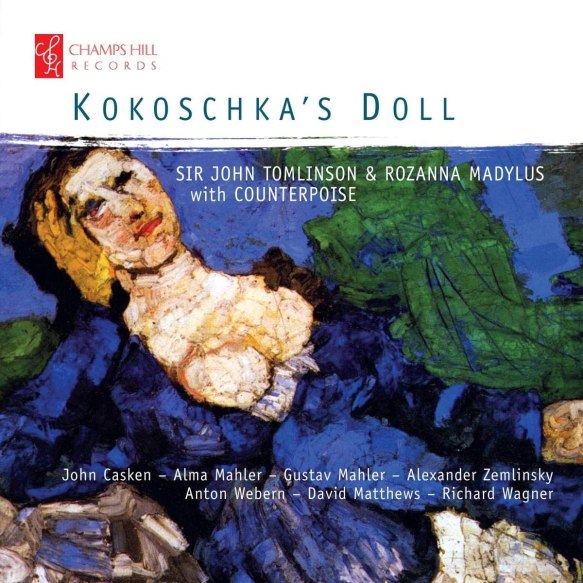
Rozanna Madylus (mezzo-soprano), Sir John Tomlinson (bass), Counterpoise [Kyle Horch (saxophone/clarinet), Deborah Calland (trumpet), Fenella Humphreys (violin), Iain Farrington (piano)]
Music by John Casken, Alma Mahler, Gustav Mahler, David Matthews, Richard Wagner, Anton Webern and Alexander Zemlinsky
Champs Hill Records CHRCD150 [81’54”]
Producer Matthew Bennett
Engineer Dave Rowell
Recorded 21-22 May 2018 & 17 January 2019, Music Room, Champs Hill, Sussex
Written by Richard Whitehouse
What’s the story?
The enterprising ensemble Counterpoise returns with its second release – an ambitious and wide-ranging selection centred upon that redoubtable femme fatale who was Alma Mahler and with a major new piece of music-theatre featuring Sir John Tomlinson from John Casken.
What’s the music like?
The generous programme effectively divides into two parts. The Art of Love opens with four songs by Alma – her setting of Julius Bierbaum’s Mild Summer Night and A Nocturnal Light followed by that of Gustav Falke’s Harvest Song, all of them accorded a fresh perspective in resourceful arrangements by David Matthews. Much the finest is the recently located setting of Leo Greiner’s Lonely Walk, but even this must yield to the radiance of Paul Wertheimer’s Blissful Hour by Zemlinsky, Alma’s lover before Mahler and an underrated Lieder composer.
Matthews’s subtle arrangement of Mahler’s rapturous Rückert setting If You Love for Beauty, followed by his ominous Wunderhorn setting Where the Splendid Trumpet Sounds, proceed Iain Farrington’s violin-and-piano transcription of the start of the Adagietto from Mahler’s Fifth Symphony (it would be worth hearing the rest). Webern’s glinting Trio Movement for clarinet, trumpet and piano is intriguingly countered by Matthews’s hardly longer yet more equable Transformation (with addition of piano); after which, his arrangement of Wagner’s Dreams (last of five settings after Mathilde Wesendonck) underlines its rapt introspection. Rounding off this first part with Liszt’s take on Isolde’s Liebestod might almost be thought rather predictable, but Farrington’s pointedly unshowy rendering is an undoubted pleasure.
The second half of this programme is devoted to Kokoschka’s Doll – a melodrama for bass-baritone and ensemble by John Casken, who has also devised the text in collaboration with Barry Millington. Drawing on the artist’s letters and autobiography, this almost 40-minute piece focusses on Kokoschka’s fractious liaison with a recently widowed Alma Mahler, his near-death experience as a soldier on the Eastern front, then his ill-fated attempt to recreate Alma as a doll to his idealized specifications. Unfolding between past and present, the text provides plenty of leeway for Sir John Tomlinson to convey the tortured while not a little self-seeking protagonist through an adept interplay of speech and parlando – dispatched with his inimitable blend of fiery rhetoric and soulful rumination. Instrumentally the music is rich in timbral and textural nuance, following the emotional ebb and flow of Kokoschka’s musings as they spill over into the irrational. An engrossing concept, skilfully realized, which would certainly be worth presenting in a scenic version at some of the UK’s many studio-theatres.
Does it all work?
As an overall sequence, certainly. Counterpoise is an object-lesson of unity within diversity, whether in the range of music this ensemble brings together or in the arresting nature of the arrangements it favours. Added to which, the singing of Rozanna Madylus is a treat in store.
Is it recommended?
Indeed. Performances and recording leave nothing to be desired, while the booklet features a succinct introduction by Millington along with reproductions from Kokoschka’s drawings of his ‘Alma Doll’ – more appealing visually than it becomes at the denouement of the scenario!
Listen and Buy
You can read more about this release, listen to clips and purchase from the Champs Hill website
Ask The Audience Arcana at the Proms This is the latest in the series where Arcana invites a friend to a Prom who does not normally listen to classical music. In an interview after the concert each will share their musical upbringing and their thoughts on the concert – whether good or bad! Here, Annie Turner (above) gives her thoughts on Prom 62.
Baiba Skride (violin), Siobhan Stagg (soprano), Christopher Maltman (baritone) BBC Symphony Orchestra / Siobhan Young
Bayan NorthcottConcerto for Orchestra (2014-2016, world premiere); MozartViolin Concerto no.5 (1775); ZemlinskyLyric Symphony (1922-23)
I was born in 1980 and so my earliest musical memories would be Vangelis, Dire Straits, Phil Collins and stuff like that, so I’m very fond of that music in a sentimental way. I was really interested in playing music, and I remember when I was about seven or eight I was absolutely desperate to learn the recorder, as the older kids in school were playing them. My mum asked the teachers but they said I was too young, and I had to wait until I was nine!
I learned recorder and got to play in the school concerts, but after that you pick up another instrument, so I did keyboard. I went to a country school in Australia, so there wasn’t a big music program. I learned piano for a while but struggled with the music because I didn’t find it interesting! It was classical, and it was a bit boring for me as a kid, but I really loved listening to music and working out the fidelity for myself. My dad was really into Andrew Lloyd Webber, and I used to work out bits of melody from Phantom of the Opera and Cats.
Then I stopped and didn’t pick it up again until high school when I was interested in bands. I got interested in grunge and wanted to play it, so I got into drums and guitar lessons, and really loved that. By the time I was that age I got really shy and didn’t want to play in front of anybody, so I was a bedroom musician. I still kept studying music at school though, and then when I graduated from high school I really wanted to play in a band.
I moved to Melbourne to go to university, and it was my dream to play in a band, so I just had to get over my stage fright! I joined any band that would have me…and I’ve played in some terrible bands and some awesome bands, but I mostly ended up playing drums in all of them, so I dropped the guitar. I played in a heavy metal band, a punk band and an experimental bands, a few jam bands. I did that for a few years, and we recorded and toured which was great. Then I moved to London and didn’t do it again, because London was a bit too big and intimidating and it was hard to have the resources. So that was my musical upbringing!
Could you name three musical acts you love, and why you love them?
There is a Norwegian black metal band called Satyricon, which I love, and I love them because I find their music is well written, well-constructed, engaging, it’s very melodic, atmospheric, it’s quite dark as well which I find when you’re in that mood. It’s frenetic, there’s a lot of energy to it, and I find it really interesting.
I don’t find I listen to acts any more, I listen to songs rather than acts…but I actually love Calvin Harris! I’ve followed his career, and I don’t love everything that he’s done, but I really love the fact he’s a pop purist. He writes and produces but he does it very well in a purely pop way but I think he respects that genre. He does quality work and it’s such good, good pop I think it’s genius – the construction, the way he has that mix of happiness and sadness in one song. Pop music you have to capture the kind of strategy of teen romance, which is kind of ‘gaggy’ but at the same time it’s got drama, some of it’s got humour, and I just think he’s excellent and very intelligent pop auteur.
For the third I would have to say I love Nirvana really, because that was the band I really got into in depth, because it was rebellious, artistic, subversive, but also even though it was very aesthetically abrasive it was pop music right down the line in the middle. It got me very interested in playing music as well as listening to music, and as well it had more implications for popular music. I was very obsessed with that band for a good five years!
What has been your experience of classical music so far?
I’m generally familiar with the big hits because you hear them on TV, and on adverts, and there are definitely pieces I’ve come to know and like, but other than that it’s really through watching films. I did a degree in film theory, and studied lots of films, but didn’t really study the music on the film.
I guess also there was a time when I would tune the radio to Classic FM because I didn’t want anybody to sing at me, I didn’t want to hear any words! I wanted something I knew would be relatively calm and peaceful. I know it’s not always like that though, and that classical music can be tumultuous! I was seeking something that would be a bit more calming I suppose. I remember I did buy an iTunes album of the greatest hits of the classics, but I didn’t really follow it any further than that.
How did you rate your first Proms experience?
I really enjoyed it. I had no expectation, and I guess I thought I might have got bored because if I didn’t know the music I might not follow it. I was surprised that I really did find myself getting enthralled, so I rated it to the point where I would definitely come back on my own. I would like to investigate it more, ask for tips, you know?
I like the opera Carmen, but any other opera I don’t like, because sometimes it sounds to me like yelling. I know you could say I listen to death metal, and that’s shrieking, but you know, it’s just yelling! The vocal music we just saw I didn’t think about it that way, I heard the music and looked at their faces, saw that emotion, and it felt a bit like I was watching a play. I think I might be coming around to being converted!
What did you think of the Bayan Northcott Concerto for Orchestra, the first piece?
That started off really avant-garde, and more modern, and I guess that surprised me in how it developed. It developed very smoothly into something that was a bit more formulaic in a classical sense. I had to remind myself that I didn’t really know what was going on, and the transitions I enjoyed. I felt that one took you on a bit of a journey that was quite surprising. I particularly liked the dynamics where you could hear something that was really loud, layered and reverberant, and then you could get something that was really quiet and minimal on one instrument. I enjoyed the delicacy of the sound, because when you see a band or a DJ you don’t get that, you just get ‘loud’ or ‘off’!
What did you think of the Mozart?
I thought I recognised it from having heard it before. I really liked it, and having someone palying solo you can focus in on it and follow their emotion, which was new and interesting, and I thought it was interesting too how the orchestra seemed to be all on the same level.
Normally you go to see a band and you think I’m seeing my idols, or seeing this famous person, and the people who created the music. They’re in a higher hierarchy so to speak. With the orchestra I had this sense that they’re just normal people, serving the music and all enjoying it. I liked it when it wasn’t about the composer, the rock star, and not about the conductor – they’re not facing us, they’re just delivering it. I really liked that sense of the music being the star. That was a new experience, you could see a different perspective even in the formalities of ‘now it’s my tern to stand up and play’, the ritual of it. It was really touching, and I think classical music might tend to have this image of being a little bit posh, a little bit fancy, but actually these people are not royalty, they’re working for the music. There wasn’t any grandiosity, it was very humble.
And the Zemlinsky?
That was probably my favourite. I was a bit apprehensive because it was like opera, and I’ve not really liked opera before, plus it sounded like it was in German. I don’t speak German, but I wouldn’t have thought it would be a language that would lend itself to singing! But OK, I was really surprised. I stopped thinking about the music. My mind did keep wandering and I was thinking about my own life, and I don’t know if the music was really influencing that or not, but it wasn’t like I was standing there going oh, that was a great bit of trombone, I was thinking about my own life! I was thinking about what was going on in my life.
I’ve recently started doing meditation, and know that it’s good to be present and mindful, so I did start to drag myself back and focus on the sounds and what was going on. It was good, though I did feel like it was a soundtrack to my thoughts. There was a lot of percussion and I really liked the textures of the drums, how deep that sound is, and I think there was a lot of melancholy and ‘blue’ notes. I like that darker sound, I guess that might be a bit of a cliché, but the sadder stuff probably says more to me than the jolly little dances I suppose!
I deliberately didn’t research the program, so think I will read that on the bus home which will be really interesting, to see what was in the text!
Would you go again?
I would. It would be amazing to see a piece I was already familiar with and really liked, so next year I can find out which composers I like more and make a plan to see more of them. At the same time I would also select something at random – something familiar and something new – and see how that works!
Soloists Christopher Maltman and Siobhan Stagg take the applause with conductor Simone Young and the BBC Symphony Orchestra after their performance of Zemlinsky‘s Lyric Symphony(c) Chris Christodoulou
Every festival has its ‘down’ periods – and here it was the turn of the Proms. Don’t stop reading there though, as by ‘down’ period I mean a Royal Albert Hall that was perhaps half full and music that was relatively unknown. The combination can on occasion lead to an unsatisfactory evening, but here it was a heartening opposite.
It was good to note a rare UK appearance for the Australian conductor Simone Young, her first at the Proms. Young is predominantly an opera specialist, so it was perhaps inevitable that Zemlinsky’s Lyric Symphony of 1923 should bring out the very best in her brief relationship with the BBC Symphony Orchestra.
This powerful, passionate account got off to the best possible start, assertively bringing Zemlinsky’s themes of doomed love to the front of the layered texture and packing the music with drama. Here Young was helped by the woodwind and brass, horn player Nicholas Korth in particular, though when singers Christopher Maltman and Siobhan Stagg got into action theirs was the defining contribution.
Baritone Maltman’s silky contribution was brilliantly judged, an ideal complement to Stagg’s soaring soprano, though the biggest notes on her part were saved for the particularly anguished lines in the poems of Rabindranath Tagore. When she began Stratt was a little coy, beautifully so, for this got the audience on to her side and meant we all felt her tragedy in Vollende denn das letzte Lied (Then finish the last song). Maltman it was who ended the symphony, striving for peace, which Young ultimately found in the beautifully floated coda.
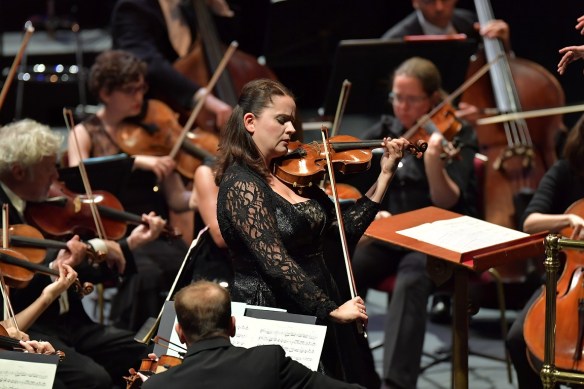
The performance was the shade to the light of Mozart’s Violin Concerto no.5. This did receive a slightly heavy performance in comparison to others, but the strings of the BBC SO were beautifully graceful in the slow movement and accommodating to soloist Baiba Skride (below, with the orchestra) in the outer fast movements.
Skride’s violin makes a beautiful sound, and it was a feature of her performance that the notes were floated towards the audience, respectful of the orchestral accompaniment but making the most of Mozart’s melodic inspiration. The choice of cadenzas by Brahms’s contemporary Joseph Joachim was a little risky but the virtuosic passages were sensitively handled, while in the finale, the so-called ‘Turkish’ part of the concerto that actually sounds more Hungarian, there was a pleasing rustic feel, as though we had all been ushered outdoors together. As a footnote to this, Skride chose a movement from a sonata by the eighteenth century composer Johann Paul von Westhoff as her encore.
First up on the program was a world premiere, Bayan Northcott’s Concerto for Orchestra. It is great to have so many in the Proms season, with the unfortunate caveat that not many of these pieces get a second hearing. This one was a premiere in two respects, being Northcott’s first work for orchestra alone. At the age of 76 that is an impressive achievement, and his care over the composition could be sensed in a compressed piece that was full of incident. Debts to 20th century composers such as Hindemith were occasionally felt, but the enthusiasm of the two fast movements drove the music forward, speaking in tunes but also impressing the ear with their instrumental textures too.



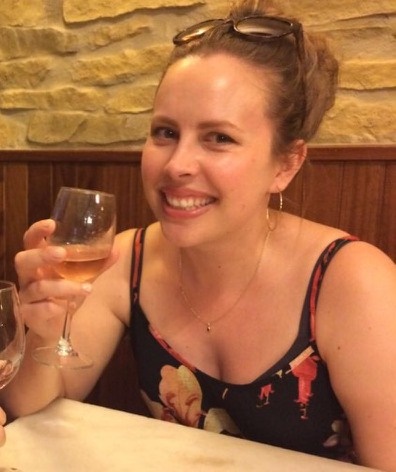 This is the latest in the series where Arcana invites a friend to a Prom who does not normally listen to classical music. In an interview after the concert each will share their musical upbringing and their thoughts on the concert – whether good or bad! Here, Annie Turner (above) gives her thoughts on Prom 62.
 Arcana.fm