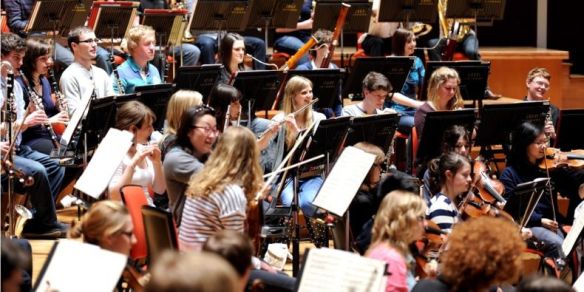
Live review – CBSO Youth Orchestra / Cristian Măcelaru: Copland Symphony 3, Clyne & Szymanowski with Tasmin Little

Tasmin Little (violin) CBSO Youth Orchestra / Cristian Măcelaru (below)

Symphony Hall, Birmingham
Sunday 24 February 2019, 3pm

Clyne This Midnight Hour (2015)
Szymanowski Violin Concerto no.1 Op.35 (1916)
Copland Symphony no.3 (1946)

Written by Richard Whitehouse

Concerts from the CBSO Youth Orchestra have long been a regular and welcome fixture on the Symphony Hall calendar, with this afternoon’s programme offering a judicious selection such as ranged across almost a century of music by British, Polish and American composers.

Many CBSO Youth Orchestra concerts feature a world or local premiere, and today started with a first Birmingham outing for Anna Clyne’s This Midnight Hour. Drawing inspiration (albeit obliquely) from poems by Juan Ramon Jiménez and Charles Baudelaire, this compact piece initially alternates between energy and rumination with steadily accumulating impetus. A pity, then, that the second half rather loses focus through an uneasy amalgam of waltz-like flaccidness and folk-inflected juvenilia; the whole seeming rather less than the sum of its parts.
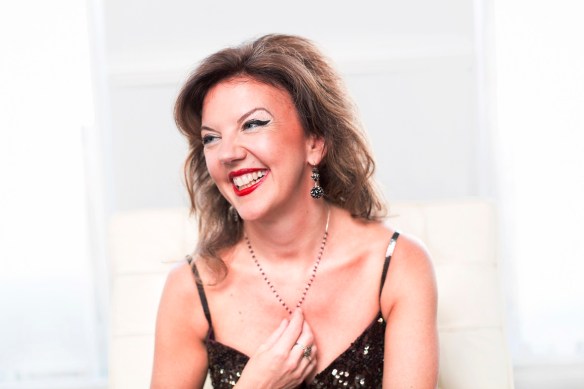
Tasmin Little (above) then joined the orchestra for Szymanowski’s First Violin Concerto, now firmly established as a repertoire item after many years on the periphery. Not the least fascinating aspect is its formal ambiguity – the continuous span interpretable both as a three-movement form as well as an extended sonata design.

It was a measure of Little’s insight that she elided between these possibilities in a performance which stressed the music’s organic inevitability as much as its heady sensuousness, abetted by Cristian Măcelaru’s attentive handling of an orchestration as by no means ‘plays itself’ in terms of overall balance. This was evident not least in the rapturous main climax – after which, Little vividly despatched the brief cadenza prior to the coda’s poignant recollection then the disarming evaporation of those final bars.
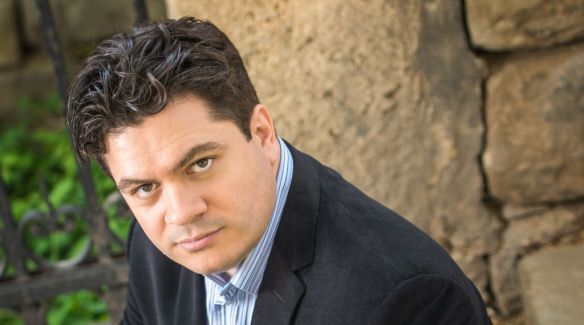
Copland’s Third Symphony is another piece to have garnered regular hearings in recent years – consideration of its being an anomaly in the composer’s output, by dint of its monumental aspirations, having become secondary to the sheer impact invested into its relatively modest (Brahmsian rather than Mahlerian) dimensions. A quality Măcelaru kept in mind throughout what was a cohesive and convincing account – whether in the steadily arching accumulation of tension then release across the first movement, tensile interplay of energy and nonchalance in the scherzo, or the calmly unfolding sequence of variants on a wistful opening theme that is the slow movement. Not the least significant aspect is the degree to which Copland secures thematic consistency across the broader span in the interests of formal and expressive unity.

The CBSO Youth Orchestra responded admirably, not least when being tested to the limit by the music’s polyphonic intricacy and textural density. Gratifying, too, that the best was saved until last – the finale powerfully launched by a paraphrase on Fanfare for the Common Man, before it heads into intensive discussion of the various thematic strands then builds inevitably to a majestic peroration. In Măcelaru’s hands, the latter conveyed affirmation without bathos – as though to confirm that emotional oneness no doubt at the heart of Copland’s conception.

The performance assuredly left its mark on the Symphony Hall audience, which responded with a well-deserved ovation. Next up is a concert by the CBSO Youth Orchestra Academy – for a programme of Weber, Shostakovich and Dvořák – at Town Hall on Sunday 28th July. You can find out more on the orchestra’s website

Further listening

Unfortunately there are no recording of Anna Clyne‘s This Midnight Hour online currently, but you can hear a recording of her orchestral piece Night Ferry on Spotify below:

Meanwhile Tasmin Little‘s recording of both violin concertos by Szymanowski for Chandos Records can be heard here, coupled with a scarcely recorded concerto by Mieczysław Karłowicz:

Finally Copland‘s Symphony no.3 can be heard below in a famous recording where the New York Philharmonic Orchestra is conducted by Leonard Bernstein:
Vilde Frang, BBC Symphony Orchestra / Sakari Oramo: Anna Clyne, Britten & Beethoven ‘Pastoral’

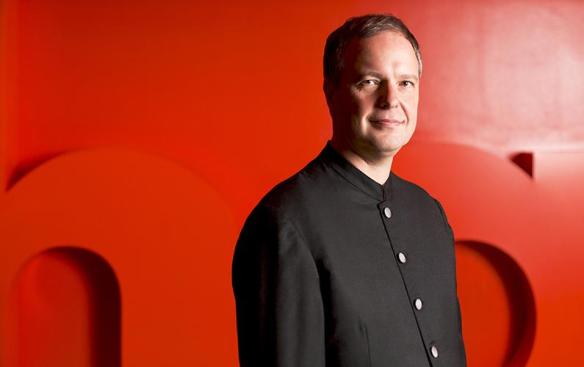
Vilde Frang (violin), BBC Symphony Orchestra / Sakari Oramo (above)

Clyne This Midnight Hour (2015) [London premiere]

Britten Violin Concerto, Op.15 (1939)

Beethoven Symphony No.6 in F, Op.68, ‘Pastoral’ (1808)

Barbican Hall, London; Wednesday 21 March 2018

Written by Richard Whitehouse

You can listen to the broadcast of this concert here, available until 20 April 2018

Most concerts by the BBC Symphony still feature either a world or national premiere, and tonight’s concert began with a first London outing for Anna Clyne’s This Midnight Hour. Drawing inspiration from poems by Juan Ramon Jiménez and Charles Baudelaire, this 12-minute piece duly alternates between energetic and more ruminative music in a ‘stretto’ of accumulating impetus. A pity the climactic stage loses focus in an amalgam of waltz-like flaccidness and folk-inflected jejunity – suggesting this as not one of Clyne’s better pieces.

Britten’s Violin Concerto has certainly come in from the cold over recent years. Vilde Frang was a little tentative in the initial Moderato, with its interplay of wistful lyricism and driving impetus, but the central scherzo was finely judged through to a seismic climax then dextrous cadenza leading into the finale. The earliest among Britten’s passacaglias, it makes plain his feelings over the demise of the Spanish republican movement, and Frang (below) had the measure of its sombre inwardness and high-flown rhetoric prior to a recessional of haunting eloquence.

As so often, Sakari Oramo was an astute and attentive accompanist – thereafter putting the BBCSO through its paces in a fluent and often searching account of the Pastoral Symphony. In this, as in Beethoven’s music overall, Oramo was his own man – omitting the exposition repeat in what was an incisive but never headlong reading of the first movement, followed by an Andante whose rhapsodic unfolding was accorded focus by the flexible underlying tempo and fastidious shading of string textures as has long been a hallmark of Oramo’s conducting.

The last three movements proceed continuously and if the scherzo was a little too streamlined for its verve and humour fully to register, the ‘Thunderstorm’ made for a powerful interlude before (and climactic upbeat to) the finale. As disarming melodically as it is difficult in terms of pacing, this unfolded with a sure sense of its developing variation; allied to a lilting motion which evokes a cosmic dance offered as thanks for peace in time of crisis. Maybe the closing cadence was just a touch over-emphatic, but the sense of a journey fulfilled was undeniable.

You can watch Vilde Frang talk about the Britten Violin Concerto in a BBC video here For more information on the BBC Symphony Orchestra, head to the orchestra’s homepage – and for more on their chief conductor Sakari Oramo, click here

Meanwhile you can listen to Vilde Frang’s disc of the Britten and Korngold Violin Concertos, recorded for Warner Classics, on Spotify:

Britten Sinfonia At Lunch Two: Anna Clyne’s This Lunar Beauty

britten-sinfonia

Julia Doyle (soprano), Marios Argiros (oboe), Maggie Cole (harpsichord), Jacqueline Shave, Miranda Dale (violins), Clare Finnimore (cello), Caroline Dearnley (cello)

Wigmore Hall, 20 January 2016

Written by Ben Hogwood

If you live in London or the South East of England, and fancy a bit of musical exploration, then the Britten Sinfonia’s At Lunch series comes highly recommended.

Celebrating its tenth anniversary, the enterprise promises a brand new work in every concert – and proceeds to build the whole hour of music around it, often with the shared theme of a particular instrumental or vocal combination. With programme notes for adults or schoolchildren, it is one of the most accessible lunchtime concerts you could wish to enjoy – and as well as having the obvious bonus of professional quality performances, it is completely judgement-free!

This particular concert illustrated just why the formula works so well. Taking as its theme the combination of voice, oboe and strings, the Britten Sinfonia built an intricately weaved concert taking in arias from Bach and Scarlatti cantatas as well as two very different approaches to minimalism from Arvo Pärt and Ligeti. It was fitting, then, that the final piece – the new commission from Anna Clyne, This Lunar Beauty, should bring all these strands together.

anna-clyne

Anna Clyne photo by Javier Oddo

Setting the W.H. Auden poem of the same name, Clyne has written a piece of outstanding beauty. Its calling card is a distinctive melody that seems to be sourced from medieval England, but works it in a way of which the late 1960s British folk pioneers such as Fairport Convention, Steeleye Span or Pentangle would be entirely proud.

The repetitions of the tune, given in soprano Julia Doyle’s clear tones, were subtly varied by additions and subtractions to the instrumental texture, filling up with strings or paring back so the glitter of the harpsichord could be sensed on top. This Lunar Beauty left a strong emotional impression, using its forces sensitively in new music of rare quality and depth.

Before this, Doyle leant her clear tones to three varied arias from Bach Cantatas, with oboist Marios Argiros excelling in the obbligato to the aria Tief gebückt und voller Reue. We also heard Salvatore Sciarrino’s arrangement of two arias by Alessandro Scarlatti, the first of which had a striking accompaniment of muted strings without vibrato.

The two very different approaches to minimalism were fascinating. In Arvo Pärt’s Fratres time stood suspended as the string quartet’s theme, first heard in ghostly harmonics, gradually found body and soul before ebbing away into the distance. Ligeti’s Continuum froze time in a wholly different way, the solo harpsichord – brilliantly played by Maggie Cole – seemingly trapped in rapidly flashing strobes. Somehow, despite the hyperactive energy, this too found its own stillness.

A very fine concert, hopefully to be broadcast on the BBC in the future. In the meantime, have a listen to the audio below – and get yourselves over to listen to vocal works on Anna Clyne’s website, because this is a composer we want to hear a lot more of!

You can also hear her new Violin Concerto The Seamstress on the BBC iPlayer, performed by Jennifer Koh and the BBC Symphony Orchestra conducted by Sakari Oramo. The concert is available until 14 February 2016