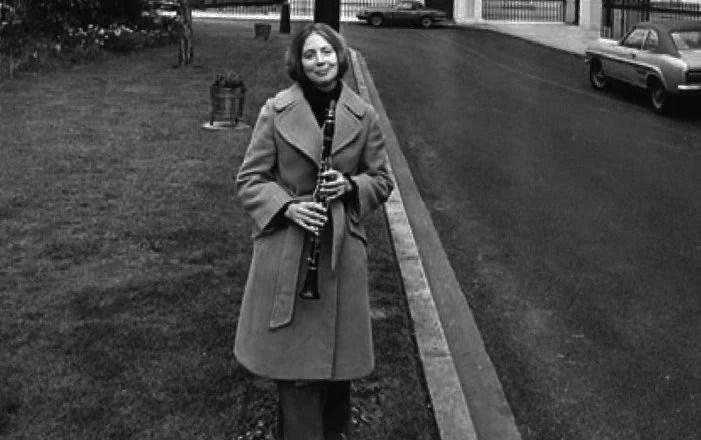
Earlier this week we learned of the sad news of the death of Amelia Freedman. In a post on their website, the Nash Ensemble describe Amelia as their “creator and guiding light”, with “an extraordinary gift for creative programming that was appealing as well as broadening musical horizons”. In their obituary of Amelia, the Daily Telegraph described her as “the most influential British classical music impresario of the late 20th century”.
Her work bore fruit both in the concert hall, through the Nash Ensemble’s long relationship with Wigmore Hall that began in 1967, and a long recording career that is noted for its inventiveness and high performing standards.
The discography below is just a hint of what the Nash Ensemble have achieved on record, including a work by Amelia’s good friend, the late Sir Harrison Birtwistle, as well as the String Trio by David Matthews, which he dedicated to Freedman. Also included are a recent recording of Debussy’s Sonata for Flute, Viola and Harp, a pioneering recording of the attractive Nonet by Sir Arnold Bax, and the vibrant Piano Quartet in B flat major by Saint-Saëns:
David Cohen (cello), London Symphony Orchestra / Sir Antonio Pappano
Vaughan Willams Symphony no.9 in E minor (1956-57) Elgar Cello Concerto in E minor Op.85 (1919) Bax Tintagel (1917-19)
Barbican Hall, London Sunday 15th December 2024
Reviewed by Richard Whitehouse Picture (c) Mark Allan
Sir Antonio Pappano‘s conducting of Vaughan Williams’s Sixth Symphony in March 2020 will be recalled as almost the final live event before the descent of lockdown. Forward to the present found him tackling the composer’s Ninth Symphony under outwardly different circumstances.
Such context is significant given this work picks up where its predecessor left off, the Sixth’s fade into nothingness making possible that ominous and otherworldly beginning of the Ninth. Few conductors opt for its rapid metronome markings, but Pappano’s was an unusually broad conception of a first movement whose Moderato maestoso marking was evident throughout. Any lack of cumulative fervency was more than countered by a luminosity which permeates the music’s textures, and nowhere more so than with that lambent aura conveyed by its coda.
More an intermezzo than slow movement, the ensuing Andante sostenuto may have taken its cue from Hardy’s Tess of the D’Urbervilles but its interplay of bleakness, violence and ardour satisfies on its own terms and Pappano’s take was audibly cohesive. Nor did he misjudge the Allegro pesante of a scherzo which veers between the martial, sardonic and the ethereal with as much formal freedom as VW allows his ‘reeds’ in pointing up its expressive recalcitrance. Despite being marked Andante tranquillo, the finale is no peaceful comedown and Pappano was mindful to balance the expansively unfurling arcs of its opening half with the mounting intensity of what follows. Moreover, those three seismic ‘gestures of farewell’ summoned an emotional frisson that felt comparable to anything Vaughan Williams had previously written.
If it no longer elicits the lukewarm response as at its premiere, the Ninth Symphony remains elusive and often disquieting. Securing an impressive response from the London Symphony Orchestra, flugel horn and saxes evocatively in evidence, Pappano certainly had its measure.
A pity it was thought necessary to place this work in the first half, as following it with Elgar’s Cello Concerto felt a little anti-climactic. Not that David Cohen, securely established as LSO section-leader, was other than committed – his reading, gaining conviction as it unfolded, at its best in an Adagio of suffused eloquence then a finale that built purposefully to a soulful if not unduly emotive culmination and brusque payoff. Neither the unfocussed first movement nor a brittle scherzo hit the mark but, overall, this account was more then the sum of its parts.
Following Vaughan Williams’s and Elgar’s last major works with a middle-period one by Bax might be thought sleight-of-hand as regards programming, but the latter’s March for the 1953 Coronation would hardly have seemed apposite and Tintagel provided an undeniably rousing send-off. For all its indebtedness to Debussy, its surging Romanticism is its own justification and Pappano ensured that every aspect of this alluring (and on occasion lurid) seascape could be savoured to the fullest – not least its apotheosis then a conclusion of resplendent opulence.
Hopefully Pappano will schedule further British music in addition to continuing his Vaughan Williams cycle. Whatever else, Bax seems tailor-made for the LSO’s virtuosity such that his Second or Sixth symphonies, or another of his tone poems, would assuredly leave their mark.
Members of the English Sinfonia: Janice Graham (violin), Nick Bootiman (viola), Julia Graham (cello) Chris Hopkins (piano)
Vaughan Williams The Lark Ascending (1914) Bridge Miniatures – Book 2, H88 (1910) Coleridge-Taylor Piano Trio in E minor (1893) Holst String Trio in G minor (1894) Bax Piano Quartet in One Movement (1922)
St. John’s, Smith Square, London, 15 December 2020 (lunchtime)
Reviewed by Richard Whitehouse
Celebrating its 60th anniversary next year, the English Sinfonia will be remembered by older listeners for those valuable recordings of British music with Neville Dilkes (not least the first modern account of Moeran’s Symphony). Its current incarnation as ensemble-cum-chamber orchestra enables it to tackle a wide repertoire, and even though only the core personnel was featured in this afternoon’s concert, the works that were chosen offered a more than plausible overview of British chamber music composed across the late 19th and early 20th centuries.
Easy to forget that, long before his music assumed a more radical mindset, Frank Bridge was a composer of lighter fare. Hence those three sets of Miniatures for piano trio – classy salon music of which the second set moves from a soulful while never cloying Romance, via an infectious and decidedly scherzo-like Intermezzo, to a Saltarello with more than a hint of menace in its hectic dash. By comparison, the Piano Trio of Samuel Coleridge-Taylor tries a little too hard to impress. If this early piece is hardly the equal of such as the later Clarinet Quintet, its three compact movements are never less than eventful – whether in the vehement Allegro with its portentous opening, a Scherzo whose unremitting energy brings little respite, or Finale whose distinctive furiant rhythm sees the whole work through to a forthright close.
Unlike the above, Holst composed relatively few chamber pieces in his maturity. While his String Trio evinces little sense of what he went on to achieve, this does not lack for incident. Idiosyncratic, too, in that its compact and forthright opening movement is followed by one which, over twice as long, integrates a slow movement, scherzo and finale that add up to an unlikely if cohesive whole; the fugal intricacies of that final section a stern test of ensemble such as the present players despatched with evident resolve. Appreciably more characteristic is the Piano Quartet by Bax – its tensile single movement packing a wide range of ideas and moods into little more than 10 minutes; and following an essentially conflicted to triumphal trajectory recalling that of the combative First Symphony which immediately preceded it.
Opening this afternoon’s programme, Janice Graham gave an affecting account of The Lark Ascending in the version for violin and piano first heard in public exactly 100 years ago. Now the orchestral version has become ubiquitous, this chamber guise can feel almost a reduction, yet the lucidity of its formal layout becomes even more explicit, and the understated poise of its piano part – as rendered by Chris Hopkins – belies any doubts as to Vaughan Williams’s limitations when writing for the instrument. An eloquent start to an enterprising programme.



 Arcana.fm