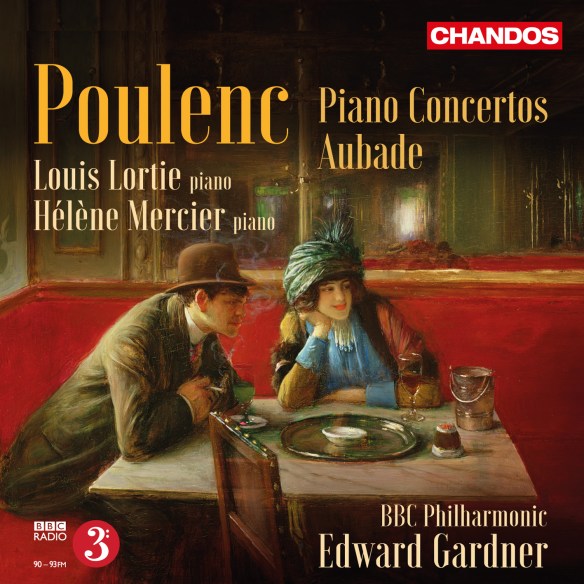
On record: Poulenc – Works for piano and orchestra

Featured recording: Poulenc – Works for piano and orchestra (Chandos)
poulenc-lortie

Louis Lortie, a French-Canadian pianist, teams up with conductor Ed Gardner and the BBC Philharmonic Orchestra for a disc presenting Poulenc’s complete music for piano and orchestra, as well as some of his works for two pianos. Here he is joined by regular duet partner Hélène Mercier.

What’s the music like?

Poulenc is well-loved among 20th century composers, often for his gift of writing bittersweet melodies that make the listener smile – such as the oboe theme that dominates the Rondeau section of the Aubade for piano and orchestra, the second work on this disc.

Poulenc is a cheeky composer, thumbing his nose behind your back in a sense, and as with most French composers the imaginative and colourful orchestrations bring the music to life. Every so often Poulenc throws in a turn of musical phrase that makes the listener smile, with an exaggerated gesture here or a knowing chord progression there.

This new collection from Chandos brings together an impressive range of writing. The Piano Concerto is perhaps not as popular as it might be, for it often sparkles in this performance, and that label certainly applies to the entertaining and multi-faceted Aubade from 1929. This work, Roger Nichols informs us in his authoritative booklet note, was written in one of the composer’s depressive bouts, and it tells the story of how the huntress Diana is driven to suicide by her own ‘love that the gods forbid’.

The brief works for two pianos included here are greatly affecting – the doleful Élégie and the free-spirited L’Embarquement pour Cythère especially – while the concise Sonata packs an energetic punch. When writing for two pianos and orchestra in the Concerto Poulenc must have had great fun, for this is full of frolics – but with the customary cautionary notes just beneath the surface.

Does it all work?

Yes. This collection is consistently entertaining, played with great enthusiasm and affection and recorded in such a way that the light and shade of the composer’s writing is fully revealed.

The Aubade is at times po-faced but has an almost ever present glint in the eye, as though it can’t resist cracking a joke amongst the downward thoughts. In the double concerto, Mercier and Lortie enjoy sparkling and spiky exchanges between pianos and orchestra, and in the finale there is what sounds like a clockwork mechanism towards the end.

The tender second movement of the Sonata for two pianos is beautifully done, before the finale scurries away.

Is it recommended?

Yes. Poulenc is a charmer on record, and can be enjoyably brash too. The performers here do him proud.

Listen on Spotify

This particular recording is not on the streaming service, but samples from each track can be heard here

Proms premieres – Birds with new plumage

tui-bird
The Tui Bird from New Zealand. Photo (c) Sid Mosdell

Messiaen, orch Christopher Dingle – Un oiseau des arbres de Vie (1987-1991, orch 2015)

Ravel, arr. Colin Matthews – Oiseaux tristes from Miroirs (1905, orch 2015)

BBC Philharmonic Orchestra / Nicholas Collon (Prom 29)

Duration: 4 minutes each

BBC iPlayer link

http://www.bbc.co.uk/events/ef3zc8#b0640p40

The Messiaen can be heard from 1:55; the Ravel from 35:02

What’s the story behind the pieces?

Messiaen’s Un oiseau des arbres de Vie (A bird from the tree of life) is music that is ‘incredibly technically difficult to conduct’, in the words of Nicholas Collon, given the job of overseeing its first performance in this guise, arranged by scholar Christopher Dingle.

The relatively short piece originally intended to be part of his massive, multi-movement orchestral piece Éclairs sur l’Au-Delà…, but was removed before the first performance. It is mostly scored for percussion but changes tempo and time signature more or less every bar. In the piece Messiaen profiles the New Zealand tui bird through a written-out melody of its song.

Meanwhile Ravel’s Oiseaux tristes (Sorrowful birds) is the latest French piano piece to be orchestrated by Colin Matthews. The composer has tried his hand at a number of Debussy Préludes, imagining how Ravel might have undertaken the task, but here he looks at one of the six parts of Miroirs, the suite written by the composer for piano. Ravel himself orchestrated two of the other movements, Une barque sur l’océan (A boat on the ocean) and Alborada del gracioso (Morning song of the jester).

The piece is intended to portray the sorrowful birds in the depths of a very hot summer forest. They are lost.

Did you know?

Ravel’s orchestration of Musorgsky’s Pictures at an Exhibition is one of many versions of the Russian composer’s suite for piano – but is the most performed.

Initial verdict

The Messiaen is bright and strongly rhythmic, but not in a conventional sense. It is very treble based, and is punctuated by crisp chords that have an unusual colour, with the wood block and tuned percussion heavily in evidence.

Colin Matthews’ orchestration is evocatively coloured, ideal for a humid evening at the Royal Albert Hall. The mood is oppressive, the brass lending weight to the lower end of the sound. It is clear from this that Matthews has listened closely to Ravel’s own methods of orchestration, because his way with the colours available is surely near to what the composer might have imagined.

Second hearing

tbc!

Where can I hear more?

Colin Matthews’ orchestrations of Debussy Préludes can be heard in a release made by the Hallé record label, found on Spotify here

Proms premiere – Luke Bedford: Instability

luke-bedford

Luke Bedford

BBC Philharmonic Orchestra / Juanjo Mena (Prom 20)

Duration: 22 minutes

BBC iPlayer link

Instability can be heard by clicking here

What’s the story behind the piece?

You can look at the music itself courtesy of Luke Bedford’s publisher, Universal Edition, here

In the introduction on the same page, Bedford sets the scene for his new piece. “Ideas in this piece are torn apart by a strange energy and reform in new, dynamic relationships. There is a constant tension between growing and collapsing. That which seems durable can vanish in an instant. The piece will include the Albert Hall organ, a detuned orchestra and possibly the first use of a cricket bat in an orchestral piece.”

Reflecting the world we live in and experience. Was going to be a set of movements but is now in one continuous duration. Cuts between ideas in an unexpected and dramatic way. Some of the orchestra – wind and brass – play a quarter-tone lower.

Did you know?

Initial verdict

As the BBC Radio 3 presenter Petroc Trelawny observes, Instability is a piece that vividly captures the uncertain and often overwhelming times that we live in. It is a very edgy piece indeed!

From the start (35:22 on the link) some quiet murmurings among the orchestra but then a sudden outburst that changes the whole dynamic of the piece. Bedford writes some striking music for the orchestra, a dramatic set of contrasts that perhaps intentionally leaves the listener completely on edge with the huge rumbles of sound. There is not so much melodic, as the big chords are walls of sound, but there is a good deal of pent-up anger released with them it would seem.

The organ is integral to the music, tending towards the upper end for a shrill sound, but cutting through around the 44’ mark with an emphatic blast of C major tonality. After this the piece becomes uncertain and wary again, with some creepy sounds and ominous, held low notes.

I couldn’t hear where the cricket bat comes in but assumed that to be in the percussive section around 41:30, where it feels like a lot of pipes are struck.

From around 48:55 on the link the cellos and violas intone a solemn melody, but the rest of the orchestra seems hell-bent on breaking this up and smothering it. Then the forces bang into each other chaotically before cutting out to near silence. Then what seems to be a coda starts, with another quite solemn and drawn out melody broken up by metallic chords from brass, wind, percussion and high organ.

To me this piece feels like an attempt to live a proper life in a society that is chaotic, uncertain and full of dread. At the end this tension is unresolved.

Second hearing

tbc!

Where can I hear more?

You can watch a portrait of Luke Bedford in this video uploaded to YouTube by the London Sinfonietta:

Under the Surface at the Proms – John Foulds’ Three Mantras

Prom 38, 13 August 2015 – London Symphony Chorus Womens’ Voices, BBC Philharmonic Orchestra / Juanjo Mena at the Royal Albert Hall

john-foulds

John Foulds Three Mantras (1919-1930)

http://www.bbc.co.uk/events/exq5v2#b064y5hj

We definitely undervalue the BBC orchestras when the Proms take centre stage. I say that because this was one of the most colourful orchestral Proms it has been my pleasure to witness, and much of the credit for that should go to the BBC Philharmonic Orchestra, a riot of bright shades under Juanjo Mena in Messiaen’s Turangalîla-Symphony. Yet while that performance will inevitably take centre stage, it was another work that stole the show.

John Foulds has spent a long time languishing in the musical wilderness, but in the last ten years he has begun to reach a bigger audience. A good deal of thanks for this should go to conductor of the BBC Symphony Orchestra, Sakari Oramo, who recorded two discs of his orchestral works with the City of Birmingham Symphony Orchestra. They enchanted us with Foulds’ inventiveness, and most importantly his eagerness to incorporate Eastern cultures within an extremely Western art form. In this respect he was in line with Gustav Holst.

One of the finest works in this respect is the 3 Mantras, thought to be part of a massive Sanskrit opera, Avatara. Very sadly that never came to be, and 300 pages are lost from the score, but the 3 Mantras survive and make a very accomplished and unusual orchestral piece. The colours are simply beautiful, achieved through a wide variety of percussion, harps and shimmering strings, all of which Mena marshalled to show the detail of Foulds’ inventive orchestration.

It is the second piece, the Mantra of Bliss (starting at 8:13 on the link above) that is the most striking, a meditation of radiant orchestral beauty, where Foulds uses a wordless female chorus to enchanting effect. Holst had done this before, in Neptune from The Planets, but rather than that cold emptiness Foulds creates exotic warmth.

The outer two mantras are very different; the first a bustle of activity that slows for a moving slower melody; the third an almost barbaric dance that wheels out of control and wields a fearsome set of percussion at the end. This was a terrific performance from the BBC Philharmonic, showing off Foulds’ gifts to a new audience that will hopefully look to discover more of the music of this remarkable composer.

Want to hear more

You can hear a playlist from BBC Radio 3’s CD Review, where Andrew McGregor explores recordings of John Foulds’ music, by clicking here

There will be more Under the Surface features as the Proms progress, exploring lesser known pieces and composers at the festival

Proms premiere – HK Gruber: into the open…

hk gruber

HK Gruber photo by Jon Super

Colin Currie (percussion), BBC Philharmonic Orchestra / John Storgårds (Prom 5)

Duration: 28 minutes

BBC iPlayer link

http://www.bbc.co.uk/programmes/b062jn0t/player

The Gruber starts at 3:46 on the programme, with commentary beforehand

What’s the story behind the piece?

In an interview with Arcana, Colin Currie revealed the piece to be a memorial to David Drew, who in 1976 was appointed director of publications at the leading music publisher Boosey & Hawkes. Drew became known principally for his work revitalising the output and reputation of the composer Kurt Weill. In his obituary of the director, composer Alexander Goehr wrote for the Guardian how “he prepared scores, travelled Europe and America promoting the works, was instrumental in forming the Weill Foundation (1973) and not only changed, if not created, the public perception of the composer, but contributed to a sea-change in the development of composition in the second half of the 20th century.”

These works included Die Sieben Todsünden (The Seven Deadly Sins). Weill is a composer close to HK Gruber’s heart – and Gruber became an established composer on the Boosey roster.

Currie told Arcana about how, “The piece itself is about thwarted feelings of desperation and loss. It confronts bereavement in an angry and passionate way. It is a violent piece, and an unhappy one too – but it is also extremely lyrical and tender. The person, the subject, is clearly missed – but it is not easy to put into words.”

The Radio 3 broadcast talks of how the performance parts ‘verge on the impossible’ – and not just for the soloist!

Did you know?

Gruber sang with the Vienna Boys’ Choir as a child – and went on to play double bass in the Vienna Radio Symphony Orchestra.

Initial verdict

The immediate reaction to this piece is that it will need more than two hearings to fully come to terms with the music within! It is a substantial piece of work, a work of many colours – using the multitude of percussion to the limits of its potential.

A cold emptiness is immediately evident at the beginning, the marimbas in prominence early on, as the size of the structure becomes clear. This is a slow building piece, in keeping with Gruber’s concept of it as a procession – and there are a few signposts that became clear on the first hearing.

At 8’40” in the program link there is a notable change as softly oscillating woodwind offer some consolation, then the brass have more thoughts about 11’32”, the orchestra gathering itself for a powerful onslaught towards the end of the piece – but the end is quiet.

To be honest I did rather lose the thread of the piece from halfway but I suspect that is a ‘listener fault’ rather than anything Gruber has done! Hence the need for more than one further listen.

It should be pointed out the performance standard seems to be incredibly high, despite what Currie was saying about the difficulty!

Second hearing

tbc!

Where can I hear more?

A good next port of call is BBC Radio 3 program CD Review, who explore recordings of Gruber’s music here – which gives you the ideal opportunity to hear snapshots of his music along with the thoughts of others.