
BBC Proms 2023 – Felix Klieser, Bournemouth Symphony Orchestra / Kirill Karabits – Karabits, Mozart & Rachmaninoff

Prom 24 – Felix Klieser (horn), Bournemouth Symphony Orchestra / Kirill Karabits

Karabits Concerto for Orchestra no.1 ‘A Musical Gift to Kyiv’ (1980-81) [UK premiere]
Mozart Horn Concerto no.4 in E flat major K495 (1786)
Rachmaninoff Symphony no.2 in E minor Op.27 (1906-08)

Royal Albert Hall, London
Wednesday 2 August 2023

by Richard Whitehouse photos by Mark Allan / BBC

While not exactly a ‘best kept secret’, Kirill Karabits’ tenure at the helm of the Bournemouth Symphony Orchestra (soon to enter its 16th season) might have attracted even greater national attention than has been the case, with this evening’s Prom offering various pointers as to why.

One of Karabits’ concerns has been promotion of music from Eastern Europe in general and in particular Ukraine, where the role played by his father Ivan (1945-2002) was considerable. Written across the 1980s, the latter’s three Concertos for Orchestra follow on from those by his Russian forebear Rodion Shchedrin by homing in on facets of post-war music in a direct and accessible fashion. As its title indicates, his first such piece commemorates the Ukrainian capital – here the 1500th anniversary of its founding – over the course of a single movement whose monumental if never impersonal introduction leads into a series of evocatively scored episodes that culminate in a shimmering climax replete with the pealing of bells. The ending, as atmospheric as it proves unexpected, is just the most striking aspect of this engaging work.

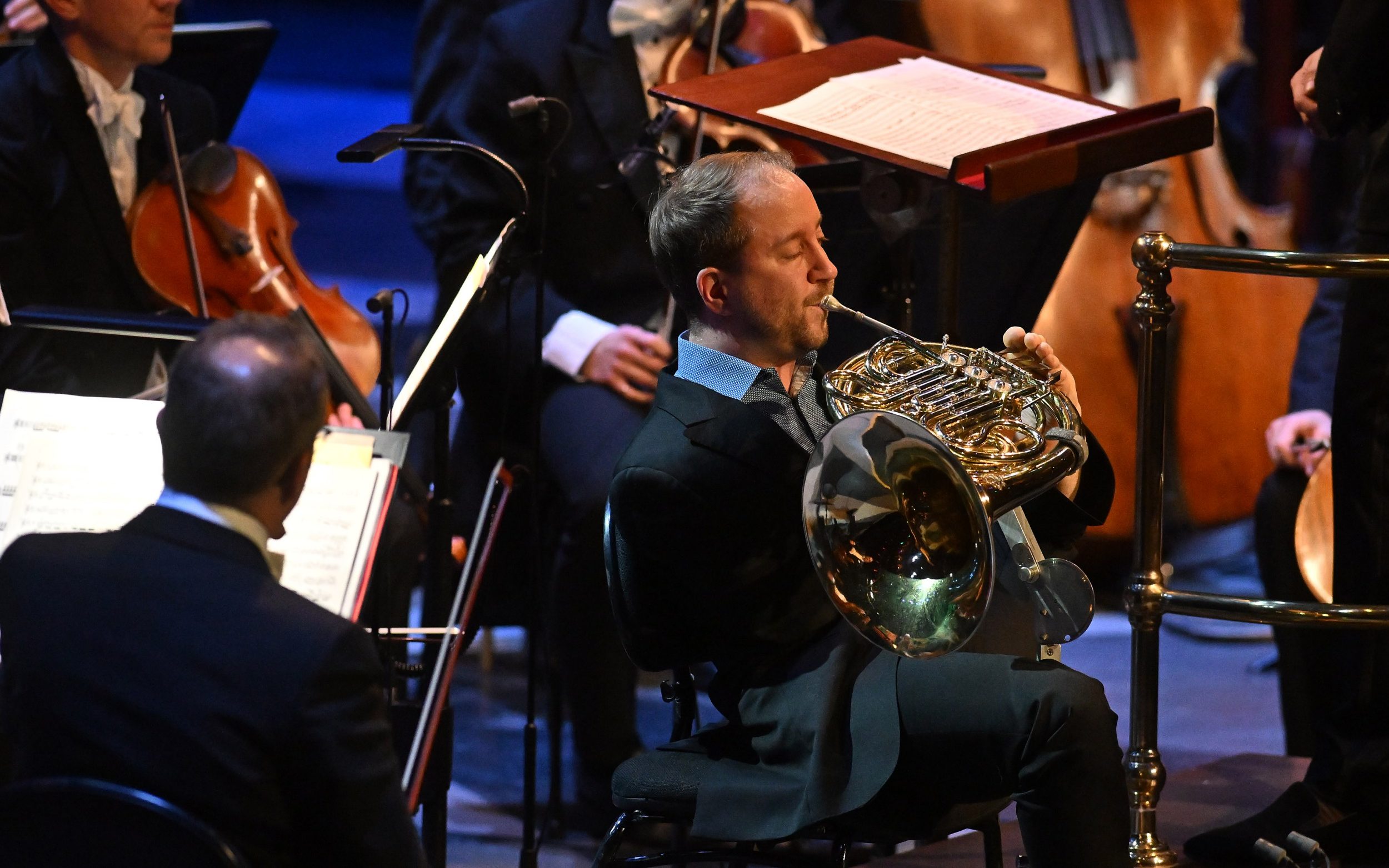
Equally unexpected, for those previously unaware, was the emergence of Felix Klieser on the Albert Hall platform to play Mozart’s Fourth Horn Concerto with his left foot. Not that those listening on the radio would have sensed anything unusual about this performance, Klieser’s warm and rounded tone a throwback to an earlier generation though melding seamlessly into the reduced orchestral forces. Most popular of its composer’s four such pieces (but not heard complete at the Proms for 34 years), its opening Allegro unfolded with an admirable balance between energy and grace; the Romanza exuding a charm that was never cloying and the final Rondo a pert humour. Clearly having enjoyed his appearance on this stage, Klieser returned for the finale of Mozart’s Third Horn Concerto with its even more overt hunting associations.

Prom 24 – The Bournemouth Symphony Orchestra conducted by Kiril Karabits (Felix Klieser horn) perform Ivan Karabits: Concerto for Orchestra No. 1, ‘A Musical Gift to Kyiv’ UK premiere, Wolfgang Amadeus Mozart: Horn Concerto No. 4 in E flat major and Sergey Rachmaninov: Symphony No. 2 in E minor at the Royal Albert Hall on Wednesday 2 August 2023 Photo by Mark Allan

Karabits (above) has not yet added Rachmaninoff to his Bournemouth discography, but his account of the Second Symphony suggests he should do so. A sombre yet alert introductory Largo set the course for an opening movement whose eschewal of histrionics did not preclude a powerfully cumulative response to its lengthy development or decisive take on its brief coda. The scherzo then had the requisite incisiveness, and if Karabits slightly over-indulged the ‘big tune’, there was no lack of impetus across its headily contrapuntal trio or glinting irony in its closing bars.

Almost over-familiar now, the slow movement demonstrably gained from a flowing and even lilting tempo such as encompassed its rapturous central section as securely as its serene main melody – with Barry Deacon the eloquent clarinettist on its first appearance. Uncut or not the finale can outstay its welcome, but Karabits duly had the measure of its festive progress – his headlong tempo making for a slightly jarring transition into the secondary theme, but with the gradual subsiding of activity at the centre then its stealthy re-accumulation assuredly handled.

Nor was the focus of his approach to this movement’s culmination in doubt, the return of the work’s ‘motto’ setting the seal on an engrossing and unusually cohesive reading which augurs well for this partnership even after Karabits relinquishes his post at the close of next season.

For more on the 2023 BBC Proms, visit the festival’s website at the BBC. Click on the names for more information on Felix Klieser, Kirill Karabits and the Bournemouth Symphony Orchestra – and composer Ivan Karabits
BBC Proms 2023 – NYO Jazz (USA) with Dee Dee Bridgewater

Prom 23 – NYO Jazz (USA) with Dee Dee Bridgewater

Dee Dee Bridgewater (vocals), NYO Jazz / Sean Jones (trumpet)

Duke Ellington trans. David Berger Braggin’ In Brass
Sean Jones The 29ers
Roy Hargrove arr. David Gibson Strasbourg/St. Denis
Duke Ellington arr. Slide Hampton Cottontail
Spencer Williams arr. John Clayton Basin Street Blues
Mongo Santamaría arr. Clayton Afro Blue
Newley / Bricusse Feeling Good
James Brown I Got You (I Feel Good)
Billie Holiday arr. Cecil Bridgewater Fine and Mellow
Leonard Lee arr. Frank Foster Let the Good Times Roll
Wycliffe Gordon We’re Still Here

Royal Albert Hall, London
Tuesday 1 August 2023, 10.15pm

by Richard Whitehouse photos by Chris Christodoulou / BBC

Jazz bands, battling or otherwise, have become something of a fixture for late-night Proms and this latest instance saw a debut at these concerts for NYO Jazz – together with a singer who has kept the role of jazz vocalist, long synonymous with big-bands, well and truly alive.

The latest incarnation of the jazz youth orchestras having emerged from Carnegie Hall over this past decade, NYO Jazz may have been relatively modest in numbers but lacked nothing in impact. That virtually all its members fell into the 18-25 category was duly belied by the sheer technical facility but also the versatility – whether individually or collectively – with which they ranged across the spectrum of styles as encompassed by the big-band medium, much of it suitably demonstrated by the 10 numbers that comprised this evening’s set-list.

The programme was launched in fine fashion with a sassy take on Duke Ellington’s Braggin’ in Brass, giving each of the orchestra sections its time in the spotlight. An energized presence as trumpeter and director, Sean Evans contributed a distinctive number in The 29ers, a tribute to jazzers born on the 29th of the month (not least Ellington); the prominence accorded brass and reeds complemented by limpid cameos for guitar and piano. Next was a smouldering take on Roy Hargrove’s Strasbourg / St Denis and notable for its intensive work-out on double bass.

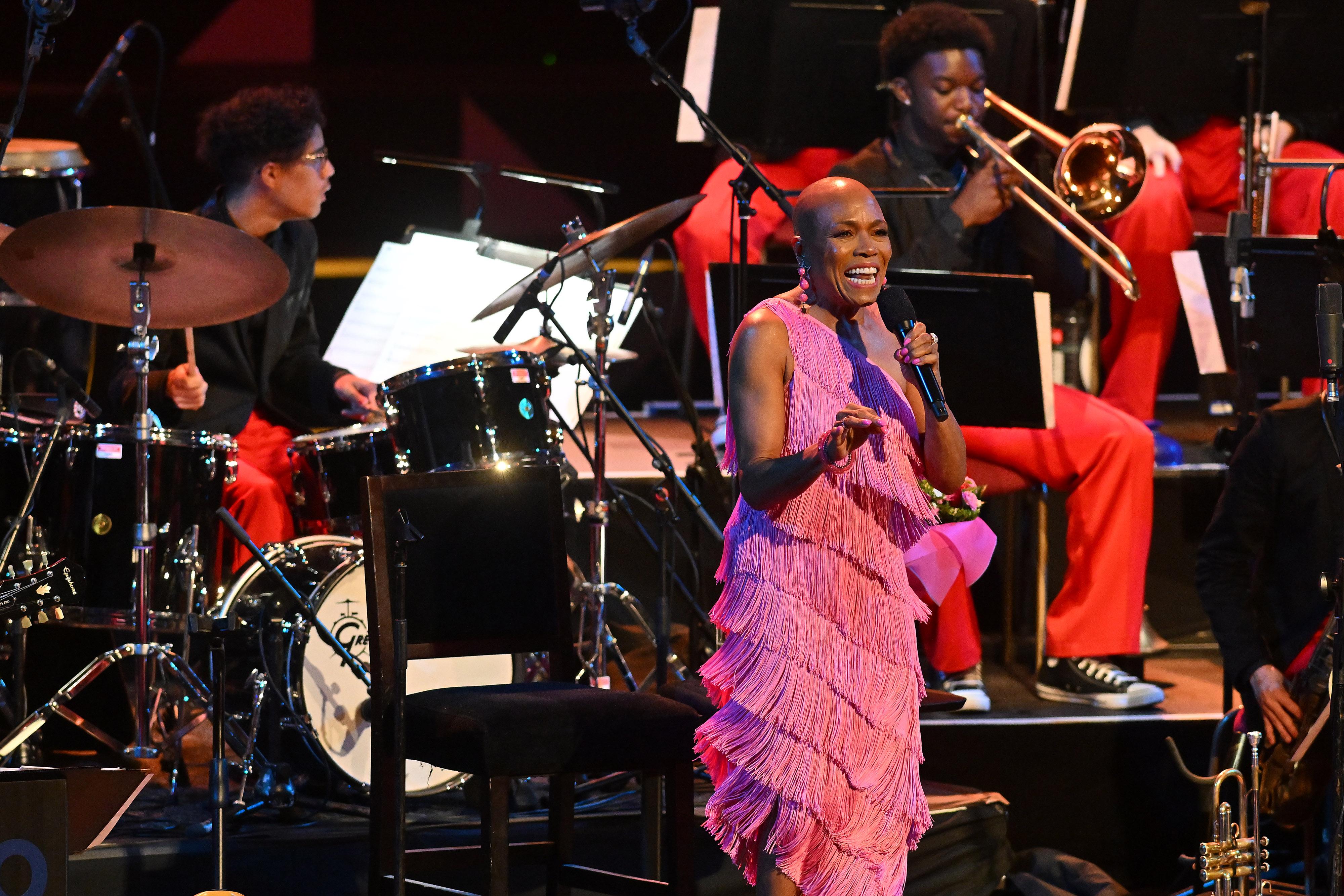
Dee Dee Bridgewater – singer, actor, magnetic stage-presence and one of a (surprisingly?) select handful of vocalists who have moved between the very different domains of jazz and pop – then took the stage for an animated take on Ellington’s Cottontail, her distinctive scat to the fore alongside the NYOJ’s reeds. This was followed by the sultry strains of Afro Blue by Mongo Santamaría, its Cuban antecedents evident through driving percussion and lyrics whose ‘shades of delight’ sentiment was everywhere apparent. It might have had a complex genesis but the Anthony Newley / Leslie Bricusse number Feeling Good, later immortalized by Nina Simone, segued effortlessly into the James Brown classic I Got You (I Feel Good) – this latter’s swaggering impetus abetted by a visceral solo contribution from baritone sax.

The tempo relaxed incrementally for a soulful take on Billie Holiday’s Fine and Mellow, its all-round looseness enhanced by contributions on double bass, drum-kit and piano. Spencer Williams’ Basin Street Blues is a breezy number whose homages to Ella Fitzgerald and Louis Armstrong were uncannily emulated by Bridgewater’s vocal. She rounded off her sequence with a roistering take on the Shirley Goodman / Leonard Lee number Let the Good Times Roll, made famous by B.B. King and whose roster of brass here featured a stentorian trumpet solo.

Throughout this set (evidently designed with the requirements of a late-night Prom in mind, and one where only a few punters were seen leaving before the close), the NYOJ musicians gave their all. Sean Jones took lead on vocal and trumpet for the fervent groove of Wycliffe Gordon’s We’re Still Here, notable for its contributions from piano and electric keyboard – which instruments partnered Jones in his calmly affectionate allusion to the Londonderry Air, just before the final moments let rip to the undoubted delight of those on and off stage.

For more on the 2023 BBC Proms, visit the festival’s website at the BBC. Click on the names for more information on NYO Jazz, Sean Jones and Dee Dee Bridgewater.

BBC Proms 2023 – Mariza sings Fado

Prom 9 – Mariza with Luis Guerreiro (Portuguese guitar), Phelipe Ferreira (acoustic guitar), Adriano Alves ‘Dinga’ (bass guitar), João Freitas (percussion), João Frade (accordion), Strings of the London Contemporary Orchestra

Royal Albert Hall, London
Friday 21 July 2023

by Richard Whitehouse photos by Chris Christodoulou / BBC

The incidence of ‘world music’ at the Proms might be appreciably less than in its heyday of two decades ago, but a number of major figures still tread the boards at the Albert Hall and hearing Mariza this evening prompted a thought as to why she had not been invited before.

Maybe because Fado, of which she became the leading exponent on the death of its previous standard-bearer Amália almost a quarter-century ago, is still heard as provincial in its idiom and appeal. Emerging from urbanized Brazilian in the mid-19th century, it latterly took hold in Portugal as a means of opposing the authoritarian regimes in power until 1975 and retains its cultural potency today. With her Mozambiquan heritage and willingness to embrace other genres, Mariza has widened the stylistic remit of Fado but without diluting its essential ‘soul’.

An elegant and commanding but never overbearing presence on stage, she was joined tonight by a quintet of musicians whose intricate if discreet accompaniment was the perfect backdrop for this representative cross-section from her eight albums released over the past two decades. The smouldering pathos of What a strange way of living set the prevailing mood, followed by the pensiveness of There are Words that Kiss Us and the intimacy of Tear with its first hint of that vocalise Mariza unfurls to heighten the emotional ambit. The engaging Paper Carnations has a resonance for all who recall events of nearly 50 years ago, while Rain is the archetypal Fado number the world over. The underlying restlessness of Vain Wishes was complemented perfectly with the plaintiveness of Where Are You Going? from Mariza’s forthcoming album.

Thus far the set featured the strings of London Contemporary Orchestra, whose atmospheric arrangements evoked those by Wally Stott (later Angela Morley) for Scott Walker’s late ’60s albums. Their departure none the less abetted the immediacy of the music-making, witnessed by the impulsiveness of A Kiss of Longing and confiding warmth of I Wish, before the radiant poise of Spring brought the expected ovation. Hardly less enthusiastic was that accorded The Best of Me, its soaring aspiration furthered by the propulsive tread of Green Lemons then the rousing sentiments of Listen, Mr Wine when the singer’s rapport with her audience was made manifest. There was no lack of verve in the infectious White Rose, or in the headily rhythmic Black Boat with its breathtaking pause where one could have heard the proverbial pin drop.

A later than usual start and absence of an interval meant that this concert proceeded straight through 85 minutes, though neither musicians nor audience betrayed any sign of fatigue over its course. While the majority of a near-capacity house doubtless consisted of afficionados or enthusiasts, those unfamiliar with Mariza will surely have been encouraged to delve further into her music. As a starting-point, the studio album Fado Tradicional (2010) or live album Concerto em Lisboa (2006) are ideal for immersing oneself into what this music has to offer.

Tonight, however, the strings of the LCO emerged back on the stage to accompany Mariza and her ensemble in the incantatory O People from My Country – if not (yet) the Portuguese national anthem, then certainly a number such as encapsulates Fado at its soul-stirring best.

For more on the 2023 BBC Proms, visit the festival’s website at the BBC. Click on the names for more information on Mariza and the London Contemporary Orchestra

BBC Proms 2023 – María Dueñas, BBC Symphony Orchestra / Josep Pons – Falla, Lalo, Debussy & Ravel

Prom 8 – María Dueñas (violin), BBC Symphony Orchestra / Josep Pons

De Falla La vida breve (1904-05) – Interlude and Dance
Lalo Symphonie espagnole, Op. 21 (1874)
Debussy Ibéria (1905-08)
Ravel Boléro (1928)

Royal Albert Hall, London
Thursday 20 July 2023

by Richard Whitehouse photos by Chris Christodoulou / BBC

The Proms went to town on Spanish music just over two decades ago, and if tonight’s concert featured only one piece by a Spanish composer, an aura of ‘Spanish-ness’ fairly pervaded this programme which likewise found the BBC Symphony Orchestra in excellent form throughout.

The piece in question was Interlude and Dance from de Falla’s opera La vida breve, once a regular fixture at these concerts and one which makes for an ideal encore or (as here) curtain-raiser according to context. Josep Pons duly brought out the drama of its initial pages, before heading into a rendition of the main section such as (rightly) predicated suavity over rhetoric, while not lacking for impetus as this music reached its effervescent close. Lasting little more than an hour, the opera ought to enjoy more frequent revival as part of a judicious double-bill.

Édouard Lalo is himself a composer worth revival, his Symphonie espagnole having regained something of its familiarity from half a century ago. Her tonal warmth and incisiveness made María Dueñas an ideal exponent, while her rapport with the orchestra accordingly underlined its concertante-like ingenuity. There was no lack of energy or pathos in the opening Allegro, the capering elegance of the Scherzando duly complementing the forcefulness of the ensuing Intermezzo before the Andante brought a finespun eloquence, itself offset by the final Rondo with its indelible main theme and never wanton virtuosity. Evidently a first-rate accompanist, Pons drew as subtle a response from the BBCSO here as in a rapt arrangement for violin and strings of Fauré’s song Après un Rêve which Dueñas offered as the entirely apposite encore.

Debussy allegedly spent just one day over the Spanish border, but his feel for that country’s musical essence in Ibéria could not be gainsaid. The unwieldly trilogy that is the orchestral Images often makes performance of this in itself a stand-alone triptych preferable, and Pons had its measure from the outset of Along the Streets and Pathways, with its characteristic alternation of decisiveness and hesitancy. Nor was there any lack of ecstatic languor in The Perfumes of the Night whose soulfulness only gradually became apparent – Pons making a rhythmically seamless transition into The Morning of a Festive Day with its vivid evoking of castanets and guitars, along with a folk-inflected élan as carried through to the headlong closing bars. Highlighting of detail never risked cohesiveness in this scintillating account.

Ravel’s Rhapsodie espagnole would have been an ideal work to conclude this concert, though few in the audience would surely have begrudged hearing Boléro in its place and Pons did not disappoint. At just over 15 minutes it was appreciably faster than the inexorable unfolding its composer most likely envisaged, but the combination of textural definition and astute placing of detail ensured this traversal enticed over the short term as keenly as it compelled across the whole. In what is a ‘concerto for orchestra’ without equal, it would seem invidious to single out individual contributions, but Alex Neal was unerring in his articulation of the side-drum ostinato, while Antoine Bedewi’s timpani steered those climactic stages through to a forceful but not overbearing denouement. If not the ultimate Boléro, this was certainly one to savour.

For more on the 2023 BBC Proms, visit the festival’s website at the BBC. Click on the names for more information on the BBC Symphony Orchestra, Josep Pons and María Dueñas

BBC Proms #7 – Soloists, La Nuova Musica / David Bates: Purcell Dido and Aeneas

Purcell Dido and Aeneas (c1689)

Dido – Alice Coote (mezzo-soprano)
Aeneas – James Newby (baritone)
Belinda – Gemma Summerfield (soprano)
Sorceress – Madeleine Shaw (mezzo-soprano)
Second Woman – Nardus Williams (soprano)
Sailor – Nicky Spence (tenor)
Spirit – Tim Mead (countertenor)
First Witch – Helen Charleston (mezzo-soprano)
Second Witch – Martha McLorinan (mezzo-soprano)

La Nuova Musica / David Bates (harpsichord)

Royal Albert Hall, London
Tuesday 19 July 2022 (late night)

Reviewed by Richard Whitehouse Photo (c) Chris Christodoulou

After the existential confrontations of Vaughan Williams and Tippett earlier this evening, the more restrained yet no less acute expression of Dido and Aeneas came as a necessary tonic – with Purcell’s only through-composed work for the stage leaving a memorable impression.

The nature of its conception might remain as conjectural as the circumstances of its premiere, but there can be no doubt that this opera’s blazed a trail over the centuries that followed. Not the least of its attributes is a formal economy and a tensile dramatic trajectory whose ‘less is more’ aspect could scarcely be more evident. Neither is there any lack of expressive diversity in a score where elements of levity, even slapstick are aligned with a dramatic acuity which draws the three short but judiciously balanced acts into a cohesive and inevitable continuity.

Tonight’s concert performance manifestly played to these strengths. For the title-roles, Alice Coote brought gravitas and nobility of spirit to that of Dido, with James Newby an impulsive while knowingly fickle Aeneas. It was, however, Gemma Summerfield who stole the show as Belinda in rendering this most dramatically fluid of the opera’s parts with an emotional force, latterly foreboding, that was never less than captivating. Madeleine Shaw was larger than life if never overly parodic as the Sorceress, with Tim Mead a plangent Spirit whose intervention (from the organ console) seals the fate of the main protagonists. Credit, too, to Nicky Spence for an uproarious yet winning cameo as the Sailor in a scene whose Village People campery seemed entirely apposite in context and hence made this opera’s outcome the more affecting.

Directing La Nova Musica from the harpsichord, David Bates never lost sight of the dramatic continuity while ensuring an exemplary balance between chorus and ensemble. The former responded with a judicious combination of eloquence and discipline, whereas the emphasis on a continuo section of theorbos, harps and even guitar opened out but never obliterated the bracing string sonorities. Tempos were almost invariably well chosen, and though the final chorus was undeniably drawn out, this reinforced its postludial function to the work overall.

The past 58 seasons have since Dido and Aeneas given complete on four previous occasions, each time reflecting on how the opera was perceived at the time. Tonight’s performance was such a statement, and one as reaffirmed its greatness some 333 years after the first staging.

For more information on the 2022 BBC Proms season, you can visit the festival website. For more on the artists, click on the names for La Nuova Musica and David Bates.