
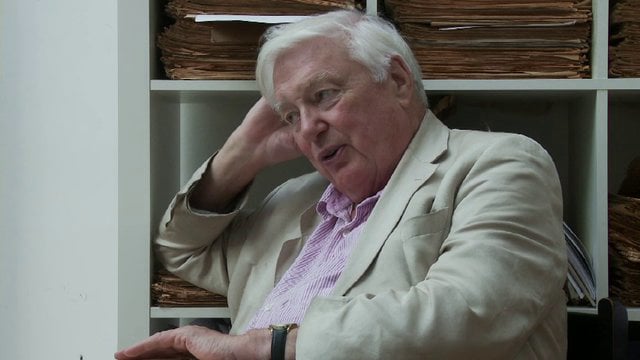
Hugh Wood
Rebecca Bottone (soprano), BBC Symphony Chorus and Orchestra / Sir Andrew Davis (Prom 7)
Duration: 20 minutes
BBC iPlayer link
http://www.bbc.co.uk/programmes/p02xv5wc/player
This piece will shortly be broadcast on BBC4 on July 30, at which point I will provide a new link.
What’s the story behind the piece?

Procession for the wedding of Elizabeth to Frederick VAn engraving by Abraham Hogenberg, c. 1613, used courtesy of the History Today website
Epithalamion, though not one of Hugh Wood’s biggest works, was a mere sixty years in the writing. Wood first started work on it in 1955, only to abandon it, returning to the piece last year.
Epithalamion – an old word for ‘marriage song’ – celebrates the wedding of Princess Elizabeth Stuart, daughter of King James I, and Frederick, Count Palatine, on St Valentine’s Day 1613. The text was written specially for the occasion by John Donne, who used Valentine’s Day as his inspiration for the text.
Wood writes mainly for chorus and orchestra, with soprano and bass soloists (Rebecca Bottone and Nicholas Epton) listed in the Proms programme.
The story takes us through the wedding, as the couple strive to be alone together, to the bliss of the next morning.
Did you know?
Wood writes in largely traditional forms, so as well as a large-scale Symphony he has completed concertos for piano, violin and cello – as well as five celebrated string quartets.
Initial verdict
The celebrations begin with a great swell, the orchestra and choir making a joyful and expansive noise. Yet on first listen from the arena something about Wood’s music did not quite take off in this performance.
That is not a reflection on the quality of the choral writing, nor the brassy fanfares, both of which carry strong echoes of William Walton – who was of course still very active in 1955.
Yet the celebrations did not come through as consistently joyous – perhaps because of the couple striving to get away together – and it was disappointing the soloists were not used more, especially with the quality of Rebecca Bottone’s soprano well in evidence. She comes across fine on the radio but was awkwardly placed in the Hall itself, positioned top left by the percussion. Nicholas Epton, who I assumed to be taking Frederick’s part, had just one tiny cameo.
Wood’s musical language is appealing, with fulsome harmonies and appealing melodies with an upward curve, but although Sir Andrew Davis – to whom the piece is dedicated – gave it maximum input, Epithalamion fell a bit flat. Hopefully the radio broadcast will redress that!
Second hearing
tbc!
Where can I hear more?
You can read more about Hugh Wood at Music Sales, one of his two publishers, – where you can also listen to a short playlist of his compositions.
Meanwhile, here is a performance of his String Quartet no.4 from the Escher Quartet:
Encore: Hugh Wood – String Quartet No. 4 from Royal Philharmonic Society on Vimeo.
As part of the Royal Philharmonic Society's Encore Scheme, this short film opens up the music of British composer Hugh Wood.
Hugh Wood's Fourth String Quartet was selected as one of the works on the current scheme, which focuses on chamber music.
It was performed for Encore by the Escher String Quartet.
Encore is a scheme in partnership with BBC Radio 3. Encore is supported by the PRS for Music Foundation, The Mercers’ Company, The D’Oyly Carte Charitable Trust and the Idlewild Trust.

 Arcana.fm