
Schumann Piano Concerto in A minor Op.54 (1841-5)
Smetana Má vlast (1874-9)
Vikingur Ólafsson (piano), Berliner Philharmoniker / Kirill Petrenko
Royal Albert Hall, London
Saturday 31 August 2024
reviewed by Richard Whitehouse Photos (c) Chris Christodoulou
This first concert in its latest Proms visit by the Berliner Philharmoniker and chief conductor Kirill Petrenko featured a complete performance of Smetana’s Má vlast as the second half of a programme that, at barely the length of an average Mahler symphony, need not be unusual.
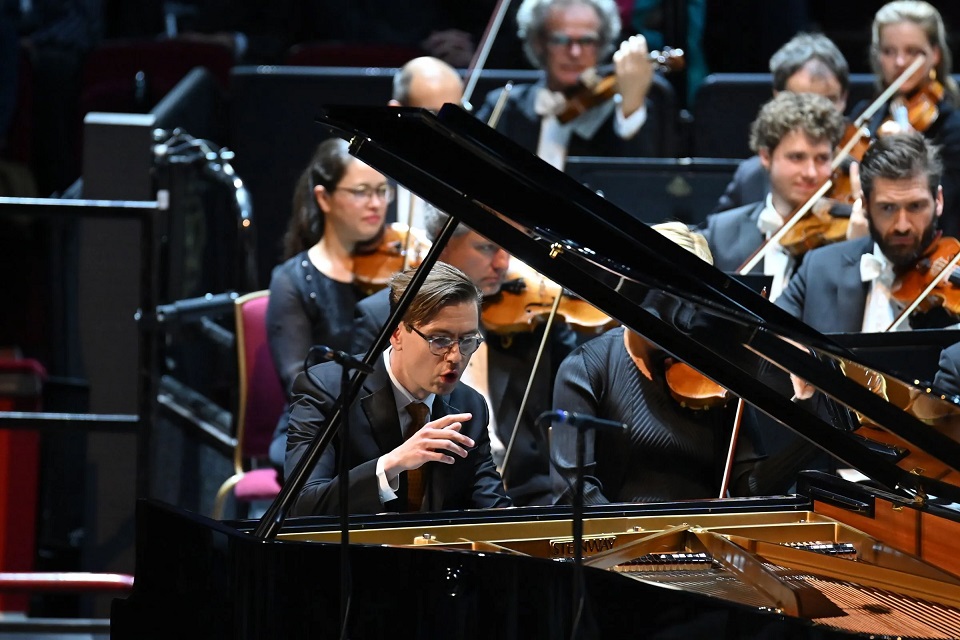
Few would, in any case, object to Vikingur Ólafsson tackle Schumann’s Piano Concerto in an account as dextrously articulated as it was unerringly proportioned. Not least an initial Allegro such as avoided any tendency to mid-tempo ‘drift’, those subtly contrasted themes building a cumulative impetus carried into the combative cadenza then a coda whose tensile energy was judged to a nicety by Petrenko. Some might have felt the Intermezzo too interventionist in its alternation of capriciousness and pathos, but absence of the cutesiness and cloying was more than its own justification and not least when that transition into the final Allegro had such an expectancy. Rhythmically supple with unwavering focus on its overall continuity, this set the seal on a reading whose technical finesse and interpretative insight ensured a riveting listen.
Ólafsson caused some stir at these concerts three years ago with Bach and Mozart concertos, and it was the former composer who provided the encore: the Adagio from the Fourth Organ Sonata (BWV528), transcribed here by August Stradel and rendered with understated poise.

More Czech music so soon after the Czech Philharmonic’s brace of Proms might have been too much of a good thing, but Petrenko’s Má vlast was very different from Jakub Hrůša’s in its lithe expression and streamlined textures. Nor was there was any lack of emotional depth – hence those earlier stages of Vyšehrad as it emerged eloquently on harps towards a fervent climax, its dramatic central section of a razor-sharp precision before subsiding into the main theme’s moving return. Vltava was scenically evocative and formally cohesive as it took in folk-dance, nocturnal landscape and treacherous rapids prior to its resplendent emergence in Prague, then Šárka unfolded its narrative of a matriarchal icon and her heroic demise with an impulsiveness that went into overdrive – without being overdriven – at its dramatic close.
It may be more generalized as to content, but the initial half of From Bohemia’s Woods and Fields is spellbinding as it conjures a pantheist ecstasy (in the process, anticipating Janáček and Minimalism) to which the BPO players were audibly attuned – Petrenko mindful not to overstate the relative blatancy of what follows. Most impressive, even so, were the final two stages whose gaunt rhetoric and granitic sound-world most often make for uneasy listening. Not here, however, as Petrenko gauged the motivic eddying of Tábor so that its underlying momentum held good through to the inevitable segue into Blaník. Emotional tension here was unremitting, the intensive interplay of Vyšehrad-theme with Hussite-chorale building to an apotheosis of Beethovenian power before letting loose for a coda of visceral exhilaration.
Its composite nature makes Má vlast difficult to sustain in performance, but there could be no doubt Petrenko managed this through his and the BPO’s acute yet never wanton control over every facet of the greater concept. A memorable performance and an impressive achievement.
You can get details about this year’s season at the BBC Proms website – and you can click on the names to read more about the Berliner Philharmoniker, their chief conductor Kirill Petrenko and piano soloist Vikingur Ólafsson
Published post no.2,289 – Monday 2 September 2024





 Arcana.fm