Keith Emerson

The sad news today is that Keith Emerson, spearhead of the legendary trio Emerson, Lake and Palmer, has died aged 71.

The group could be regarded as the original pirates of classical music, taking pieces by Sibelius, Prokofiev, Bach, Bartók and – famously – Musorgsky‘s Pictures at an Exhibition, reworking them affectionately for rock band and a new audience.

By way of tribute, here they are in their most famous arrangement of all, Copland‘s Fanfare for the Common Man:

A full appreciation of Emerson’s achievements, especially with regard to his use of classical music, will follow in due course.

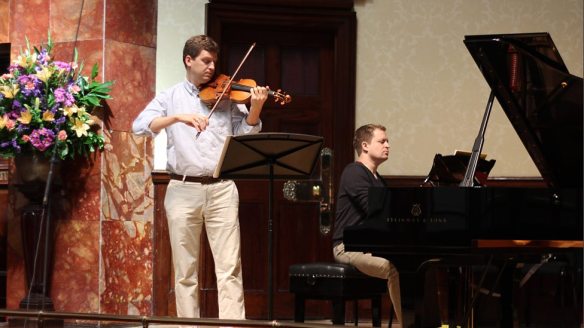
Wigmore Mondays – Denis Kozhukhin – Out of Doors

denis-kozhukhin
Denis Kozhukhin (piano)

Wigmore Hall, London

Monday, 22 February 2016

Audio (open in a new window)

http://www.bbc.co.uk/programmes/b071774c

Available until 24 March

What’s the music?

Haydn – Piano Sonata in D major, HXVI:24 (1773) (10 minutes)

Brahms – Theme and Variations in D minor (1860) (10 minutes)

Liszt – Benediction du Dieu dans la solitude (1847) (16 minutes)

Bartók – Out of Doors (1926) (14 minutes)

Spotify

Denis Kozhukhin has recorded the Haydn sonata but not any of the other works in this repertoire. In case you are unable to hear the radio broadcast the below playlist contains legendary recordings of the Brahms (Radu Lupu), the Liszt (Claudio Arrau) and Andreas Haefliger’s account of the Bartók:

About the music

Haydn is acknowledged as the godfather of so many forms that became the norm in classical music from the late 1700s onwards. As well as the symphony and the string quartet, he left a great body of piano sonatas that are fresh, original and ground breaking. Later examples from Beethoven and Schubert would surely not have been written were it not for works such as the D major example here.

The Brahms Theme and Variations is actually an arrangement of the second movement of his String Sextet no.1 – and transcribes for piano effortlessly, so much so that the listener would think it was a piano original. This was in order for it to be played by Clara Schumann, who received the score as a forty-first birthday present in 1860.

Liszt wrote his Benediction as part of a cycle of ten pieces for piano called Harmonies poétiques et religeuses in 1847. It is a relatively long, single span of contemplation, and in it the composer writes music that could be seen as an early pointer towards the so-called ‘impressionism’ of Debussy and Ravel. So often known for writing barnstorming piano pieces, Liszt takes his foot off that particular pedal for once.

Liszt’s fellow Hungarian Béla Bartók wrote his short set of five pieces, Out of Doors, in 1926. As its name suggests it is a celebration of the Hungarian countryside, by raucous day – pipes, drums and chases – and by atmospheric night, where the sounds of amphibious creatures can be heard in some of his exquisite nocturnal picture painting.

Performance verdict

From this concert it is very clear that Denis Kozhukhin is a special talent. The well-designed hour of music moved almost seamlessly from the simplicity of Haydn to the brazen antics of the Bartók with almost no join.

Kozhukin’s Haydn was lovely, the D major sonata receiving an airy performance with plenty of rubato – which means a stylish way of letting the music breathe – so that the rhythms were not too rigid.

The Brahms was similarly magical in the quieter passages, allowing Kozhukhin to use an imposing tone when the music returned to the minor key. This was a performance flying in the face of the obvious technical difficulties presented by the composer – and the same could be said for the Liszt, reaching moments of hypnotic beauty in its outer sections.

Kozhukhin took his time here, creating and maintaining the mood of contemplation, holding the atmosphere while easily managing the fiendishly difficult writing for the right hand. In the Bartók he found a good balance between percussive power and the primitive, folksy material that the composer brings to the surface. As a result Out of Doors felt like a celebration, entertaining and energetic, but with an added chill to the night pieces.

What should I listen out for?

Haydn

1:10 – the piece starts with a flourish in the right hand, one that recalls the sonatas of Scarlatti – as BBC Radio 3 announcer Fiona Talkington points out. It is a fresh tune that twinkles with the accompaniment that Haydn chooses, with very little bass. As is customary the first section is repeated (2:14) before at 3:20 Haydn starts to develop his main idea, moving it around harmonically. This is brief – as at 4:25 we hear the main idea again.

5:47 – the slow movement, which is immediately quite sombre and preoccupied. It is in the style of an aria, as though an imaginary singer were taking the line Haydn gives to the right hand. It is a brief but poignant movement, lost in thought towards the end. Haydn emerges from the quiet mood, leading straight into…

8:54 – the last movement, a short structure bright in tone and with an amicable tune. The end is rather nicely done.

Brahms

11:44 – Brahms begins with a grand statement. The first statement of the tune is given to the right hand, while the left plays arpeggiated chords. It is a big tune – and the first of six variations starts at 13:09, still in the minor key. By 15:38 the music is worked up and full of darkly coloured passion, but then Brahms slips effortlessly into the major key and a lighter outlook (16:54), from where Kozhukhin leads to a radiant variation. At 20:04 the austere minor key returns, but Brahms still finished in the major key, settling the strife experienced earlier.

Liszt

22:35 – Benediction du Dieu dans la solitude (God’s blessing of solitude) is a radiant performance of a piece that begins with a very long melodic phrase. It is quite unusual for Liszt in having very few moments of fire and brimstone, and instead achieves a kind of ecstasy of contemplation. The key – F sharp major – is key to this, the black keys somehow much more mystical than the white on this occasion! There are two central sections – both calming influences (28:39 and 30:58) before the original material returns (32:28). We hear all three tunes before the piece closes softly.

Bartók

39:03 – With Drums and Pipes – an exuberant if heavy start, low on the piano. This is almost an early precedent of rock music with its pounding rhythms!

40:40 – Barcarolla – a slower dance that flows nicely but which sounds uneasy, as though the direction of the boat on the water is uncertain.

43:10 – Musettes – this is rustic, dance-based material, where a lot of the tunes sound as though they are packed with wrong notes (they aren’t!) It makes them strangely charming.

46:05 – The Night’s Music – a classic example of a Bartók night setting. The music closes in on itself, and in the distance some animal / insect noises can be heard, disturbing the night’s piece when they get closer or make sudden noises, such as when Kozhukhin slams the upper end of the piano. It is an atmospheric and highly descriptive piece of music, and more than a little eerie as the sounds persist, seemingly stopping any chance of sleep.

51:11 – The Chase – a bruising encounter with the hands seemingly all over the place on the keyboard. The rhythms are deliberately inconsistent as the music hurries along, with great dissonance and surprises in both parts.

Encore

54:35 – the first encore is a sonata from Domenico Scarlatti – a relatively slow one that makes much of a trill in the right hand. It was published as Kk247 and lasts four minutes…after which point (at 59:01) we hear another sonata, this time from the Spanish composer Antonio Soler – a brighter example in D major – just the two minutes.

Further listening

At the bottom of the playlist you can hear the original Brahms Theme and Variations, written as the second movement in his String Sextet no.1. You can then hear another set of variations – on a theme of Haydn – as well as trying to second guess where Liszt was heading, in the direction of Ravel’s Jeux d’eau! Finally some more Bartók – his three movement Piano Sonata, just as raucous and unhinged as Out of Doors. Listen below:

On record: Janine Jansen plays Brahms and Bartók Violin Concertos

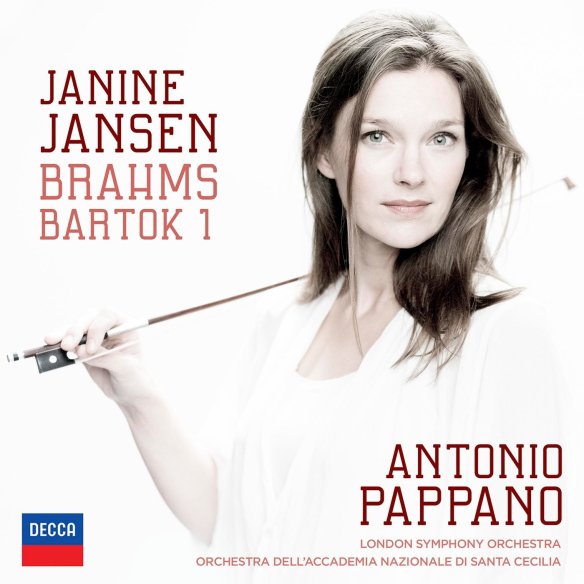
Featured recording: Janine Jansen pairs the Brahms Violin Concerto with Bartók’s First
brahms-bartok-jansen

Leading violinist Janine Jansen explores violin concertos by Brahms and Bartók, bringing out the Hungarian connections between them. The accompaniment is from Antonio Pappano and orchestras from the Santa Cecilia Academy and London.

What’s the music like?

This is an unusual pairing that has not been tried on disc before, but it makes perfect sense. Brahms’ Violin Concerto has a finale that makes much of Hungarian gypsy music, so the leap from that to the thoughts of the young Bartók is not as big as you might think.

The Brahms is a big piece, heavily weighted towards its first movement, which at 21 minutes is more than half the length of the work. In this recording Janine Jansen uses cadenzas (the display parts for violin alone) written by Joseph Joachim, Brahms’s friend and the dedicatee of the concerto. Joachim was a long-fingered virtuoso, and because of that the violin part is technically very demanding.

Bartók’s Violin Concerto no.1 is the first of two such published works, and was completed when the composer was in his mid-20s. It also includes traditional Hungarian music but now the language is noticeably more modern, with crunchy harmonies, swaggering cross rhythms and a solo part that sounds more like a duel with the orchestra. In the Brahms the two forces are very much ‘on side’.

Does it all work?

This is an inspired pairing. Jansen plays with a beautiful tone in the Brahms but just as much credit should be levelled at conductor Antonio Pappano and the Santa Cecilia orchestra, for their singing accompaniment that makes the listener want to hum along with the tunes. The Brahms has been recorded a lot of late but in this recording there is a fresh approach, as though the melodies have just been written. The oboe solo in the slow movement is gorgeously played, while the rustic finale is joyous and uninhibited.

The Bartók is similarly fresh, and again the orchestra – this time the London Symphony – cut through all the different textures and crossrhythms to make sense of this occasionally complex music. The rhythmic profile is strong once again, while technically Jansen is right at the top of her game, graceful in the first movement and gritty in the second but without losing any poise.

Is it recommended?

Yes. The two works complement each other in a highly original and brilliantly played pairing.

Listen on Spotify

You can judge for yourself by hearing the album on Spotify here:

Review – James Ehnes and Andrew Armstrong play Bartók at the Wigmore Hall

bela-bartok

Arcana begins its coverage of Béla Bartók (above) for 2016 with Richard Whitehouse reviewing a concert of the composer’s works for violin and piano, part of the Chamber Music series taking place at Wigmore Hall this year.

Wigmore Hall, Sunday 10 January 2016

Bartók: Rhapsody No.2 (1928); Solo Violin Sonata (1944), Sonatina (1925) (arr. Gertler); Violin Sonata No.1 (1921)

ehnes-armstrongJames Ehnes and Andrew Armstrong © BBC

Bartók’s chamber music with violin fits neatly into two recitals, James Ehnes returning to Wigmore Hall tonight for the second of these. He and pianist Andrew Armstrong began with the Second Rhapsody, in which they found persuasive accommodation between the music’s folk-derived essence; its combative alternation of mood and pacing, or its notably subtle thematic interplay: these aspects being governed by the player, Zoltán Székely, for which it was written and which here complemented each other perfectly in aim and intent.

While it has never been short of advocates since Yehudi Menuhin blazed a trail, the Sonata for Solo Violin is still undervalued in the context of Bartók’s later output. In part this is through its idiosyncratic handling of procedures deriving from the Baroque in general and Bach in particular. This can be observed in the first movement’s interweaving of chaconne and sonata elements, the second movement’s opening-out of its initial fugue to incorporate disparate processes, then the interplay of dynamism and reflection in the closing Presto. Such qualities were brought out in an interpretation audibly acknowledging this work as a harbinger of music to come, though the absence of quarter-tones in the finale underplayed the movement’s astringency.

The second half began with a transcription of the Sonatina by Endre Gertler, resulting in a brief yet perfectly poised piece whose three movements emerge with marginally greater presence than in the piano original, while not any the less characteristic of its composer.

The two violin sonatas (written for Jelly d’Arányi, though neither was in fact premiered by her) are significant in marking off decisive periods within their composer’s output. The First Sonata, its three movements cast on an imposing and even heroic scale, brings to a head those expressionist tendencies of the previous decade yet, for all its leanings towards atonality, is centred on chromatic and whole-tone harmonies. Ehnes had the measure of the fractured design of the opening Allegro appassionato, the stark thematic elements pulled apart rather than being brought together over its course, and found anxious introspection in the Adagio – not least the funereal overtones of its central section. The final Allegro tempered its headlong rush with lyrical asides, re-establishing a sense of tonal ‘destination’ prior to the brutally decisive coda. Armstrong tackled the cruelly exacting piano part with notable lack of inhibition and matched Ehnes’ headlong tempo for the finale through to those coruscating climactic bars.

A fine showing for a work which has only latterly come into its own in terms of performance. Ehnes and Armstrong returned for the Romanian Folk Dances (1926), Székely’s transcription of which stays relatively close to the piano original without sacrificing the slightest degree of virtuosity or panache. That would describe this evening overall, confirming Bartók as master of his craft and a reminder of his stature in the context of earlier twentieth century music: a stature that is happily being accorded its due at the Wigmore this season.

You can listen to the works in this concert on the Spotify playlist below, using versions by Yehudo Menuhin where possible:

What’s coming up on Arcana in 2016?

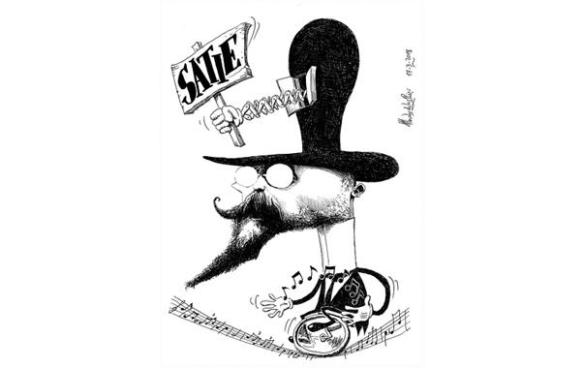
satie

Caricature du Maître d’Arcueil, Erik Satie

A question. What do Janet Jackson, Steve Hackett, Gary Numan and Cesar dog food have in common?

I’ll let you ponder the answer while setting out what Arcana has planned for some of 2016! We’ve already wished you a happy new year but having survived the first week back this is a great chance to let you know what we have planned for the year ahead.

We plan to make much more of the links between classical and pop music this year – so you can expect further episodes of The Borrowers (which already includes Manfred Mann, Plan B, Village People and Greg Lake), interviews with artists who like to work in both areas of music, and reviews of albums that appeal to both sides.

These will include the forthcoming James Holden and Luke Abbott album, a homage to Terry Riley – and we might even delve into the daunting prospect of Rick Wakeman and Alice Cooper celebrating the 40th anniversary of Pink Floyd’s Wish You Were Here, with large orchestra in tow! There is so much variety and depth in this area to explore. We also hope to hear from the artists themselves, whether electronic, prog, jazz or ‘other’.

shining

Arcana will also be training the spotlight on two composers who have been a big influence on pop music, albeit in very different ways. 2016 is the 150th anniversary of the birth of Erik Satie, and we will explore his influence on pop music from several directions. A good contrast to Satie’s music can be found in the work of Hungarian composer Béla Bartók – famously used by Stanley Kubrick in part of The Shining (above). Arcana aims to show the breadth of his writing, as well as illustrating how rock music can be said to trace back through his work. Kicking off, Richard Whitehouse will be covering James Ehnes and Andrew Armstrong playing Bartók in a concert from the Wigmore Hall tonight.

All that and the usual concert and new recording reviews…showing there is an awful lot to enjoy musically this year. Please do stick around for the ride! And the answer to the question? They’ve all used the music of Erik Satie! We’ll tell you how in due course…but for now we will leave you with his most popular piece: