In concert – CBSO / Mirga Gražinytė-Tyla: The Sea – Britten, Adès, Weinberg & Debussy

Britten Four Sea Interludes from Peter Grimes, Op. 33a (1945)
Adès The Exterminating Angel Symphony (2020)
Weinberg Jewish Rhapsody, Op. 36 No. 2 (1947) [First public performance]
Debussy La mer (1905)

City of Birmingham Symphony Orchestra / Mirga Gražinytė-Tyla

Symphony Hall, Birmingham
Wednesday 28 September 2022

Reviewed by Richard Whitehouse

This afternoon concert by the City of Birmingham Symphony Orchestra found Mirga Gražinytė-Tyla at the helm for her first concert as the orchestra’s principal guest conductor in what was a varied programme featuring music of (more or less) Jewish emphasis framed by evocations of the sea.

The Four Sea Interludes that Britten extracted from his opera Peter Grimes invariably makes a worthwhile concert-opener, not least with Dawn as hauntingly poised as this. MG-T drove Sunday Morning hard, so that the cross-rhythmic interplay between wind and strings came close to decoupling, but there was no lack of atmosphere either here or in Moonlight where a sense of emotional disintegration was almost tangible. Storm was as relentless and, in its latter stages, imploring as the music requires – hurtling forth toward a close of brutal finality.

Next, a revival of The Exterminating Angel Symphony as derived from the eponymous opera by Thomas Adès, commissioned and premiered by the CBSO last August. As previously, its four sections feel more a symphonic suite than symphony per se – the whole still amounting to more than the sum of its constituent parts. MG-T secured a virtuoso response – whether in the encroaching expressive ambivalence of Entrances, or relentless build-up and malevolent aura of March. Berceuse remains uninvolving in emotional content despite the allure of its scoring, while Waltzes provides a suavely ingenious finale in its inexorable motion towards catastrophe. It would be hard to imagine a more committed or convincing account, such that the composer – making one of his rare appearances as a non-performer – looked well pleased.

After the interval, MG-T continued her advocacy of Mieczysław Weinberg in what was billed as a ‘first public performance’ for his Jewish Rhapsody. One of various pieces at a time when Soviet composers attempted (inevitably unsuccessfully) to placate officialdom with music of an outwardly populist nature, it forms the middle part of a Festive Scenes trilogy only recently located in its entirety. Beginning with an affecting melody for flutes it proceeds, via solos for clarinet and violin, to sombrely eloquent music (a little akin to that of Kodály’s folk-inspired works from the 1930s) which gains in energy until breaking out in dance-music of decidedly manic cast – a recall of the initial melody on flute then oboe leading to the headlong pay-off. Superbly rendered by the CBSO, this is no mean discovery and warrants repeated hearings.

Finally, to La mer – a piece of which this orchestra has given many memorable performances over the decades, and which did not disappoint here. If the opening stages of From Dawn to Midday on the Sea were a little tentative, the theme for divided cellos was finely articulated and the apotheosis powerfully wrought. Play of the Waves had no lack of capriciousness or delicacy, while Dialogue of the Wind and the Sea duly contrasted those visceral and poetic elements towards a peroration that never lost sight of the essential pathos within its triumph. An impressive close, then, to a concert such as gave notice of the continued rapport between orchestra and conductor. MG-T returns next week for an equally diverse selection with Sheku Kanneh-Mason in Haydn and the CBSO’s own Marie-Christine Zupancic in more Weinberg.

You can read all about the 2022/23 season and book tickets at the CBSO website. You can visit Mirga Gražinyte-Tyla‘s website here – and for further information on Weinberg or Adès, click on the composer names
In concert – Patricia Kopatchinskaja, CBSO / Ludovic Morlot: Britten & Shostakovich

patricia-kopatchinskaja-2

Britten Gloriana – Symphonic Suite, Op. 53a (1954)
Shostakovich Violin Concerto No. 1 in A minor, Op. 77 (1947-8)
Britten Peter Grimes – Four Sea Interludes, Op. 33a (1945)

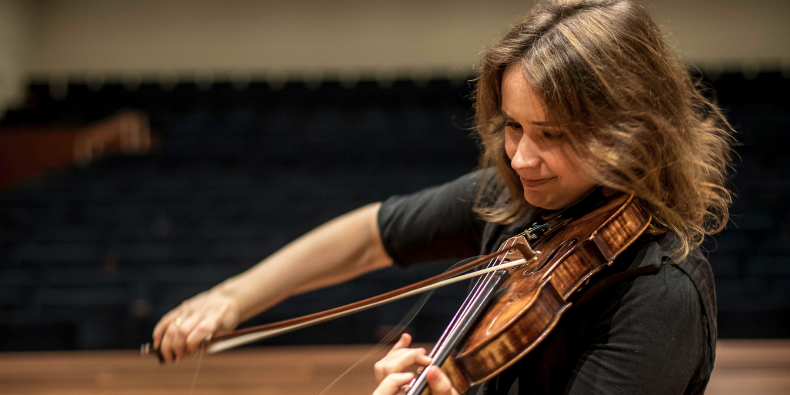
Patricia Kopatchinskaja (violin, above), City of Birmingham Symphony Orchestra / Ludovic Morlot (below)

Symphony Hall, Birmingham
Thursday 16 June 2022, 2.15pm

Written by Richard Whitehouse

This afternoon’s concert by the City of Birmingham Symphony Orchestra might largely have repeated that of the previous evening, but its inclusion of Shostakovich’s most wide-ranging concerto with suites which Britten devised from two of his operas ensured an absorbing listen.

In Shostakovich’s First Violin Concerto, it helped to have Patricia Kopatchinskaja at her most combative. Admittedly the opening Nocturne took time to come into focus, though its latter stages were powerfully shaped and with the sombre foreboding of the main climax gradually fading into silence. The Scherzo was distinguished by incisive repartee between soloist and orchestra, along with the vivid pointing up of those Jewish-derived elements which give this music a sardonic quality as becomes increasingly frenetic as the movement reaches its close.

The Passacaglia depends for so much of its emotional impact on its inexorable cumulative motion, and here Ludovic Morlot was at one with Kopatchinskaja in projecting the anguish – without undue vehemence – at its apex then forlorn manner of the soloist’s musing soliloquy. The Cadenza emerged methodically but with no lack of spontaneous expression, creating an impetus that the final Burlesque fulfilled in ample measure as it careered onwards – soloist and orchestra keeping enough in reserve for the coda fully to register its desperate defiance.

A pity last night’s UK premiere of Anna Thorvaldsdottir’s Catamorphosis (a co-commission for the CBSO’s centenary) could not be repeated, but that concert is being broadcast on BBC Radio 3 at a later date. Moreover, Kopatchinskaja had music of her own to perform when she returned to the platform for a duet with principal bassoonist Nikolaj Henriques in what was a repost to the authoritarian leaders who curtail creative expression, as have their predecessors before and after Stalin. Suffice to add that this piece made its point in notably visceral terms.

Opening the concert, Britten’s Symphonic Suite from his opera Gloriana made for a short if eventful first half – moving from the imperiousness of The Tournament, via the eloquence of The Lute Song (the tenor line of the original plaintively taken by oboist Emmet Byrne) and inspired pastiche of The Courtly Dances with its felicitous writing for woodwind and percussion, to the powerful apotheosis that is Gloriana moritura with its baleful brass and burnished strings. Not often revived, it made a suitably thoughtful impression this evening.

The Four Sea Interludes from Britten’s earlier opera Peter Grimes is more frequently heard in concert, with Morlot clearly relishing the stark timbral contrasts of Dawn as much as the scenic and temporal interplay in Sunday Morning. The highlight, though, was Moonlight whose sustained intensity and encroaching harmonic dissonance were palpably conveyed – after which, Storm concluded the sequence in vividly dramatic terms while not excluding that element of weary soul-searching as briefly ‘takes the stage’ before the dramatic close.

A distinctive programme with performances to match. Morlot is a conductor not seen often enough in the UK, and the same might be said for Markus Stenz who will be appearing with the CBSO next Thursday and Saturday in performances of Mahler’s Resurrection Symphony.

For more information on the CBSO, visit their website, and for details on the newly announced 2022/23 season click here. Meanwhile for more information on the artists, click on the names to access the websites of Patricia Kopatchinskaja and Ludovic Morlot

Another spring symphony – Benjamin Britten

by Ben Hogwood

In the last week Arcana have explored three very different symphonies with a springtime theme or feel. Now here is a fourth, a very different beast, from the pen of Benjamin Britten.

A number of years back I wrote about this piece for my Good Morning Britten blog, marking the composer’s centenary. There is a lot of scholarly debate as to whether this really is a proper symphony, but as Michael Kennedy points out in his booklet note for Britten’s own recording on Decca, it follows in the tradition of choral symphonies from Vaughan Williams and Holst, while taking more influence from the Mahler symphonies in which voices were used.

The Spring Symphony was commissioned by Serge Koussevitsky for the Boston Symphony Orchestra, and began with a rather different concept. When Britten wrote to the conductor, he said, ‘I am planning it for chorus and soloists, as I think you wanted; but it is a real symphony (the emphasis is on the orchestra) and consequently I am using Latin words’.

Things changed, as Humphrey Carpenter’s biography of the composer details. ‘Both Eric Crozier and Elizabeth Sweeting believe that the Spring Symphony owes its existence to a particular Suffolk landscape, ‘somewhere between Snape and Ufford’, writes Crozier. According to Sweeting, Britten visited this spot on a picnic with her, his housekeeper and Pears. It was ‘a glorious spring day, one of those that seem to be out of time; and she believes that this experience crystallized his love of the Suffolk countryside.’

The work actually enjoyed its first performance in the Netherlands, where, with Koussevitsky’s blessing, Eduard van Beinum conducted the first performance at the Concertgebouw in Amsterdam on 14 July 1949. A little Latin remained, Britten including the ancient song Sumer is icumen in in the work’s climactic final pages.

Britten says this is ‘a symphony not only dealing with the Spring itself, but with the progress of Winter to Spring and the reawakening of the earth and life which that means’. Carpenter maintains that ‘sweetness is the work’s predominant character – most of the poems are in the pastoral tradition – and it is much to Britten’s credit that the music never becomes cloying. This is largely due to the orchestration. Coming to it from the exigencies of the English Opera Group chamber ensemble, Britten treats the full-size symphony orchestra of the Spring Symphony (triple woodwind, four percussionists and two harps) as a palette from which he selects only a few colours at a time, with stunning results.’

Britten recorded the work first, though the version below is a live concert given by Leonard Bernstein in 1963. Once the ear becomes used to the sound it is easy to appreciate the intensity of the performance from singers and orchestra alike:

Playlist – Spring Serenades

To celebrate the month of May, and what should in theory be a passage of warmer weather (!), Arcana is celebrating the art of the Serenade in a playlist.

Serenades have been a form in classical music for a good 250 years now, elevated to a higher form by Mozart but also perfected by 19th century composers such as Tchaikovksy, Dvorak and Brahms.

This playlist chooses selections from some of the best, venturing into the 20th century for examples by Elgar, Britten and Swedish composer Dag Wirén, while drawing on wonderful ‘drawing room’ music from the 18th century by composers including Mozart, Beethoven and Hummel.

Find a quiet hour if you can, and enjoy…

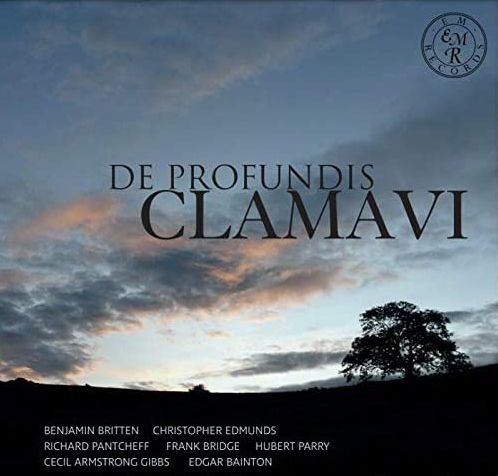
On record – Duncan Honeybourne: De Profundis Clamavi (EM Records)

de-profundis-clamavi

Armstrong Gibbs An Essex Rhapsody Op.36 (1921); Ballade in D flat (1940)
Bainton Variations and Fugue in B minor Op.1 (1898); The Making of the Nightingale (1921); Willows (1927)
Bridge Piano Sonata H160 (1921-4)
Britten Night Piece ‘Notturno’ (1963)
Edmunds Piano Sonata in B minor (1938)
Pantscheff Nocturnus V: Wing oor die Branders (2015); Piano Sonata (2017)
Parry Shulbrede Tunes (1914)

Duncan Honeybourne (piano)

EM Records EMRCD070-71 [two discs, 156’46”]

Producer Oscar Torres & Richard Pantcheff
Engineer Oscar Torres

Recorded 20 & 21 August 2020 at Potton Hall, Westleton, Suffolk

Written by Richard Whitehouse

What’s the story?

Never a pianist to pull his punches, Duncan Honeybourne adds to his expanding discography with this extensive survey of British piano music which, written across almost 120 years and evincing a range of styles, more than reinforces the descriptive heading of the overall project.

What’s the music like?

The first disc begins with the Piano Sonata by Christopher Edmunds. Birmingham-born and long active at the School of Music there, he left a sizable output from which the present work impresses through its wide expressive range within modest formal dimensions. The opening Allegro recalls Medtner in its pivoting between fervency and repose, then the Lento strikes a note of heartfelt emotion underlined by its ‘mesto’ marking. Utilizing aspects of scherzo and finale, the closing Allegro returns to more extrovert concerns as it arrives at a virtuosic close.

Edgar Bainton was still in his teens when composing the Variations and Fugue which became his first acknowledged work. Brahms is a key influence, but the music’s motivic and textural discipline ensures a formal focus throughout the nine deftly contrasted variations then into a tensile and vividly cumulative fugue. Remembered primarily for his songs, Cecil Armstrong Gibbs wrote idiomatically for the piano as is demonstrated by the intricate passagework and often bravura writing of An Essex Rhapsody, while the later Ballade exudes deeper emotion – not least an ominous central section with undeniable overtones of war. Part of a compendious sequence exploring different aspects of night, Richard Pantcheff’s Nocturnus V: Wind on the Waves follows a trajectory of impending marine turbulence that duly regains its earlier calm.

Written at the home of his daughter’s family, Shulbrede Tunes finds Hubert Parry reflecting on domestic environs in a methodically constructed cycle – the 10 pieces taking in evocations of the priory and people within. A lively humour informs Bogies and Sprites that Gambol by Nights, with a ruminative pathos to the fore in Prior’s Chamber by Firelight. Here, as in the exuberant Father Playmate, the aging composer’s devotion to Austro-German romanticism results in music which is as affecting as Parry’s orchestral and choral works from this period.

The second disc opens with two further pieces by Bainton. From among his many miniatures, Willow is a limpidly impressionist album-leaf of no mean poignancy, then The Making of the Nightingale evokes this bird’s creation in imaginative terms that are appealingly realized here. Written for the first Leeds International Piano Competition, Benjamin Britten’s Night Piece is the only acknowledged piano work from his maturity – a study in dynamic and timbral nuance of a finesse as to make one regret his stated antipathy for the modern piano on its own terms.

It is the Piano Sonata by Frank Bridge (placed before the Britten) which inevitably dominates this collection, not least as this recording is among the finest from recent years. Testimony to the composer’s response to the carnage of war as well as its impact on his evolving idiom, the three movements unfold as a single cumulative entity – the sizable opening Allegro preceded by a slow introduction whose main motivic elements are gradually elaborated for the ensuing opposition between anguish and eloquence. The savage rhetoric of its close makes the contrast with the Andante’s consoling rumination more acute, the music as if surveying a landscape of memories which elides straight into the final Allegro with its renewed confrontation of earlier motifs – on the way to a stark denouement then a resigned and almost confessional epilogue.

Pantcheff’s almost contemporary Piano Sonata rounds off this collection. Its three movements each carries an inscription from the epic poem The Axion Esti by Odysseus Elytis that sets the tone for a restive and increasingly tumultuous Inquieto, followed by an Elegia whose sombre imagery might feel almost nihilistic were it not for the plaintive expression that emerges in its latter stages, then a finale whose Alla Vortice marking aptly indicates the gradual intensifying of mood which carries this movement – and the work as a whole – towards its explosive close.

Does it all work?

Undoubtedly, when heard as a collection. Honeybourne has been astute in his planning so that each disc can be appreciated as a stand-alone recital in its own right, or as independent halves of an ‘uber-recital’ which even he would be unlikely to undertake in a live context. All except the Bridge, Britten and Parry are receiving their first recordings, and it would be surprising if some pieces did not enjoy greater exposure in future. For his dedication in championing them, and for putting together such an ambitious anthology, Honeybourne can only be commended.

Is it recommended?

Very much so. The piano sound is a shade hard at climaxes, while spacious and wide-ranging elsewhere, with detailed notes on each work and composer from various sources including the pianist. It adds up to an impressive release and a highlight of the EM Records catalogue so far.

Listen & Buy

You can discover more about this release and listen to clips at the EM Records website, where you can also purchase the recording. For more on Duncan Honeybourne, visit his website – and for more on Richard Pantcheff click here