Talking Heads: Bruce Brubaker

by Ben Hogwood

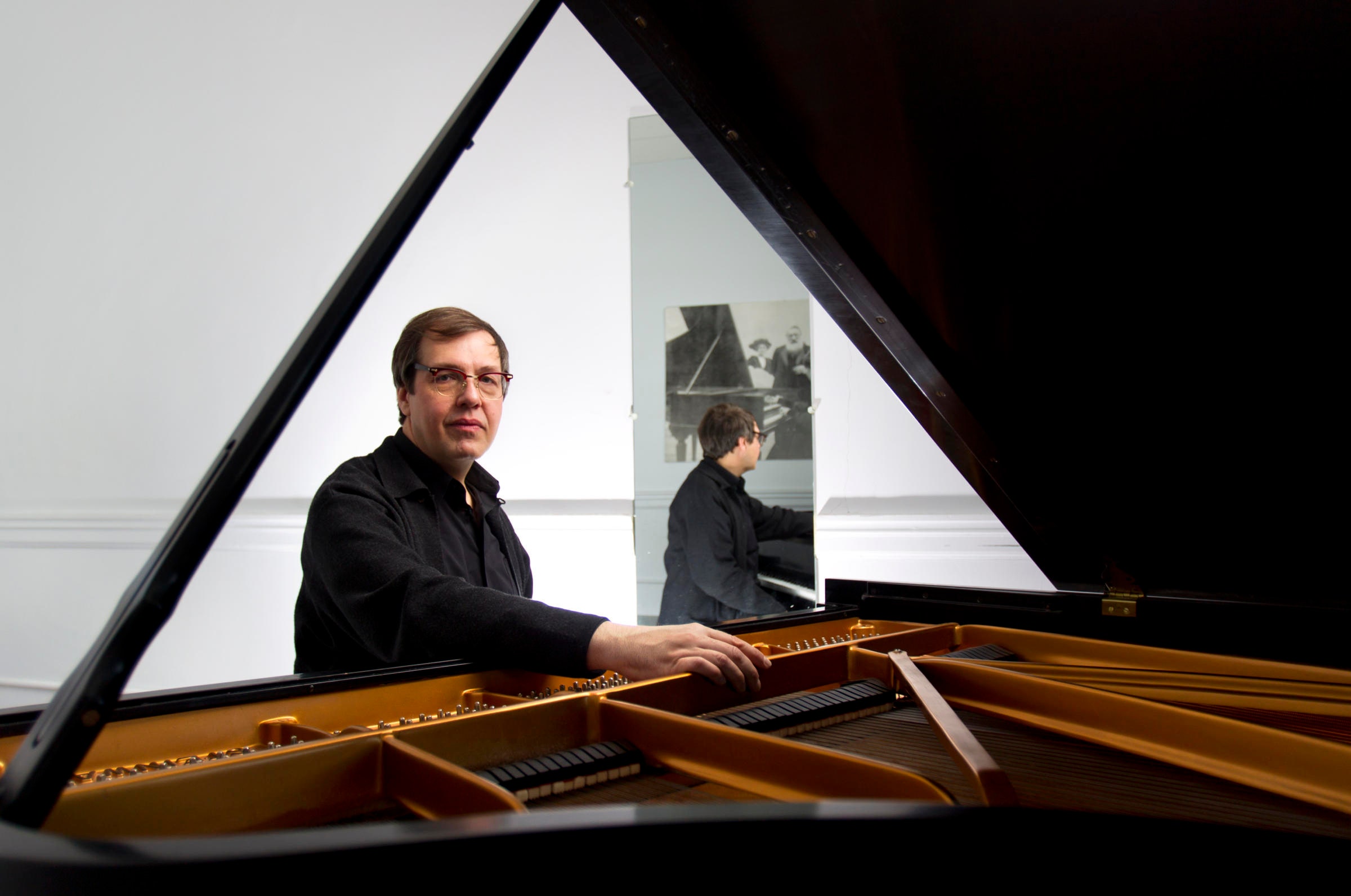
Pianist Bruce Brubaker is a man who likes a challenge. A prolific and highly respected performer of music by Philip Glass, Steve Reich and Meredith Monk – and recent collaborator with Max Cooper, Brubaker has in recent times turned his attention to the music of Brian Eno. In November he released an album of piano interpretations taken from the former Roxy Music keyboard player’s solo work – including a complete account of the seminal Music For Airports. The album, Eno Piano, has been released on the InFiné label, Arcana sat down with him to discuss the project, gleaning some fascinating insights into Brubaker’s world of contemporary and classical piano playing.

Given his impressive CV up until now, the music of Brian Eno appeared a logical step – albeit not an easy one. The genial pianist takes up the story. “No, because as you know, Music For Airports and almost all of Brian’s earlier work in this ambient area was studio music and he made it without really any kind of reference to live performing. There were no scores, no plan even! On Music For Airports he provides these little drawings showing you about the patterns involved, but the idea of playing it live was really very far away.

The prospect of recording Eno on the piano had great appeal. “I’m fascinated by the idea of using the wrong tools to make this music. In the original they are physical tape loops that have been used to make the sounds of Music For Airports, so when you hear a particular pattern of notes, and it’s repeated, you are literally hearing the same thing – the exact micro timings the exact balances are the same. In our version I’m playing those things by hand each time, so they’re not the same thing. It’s an interesting problem, and I kind of like it!”

It also resonates with Eno’s methods of composition. “You know Brian did that thing with Peter Schmidt called Oblique Strategies, with the deck of cards – one of my very favourite Oblique Strategies is “Repetition is a form of change”. That’s really a big part of this, so even when you use a tape loop, and play the same notes exactly in the same rhythm, exactly the same way, the effect to the listener / human is not exactly the same. We’re impinging on that, in a slightly different way, because now things are not identically the same. Perhaps the listener perceives this, perhaps they don’t. I think all that ambiguity is right in the neighbourhood of what he was doing in the first place.”

Certainly in music of this kind, the fifth instance – for example – of a melodic phrase is very different from the first, because of the listener being more ‘in the zone’. Brubaker agrees. “Absolutely. I think that as each person hears a piece of music, because of all the things you’ve heard before, the place you live, the sound environment you’re in, every single person – as they hear musical sounds – makes a new piece of music by listening. For everybody sitting in a room, at a concert or hearing a recording there’s a somewhat different piece of music being completed as they listen. That appeals very much to me and our sense of our own time, where people’s participation in the process of music is, I think, much greater. It’s not a passive thing. When you’re hearing something like Music For Airports, you really are invited or allowed to be inside and to make those connections yourself. It’s infinitely variable. Then when you come back and hear it again, it will also vary, so if you hear it for the tenth time, you probably don’t hear the same thing as you did in the beginning. I’m thinking of If on a Winter’s Night a Traveler by Italo Calvino, where he says something like, “I returned to the books that I read when I was a young man, and I find that they have changed”. Of course, he knows that they haven’t, the physical printed book is exactly the same – but different when he reads it. I think that that’s where we were trying to be with this.” The question also arises that if Brian Eno sat down to write Music For Airports today, we would end up with something very different. “Definitely”, he agrees.

In spite of its ambience, Music For Airports has a number of interpretative issues and is an intense experience for the performer. “One of the challenges was to figure out how much to allow these repetitions of the same material to vary, or how much to try to make them the same. As a human being, if repeat something over and over again, each one will be different. Do you intentionally push them to be different or not? It’s actually not that much different than playing other minimalist or repetitive music like Glass because I think it’s the same thing. I always found in Glass that if you intentionally varied something, it usually seemed like too much. The better way to do it was to be more like an observer and not really a participant. If you can get yourself into a state of being where you’re listening to the sound as it happens, but to be outside and hearing it happen, and then responding to whatever is unequal but not really making it happen. That is true here too, as it goes by, you monitor and notice the things that vary, but you’re not really making them happen. If you try to do that, then it almost always seems like a heavy hand too much.”

Brubaker’s detail is fascinating, as he moves on to consider his topic further. “I guess it’s true of a lot of kinds of art. One of the strange things about music that’s improvised versus music which is planned beforehand is that a lot of the music that we like, which is planned in advance, aspires to a quality of improvisation. Even if you’re listening to a Beethoven symphony, probably the best performance is the one that seems like it’s not written down, the one that seems like it just happened – even though we know that’s not true. If you map that on to the world of movies or theatre, that’s exactly the same, right? In a movie, for the most part, you understand the actors have learned their lines and rehearsed them many times, but if you’re lucky, you forget all about them. You have the sense that whatever the action is, in the scene you’re watching, it’s really happening. The same thing is true in music, you want to be engaged in what’s happening so that it seems like it’s just a spontaneous event.”

Although he cannot remember his first encounter with Eno’s music, Brubaker admits to a connection with the minimalism of the 1960s and 1970s. “I did get this idea of trying to play Music For Airports on the piano quite a while ago, but then there always seemed to be this big problem, which was how we can make very long sustained notes, because that’s such a feature of the piece – and some parts of the music actually have human singing. Then I heard this jazz pianist in America play a concert where he had modified one of these devices that electric guitar players use, the E-bow – and cut it down to put on one string inside a piano. He did an improvisation around this long droning note. I started to think maybe you could do that with the piano and use a bunch of E-bows to make long notes. Then almost by chance I was talking to one of the people at my record company who happen to know of an inventor in France, who had started working on a system like this, specifically for the piano. We met and started talking about it, and that is what we used for this album.”

He explains the methodology. “There are these electromagnets suspended over a piano string, and the string is allowed to vibrate either by putting down the pedal on the piano or in some other way where you can raise the damper. The electromagnet creates a signal that causes this vibration in the spring, which can be controlled very specifically with frequency. You can also produce overtones. Then we found with the lower strings, if you continually excite one of those strings, which are wrapped with another kind of metal, you actually get a pulse. This also fascinates me because we’ve never heard a piano string that was vibrating continuously! When you’re hearing piano sounds in a normal piece of music, you’re always just hearing the decay of that sound, you’re not really hearing the impulse and you’re the impulse for just a little tiny bit of time. What we’re doing now is we’re actually making the string vibrate for a long period of time, like you would on a violin. And so, you know, the nature of the tone, in some cases was really surprising because we’ve never heard it before.”

A new instrument, even! “I was joking about this, but I think it’s true. Eno Piano is not just the title of the album, it’s also an instrument. A long time ago Brian said that the studio is a musical instrument, so it is turning it around and showing that an instrument can also be a studio! The way we’re using it is something that really couldn’t have happened very, very long ago.” The emphasis falls on the string part of the piano rather than its percussive element. “There are other examples of course, in John Cage, and the American composer C. Curtis Smith, who wrote a whole bunch of music for pieces of string or fishing line were used inside the piano. I also played a Cage piece where you had to thread the strings through, and we were able to make a long tone that way.”

Brubaker had the pleasure of meeting Cage on several occasions. “I actually played with him a couple of times. I played Radio Music with him once, and a new chamber music piece he had written. I always found his effect was really very powerful and a spark towards something more. This chamber music piece, called Seven, he had notated using a heavy Japanese brush with ink, and so a lot of it was very difficult to read. The brush was irregular and some of the notes were very thick and some of them were very thin and scrappy and you couldn’t really tell what the notes were. I remember saying, “Mr Cage, can you tell me what the notes are in this chord?” He probably gave the ultimate advice that you could give to any musician in any situation. He said, “Just listen, and you’ll know what to do”, which I thought was pretty good. At the time I just wanted him to tell me what the notes were, but he wouldn’t do that!”

He also recalls a musical example. “I played a little solo piece called Dream, with a long meandering melody, a pretty piece like a lot of his music from the 1940s and early 1950s. I played a concert where he was giving a commentary and had played it from memory. One of the audience asked Cage, “What would happen in the performance if the pianist got lost?” Right away Cage said, “That would be wonderful!” That was good – and that touches this illusion of spontaneity, the illusion of something that isn’t planned. By getting lost, you might be found again. Even in the 19th century, it’s pretty well documented that pianists giving concerts from memory was a kind of substitution for people who didn’t improvise. When Liszt played his own music in public, he always held up the score so that people would know he was not improvising. That back and forth between what the music is and how it sounds is something very interesting, especially with the recent importance of sound artists. A lot of these people come from the visual art world, using sound not as music but as something that they can manipulate and sculpt. I think that actually connects back to Brian Eno. You could say he wasn’t really making music but more creating this sound environment, this space to be inside.  That boundary between written music and the world of sound has got much closer, and that will probably continue to be the case.”

One of Eno’s more recent compositions, the single-track album Reflection from 2017, comes to mind. “I think that’s the greatest achievement, being on the cusp of paying attention, or not paying attention”. Some of the pieces chosen on Brubaker’s album – By This River and The Chill Air – sound as written. In the live show we are using those two short pieces in the middle of Music For Airports which I was very sceptical about at first, but I think it does help and is good for the audience.”

Though Brubaker’s recent recorded output is more minimal, his background is steeped in classical music. “I trained as a classical pianist, and I taught at Juilliard for a long time. Even now the students I teach really are primarily interested in Beethoven and Liszt, not even going very far into the 20th century. Sometimes I feel like I almost have a double life! When I go out and do my own artistic work it tends to focus on much more recent things, but when I go back to teaching it’s Beethoven all the time. On the other side I still feel there’s a long connection, and that some of the things we’re talking about with non-directional music, which is to be completed by the listener, connect to what was happening in European music, maybe in the 10th and 11th century. If you go back long before the Classical period, before the composer identity was so formed, there were many other ways of making music, and in other musical cultures outside of European music. One of the things that happened, say with minimalism in the 1960s, is that some of that authority of the composer was lessened. It’s not so much a kind of top-down hierarchical format, and instead the listener, the performer are much more included in the complete art. I think that’s a good thing.

We always seem to blame Beethoven, but he really created a kind of art where the composer really was operating as a kind of God and, and making this musical experience where you weren’t really invited to be a participant. I’m probably overstating it a little bit because I think these different ways of using music exist in lots of kinds of music, so you can approach almost any piece with various ways of participating. But I think Glass actually is the one who said that he found that when you listen to a symphony by Beethoven, the climax generally happens at the same place every night and the organisation of the overall peace really remains the same. His contrast was going to see a play by Samuel Beckett, where the play seemed like a different experience each time he saw it. It was much more of a of a network of relationships rather than this narrative of beginning and development and progression to some kind of goal. It was less teleological if you want to go that way! A lot of European art of the 18th and 19th centuries was directed towards a goal, which could be very satisfying, and then there’s some kind of conclusion. On the other side, with a lot of minimalist music and repetitive music, you can argue that there is no ending – and no beginning either. You’re just in the middle. And of course, isn’t that the experience of life? You don’t remember being born and you haven’t died? So here we are, and I think that’s a very appealing art for our time.”

Finally we move on to discuss Brubaker’s work with Max Cooper, where the pair reinterpreted the music of Glass. “That was a really good project for me, I enjoyed it a lot. It was quite unpredictable, because there was this algorithm in use in the software that translated the signals from my piano playing. Every time we did the performance, those signals would vary slightly, depending on the precise touch, the dynamics, everything about the pedalling, and then those signals were controlling Max’s computers and his synthesizers. Every time we did the performance, that information that he received was really quite different, so what I would hear from him was really varying every day. So it was quite unpredictable, and sometimes it was a little confusing because it could be quite chaotic. What you hear on that album is actually a live show from Paris, and he did a little bit of changing because he didn’t like the quality of the sound. It was quite a voyage!”

Brubaker hasn’t spoken to Eno about his new project – yet – but the pair have conversed previously. “He’s working on the rehearsals for The Ship live show, which are using up all his time, as well as a bunch of other things. I started talking to him about this a long time ago, and I think he’s very open to the idea now of other people taking his music. I always wonder about that with very iconic pieces. I did some piano transcriptions of music by Meredith Monk, and that was a very interesting project where she was really very involved. It was complicated for her because she liked the idea that it was going to be her music heard in a different way, but at the same time she really wanted to be sure it was what she wanted. And I think Brian is not like that and has a very different attitude. In that sense, he is probably much open to other possibilities.”

Eno Piano rewards focussed listening – as well as giving the listener the option to draw back and observe from afar. Typically Brubaker, before he goes, is able to introduce another point of reference. “You probably know this piece that Erik Satie wrote at the beginning of the 20th century, called Furniture Music. My understanding is that he wrote it for some kind of art gallery, some kind of show that was being given. He had the musicians in the room, and he told the audience not to pay attention to them – but he got unhappy because when the musicians started to play the audience got quiet! They were listening intently, and Satie was unhappy because he wanted them to ignore it. I rather liked that.”

You can listen to Bruce Brubaker’s Eno Piano below – and explore digital purchase options. Click here for Bruce Brubaker’s website, and here for his InFiné artist page

In concert – Brian Eno & Baltic Sea Philharmonic @ Royal Festival Hall

Brian Eno (vocals, instruments), Melanie Pappenheim (vocals), Leo Abrahams (guitar), Peter Chilvers (instruments, software), Peter Serafinowicz (vocals), Baltic Sea Philharmonic Orchestra / Kristjan Järvi

Brian Eno
The Ship [The Ship, Fickle Sun (I), Fickle Sun (II) The Hour Is Thin, Fickle Sun (III) I’m Set Free]
By This River, Who Gives A Thought, And Then So Clear, Bone Bomb, Making Gardens Out Of Silence, There Were Bells

Royal Festival Hall
Monday 30 October (9 pm concert)

by Ben Hogwood photos (c) Ben Hogwood, not to be reproduced without permission

The estimable Setlist website, documenting the concert history of artists and bands, has a notable seven-year gap between Brian Eno’s last live appearances and this new tour, in which he has been bringing an orchestral perspective to his 2016 album The Ship.

Many artists in Eno’s ambient sphere have looked at the orchestra as a vehicle for original composition, but more recently the tendency has been for artists to use it to regenerate past material, and – perish the thought – boost awareness and bank balance by association through touring. This tactic is clearly not for Eno, who invested a great deal of time in finding the right ensemble before even looking at the layout of this tour. Seeking fresh talent and players with flexibility, he alighted on the Baltic Sea Philharmonic Orchestra, a ten-year-old ensemble conducted by the dynamic Kristjan Järvi. It is fascinating to think that Kristjan, part of a remarkable Estonian conducting trio after father Neeme and elder brother Paavo, is creating new directions for his family, stepping out on ever more adventurous voyages into contemporary music.

This one – on the banks of the Thames – takes its lead from the most famous voyage of the 20th century, the Titanic. Yet Eno chooses not to tell the story in graphic detail, portraying the ship instead through shades of orchestration, atmospheric noise and folk-like utterances. These are made through his own sonorous tones, which worked in this concert to vivid effect. The sonic picture was surely aided by the inclement weather in the UK, the audience becoming part of the vessel as the sea spray splashed against the side. Meanwhile the creaks of the orchestra’s wooden instruments portrayed the boat’s natural bowing and bending.

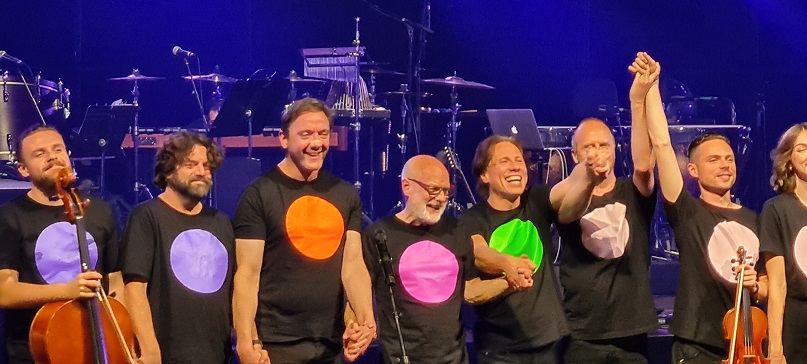
Eno’s music for The Ship reflects his ambient work, in which the music makes incremental changes in its own sweet time, but it shows how ambient music can also be loud. As time progressed this performance assumed a dramatic intensity way above that of the home listening experience. The orchestra’s control was a key aspect, with Järvi ensuring the musicians had as much freedom as they wanted. He walked around the stage to cajole individual players or sections, then faced the audience as though looking out to sea himself. Dressed in colour-co-ordinated t-shirts, the players could see each other and their conductor in the dark – not to mention the cerise shirt of Eno, a point of vivid colour in the middle.

Eno’s vocal was complemented by the understated yet versatile voice of Melanie Pappenheim, and the thoughtful input of guitarist Leo Abrahams and keyboard player / software designer Peter Chilvers. Also present was the actor and comedian Peter Serafinowicz, reading a monologue on war through rich bass tones.

The Ship, a three-movement suite, had at its heart Fickle Sun, itself in three parts. Here the onward motion of the orchestra was irresistible, still moving slowly like the Titanic but flattening everything in its path. Then, the struggle over, Eno reached for the Velvet Underground cover I’m Set Free, its heart-shifting chord progression nudging at the emotions with every repetition, providing an tidal swell for the audience.

This performance was a triumph of spirit and resolve, a warming combination in these troubled times. The encores continued in the same vein, though the deeply uncomfortable Bone Bomb, from 2005 album Another Day On Earth, provided painful relevance with its response to an article on a suicide bomber in Palestine. Eno paused the music after this to give his own unstinting views on the conflict with Israel, declaring proceeds from the Ships gigs would go to help those suffering from the war in Gaza.

Of the other encore items Making Gardens Out Of Silence, from last year’s ForeverAndEverNoMore, reached a more obvious inner peace, before There Were Bells, found Eno’s music once again reaching beyond the ambient to find notes of sustainable emotional power. Equal strength was found in By This River, the earliest music of the night (from 1977), and the track that stayed with the audience long after the concert had finished.

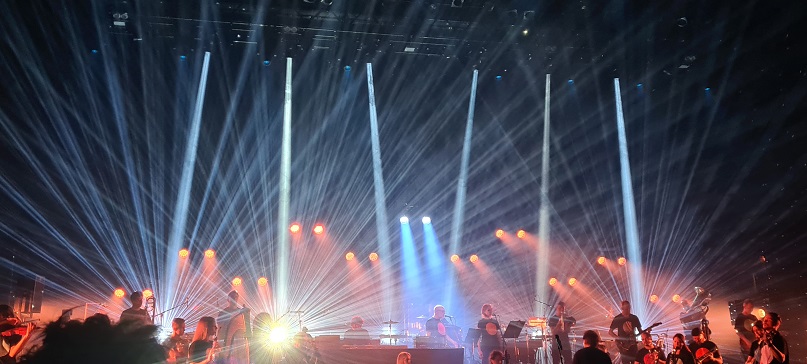
At the end Eno and Järvi generously credited the band and orchestral musicians, looking beyond to single out those responsible for monitoring and lighting, two crucial overlooked b but crucial elements of any performance. The lighting was wholly suitable, the relative darkness allowing the audience to use their mind’s eye in response to Eno’s resolute constructions. Thus was a memorable evening, and one in which the main man himself was also deeply moved.

New music – Bruce Brubaker: Eno Piano – Music for Airports, 2/1

American pianist Bruce Brubaker is one of those artists whose every move is worth monitoring, for his musical quests bring many rewards.

Brubaker is perhaps best known for his work with the music of Philip Glass, John Cage and Meredith Monk, but now he makes a very intriguing turn in the direction of Brian Eno, creating an album for the InFiné label that will include a selection of ambient music, including Music for Airports.

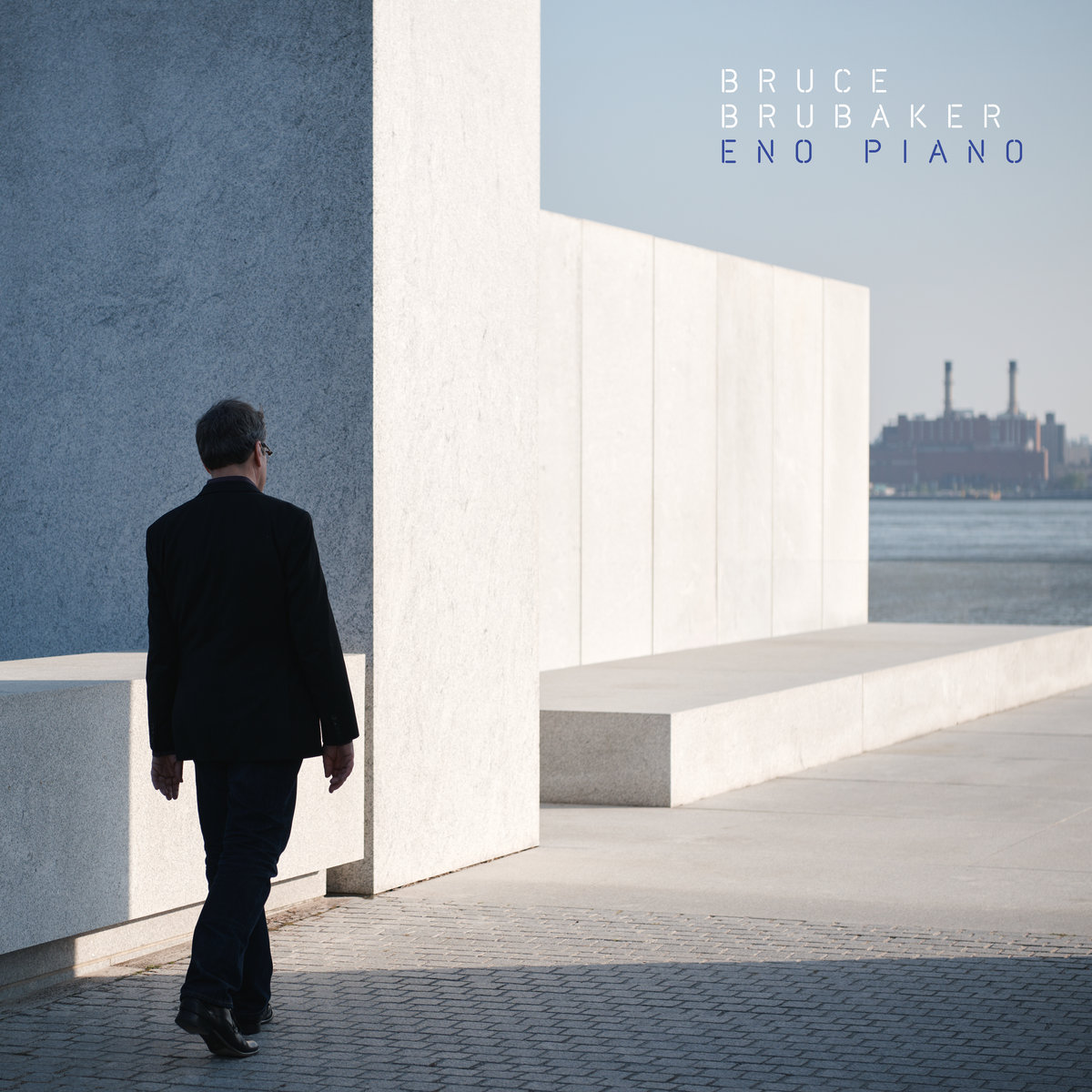
The press release asks a question: “Can a single instrument convey ambient music originally made through studio techniques and tape loops? Eno Piano is a companion to Bruce Brubaker’s acclaimed album Glass Piano (2015) — even the two album covers are companions. Named by Pitchfork “one of the most exciting pianists in the contemporary American classical scene,” Brubaker, in Eno Piano, shows that just as the studio can be a musical instrument, a single musical instrument can be a studio.”

Have a listen below and see what you think:

Talking Heads: Brett Dean

interview by Ben Hogwood

Brett Dean is enjoying a productive start to 2022 in London musical life this year. Late January saw the UK premiere of his Piano Concerto, with Jonathan Biss and the BBC Symphony Orchestra, while the following month Lawrence Power gave a performance of the Viola Concerto with the London Philharmonic Orchestra. The viola is Dean’s ‘home’ instrument, but more recently he has cast his eye further down the stringed instrument range to write for the cello. This work – the Cello Concerto – has had a number of high-profile performances around the world with its dedicatee Alban Gerhardt as soloist. Gerhardt now brings it to the UK for the first time, completing a date originally scheduled during the pandemic.

Australian composer Dean lives in the UK, and Arcana join him on a Zoom call from his home in a village near Newbury. We start by talking about the concerto’s genesis, which runs right back to when composer and soloist met for the first time. “I have known Alban for a long, long time,” he reveals. “His father, Axel, was a colleague of mine when I was playing in the viola section of the Berlin Philharmonic. They all have musician’s names – Alban, Cosima, Pamina – all quite quirky but very definitely music related names. I first encountered Alban when he was a teacher, and I taught his elder sister Manon the viola. For quite some years she has played in the viola section of the Deutsche Oper in Berlin. I’ve known the family and known Alban since he was 16 or 17, and I played in the Berlin Philharmonic when he gave his debut, which would have been in the early 90s. He played the Tchaikovsky Rococo Variations and so it was coming full circle to write not only the Cello Concerto but prior to that I’d written him a piece for cello and piano, which he premiered with Steven Osborne. We’ve been collaborators for quite some time, and in recent years we have played in a string quintet which tours occasionally. It’s been a very special time, and great to unpack this piece with him.

Gerhardt is a fierce advocate of contemporary music. “With even the brand new pieces, he plays them all from memory”, reveals Dean. “He has an extraordinary dedication. He would play that down and say simply that he plays better from memory, but that’s underestimating what must go into that because it’s not easy to commit brand new pieces to memory.” Committing this new piece must have been a labour of love, given the distinctly shaded cello part? “It’s hard for me to judge, but it does have motifs and things you can remember. I do think my instrumental writing does allow and certainly uses motifs that you can remember. At the same time there is plenty of variation and modification and manipulation of those motifs such that it must be easy to end up going down the wrong path! That can happen in standard repertoire, having played quite a few viola concertos from memory – it is a very particular skill. It is liberating, I remember – although it’s been a while since I’ve played any of the big concertos from memory – but it is a great feeling when you get to that point.”

Was Brett writing the Cello Concerto as much for Alban the player as he was for the cello as an instrument? “Certainly”, he says emphatically. “The piece actually started life as a piece for solo cello, which strictly speaking I didn’t write for Alban. It was actually a competition piece for the Feuermann competition in Berlin, back in 2014 or 2015. It was called 11 Oblique Strategies, which was inspired by Brian Eno and Peter Schmidt‘s pack of cards. It is a pack of cards that they put together, and you pull out a card. It was meant for creative artists, in Eno’s case in a studio and stuck for an idea. You go to the pack, pull out a card and it will have some sort of aphorism on it, like building bridges, burning bridges, or “You are sitting in a very large room and it’s very quiet” – things that get the mind ticking over. It became quite a thing back in the ‘70s. Famously David Bowie used these strategies when he was in his Berlin phase, writing Low and Heroes.”

Dean’s approach differed slightly. “With this piece it doesn’t have the spontaneity that Brian Eno built into the idea, because I actually chose eleven cards beforehand and ordered them. I was fascinated by the concept though and given that it was a competition piece for young cellists it seemed an appropriate thing to write a piece that somehow was about the creative and the recreative process. Alban was part of it, because he was the first cellist I ever showed the piece to, and he would run through it for me and with me. That meant I had a profound cellist’s approval. It seemed somehow fitting then when the concerto commission came up to take these ideas, because I was really happy with how the solo piece turned out, as it seemed to be one of those solo pieces that was opening multiple windows for me. He explains further. “Some pieces lead you further than other pieces do, and this piece cracked a few hard nuts for me compositionally. It seemed appropriate to use it as the basis of a piece for Alban, given he’d been part of its early stages. It is for Alban, and also for the cello.”

Dean has a confession to make. “The cello is the instrument I probably would have liked to have been playing. I love the viola, it has been good to me, but there is something about the whole gesture of cello playing that is quite stupendous and grand, and all the mastery and the range it has, I have always enjoyed writing for it. Even with chamber pieces of mine that feature the cello, it ends up having a good time! My quartets have a full prominent part, while I’ve written for the twelve cellos of my former colleagues in Berlin, the piece Twelve Angry Men. So, it was a wonderful and pleasing opportunity to write a concerto and above all for Alban, who I’ve known so long.”

The Cello Concerto has a long, continuous span across its single movement, so while there are some distinct divisions it is very much one broad section. Dean considers his answer. “I mentioned the cracking of difficult nuts with that solo piece, and I think the thing I was able to unify in that piece, in its many short movements, was the first time I felt I’d been able to approach something in the manner of a composer like György Kurtág, who I admire greatly. The Kafka Fragments are a good case in point. They are around 60 minutes long but are made up of so many small components, and yet it somehow is this single statement. I’ve always been fascinated by how he does that. With the solo cello piece I felt I got somewhere along that path. I had these very contrasting and different eleven sections that somehow hung together in a way that I found pleasing, and that was somehow more than the sum of its parts. It was building on that to come up with this big span in the Cello Concerto, and I’m really pleased that comes across because that’s not a given by any means.”

Another feature of the concerto is its striking orchestral colours, which prompts the question – does he find it advantageous writing for the orchestra having been part of one? “I’m sure”, he says emphatically. “I can’t imagine writing for orchestra without having had the background I’ve had. I’ve always felt it’s a bit like a home game writing for orchestra, because I go back into my orchestral mindset. I do still get a printout of the viola part and play through it, to see what it feels like. Even when I finished writing Hamlet, I got the viola part and slogged through it over a couple of days. It was bloody hard! It doesn’t necessarily make all that much sense. Just the viola part of an opera, but you know, the viola part of something like a cello concerto, given the action in in the divided strings, it gives you an indication of whether the energy is working correctly. It’s incredibly valuable in orchestrating contemporary music to know how to gauge energy. I find it really important to write parts that are challenging for orchestral players, but in that challenge it needs to be achievable, not too complex. That’s what I really liked about pieces in my own time in a professional orchestra. In the early years of the Berlin Philharmonic, it didn’t include that much really contemporary music, but I also did a lot of chamber music, and that included a lot of contemporary music with like-minded younger members of the Philharmonic. Yet as Claudio Abbado took over from Herbert von Karajan, and then Simon Rattle took over from Abbado, the repertoire changed significantly anyway.”

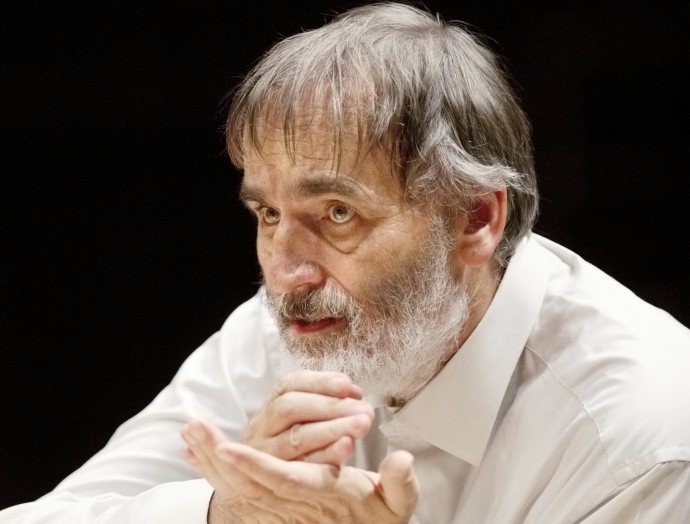
In writing for orchestra, Dean drew inspiration from one of his contemporary composers, Helmut Lachenmann (above). “As he said, an orchestra is an incredible kind of fascinating machine. It’s got 100 moving parts, and they all have a human brain, but getting them all to move in the same direction at the same time is another matter altogether! I met him a few times, and never had lessons with him, but we did talk a bit about those sorts of things. It was fascinating to also see the very different and quite extraordinary sound world that he creates. It’s much more about particular sounds and noises that you can get out of instruments. He could tell a brass player exactly where to put the embouchure to get exactly the sound he needs, which is why he’s been so convincing when he steps in front of an orchestra. On the page they look daunting, but he knows it’s achievable, and I learned a lot from that, to make it somehow a really positive challenge for each and every member of the orchestra rather than giving them a page load of black, notes everywhere! You won’t get the orchestra on side that way.”

The concerto is a collaboration of forces, rather than a contest between them. “That was something I was pleased about. The solo piece had a title Oblique Strategies, but it was about the creative process. It’s not necessarily trying to tell a story in the way quite a few of my pieces, including a couple of the concertante pieces, do. The first movement in my Trumpet Concerto, which I wrote for Håkan Hardenberger (below), is called Fall Of A Superhero. It is about pushing this trumpet to the max, so that actually the trumpet conks out at the end of the first movement. My Clarinet Concerto is called Ariel’s Music, and is a requiem for Elisabeth Glaser who was one of the first but one of the most prominent early campaigners in the AIDS era. She had been infected with HIV in a blood transfusion, and possibly because she was not from the gay community but from a straight community she had traction with the Reagan administration at the time, which was doggedly blaming it on lifestyle choices. That is also very much a ‘one pitted against many’ scenario. In the Cello Concerto I was pleased to try writing a concerto that was more about a collaboration. It is about the cello initiating ideas that get picked up by the orchestra, then sometimes the other way around, and about finding colours of the solo cellist with the orchestra rather than being in competition with them.”

Dean agrees that it is gratifying having the concerto performed several times as part of major orchestral programmes, each time with Gerhardt as soloist. “It’s obviously thrilling for me as a composer, even despite quite a few performances getting ‘Corona’d’! The performance in London was going to happen in 2020 but got rescheduled. That’s the big advantage of having a soloist like Alban, who is such a genuine champion of new music. There are many soloists who, dare I say it, feel it is a good move to commission a new concerto every now and then, but Alban is very committed to the idea in itself. Again, as in Håkan’s case as a trumpeter, you’ve got to build the repertoire. Yes, you can play Haydn and Hummel all your life, but that’s what his guiding principle has been, to create repertoire for the trumpet as a solo instrument. In the cello’s case, there are plenty of great pieces you can rely on, but not as many as the violinists or pianists. Alban’s dedication to really forging new repertoire is extremely genuine, and the other advantage is co-commissioning to get several guaranteed performances, because you’ve got various stakeholders in in the game, which is a blessing. It really makes a huge difference for me as a composer.”

Dean’s mention of Brian Eno earlier in the interview deserves to be revisited, as it implies the composer has been very open in his musical education and what he takes on as a composer. It wasn’t always that way. “The irony is that my education, my practical upbringing, was very much classical. I learned violin as a kid and progressed to the viola and chamber music. Then I went through the conservatory, and it was all classical music. However, the person that really got me fired up as a budding composer, and who awoke the latent, ambitious composer in me was a rock musician, a guy called Simon Hunt from Sydney.”

The two struck up a firm friendship and musical relationship. “We discovered a likeminded need to explore territory other than where we were, other than our day job. I was enjoying hugely my time at the Berlin Philharmonic, and yet I was aware of its limitations. The late von Karajan era was Richard Strauss and Bruckner, Beethoven and Brahms, and not a lot else. He was getting sick of I-IV-V chord progressions, if you like! He was the ‘interesting sounds’ person in this otherwise not especially enterprising rock band, and we started improvising together. It was through that, with close mic-ing of the viola and a piano frame and an early sampler, I was learning as much from being in a studio with Simon as I was playing in the Berlin Philharmonic. Somehow the ambition to compose came as much from retracking sessions in divey studios in inner city Sydney when I was back on holidays, or this little studio we had near Checkpoint Charlie, in the days before the Berlin wall came down. It was very enterprising and kind of pioneering, and I found it was a great complement to donning the tails and playing Bruckner, to be in alternative music cafes playing this new music. I still need the electronic geek to find my way around the studio! I’ve never really learned to operate the studio myself, but it liberated my ear to musical potential, even if it was a recording of shattering glass. Those sorts of things became part of the pieces that Simon and I were making, often for short films. They became part of the vernacular or the vocabulary of sound that I was only too keen to expand. Quite a few pieces of mine, particularly early on, included electronics.”

The appeal of his first discipline is clear, however. “Increasingly, whilst I will still have a kind of an extra few sounds created electronically, I do like to get as much variety of colour as I can out of the orchestra itself. In the Cello Concerto I have written for Hammond Organ for the first time, for example! I couldn’t say why, but there was something about it that was the sound I was after. I like the bizarre aspects of it, the oddness that it brings.”

On a more sombre note, our talk turns to the influence of the recently departed Harrison Birtwistle (above), who Dean has checked as a reference point even in the notes for the concerto. The two did meet, it turns out. “The first time we met was at a concert at the Wigmore Hall in mid-2019. It was a feature of his own music with the Nash Ensemble, including a premiere of a new piece for viola and cello, Duet for Eight Strings, which was performed by Lawrence Power and Adrian Brendel. We chatted together afterwards in the downstairs bar, having been introduced, and as it turned out Harry was staying the night in the Garrick Club. We ended up sharing a taxi together, and I had to pinch myself! Here I was chatting away in the back of a taxi with one of my all-time heroes. I must say that I’m working on a new opera at the moment, and I’m happy to admit I have a vocal score of The Minotaur on my desk. I have to say there are scores of his that I turn to as much as anybody else and more than most. There is a strange arch of clockwork in his music, and yet I find it just so liberating. It frees up the imagination just to listen to it, let alone how he goes about it. It’s like a refresher course for your brain, and emotionally so engaging. I can’t say I knew him well, but I feel very connected to him through some of his pieces – in particular Pulse Shadows, one of my favourite Birtwistle pieces. It is a miracle of invention.”

Dean confirms the opera he is working on, for Bavarian State Opera, is called Two Queens. “It examines the relationship between Mary Stuart and Elizabeth I, but it does so not through Schiller / Donizetti but uses their own words, which have been beautifully put together and distilled by Matthew Jocelyn, who I worked with on Hamlet. It is due to be premiered in two short years, so I’ve got to get my skates on! It is progressing though, and I’m having fun with it.”

With that our allocated time is up – but Dean has shown in that time a keen and alert grasp of the music he is working on and its place in time, with reference to his time with the Berlin Philharmonic, his work within rock music and his vocation as a composer. Go to watch the Cello Concerto in its first London performance and you will get an idea of what he is all about.

Alban Gerhardt is the soloist, with the London Philharmonic Orchestra conducted by Edward Gardner, in Brett Dean’s Cello Concerto at the Royal Festival Hall on Wednesday 27 April. The concerto will be complemented by Britten’s Sinfonia da Requiem and Vaughan Williams’ Symphony no.5. For more information on tickets, click here

Talking Heads: Leo Abrahams

Arcana is paying a visit to the studio of musician and producer Leo Abrahams. We are there to talk primarily about Scene Memory II, his recent solo guitar album – sequel to a first Scene Memory of 2006. Perhaps inevitably discussion wavers during the course of the interview, and we end up talking about a number of the prestigious musical acts with whom Abrahams has worked and about influences on his music, who range far and wide.

We begin, however, in Siberia – which is where Scene Memory II has its musical origins. In what seems an unlikely turn of events, Abrahams was touring the region. “I have a Russian friend, a promoter, and it’s his life’s project to bring obscure music to the far reaches of Russia. For many years he’s organised what are effectively travelling festivals, which start out in the west of Russia, and drive all the way across to Vladivostok, gigging all along the way. It’s quite incredible, and it’s almost like a performance art project. He’s quite a mischievous character, but very passionate about what he does.  The tours are called Muzenergo, and back in 2013 I did one of those tours with a project I had called Amoral Avatar, and before that, when I did the Scene Memory album in 2006 he got me over to do some gigs in Moscow. That was where we started our association. The Amoral Avatar tour was a killer, with virtually no sleep – two hours a night on a coach, juddering down these roads. It was really brutal but a wonderful experience.”

The audiences proved engaging, too. “Everywhere you went, even in the very small towns in Siberia, everyone would turn out to hear it. They want to hear challenging music, they’re very interested in it. They’re partly interested because Western musicians have bothered to come to thi very remote place, and partly it’s a legacy of Soviet arts education, or the meaning of art in the Soviet system – it’s kind of a hangover from that. There’s something important, something for everybody that’s worth experiencing. So I started having the idea of making another solo guitar record some time ago, but I was struggling to write it. I thought the best solution would be to actually go on tour and force myself to improvise, and see what comes out. That coincided with my friend Iouri offering me this opportunity to tour together. I don’t think I would have been able to break the block if it hadn’t been for that experience. It was quite difficult, because although I have experience with live improvisation I have no experience with solo live improvisation. It is a whole different ballgame, because you don’t have anyone else to spark off. It was an immensely rewarding experience – it didn’t always go well, but even the failures were instructive.”

There’s no better environment for coming face to face with your limitations, and then finding ways around them. I think a lot of what I found on that tour was that I was trying to be too clever, and trying to hide behind the technology a bit. When I listened back to the recordings, I could hear my nerves. It wasn’t all bad, but it made me what I had to change to make it a viable record, as opposed to a novelty act – like look how many sounds this bloke can make with his guitar! Some nights people came to the show, and because I’d played with Roxy Music people were expecting to hear proper guitar solos. Some guys came up to me at the end and said, “Why didn’t you play guitar? It was all backing tracks!” It was guitar, but they just weren’t ready for that. In one way that validated my sonic aspirations for it, but in another way it was a failure because it felt like there was no performance for the uneducated listener to latch on to. That was also instructive. I did one gig in a Science University, outside Moscow, which was absolutely incredible because all these young students completely understood intuitively all of the structural principles that I was trying to implement. They got all the Morton Feldman-inspired ideas of imperfect symmetry and inaccurate memory, all these playful techniques. I was really not – and still am not able – to execute them properly, but they still saw those principles. and that was astounding. We finished the concert and then they all came up to the stage when we had this little seminar. It was quite amazing, and I thought I’ve finally found my audience after 20 years – science students!”

Some of the material on Scene Memory II, and the space created – for your interviewer at least – harks back to early ECM records, and a sense of time and place that seems to fall in with Pat Metheny’s solo work for the label. Could this be the case with Abrahams, reflecting his Siberian surroundings? “Maybe it was an ingredient, yeah – but even before I was in Russia, I was reaching for some of that sense of space. I would always refer it to the people who work on ECM who were in turn influenced by John Cage and Morton Feldman. It’s in this area, harmonically and structurally, that is in between – I don’t want to say classical and jazz, but more of a liminal space. I think part of that could be related on some level to the wide openness of Siberia, but in the end it’s a holistic feature rather than a linear progression of influences.”

Given the time Abrahams takes to work with other artists, did he need to devote special time to his solo work? “Yeah. I do find it difficult to switch back and forth. I always feel like I need at least five clear days, without even doing a session or mixing for anybody. I need to know I’ve got a week to just go into my own space and to waste time if I have to waste time. That’s important, but

Fortunately it’s always been the case that I’ve had these little pockets of time. Sometimes they don’t come along for a long time because I’m busy working for other people. It means that whenever I run out of work there is a backlog of ideas that I’m keen to jump into. I really love working with other people, and I never work on anything that I don’t like, which is an enormous privilege. It has also meant that I don’t have to make my own music work for me economically. It’s a passion, and it feeds into my work with others, but I’ve never thought of it as a career. It’s always something that I want to investigate for myself. In a way it’s like my little holiday.”

This would seem a relatively unusual spot for a musician to be in, but in a good way. “Yeah. It goes back to seeing one’s career as a sort of ecosystem, in a holistic way. It’s an area that fertilises other areas, a part of the whole. All other things are tangential.” It is possible to imagine a Venn diagram, with the solo work as one element. “Yeah, and to be honest, in future I think I would like it to be a bigger part of the picture. This record is the first one I really wanted to go and promote. I have made all my other records out of curiosity than anything else. Once they were finished, and I could listen to them, and they were released, that was the end of it. This one is more like the beginning of an area I would like to keep exploring, and to do live performances. I feel like I’ve found an area I want to explore again, and making a completely different record next time, which is what I’ve always done before.”

The earlier albums are certainly a different style to Scene Memory II – which is a guitar-only album, if using a number of techniques to secure the sounds. There is one effect that sounds like bowing, but Abrahams reveals how he gets it. “It’s the sustained elements, made with something called the Plus Pedal. It looks like a piano sustain pedal, and it freezes little bits of the sound. There have been pedals that have done that before, based around. granular synthesis, but the way this particular thing does it is very pure, implemented very beautifully. All the predecessors have been somewhat clunky or even a bit abrasive. This pedal opened up a lot of possibilities I hadn’t considered before. The way the pieces on the record are made is through the guitar going directly into the computer on one channel, and then changing the plugins. There’s another channel that goes to the Plus Pedal, and then that goes into another block on the computer – and there’s a whole other set of chains of plugins. It becomes like duetting with oneself, not looping in the sense that you’re playing over the previous idea, but you’re always resampling tiny bits of what you’re playing, sometimes with unexpected results – and that’s the fun bit.”

Abrahams uses the extremities of the guitar’s range, from high harmonics down to glitchy, percussive throbs that sound like drums pads but aren’t – such as the track above, Spiral Trem. “Literally every sound on the record is the guitar”, he confirms, “because it’s so processed. That particular sound is like a distortion gating, which gives you a thud. Then you EQ the thud, and it acts as a kick drum. Some of these things go so far away from the source sound that it’s arguable whether it really is guitar. There is an analogue physical instrument at the start of that chain, which by its nature is inconsistent. Rather than feeding the same thing into that system all the time it’s always changing, and I think that’s what helps give the music a sort of irregularity that relates it to a real instrument, rather than it being a sample.”

He expands further. “I did actually try playing acoustic guitar through those patches, but it was very difficult to make it work live because obviously, being an acoustic instrument, it picks up everything that’s coming back. It became slightly ungainly. I’m still thinking about ways to solve that. A lot of the pieces were made with this Telecaster”, he says, turning to the stand of guitars next to him and picking up a metallic instrument. “It has a hollow metal body and still feeds back quite easily. The body itself is kind of microphonic but feels really alive, but it’s stable enough not to compromise the performance by getting the wrong material into the patches. That’s definitely one of the areas I want to explore, to bring in more acoustic properties.”

The feeling is that Abrahams is at the start of a longer-term project. “I think so, and I feel excited about it. It’s as much the restriction as the openness which is inspiring, because some days I come in and sit down and have lots of synths and piano, and have all these colours. What do you do? It has to be dictated by either the musical idea, which is exciting, and then you orchestrate the idea, or it’s the idea of a framework that’s exciting. It’s like looking through a tiny hole into quite a big world, and that’s how I feel. After a lot of dabbling back and forth I have realised the guitar is my instrument, and I wanted to explore sounds but through the guitar.”

Abrahams has worked with a wide variety of musicians, including Brian Eno, Katie Melua, Jon Hopkins and Paul Simon, to name just four different examples. Has he shared any music with them, or is it a private project? “No, I’m quite shy about it. I think it’s out there, if people want to find it, but I don’t force it on people. I struggle even to use my mailing list. Sometimes I read the press that I’ve done and I come off as being almost pathologically self-effacing. I do think what I’m doing is interesting, but I do struggle to promote myself and I think that’s what differentiates artists from whatever it is I am – maybe artisan. There’s a really positive thing that makes people want to share, and I don’t really have that. I more enjoy just making it, but some artists have an extra gene.

One of Abrahams’ collaborators is former Wild Beasts vocalist Hayden Thorpe – he played the well-received second album for the singer, Moondust For My Diamond, earlier in 2021, and produced the first, Diviner, in 2019. “I’m really lucky because I do believe in all the collaborations that I do, and my heart’s in all of them. I feel like that part of me is quite satisfied, but as I said before, there’s something about this record which has made me want to try and reach out a little bit more. Last year, I did a couple of collaboration records, which I found really rewarding, and it ignited something in me, and gave me the confidence to do something solo again. That was really positive. In terms of sharing, I’ll show people if they’re interested, but if they’re not, I won’t. Brian Eno, for example, constantly has people trying to show him their music. I never wanted to be one of those people. I understand why people do it, but he is actually, after all this time, first and foremost my friend. If he wants to hear what I’m doing he’ll ask, and sometimes he does. I don’t want to impose.”

Sometimes it works the other way round. “I played on the last Harry Styles record, and he was so nice and really engaged. At the end of the session, with a great deal of sincerity, he took me aside and said, “Let me know when you’re doing a gig, I’d really like to come.” He’d heard all these ambient guitar sounds and he was into it. And I will. I could tell he wasn’t just being polite, he was interested, as a human being.” One of the Styles tracks on which Abrahams appears is the single Falling. “The thing is on those sessions, though, is that you do ten tracks or so but don’t know which ones made it through. I did a lot of tracks and I think I got on to three or four on the final mix. Falling is a beautiful song. He (Styles) is definitely in it for the same reason as somebody who maybe isn’t working in such a mass market. He’s fundamentally interested in music, which shouldn’t really need to be said, but it’s obvious.”

It occurs to me that the friendship with Brian Eno is helped by this lack of persistence on Abrahams’ part. “Maybe. I think the more time you spend with someone, the more you come to understand them and consider things.” The two worked closely together on Eno’s 2010 album Small Craft On A Milk Sea, which was billed as Brian Eno with Leo Abrahams and Jon Hopkins. “That was characteristically generous”, he says of the billing, “especially at the time before Jon was quite as huge as he is now. It was a really nice thing to do. He does a lot of jamming with people, and that record came out of jamming, but on this occasion he finished it quite unexpectedly. At that point he was often giving me big batches of files that he’d made with different people, and asking me to help him edit and mix them. Sometimes it would be released and sometimes it wouldn’t, but with the Small Craft record he just e-mailed Jon and I one day and said, “By the way, I finished that record!” We were both really surprised, and glad about it. He must have felt quite strongly about it.”

With the earlier reference to Morton Feldman, it is fascinating that people perceive the music as being ambient because it’s slower, and that it wouldn’t have intensity – but as Small Craft On A Milk Sea shows, that is not the case – and also Scene Memory II. The album could be listened to as an accompaniment, but never as background music. It remains an intense experience. Abrahams agrees. “That’s right. In a way it invites you in to have a different experience. Within the category of quiet music or even within ambient music there is a lot of different kinds of intention on the part of the composer.”

He gives a specific example. “Even the hypnotic quality that Feldman might want to induce as opposed to Brian or Jon is for very different reasons, and by very different means. The thing that really touches me about Feldman is that it is quiet music, but it is also very hyper-focused and dense. Sometimes it is quite fast in terms of its rate of change. It is written music, and sometimes his music is a conversation with the performer, and even quite playful, challenging the performer in playful ways to heighten their attention, so that what the audience experiences is not some kind of blissed-out manifestation, it’s a hyper concentrated and focused performance of something that is quiet and spacious. For example, quite often he will notate the music in a purposefully complicated way because he wants you to count in a certain way that’s more difficult, so that the music comes out sounding a certain way. It’s a little bit like the Rite of Spring. Somebody in 1917 wrote out the Rite of Spring in 4/4! You could do the same with Morton Feldman but you would definitely lose something. That is key, because what I definitely wasn’t trying wasn’t trying to do was make a pad and then disappear in variations to maintain interest, but essentially in a static space. I definitely didn’t want to do that. I think I wanted it to be more like seeing the elements of each patch as being like sculptures in a gallery. You’re moving round and looking at a sculpture from different angles, and I wanted to contemplate this sonic object, without sounding too pretentious! I wanted it to be focused, and not drifty.”

Abrahams talks in a way that suggests he has explored a good deal of modern classical music. “When I was a teenager, I thought I was going to be a ‘classical’ composer. I went to the Royal Academy of Music, and I quite quickly realised when I got there that it probably wasn’t for me – not just because I didn’t want it, but because I wasn’t really good enough. I showed enough promise to get in, but I don’t think I really had what it took to be a professional composer. Also, in those days, there was something called crossover, and my teacher was a wonderful composer and teacher called Steve Martland (above). He was a great person and artist, but he was in this category called crossover, which in a way was a bit unfair. His teacher, Louis Andriessen, had the same thing – because the music was rhythmic, or used ‘band’ instruments, it was termed as crossover. Thankfully, due in large part to their innovations, that term is gone now and it’s just music. That’s definitely a good thing. I think the difference is much more in the composer’s intention rather than the finished results. Experiments in notation and incorporating improvisation, or aleatoric elements, have been around for a very long time – 100 years or so – and I think we’re still playing in that ambiguous world about how much is written and how much isn’t. There is a certain quality that makes some quiet music clearly meditative, and other quiet music is clearly cerebral – and there’s a lot in between.”

Our talk moves to the shorter piano pieces of Schoenberg and Webern, with which Abrahams is familiar. “Those pieces are so, so wonderful”, he exclaims. “It’s really interesting, I think because their compositional philosophy was so intimidating and intellectual that it closed their music off to a lot of people who might enjoy it on a visceral level. They didn’t want people to enjoy their music on a visceral level, it was just that time in early 20th century, when people were ‘manifesto-ised’ to an insane degree. I love that period of art history, Russian Suprematism. In that area there were so many manifestos coming out from artists, but it doesn’t mean we have to experience the art as a manifesto anymore, because it’s part of history. One of the CDs I listen to most is a double CD of Schoenberg and Webern piano music, and I love Berg’s Piano Sonata too. It’s like he had the heart of a romantic and the head of a 20th century composer.”

“It’s moving to think of those days”, says Abrahams. “Because art meant so much, and orchestral music meant so much, people would travel from all over Europe to experience it. The victory of those people who broke the mould is that we now live in a creative world where there aren’t really those borders – but maybe there isn’t quite as much passion either.”

Returning to the inspirational figure of Steve Martland, what did he learn from his teacher? “It’s a very hard question because in a way, I think I was too young (to be kind to myself), or maybe too incompetent (to be unkind to myself), to really have learned compositional things that I might have been able to learn. Maybe he saw that. But what I really remember of him is his passion. He cared so deeply about justice. He had very clear ideas about what was right and wrong in music, and would express them in quite provocative ways. He knew that he was going too far sometimes, but he also did really believe it. He had very passionate views, which was fine and inspiring, even if you disagreed. He set up his own band too. I met him when I was fifteen, on a course called Strikeout. He would take us all to a retreat, and we’d write a piece for two weeks which would be performed by the band. It was an incredible thing to do. He must have had some sort of Arts Council funding, but it was a passion project.”

Things did not always run smoothly, however. “His main gripe with the academy at the time, where he eventually became a visiting professor, was that they didn’t take music seriously enough. He was very frustrated by that. He felt he was supposed to be the enfant terrible of the situation, but he was actually the only one taking education seriously. He sort of stormed out in the end, because one day a student reprimanded him for coming in dressed in a T-shirt and jeans, which tells you a lot about the place because the seriousness of intention and the love for what you’re doing was far exceeding that of anyone else working there. That was a terrible day. He was a wonderful man.”

His hairstyle and disposition are not too dissimilar from another self-professed enfant terrible, Nigel Kennedy. “It’s partly a class thing”, says Abrahams, “but Nigel Kennedy had a sort of a dissolute quality, which isn’t cultivated – that’s just who he is. Steve was more like a Marine, with discipline – discipline with a smile behind it, which you can hear in his music. That was who he was. He was a humanitarian without a doubt, but in art he liked precision and discipline, and sharp edges. When he died, I still felt as if people weren’t getting to the core of the person. He was a mystery, even to some of his closest friends, but I’ve always carried this deep fondness and appreciation for him.”

There is a final, classic, Martland story. “We were on this composition retreat, and I sat down to rehearse with the band. I’d written myself an electric guitar part, and we started playing. I was 15 or 16. He stopped, and said to me, “When you’re playing the guitar, please can you try and look less like you’re having a shit!” That has literally stayed with me until now. Sometimes I’m on stage and I think, have I got that face on?!”

Turning to the future, Abrahams has plenty of irons in the fire. “Yeah, I’ve actually just finished quite a few productions and mixes and stuff like that this week. One of them’s a Syrian composer called Maya Youssef, who plays in Canada – her music is beautiful, and I’m really happy to have worked on that. I’ve got some guitar sessions dotted around, but I want to try and use the next couple of months to work on my own music. I’ve got quite a lot of unfinished ideas in a slightly more ambient or even neoclassical form, than this kind of atonal and abrasive world that I’ve been in. Some of it will be pure synth, and no guitar. I’d like to try and finish those pieces. There is also one of the collaboration records that I did last year called Krononaut, with a jazz drummer Martin France and trumpeter Arve Henriksen on trumpet. We’re going to do another record, I’m not sure if Arve can but Martin and I are going to get together here in January. It’s another one of those times where I’ve got not quite such an intense production schedule, and I want to use it.”

Now the studio is where he wants it, is the writing more fluent? “It’s early days because I’ve only been here since July, and since then it’s been non-stop work. When I used to work from home in a little bedroom studio, I used to sort of fall out of bed and start work. I knew I’d had a good day when I’d not got out of my dressing gown by lunchtime!”

Scene Memory II is out now on figureight records. You can listen to and purchase the album via this Bandcamp embed: