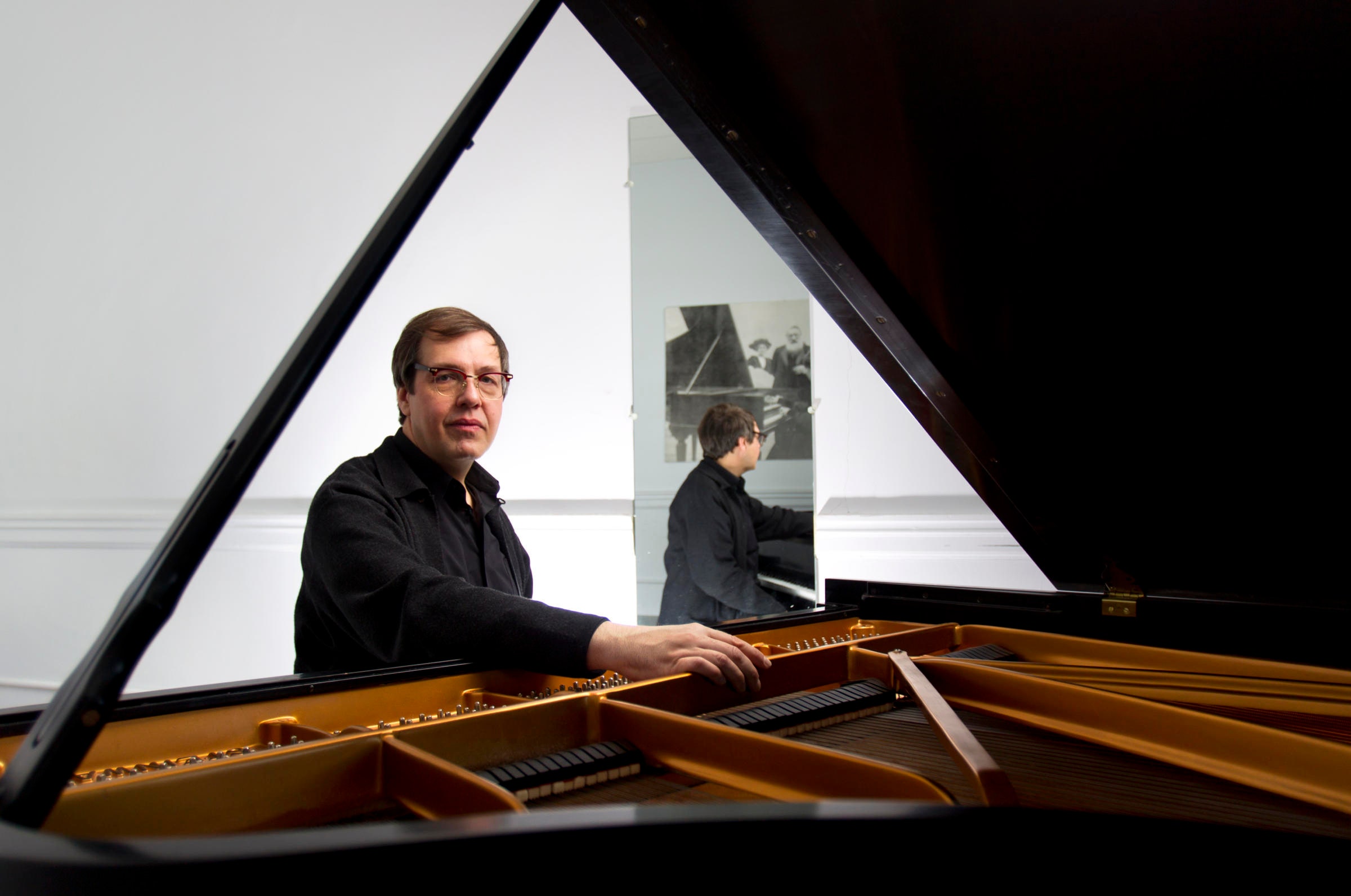
In his explorations, Brubaker continues to use a Steinway concert grand piano with electromagnetic bows that help him create sustained drone textures.
Here he takes two sections from the 1978 ambient classic Music For Airports album alongside three others, using advanced IRCAM spatialization tools to create an “immersive acoustic experience, turning the piano into a supernatural synthesizer.”
What’s the music like?
The Music For Airports excerpts, not surprisingly, are incredibly calming – and beautifully played. The second version of 1/2 uses the electromagnetic bows to create a sound almost like the clarinet in timbre. Brubaker judges the critical elements like attack and sustain just right, a faithful recreation of the original Eno work but one that gives him plenty of room and space around in the acoustic.
The slow tracks work beautifully, especially Failing Light from Eno’s Ambient 2: The Plateaux Of Mirror, the collaboration with Harold Budd, which is lovingly shaded here. The big surprise, however, is The Big Ship, where he recreates everything by hand, including the shift of rhythmic emphasis that Eno originally performed with an organ drum machine. Here it is commanding and delivered with impressive poise.
Does it all work?
Very much so. Brubaker’s eye for detail and virtuosity work hand in hand.
Is it recommended?
Enthusiastically. Eno Piano 2.0 is an obvious complement to the first instalment but shows Eno’s music in a new and enchanting light. Ambient music has lasted a lot longer than we dared imagine, and reinterpretations like this will only prolong its appeal further.
For fans of… Brian Eno, Harold Budd, Philip Glass, Michael Nyman
Now we bring news of a sequel later in the year, with Eno Piano 2 due to be released on 25 October. It is prefaced by a radio version of 1-1 from Music for Airports, which will no doubt be made available soon. In the meantime, you can enjoy being reacquainted with the full version below:
To read the full story behind Eno Piano, you can read Arcana’s recently published interview with Bruce Brubaker. In it he sets out his quest to recreate Brian Eno’s ambient masterpiece Music For Airports, made through tape loops and studio techniques, for a living and breathing musician to play on the piano.
To get the necessary sustain Brubaker has employed a number of intriguing techniques, not least the use of electro-magnetic bows over the piano, enabled by Florent Colautti.
While Music For Airports is the main act, Brubaker places it in the context of shorter works by Eno that have a more descriptive edge – The Chill Air, a collaboration with the late Harold Budd, By This River, co-written with Dieter Moebius and Hans-Joachim Rodelius, and Emerald and Stone, where his collaborators are Jon Hopkins and Leo Abrahams, with whom he still works a great deal.
What’sthemusiclike?
Incredibly restful – which of course is a description you could level at the original Music For Airports. Job done, you would think, but the reproduction of this music in human hands does reveal a slight and unexpected intensity, the performer having to maintain a very high degree of concentration and control to get close to honouring Eno’s original music.
Brubaker certainly does that, and the electro-magnetic bows help the sustain very subtly at the start of Music For Airports 2/1. The whole thing is so carefully thought through that each note feels researched but also instinctive, especially in 2/2 where the angular lines create an extraordinary sense of space.
While Music For Airports is indoors, the other three pieces are very much outside, and have a refreshing clarity. The Chill Air and By This River are bracing, wintry piano music.
Does it all work?
It does. When Bang On A Can released their chamber ensemble version of Music For Airports in 1998 it gave a new dimension to Brian Eno’s thinking. This piano work will have a similar effect, and is even more intimate in its confines.
Is it recommended?
Yes. Any Eno fan will want to hear this, and Bruce Brubaker shows just how imaginatively and thoughtfully he can attend to the music of others. This is a quiet revelation.
Listen & Buy
Published post no.2,046 – Thursday 21 December 2023
Pianist Bruce Brubaker is a man who likes a challenge. A prolific and highly respected performer of music by Philip Glass, Steve Reich and Meredith Monk – and recent collaborator with Max Cooper, Brubaker has in recent times turned his attention to the music of Brian Eno. In November he released an album of piano interpretations taken from the former Roxy Music keyboard player’s solo work – including a complete account of the seminal Music For Airports. The album, Eno Piano, has been released on the InFiné label, Arcana sat down with him to discuss the project, gleaning some fascinating insights into Brubaker’s world of contemporary and classical piano playing.
Given his impressive CV up until now, the music of Brian Eno appeared a logical step – albeit not an easy one. The genial pianist takes up the story. “No, because as you know, Music For Airports and almost all of Brian’s earlier work in this ambient area was studio music and he made it without really any kind of reference to live performing. There were no scores, no plan even! On Music For Airports he provides these little drawings showing you about the patterns involved, but the idea of playing it live was really very far away.
The prospect of recording Eno on the piano had great appeal. “I’m fascinated by the idea of using the wrong tools to make this music. In the original they are physical tape loops that have been used to make the sounds of Music For Airports, so when you hear a particular pattern of notes, and it’s repeated, you are literally hearing the same thing – the exact micro timings the exact balances are the same. In our version I’m playing those things by hand each time, so they’re not the same thing. It’s an interesting problem, and I kind of like it!”
It also resonates with Eno’s methods of composition. “You know Brian did that thing with Peter Schmidt called Oblique Strategies, with the deck of cards – one of my very favourite Oblique Strategies is “Repetition is a form of change”. That’s really a big part of this, so even when you use a tape loop, and play the same notes exactly in the same rhythm, exactly the same way, the effect to the listener / human is not exactly the same. We’re impinging on that, in a slightly different way, because now things are not identically the same. Perhaps the listener perceives this, perhaps they don’t. I think all that ambiguity is right in the neighbourhood of what he was doing in the first place.”
Certainly in music of this kind, the fifth instance – for example – of a melodic phrase is very different from the first, because of the listener being more ‘in the zone’. Brubaker agrees. “Absolutely. I think that as each person hears a piece of music, because of all the things you’ve heard before, the place you live, the sound environment you’re in, every single person – as they hear musical sounds – makes a new piece of music by listening. For everybody sitting in a room, at a concert or hearing a recording there’s a somewhat different piece of music being completed as they listen. That appeals very much to me and our sense of our own time, where people’s participation in the process of music is, I think, much greater. It’s not a passive thing. When you’re hearing something like Music For Airports, you really are invited or allowed to be inside and to make those connections yourself. It’s infinitely variable. Then when you come back and hear it again, it will also vary, so if you hear it for the tenth time, you probably don’t hear the same thing as you did in the beginning. I’m thinking of If on a Winter’s Night a Traveler by Italo Calvino, where he says something like, “I returned to the books that I read when I was a young man, and I find that they have changed”. Of course, he knows that they haven’t, the physical printed book is exactly the same – but different when he reads it. I think that that’s where we were trying to be with this.” The question also arises that if Brian Eno sat down to write Music For Airports today, we would end up with something very different. “Definitely”, he agrees.
In spite of its ambience, Music For Airports has a number of interpretative issues and is an intense experience for the performer. “One of the challenges was to figure out how much to allow these repetitions of the same material to vary, or how much to try to make them the same. As a human being, if repeat something over and over again, each one will be different. Do you intentionally push them to be different or not? It’s actually not that much different than playing other minimalist or repetitive music like Glass because I think it’s the same thing. I always found in Glass that if you intentionally varied something, it usually seemed like too much. The better way to do it was to be more like an observer and not really a participant. If you can get yourself into a state of being where you’re listening to the sound as it happens, but to be outside and hearing it happen, and then responding to whatever is unequal but not really making it happen. That is true here too, as it goes by, you monitor and notice the things that vary, but you’re not really making them happen. If you try to do that, then it almost always seems like a heavy hand too much.”
Brubaker’s detail is fascinating, as he moves on to consider his topic further. “I guess it’s true of a lot of kinds of art. One of the strange things about music that’s improvised versus music which is planned beforehand is that a lot of the music that we like, which is planned in advance, aspires to a quality of improvisation. Even if you’re listening to a Beethoven symphony, probably the best performance is the one that seems like it’s not written down, the one that seems like it just happened – even though we know that’s not true. If you map that on to the world of movies or theatre, that’s exactly the same, right? In a movie, for the most part, you understand the actors have learned their lines and rehearsed them many times, but if you’re lucky, you forget all about them. You have the sense that whatever the action is, in the scene you’re watching, it’s really happening. The same thing is true in music, you want to be engaged in what’s happening so that it seems like it’s just a spontaneous event.”
Although he cannot remember his first encounter with Eno’s music, Brubaker admits to a connection with the minimalism of the 1960s and 1970s. “I did get this idea of trying to play Music For Airports on the piano quite a while ago, but then there always seemed to be this big problem, which was how we can make very long sustained notes, because that’s such a feature of the piece – and some parts of the music actually have human singing. Then I heard this jazz pianist in America play a concert where he had modified one of these devices that electric guitar players use, the E-bow – and cut it down to put on one string inside a piano. He did an improvisation around this long droning note. I started to think maybe you could do that with the piano and use a bunch of E-bows to make long notes. Then almost by chance I was talking to one of the people at my record company who happen to know of an inventor in France, who had started working on a system like this, specifically for the piano. We met and started talking about it, and that is what we used for this album.”
He explains the methodology. “There are these electromagnets suspended over a piano string, and the string is allowed to vibrate either by putting down the pedal on the piano or in some other way where you can raise the damper. The electromagnet creates a signal that causes this vibration in the spring, which can be controlled very specifically with frequency. You can also produce overtones. Then we found with the lower strings, if you continually excite one of those strings, which are wrapped with another kind of metal, you actually get a pulse. This also fascinates me because we’ve never heard a piano string that was vibrating continuously! When you’re hearing piano sounds in a normal piece of music, you’re always just hearing the decay of that sound, you’re not really hearing the impulse and you’re the impulse for just a little tiny bit of time. What we’re doing now is we’re actually making the string vibrate for a long period of time, like you would on a violin. And so, you know, the nature of the tone, in some cases was really surprising because we’ve never heard it before.”
A new instrument, even! “I was joking about this, but I think it’s true. Eno Piano is not just the title of the album, it’s also an instrument. A long time ago Brian said that the studio is a musical instrument, so it is turning it around and showing that an instrument can also be a studio! The way we’re using it is something that really couldn’t have happened very, very long ago.” The emphasis falls on the string part of the piano rather than its percussive element. “There are other examples of course, in John Cage, and the American composer C. Curtis Smith, who wrote a whole bunch of music for pieces of string or fishing line were used inside the piano. I also played a Cage piece where you had to thread the strings through, and we were able to make a long tone that way.”
Brubaker had the pleasure of meeting Cage on several occasions. “I actually played with him a couple of times. I played Radio Music with him once, and a new chamber music piece he had written. I always found his effect was really very powerful and a spark towards something more. This chamber music piece, called Seven, he had notated using a heavy Japanese brush with ink, and so a lot of it was very difficult to read. The brush was irregular and some of the notes were very thick and some of them were very thin and scrappy and you couldn’t really tell what the notes were. I remember saying, “Mr Cage, can you tell me what the notes are in this chord?” He probably gave the ultimate advice that you could give to any musician in any situation. He said, “Just listen, and you’ll know what to do”, which I thought was pretty good. At the time I just wanted him to tell me what the notes were, but he wouldn’t do that!”
He also recalls a musical example. “I played a little solo piece called Dream, with a long meandering melody, a pretty piece like a lot of his music from the 1940s and early 1950s. I played a concert where he was giving a commentary and had played it from memory. One of the audience asked Cage, “What would happen in the performance if the pianist got lost?” Right away Cage said, “That would be wonderful!” That was good – and that touches this illusion of spontaneity, the illusion of something that isn’t planned. By getting lost, you might be found again. Even in the 19th century, it’s pretty well documented that pianists giving concerts from memory was a kind of substitution for people who didn’t improvise. When Liszt played his own music in public, he always held up the score so that people would know he was not improvising. That back and forth between what the music is and how it sounds is something very interesting, especially with the recent importance of sound artists. A lot of these people come from the visual art world, using sound not as music but as something that they can manipulate and sculpt. I think that actually connects back to Brian Eno. You could say he wasn’t really making music but more creating this sound environment, this space to be inside. That boundary between written music and the world of sound has got much closer, and that will probably continue to be the case.”
One of Eno’s more recent compositions, the single-track album Reflection from 2017, comes to mind. “I think that’s the greatest achievement, being on the cusp of paying attention, or not paying attention”. Some of the pieces chosen on Brubaker’s album – By This River and The Chill Air – sound as written. In the live show we are using those two short pieces in the middle of Music For Airports which I was very sceptical about at first, but I think it does help and is good for the audience.”
Though Brubaker’s recent recorded output is more minimal, his background is steeped in classical music. “I trained as a classical pianist, and I taught at Juilliard for a long time. Even now the students I teach really are primarily interested in Beethoven and Liszt, not even going very far into the 20th century. Sometimes I feel like I almost have a double life! When I go out and do my own artistic work it tends to focus on much more recent things, but when I go back to teaching it’s Beethoven all the time. On the other side I still feel there’s a long connection, and that some of the things we’re talking about with non-directional music, which is to be completed by the listener, connect to what was happening in European music, maybe in the 10th and 11th century. If you go back long before the Classical period, before the composer identity was so formed, there were many other ways of making music, and in other musical cultures outside of European music. One of the things that happened, say with minimalism in the 1960s, is that some of that authority of the composer was lessened. It’s not so much a kind of top-down hierarchical format, and instead the listener, the performer are much more included in the complete art. I think that’s a good thing.
We always seem to blame Beethoven, but he really created a kind of art where the composer really was operating as a kind of God and, and making this musical experience where you weren’t really invited to be a participant. I’m probably overstating it a little bit because I think these different ways of using music exist in lots of kinds of music, so you can approach almost any piece with various ways of participating. But I think Glass actually is the one who said that he found that when you listen to a symphony by Beethoven, the climax generally happens at the same place every night and the organisation of the overall peace really remains the same. His contrast was going to see a play by Samuel Beckett, where the play seemed like a different experience each time he saw it. It was much more of a of a network of relationships rather than this narrative of beginning and development and progression to some kind of goal. It was less teleological if you want to go that way! A lot of European art of the 18th and 19th centuries was directed towards a goal, which could be very satisfying, and then there’s some kind of conclusion. On the other side, with a lot of minimalist music and repetitive music, you can argue that there is no ending – and no beginning either. You’re just in the middle. And of course, isn’t that the experience of life? You don’t remember being born and you haven’t died? So here we are, and I think that’s a very appealing art for our time.”
Finally we move on to discuss Brubaker’s work with Max Cooper, where the pair reinterpreted the music of Glass. “That was a really good project for me, I enjoyed it a lot. It was quite unpredictable, because there was this algorithm in use in the software that translated the signals from my piano playing. Every time we did the performance, those signals would vary slightly, depending on the precise touch, the dynamics, everything about the pedalling, and then those signals were controlling Max’s computers and his synthesizers. Every time we did the performance, that information that he received was really quite different, so what I would hear from him was really varying every day. So it was quite unpredictable, and sometimes it was a little confusing because it could be quite chaotic. What you hear on that album is actually a live show from Paris, and he did a little bit of changing because he didn’t like the quality of the sound. It was quite a voyage!”
Brubaker hasn’t spoken to Eno about his new project – yet – but the pair have conversed previously. “He’s working on the rehearsals for The Ship live show, which are using up all his time, as well as a bunch of other things. I started talking to him about this a long time ago, and I think he’s very open to the idea now of other people taking his music. I always wonder about that with very iconic pieces. I did some piano transcriptions of music by Meredith Monk, and that was a very interesting project where she was really very involved. It was complicated for her because she liked the idea that it was going to be her music heard in a different way, but at the same time she really wanted to be sure it was what she wanted. And I think Brian is not like that and has a very different attitude. In that sense, he is probably much open to other possibilities.”
Eno Piano rewards focussed listening – as well as giving the listener the option to draw back and observe from afar. Typically Brubaker, before he goes, is able to introduce another point of reference. “You probably know this piece that Erik Satie wrote at the beginning of the 20th century, called Furniture Music. My understanding is that he wrote it for some kind of art gallery, some kind of show that was being given. He had the musicians in the room, and he told the audience not to pay attention to them – but he got unhappy because when the musicians started to play the audience got quiet! They were listening intently, and Satie was unhappy because he wanted them to ignore it. I rather liked that.”
American pianist Bruce Brubaker is one of those artists whose every move is worth monitoring, for his musical quests bring many rewards.
Brubaker is perhaps best known for his work with the music of Philip Glass, John Cage and Meredith Monk, but now he makes a very intriguing turn in the direction of Brian Eno, creating an album for the InFiné label that will include a selection of ambient music, including Music for Airports.
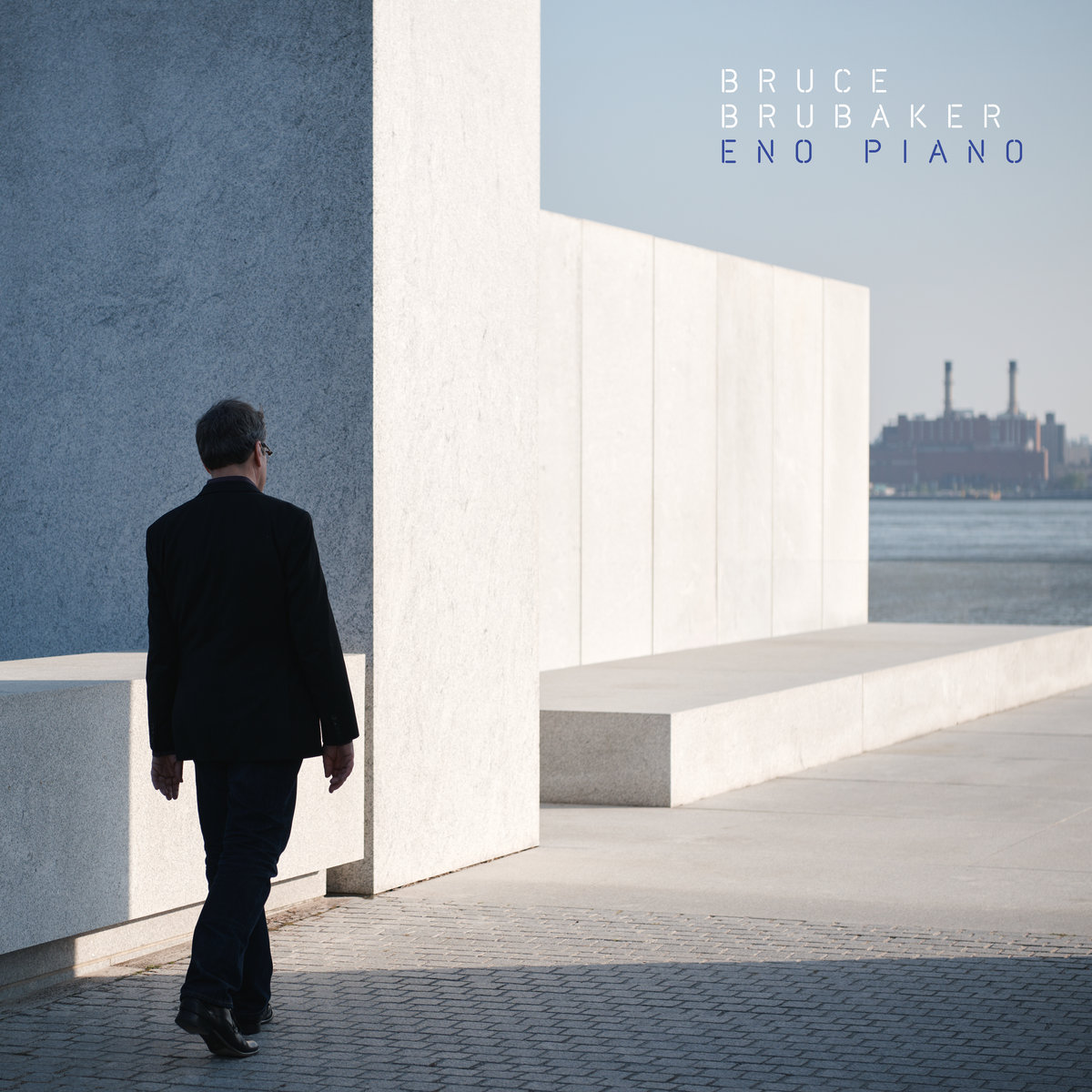
The press release asks a question: “Can a single instrument convey ambient music originally made through studio techniques and tape loops? Eno Piano is a companion to Bruce Brubaker’s acclaimed album Glass Piano (2015) — even the two album covers are companions. Named by Pitchfork “one of the most exciting pianists in the contemporary American classical scene,” Brubaker, in Eno Piano, shows that just as the studio can be a musical instrument, a single musical instrument can be a studio.”




 Arcana.fm