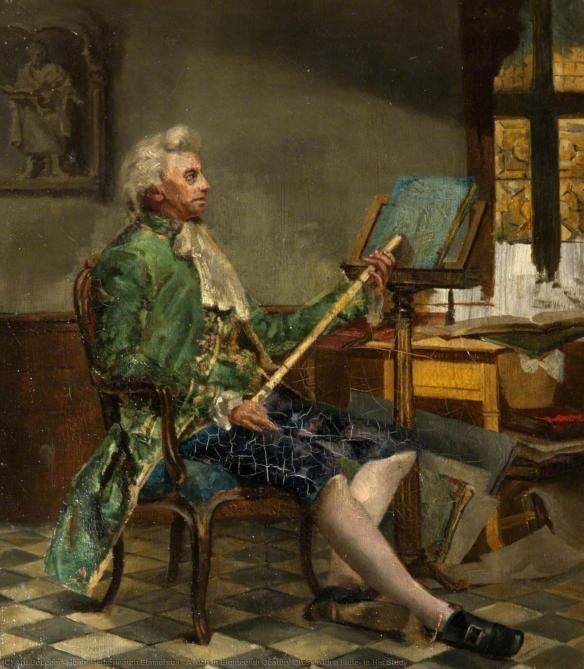
A Man in Eighteenth Century Dress with a Flute, in His Study by (Henry Hetherington Emmerson) (1877)
Duo for two flutes in B flat major WoO 26 (1790-92, Beethoven aged 21)
1 Allegro con brio
2 Menuetto quasi allegretto
Dedication ‘for friend Degenharth’
Duration 6′
Listen
Background and Critical Reception
This is the first of Beethoven’s chamber works not to include the piano – though it was not published until after his death. The dedication, ‘for friend Degenharth’, is to a lawyer, a member of Beethoven’s close circle of friends. It has prompted speculation that the piece may have been a commission or a present.
Either way, it is a short work in two movements of roughly equal length, and continues the close affinity Beethoven had with the flute at this time. Technical demands are thought to be few (according to Flutetunes.com at any rate!) so the music is suitable for most ability levels.
Thoughts
The two movements of the Duo are charming. The melodic parts are closely intertwined in the first section, like butterflies dancing in a breeze. Beethoven shifts to the minor key half way through, as though intending to move off on a set of variations. The music has a more graceful feel at this point, but then the dancing butterflies return.
The instruments stay close for the second movement, where the second flute has a simple arpeggio ‘Alberti’ figuration. There is more of a dance form evident here, in triple time.
Beethoven’s domestic side is on show here, with communal music making the main aim. As a result there is nothing too challenging here, but the charms are many.
Recordings used
Patrick Gallois, Jean-Pierre Rampal (DG) Patrick Gallois, Kazunori Seo (Naxos)
Gallois and Rampal are brilliant together, and it proves almost impossible to tell their instruments apart at times!
Spotify links
Patrick Gallois, Jean-Pierre Rampal
Patrick Gallois, Kazunori Seo
You can chart the Arcana Beethoven playlist as it grows, with one recommended version of each piece we listen to. Catch up here!
Also written in 1792 Haydn Piano Trio in G major HXV:32
Next up 8 Variations on a theme by Count Waldstein
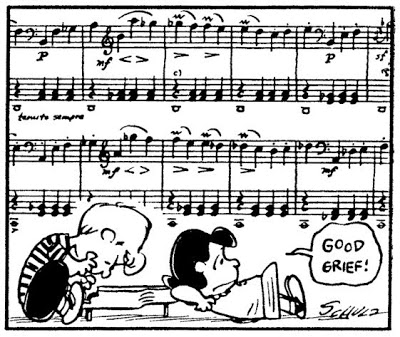
Peanuts comic strip, drawn by Charles M. Schulz (c)PNTS
An Minna WoO 115 for voice and piano (1790-92, Beethoven aged 21)
Dedication not known
Text Anonymous
Duration 0’55”
Listen
Background and Critical Reception
Very little is known or written about this short song, but it appears to be another of the small nuggets Beethoven completed before departure from Bonn to Vienna in late 1792. The text is anonymous and even a translation could not be found online.
Thoughts
An Minna is a brief song indeed. Barely has it started then Beethoven wraps it up very quickly! It has a positive complexion though, despite slightly awkward phrasing (no doubt text related). The vocal line feels quite plaintive in the baritone version, and the piano has plenty of room.
Recordings used
Peter Schreier (tenor), Walter Obertz (piano) Hermann Prey (baritone), Leonard Hokanson (piano)
As befits most of his Beethoven songs so far, Schreier does not hang about but has a nice, bright tone. Prey, in a lower ranger, is fuller and broader in scope.
Spotify links
Peter Schreier & Walter Obertz
Hermann Prey & Leonard Hokanson
Also written in 1792 Claude Joseph Rouget de LisleLa Marseillaise
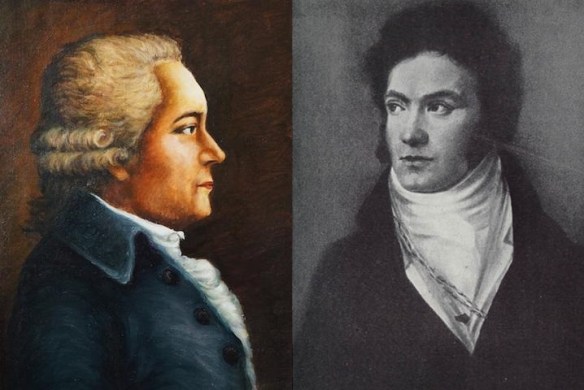
Carl Ditters von Dittersdorf (left) and the young Ludwig van Beethoven
14 Variations in E flat major Op.44 for piano trio (1790-92, Beethoven aged 21)
Dedication not known
Duration 15′
Listen
What’s the theme like?
Very simple – but Dittersdorf‘s theme has comic potential, as you might expect from a humorous stage work. In the right (or wrong!) hands this could be a bit po-faced.
Background and Critical Reception
Beethoven wrote a lot of chamber music for trio in his Bonn years – and a good deal in the key of E flat major too. This piece was not published until 1804, but is thought to have been completed in 1792 before he left for Vienna. Choosing a simple theme from a comic operetta by Dittersdorf, Das rote Käppchen (‘The little red cap’), he wrote 14 variations of varying character.
Writing to accompany the Florestan Trio recording of this piece on Hyperion, Richard Wigmore compliments Dittersdorf, whose ‘comically rudimentary tune is a vision of dry bones, as bare as the famous ‘Eroica’ theme which it faintly resembles.’ He also notes the glint in Beethoven’s eye and his predilection for mischief in several of these variations, most notably the ‘delicately tripping twelfth…’disrupted by an uncouth fortissimo outburst – Beethoven gleefully sticking out his tongue at rococo decorum’.
Thoughts
This set of variations is great fun, and you really get a sense of Beethoven flexing his compositional muscles and trying a few new things. From the first variation there are strong hints that he is going to have some fun with this theme – and so it proves. In the second variation the pianist enjoys the opportunity to flex the rhythms, bringing in the violin for a capricious third variation, before the baton passes to the cello for the benefit of its richer tone.
The ensemble passages have great energy, and for almost the first time we are getting a sense of the terrific forward drive in Beethoven’s music, especially in the propulsive movement of the sixth variation. A slow minor key deviation follows (variation 7), the cello and violin exchanging mournful thoughts, before the distant chugging of the violin and cello support a piano theme given in octaves. Variation 9 is lively and fun, while the syncopations of the tenth feel particularly advanced at this stage in Beethoven’s development.
As we approach the end, the second minor key variation (13) is even slower and more drawn out. This only makes the reappearance of the ‘home’ key all the happier, before a striking passage where the piano takes a sort of cadenza over the bare bones of the strings. Finally we return to the simplicity of the theme’s profile from the start, before a rush to the finish.
The variety and virtuosity of these variations is reminiscent of the earlier Venni Amore variations for piano, in their wide breadth of moods and techniques – and in their entertainment value, too.
Recordings used
Florestan Trio (Susan Tomes (piano), Anthony Marwood (violin), Richard Lester (cello) (Hyperion) Wilhelm Kempff (piano), Henryk Szeryng (violin), Pierre Fournier (cello) (Deutsche Grammophon) Daniel Barenboim (piano), Pinchas Zukerman (violin), Jacqueline du Pré (cello) (originally EMI Classics)
The superstar trio of Henryk Szeryng, Pierre Fournier and Wilhelm Kempff take their time with Dittersdorf’s theme in a very deliberate presentation, and Variation 2 finds Kempff in particularly airy mood – but it is really well judged. That said, they are still a good deal quicker than another superstar ensemble, including husband and wife team Daniel Barenboim and Jacqueline du Pré.
The best modern version of the variations comes from the Florestan Trio on Hyperion, which enjoys not just the sparkling pianism of Susan Tomes but also the closely-matched Anthony Marwood and Richard Lester. They all embody the first principles of chamber music by clearly listening to each other and responding in kind. As a result their recording is instinctive and fun.
Spotify links
Wilhelm Kempff (piano), Henryk Szeryng (violin), Pierre Fournier (cello) (Deutsche Grammophon)
Peanuts comic strip, drawn by Charles M. Schulz (c)PNTS
An Laura WoO 112 for voice and piano (1790-92, Beethoven aged 21)
Dedication not known
Text Friedrich von Matthisson
Duration 3’40”
Listen
Background and Critical Reception
A note on this song from the Beethoven-Haus museum in Bonn tells us that Friedrich Matthisson first published this poem in 1785 in Hamburg, under the title An Serena. In 1787 however the poem appeared unchanged in the first edition of Matthisson’s poems, under the new title An Laura.
Beethoven’s setting followed soon after – maybe as little as three years – and only the first and third verses were written out under the music in the autograph score. This is taken as an indication that the first part was to be repeated for the second verse.
Thoughts
The message from this song is positive to begin with, joyful even – and the soprano line carries nicely above flowing piano accompaniment. Beethoven gets quite chromatic with the melody towards the end of the first two verses, before a change of mood in the central section heightens the drama.
After that brief aside we return to the music of the opening, if not the mood – a scene at the grave casting a shadow over proceedings. It is as though Schubert and Mahler are waiting in the wings at this point.
Recordings used
Pamela Coburn (soprano), Leonard Hokanson (piano) (Capriccio)
Peter Schreier (tenor), Gisela Franke (piano) (Brilliant Classics)
Pamela Coburn brings a relatively rich soprano line to this song. Peter Schreier is a fair bit quicker, pushing the melody along.
Spotify links
Pamela Coburn, Leonard Hokanson
Peter Schreier, Gisela Franke
Also written in 1792 Sterkel 3 Violin Sonatas, StWV 198
Peanuts comic strip, drawn by Charles M. Schulz (c)PNTS
Punschlied WoO 110 for voice, choir and piano (1790-92, Beethoven aged 21)
Dedication not known
Text Anonymous
Duration ’50”
Listen
Background and Critical Reception
This is another example of Beethoven setting a ‘Gesellschaftslied’ – a public form of the song, but in this case thought to be for private consumption. It is another drinking song, setting its anonymous text with a similar structure to the previous Trinklied.
A florid piano introduction brings in the singer, who encourages each of his friends to drink the punch as it goes round the room. The choral response is emphatic: ‘Wir trinken alle hocherfreut, so lang uns Punsch die Kumme beut’ (‘We’ll surely stay a merry bunch, as long as our cups stay full of punch!’)
Thoughts
This is a good complement to the Trinklied – and is pretty much the next gulp from the flagon, with high spirits and good cheer! For a second time Beethoven reads his room well, leading the festivities with music of celebration.
Recordings used
Hermann Prey (baritone), Heinrich Schütz-Kreis Berlin, Leonard Hokanson (piano)
Peter Schreier (tenor), Gisela Franke (piano)
Once again Hermann Prey is on fine form, with sprightly piano playing from Leonard Hokanson and a fulsome choir. They eclipse Peter Schreier’s slightly higher version, which lacks a choir and cuts out the piano introduction.
Spotify links
Hermann Prey, Heinrich Schütz-Kreis Berlin, Leonard Hokanson



 Arcana.fm