
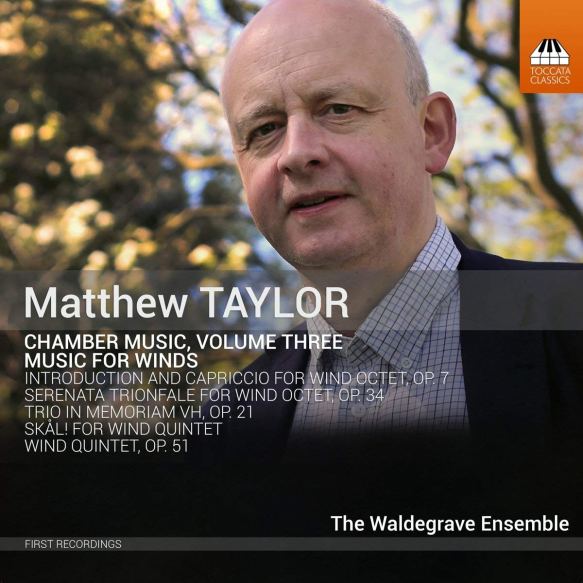
Taylor Chamber Music, Volume Three: Music for Winds
The Waldegrave Ensemble and friends
Introduction and Capriccio op.7 (1990)
Trio in memoriam VH op.21 (1997/2018)
Serenata Trionfale op.34 (2005)
Wind Quintet op.51 (2014-15)
Skål! (2004)
Toccata Classics TOCC0486 [54’16”]
Producer/Engineer Michael Whight
Recorded July 20-21 at Trinity United Reformed Church, Wimbledon; Trio recorded March 3 2018 at St Barnabas, Mitcham
Reviewed by Richard Whitehouse
What’s the story?
A further disc from Toccata Classics of Matthew Taylor (b. 1964) focussing on his not inconsiderable output for wind ensemble, played by musicians who have worked with this composer on numerous occasions and have a sure understanding of his unmistakable idiom.
What’s the music like?
Most substantial in actual content are the two pieces for wind octet. Among Taylor’s earliest acknowledged works, Introduction and Capriccio comprises an opening section that exudes an ominous expectancy, duly offset by the main section which, with its vaunting motion and ever more demonstrative exchanges, provides a succinct yet eventful showcase for what is still a largely untried medium. Any stylistic uncertainty has been ironed out by the time of Serenata Trionfale, a companion piece to Nielsen’s Serenata in vano and proffering a rather different scenario from its deadpan stoicism. Formally Taylor’s work unfolds in deceptively Classical fashion from the alluring harmonies and unforced motion of its initial Andante, via the impetuous exchanges (not a little Tippett-like) of its scherzo then the more nuanced and often speculative dialogue of its intermezzo, to a finale whose bewitching introduction from offstage oboe is succeeded by a Presto which drives forward to its suitably uproarious close – the taciturn protagonist having in this instance been purposefully and successfully wooed.
Mention of Nielsen is a reminder his Wind Quintet remains unequalled in this genre. Taylor plays oblique tribute to in with Skål!, a jeux d’esprit that coincidentally offers a masterclass in how to fit the maximum allusions to Nielsen’s six symphonies into a minimal time-span (that to the First Symphony might well take some spotting). Only recently has Taylor essayed a Wind Quintet, and here the underlying model is not Nielsen but Malcolm Arnold. Its seven short movements play continuously – beginning with a lively Preludio festivo then taking in a skittish Hornpipe and Pensive Waltz with more than a hint of wistfulness; followed by a teasing Habanera and energetic Tarantella, before a Pastorale evinces the most searching and soulful music prior to an Epilogue which brings the whole work infectiously full circle.
That leaves the Trio in memoriam VH for flute, violin and cello, a typically individual tribute to the Danish composer Vagn Holmboe (1909-96). The opening movements are both marked Allegretto, with the elegant interplay and often reticent expression of the former (pointedly marked ‘innocente’) finding potent contrast in the playful manner of its successor; the work closing with a Moderato whose plangent musing draws on timbral shadings of real poise and finesse. Taylor’s commemoration results in the deepest and most eloquent music on this disc.
Does it all work?
Yes. Taylor has an instinctive feel for wind instruments (not surprising given he played the oboe during his formative years), evident throughout those works featured here – idiomatic and innovative despite (or even because of?) the absence of ‘advanced’ playing techniques.
Is it recommended?
Indeed. Performances by the Waldegrave Ensemble and associated musicians do full justice to this music’s distinctive qualities, abetted by a recording that affords clarity without undue closeness of perspective. Taylor himself provides the informative and amusing booklet notes.
You can read more about this release and listen to clips on the Toccata Classics website, or listen in full on Spotify below:
Matthew Taylor’s composer website can be found here, while for more on the Waldegrave Ensemble click here

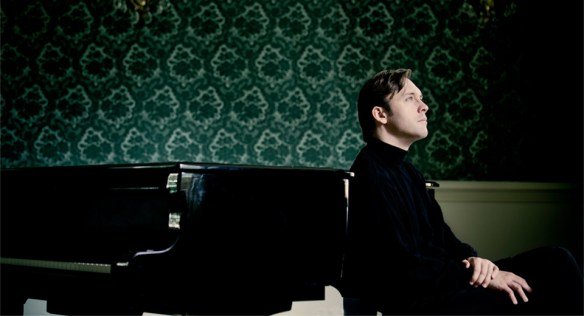
 The final Ask The Audience from the 2017 BBC Proms is with Leanne Mison, who promotes and endorses an impressive roster of electronic music artists for Bang On PR. Leanne talks to Arcana about a Prom given by the Royal Stockholm Philharmonic Orchestra and their chief conductor Sakari Oramo, – with two solo vocal turns from the superstar New York soprano Renée Fleming.
 Fleming’s contributions grouped into a loose theme of distant light and transformation. Barber’s Knoxville: Summer of 1915 is a love letter to the American home, and its dappled evening sunlight flickered beautifully under the hands of Oramo, the composer’s warm harmonies setting the scene for Fleming’s characteristically full bodied interpretation. She inhabited the storyteller’s guise with effortless and instinctive calm, though the animated middle section was also very well judged. With just the right amount of sentimentality, this was an ideal performance, and an aptly chosen encore of the song Sure on this shining night blazed a similar trail.
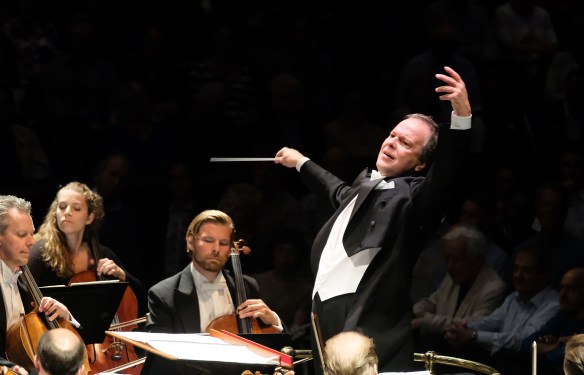 Finally we heard Carl Nielsen’s Second Symphony, ‘The Four Temperaments’, receiving its second Proms performance in three years after the festival’s complete neglect of it in the 20th century. It is a powerful piece, and this account made a strong impression. Although the feverish first movement (Choleric) was convincing and brilliantly played the emotional centre lay in the Melancholic third movement, where Oramo wrought music of impressive angst and depth. Nielsen’s struggles were resolved by the Sanguine finale, where the composer lets rip perhaps a little too easily, but again the structure and the melodic groups made perfect sense. Oramo has built a strong affinity with the Danish composer’s music over the years, and there was something very satisfying in these days of disunity at seeing a Finn conduct a Swedish orchestra in Danish music.

 Arcana.fm