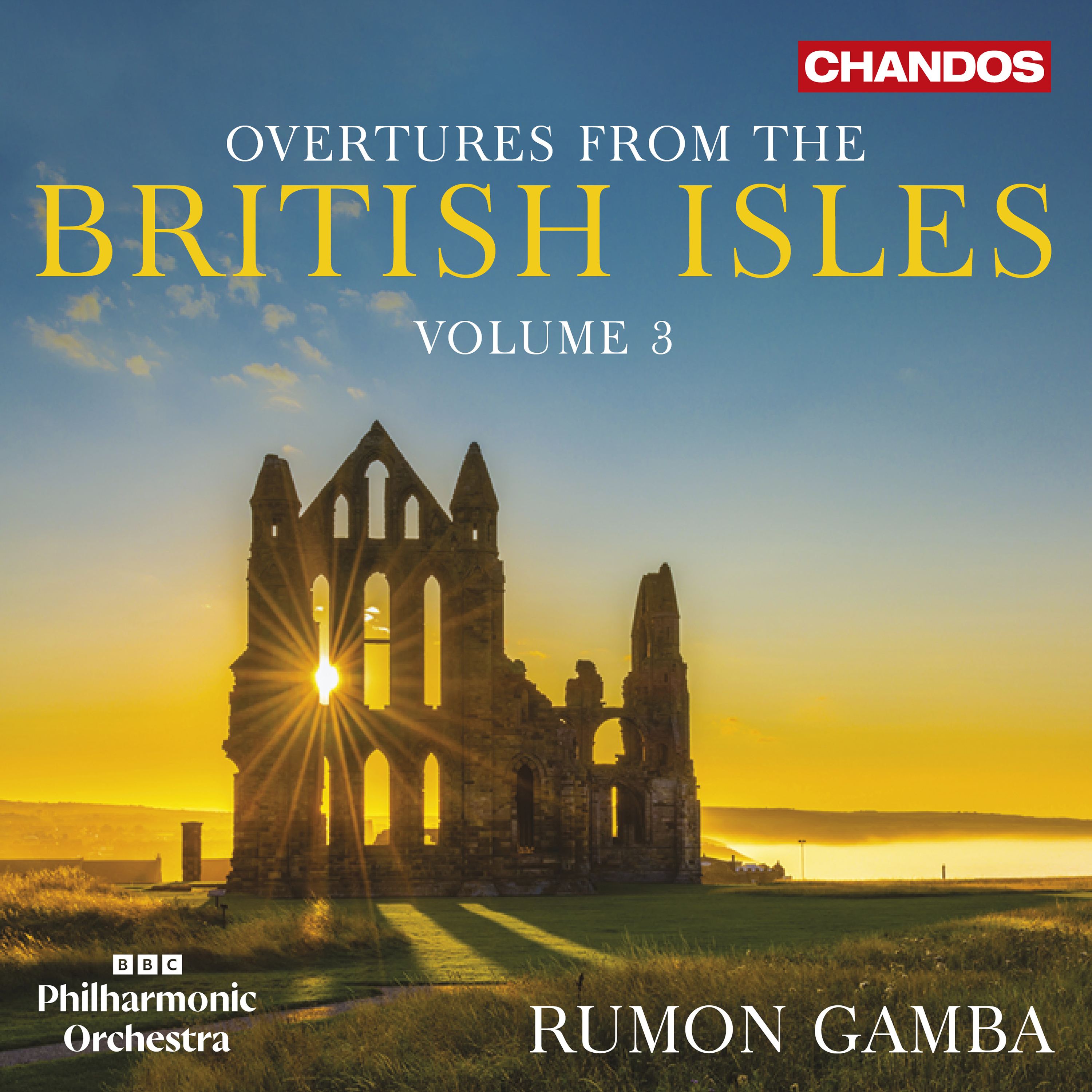
On Record – BBC Philharmonic Orchestra / Rumon Gamba: Overtures from the British Isles Vol. 3 (Chandos)

BBC Philharmonic Orchestra / Rumon Gamba

Arnell The New Age, Op. 2 (1939)
Brian The Tinker’s Wedding (1948)
Bridge Rebus H191 (1940)
Britten orch. Colin Matthews Overture to ‘Paul Bunyan’ Op.17 (1941)
A. Bush Resolution Op.25 (1944)
G. Bush Yoric (1949)
Fenby Rossini on Ilkla Moor (1938)
Jones Comedy Overture (1942)
Orr The Prospect of Whitby (1948)
Parker Overture to ‘The Glass Slipper’ (1944)
Rawsthorne Street Corner (1944)

Chandos CHAN20351 [77’20’’]
Producer Jonathan Cooper Engineer Stephen Rinker, Philip Halliwell

Recorded 23 May (Arnell, Brian, Britten, G. Bush, Rawsthorne), 20 November (Parker), 21 November 2024 (Bridge, A. Bush, Fenby, Jones, Orr) at MediaCityUK, Salford, Manchester

Reviewed by Richard Whitehouse

What’s the story?

Chandos continues its series devoted to British Overtures with the third instalment featuring three first recordings among those eleven works which, between them, demonstrate just how significant to British concertgoing was this now neglected genre throughout the inter-war era.

What’s the music like?

The album gets off to a cracking start with The Tinker’s WeddingHavergal Brian’s overview of a play by J. M. Synge, by turns uproarious and ruminative, that duly launched his abundant Indian Summer. After this, Geoffrey Bush’s Yorick cannot help sounding well-behaved if with sufficient expressive contrast for an evocative portrayal of Shakespeare’s hapless jester. In his detailed booklet note, Lewis Foreman describes Alan Rawsthorne’s Street Corner as ‘‘largely forgotten’’, which is a pity given its vivid conjuring of time and place has dated as well as the best Ealing Comedy. If Daniel Jones’ take on its subject may be less memorable, his Comedy Overture exudes more than enough humour and intrigue to make its acquaintance worthwhile.

Frank Bridge’s last completed work, Rebus was unheard for decades after its premiere but this third recording confirms it as a minor masterpiece and the finest of all these pieces – not least as an object-lesson in being accessible without diluting individuality. Robin Orr first attracted attention with The Prospect of Whitby, and his bracingly resourceful evocation of the London pub should not have waited so long for its recording. Richard Arnell was clearly out to make a statement of intent with The New Age, which generates real energy between imposing outer sections. Benjamin Britten might not have intended to preface his operetta Paul Bunyan with an overture but, as realized by Colin Matthews, it leaves a pleasing if anonymous impression.

Far more personality is conveyed by Alan Bush in Resolution, derived from an earlier piece for brass band and which continues that dialectical facet evident in much of his earlier music through its contrapuntal dexterity. There could be no greater contrast than The Glass Slipper, Clifton Parker’s overture to Herbert and Eleanor Farjeon’s ‘fairy tale with music’ that found success as a Christmas Matinee in London’s West End. Most appealing for its slightness and knowingly fey charm, it ideally complements Rossini on Ilkla MoorEric Fenby’s ingenious homage to the Italian master which came about through (deliberate?) misunderstanding only to enjoyed frequent performance, and which entertainingly rounds off the present collection.

Does it all work?

Yes, whether in terms of the overtures heard individually and a continuous overall sequence. Those who have acquired those previous volumes (or Chandos’s two issues of British Tone Poems) will recall that Rumon Gamba favours predominantly swift tempos and so it proves here, though there is never a sense of this music unnecessarily being rushed, while the BBC Philharmonic is more than equal to the often considerable technical demands of each piece. None of those overtures previously recorded can surely have emerged so effectively as here

Is it recommended?

Indeed it is. The continued absence of overtures from the programmes of most UK orchestras means such pieces have little chance of reaching a new public other than with recordings, and there could be no greater incentive to get to know them than through a collection such as this.

Listen / Buy

You can hear excerpts from the album and explore purchase options at the Chandos website, or you can listen to the album on Tidal. Click to read more about the BBC Philharmonic Orchestra and conductor Rumon Gamba

Published post no.2,794 – Tuesday 10 February 2026
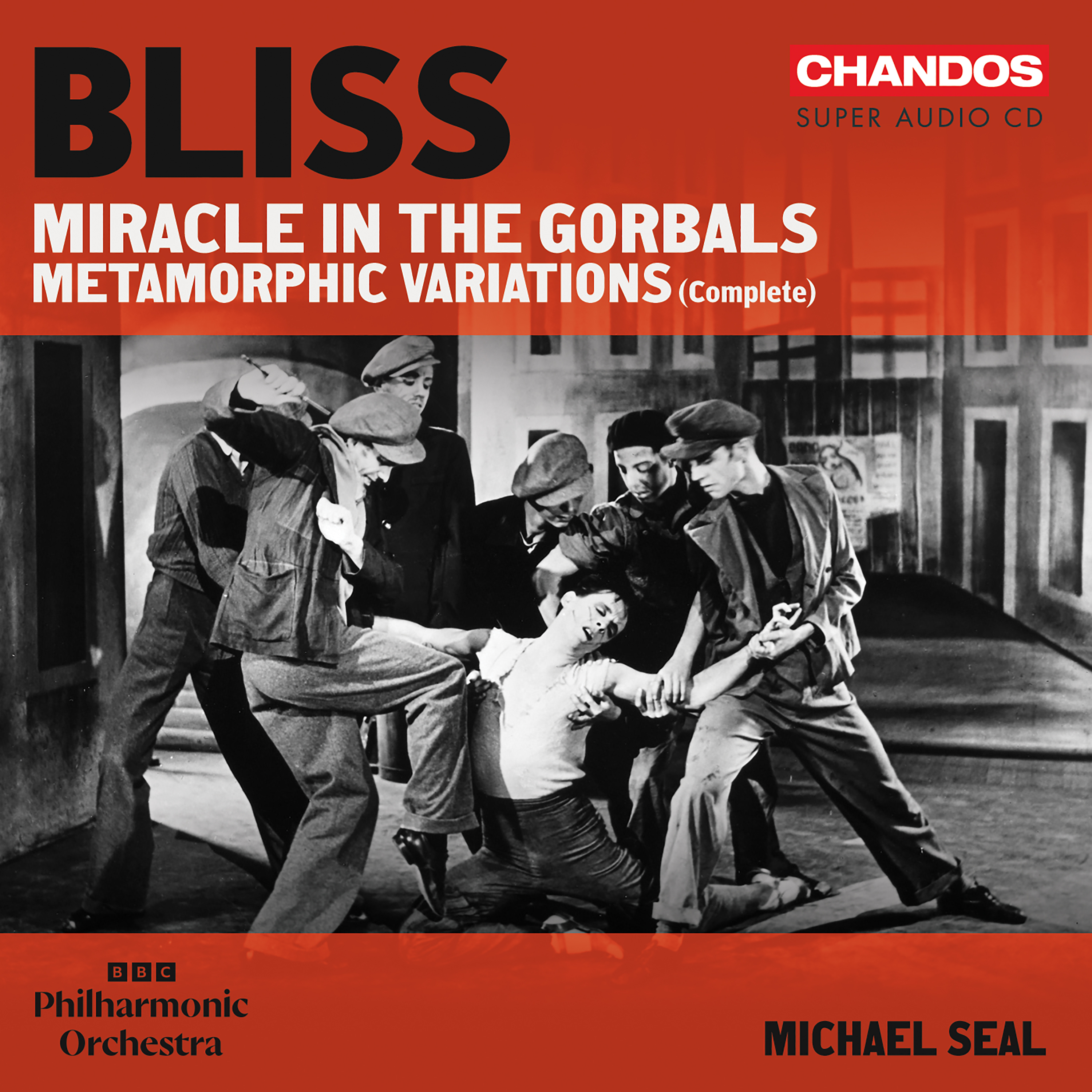
On Record – BBC Philharmonic Orchestra / Michael Seal – Bliss: Miracle in the Gorbals, Metamorphic Variations (Chandos)

BBC Philharmonic Orchestra / Michael Seal

Bliss
Miracle in the Gorbals, F6 (1944)
Metamorphic Variations, F122 (1972)

Chandos CHSA5370 [79’57”]
Producer Brian Pidgeon Engineers Stephen Rinker, Owain Williams (Miracle in the Gorbals), Amy Brennan (Metamorphic Variations)

Recorded 27 February 2025 (Metamorphic Variations), 1 March 2025 (Miracle in the Gorbals), MediaCity UK, Salford, Manchester

Reviewed by Richard Whitehouse

What’s the story?

Chandos issues the most important release of music by Arthur Bliss for the 50th anniversary of his death – coupling the second of his four ballets, in its new critical edition, with the last as well as the most ambitious of his orchestral works in what is its first complete recording

What’s the music like?

With its striking choreography from Robert Helpmann (after the story by Robert Benthall), Miracle in the Gorbals was initially even more successful than its predecessor Checkmate – being revived annually between 1944 and 1950. Other than a 1958 revival, however, there was no more stagings until that by Birmingham Royal Ballet in 2014; not least because the magic realism that transcends an otherwise grimly realistic scenario and struck a resonance in wartime Britain became passé soon afterward. Yet the quality of a score as finds Bliss at his most populist but also most uncompromising cannot be denied, and this new recording conveys these extremes in full measure. Hearing sections III (The Girl Suicide), X (Dance of Deliverance) and XV (The Killing of the Stranger) ought to banish any lingering doubts.

Premiered at Croydon’s Fairfield Halls during April 1973, Metamorphic Variations is Bliss’s lengthiest orchestral work. Shorter than intended, even so, with two sections being omitted at its first hearing and subsequently. This recording sees their belated and rightful reinstatement.

The three primary ideas are outlined in Elements: an oboe cantilena, a phrase for horns then strings, and a cluster from woodwind – melodic, rhythmic and harmonic possibilities that are explored intensively in what follows. The additional sections are an atmospheric Contrasts, whose absence has been to the detriment of overall balance, then a Children’s March which pivots from innocence to experience. Highlights include an increasingly animated Polonaise and Funeral Processions with its anguished culmination. Towards the close, a proclamatory Dedication duly underlines the inscription to artist George Dannatt and his wife Ann, then Affirmation draws those initial elements into a sustained peroration that pointedly subsides into a return of the oboe cantilena which, in turn, brings the closing withdrawal into silence.

Do the performances work?

Although the concert suite from Miracle in the Gorbals has received persuasive accounts by the composer (EMI/Warner) and Paavo Berglund (Warner), the complete ballet has only been recorded by Christopher Lyndon-Gee with the Queensland Symphony (Naxos) – compared to which this latest version, aside from its using the critical edition by Ben Earle, is superior in playing and recording. Here, as in Metamorphic Variations, the BBC Philharmonic responds assuredly to Michael Seal whose interpretative stance is distinctively his own. This latter has been recorded by Barry Wordsworth (Nimbus) and David Lloyd-Jones (Naxos), along with a broadcast from Vernon Handley (BBC Radio Classics), but the newcomer’s conviction gives it an advantage apart from those variations whose reinstatement enhances the work’s stature.

Is it recommended?

Very much so, not least given the spaciousness and realism of its SACD sound, together with informative notes from Ben Earle and Andrew Burn. Is it too much to hope Chandos will yet tackle either of Bliss’s operas which, along with The Golden Cantata, are his only significant works still to be commercially recorded? Michael Seal would be the ideal candidate to do so.

Listen / Buy

You can hear excerpts from the album and explore purchase options at the Chandos website, or you can listen to the symphonies on Tidal. Click on the names to read more about the Arthur Bliss Society, conductor Michael Seal and the BBC Philharmonic Orchestra

Published post no.2,783 – Friday 30 January 2026

In appreciation – Paul Westcott

by Ben Hogwood

Yesterday a memorial service was held for the much-loved and much-missed Paul Westcott, who sadly left us late last year.

Paul was for many best-known as the effervescent press officer for Chandos Records, a role he made his own. I think I speak for many of his friends, colleagues and associates when I say how grateful I am for his encouragement at every turn, his enthusiasm for the music he was working with, and his friendship.

The playlist below captures all the music either played or performed at the service, including several recordings either made or appreciated by Paul’s dear friend Richard Bonynge.

One notable omission from the playlist is Roger Webb‘s Theme from Hammer House of Horror – which is posted first to highlight Paul’s mischievous character!

On Record – Michael Collins, BBC Philharmonic Orchestra / Rumon Gamba – Arnold: Clarinet Concerto no.1, Philharmonic Concerto etc (Chandos)

Arnold
Commonwealth Christmas Overture Op.64 (1957)
Clarinet Concerto no.1 Op.20 (1948)
Divertimento no.2 Op.24 / Op.75 (1950)
Larch Trees Op.3 (1943)
Philharmonic Concerto Op.120 (1976)
The Padstow Lifeboat Op.94a (arranged for orchestra by Philip Lane)

BBC Philharmonic Orchestra / Rumon Gamba

Chandos CHAN20152 [68’50″’]
Producers Brian Pidgeon and Mike George Engineers Stephen Rinker, Richard Hannaford and John Cole
Recorded 5 & 6 December 2019, 29 July at MediaCity UK, Salford

Reviewed by Ben Hogwood

What’s the story?

This collection of six pieces from Sir Malcolm Arnold’s composing career stretches from one of his first published pieces, Larch Trees, to one of his last, the Philharmonic Concerto. Both were written for the London Philharmonic Orchestra, for whom he played trumpet from 1941 until 1948, and with whom he maintained a close association as a composer.

In between these pieces Chandos have chosen a satisfying mix of styles to reveal Arnold as a multi-faceted composer, not just the humourous one of which we hear most. That side of his writing is happily celebrated through The Padstow Lifeboat and the Divertimento no.2 for orchestra reveals the happiness he found through writing for children and young people, being young at heart himself.

The Commonwealth Christmas Overture finds Arnold in commission mode, called upon to write the music for Royal Prologue: Crown and Commonwealth, a programme narrated by Sir Laurence Oliver to preface the 25th Christmas speech by a ruling monarch. Completing the collection is the first of many concertos from Arnold’s pen, and the first of two for clarinet.

What’s the music like?

Chandos have already presented us with a good deal of Sir Malcolm Arnold’s music, and this is further enhanced by a programme giving us first recordings and revealing each side of the composer’s personality.

The Commonwealth Christmas Overture gets proceedings off to a suitably ceremonial start, with plenty of bluster and high jinks, all buoyed by colourful percussion. The influence of William Walton is immediately evident, for the main theme has more than a little in common with his own ceremonial march Crown Imperial, but Arnold goes on to develop it in his own inimitable way.

The Clarinet Concerto is a compact piece, deft and slightly bluesy in the outer movements but pausing for meaningful reflection in the Andante, the emotional centre of the work.

The Second Divertimento, long thought lost, is a fun piece where a lot happens in nine minutes! Using a traditional-sounding structure, Arnold has a lot of fun with the bracing Fanfare, atmospheric Nocturne and grand Chaconne, harnessing the power of the large orchestra.

The two pieces for the London Philharmonic are next, and are vividly contrasting pieces of work. Larch Trees is an evocative musical sketch, reminiscent of Moeran in the way it pans out over the rugged terrain of northern England, while also confiding intimately in its listeners through the woodwind. The Philharmonic Concerto is more obviously noisy and confrontational, this late work utilising the dissonance which will be noted by those familiar with Arnold’s later symphonies. This is not comfortable music but it is brilliantly written, challenging the orchestra to throw off their shackles. The probing violin lines of the Aria offer a chance for deeper reflection.

Finally The Padstow Lifeboat, one of Arnold’s brass band treasures, with its persistent ‘wrong note’ which warns all shipping. It makes for the ideal sign-off.

Does it all work?

Yes, and wonderfully so. Rumon Gamba has enjoyed a long and fruitful association with Arnold’s music and comes up trumps here, leading the BBC Philharmonic Orchestra in some characterful and personal accounts. Arnold could hardly wish for better advocacy and understanding, the conductor charting his youthful prowess in Larch Trees, whose softer contours benefit from excellent recording by the Chandos engineers.

The Clarinet Concerto no.1 is brilliantly played by Michael Collins, negotiating the wide leaps of the solo part with aplomb, while responding with grace in the soulful slower sections. The strings of the BBC Philharmonic exploit the depths of the darker slow movement, its temperature appreciably colder by the end.

Is it recommended?

Enthusiastically. This is an anthology that will appeal to seasoned Arnold listeners, for its mix of the familiar and a curio or two, while it is also the ideal place for those new to the composer. If you are after some music to combat the onset of January, you have come to the right place!

Listen

Buy

For more information and purchasing options on this release, visit the Chandos website

On Record – BBC Concert Orchestra / Bramwell Tovey – Poulenc: Les Animaux modèles, Sinfonietta (Chandos)

Poulenc
Sinfonietta (1947-48)
Two movements from ‘Les Mariés de la Tour Eiffel’ (1921, revised 1957)
Pastourelle from L’Éventail de Jeanne (1927)
Les Animaux modèles (complete ballet) (1940-42)

BBC Concert Orchestra / Bramwell Tovey

Chandos CHSA5260 [74’22″’]
Producer Brian Pidgeon Engineers Ralph Couzens, Alexander James
Recorded 10-12 March 2022 at Watford Colosseum

Reviewed by Ben Hogwood

What’s the story?

This collection of colourful works for orchestra by Francis Poulenc has as its main work the ballet Les Animaux modèles, based on The Fables of Jean de la Fontaine. A vibrant work, it clearly had huge significance for the composer, who started on its composition after the Nazi occupation of Paris in 1940, his aim ‘to find a reason to hope for the future of my country’. It received its first performance at the Paris Opera in 1942.

The ballet is symbolic, summarised in Nigel Simeone’s excellent booklet note about ‘a celebration of France’s past at its most lustrous’ than a collection of charming animal stories. It does however bring the story to life from the outset, with a vivid description of the dawn cutting to sharply characteristic portrayals of The Bear and The Two Companions, the former portrayed through an excellent horn solo, The Grasshopper and the Ant, The Amorous Lion, The Middle-aged Man and His Two Mistresses, Death and the Woodcutter, The Two Cockerels and finally The Midday Meal.

Complementing the ballet is the Sinfonietta, written for the BBC Third Programme and first heard in 1948. Initially the main themes of the work were to be part of a String Quartet that Poulenc was working on in 1945, but after its abandonment his friend and fellow-composer Georges Auric recognised the potential of the musical material. The work is dedicated to him in acknowledgement.

Completing the disc are two movements from Les Mariés de la Tour Eiffel, a collaborative single act ballet with Auric and the other members of composer collective Les Six, of which Poulenc was a leading member. There is also a soft-centred Pastourelle from another such collaborative piece, L’Éventail de Jeanne.

Very sadly this is the final recording made by the BBC Concert Orchestra’s principal conductor, Bramwell Tovey – completed just four months before his sad death from cancer at the age of 69.

What’s the music like?

In a word, colourful. Les animaux modèles is unquestionably the star turn, brilliantly played and characterised in this recording. Poulenc’s music is richly tuneful and beautifully orchestrated, often showing the influence of Stravinsky but realised with his own flair and mischievous humour. The central section of The Grasshopper and The Ant is a case in point, where a thrillingly brisk section cuts to an enchanting violin cadenza, the music briefly held in a spell until its release by shrill trumpets.

The Amorous Lion is a scene of great contrasts, with orchestral outbursts and volleys of percussion cutting to tender asides from string and woodwind choirs. The most substantial section – and arguably music – can be found in The Two Cockerels, where Poulenc realises music of great power and depth to portray the combat of the two birds. The surging climactic point, halfway through, is music of particularly strong feeling and resolve, Poulenc’s sentiments against the war reaching their heartfelt climax – before powerful exchanges between brass and the final toll on low piano. With passions largely spent, The Midday Meal provides a regal epilogue.

The slighter movements are no less fun, and The Middle-aged Man and his Two Mistresses scurries along furtively. Following Poulenc’s synopsis is enormously helpful, signposting the composer’s pictorial responses to the storyline as well as emphasising his wit.

In spite of its name, the Sinfonietta is one of Poulenc’s most substantial compositions. Far from being a slight, frothy work, it has a big-boned structure easily outdoing those dimensions, lasting nearly half an hour. Its convincing melodic arguments are led by the assertive first theme, drawing parallels with the Organ Concerto for its bite and resolve, while the second theme, beautifully realised here, brings mellow woodwind colouring. The second movement is a lively scherzo, balanced with tender asides that are fully realised in the slow third movement, a lyrical and colourful Andante cantabile. The brisk finale signs off with a flourish.

The two movements from Les Mariés de la Tour Eiffel are short but mischievous and entertaining, with humourous trombone interventions, while the Pastourelle is a charming addition.

Does it all work?

Yes. These are fresh, vibrant performances given with evident affection by the BBC Concert Orchestra. Bramwell Tovey brings out the colourful orchestrations, allows the lyrical melodies a bit of heart-on-sleeve approach where appropriate, and brings rhythmically sharp responses too. Poulenc’s colourful writing is brought to the fore, along with the melancholic undertones his music often carries.

Is it recommended?

Yes, on many levels. The quality of the music, the excellent Chandos recordings from Watford Colosseum and some very fine performances from which Bramwell Tovey takes his lead. The icing on the cake is the choice of Henri Rousseau’s Monkeys and Parrot in Virgin Forest as cover art. It is the ideal complement for a wonderful album.

Listen

Buy

For more information and purchasing options on this release, visit the Chandos website