
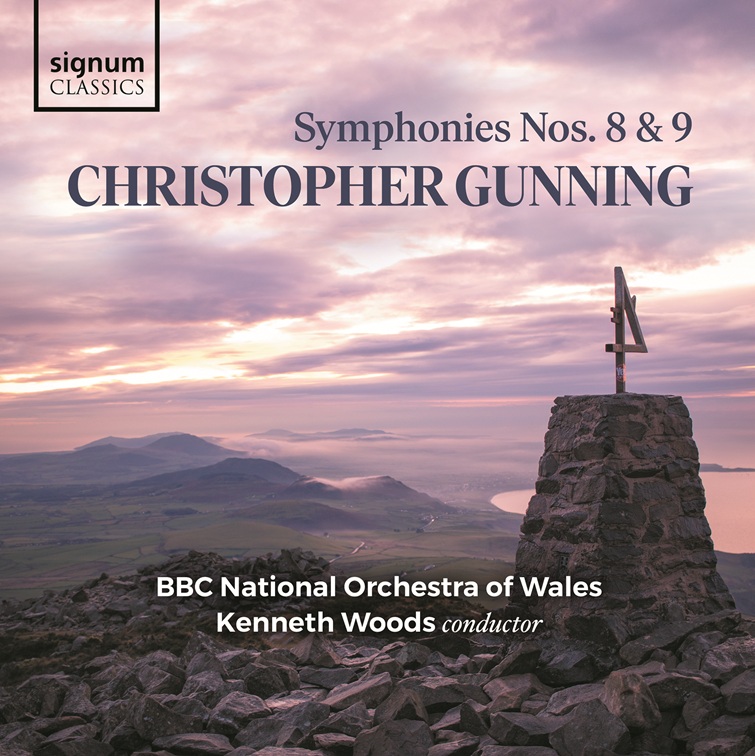
On Record – BBC National Orchestra of Wales / Kenneth Woods – Christopher Gunning: Symphonies nos. 8 & 9 (Signum Classics)

BBC National Orchestra of Wales / Kenneth Woods

Christopher Gunning
Symphony no.8 (2015)
Symphony no.9 (2016)

Signum Classics SIGCD949 [67’33”]
Producer Phil Rowlands Engineer Mike Hatch

Recorded 11-13 March 2024, Hoddinott Hall, Wales Millennium Centre, Cardiff

Reviewed by Richard Whitehouse

What’s the story?

Signum Classics continues its coverage of the late Christopher Gunning with this coupling of two symphonies, a genre that dominated the composer’s thinking in later years, and which get the advocacy they deserve from the BBC National Orchestra of Wales with Kenneth Woods.

What’s the music like?

Although he studied at London’s Guildhall School of Music and Drama with early ambitions as a symphonist, Gunning’s subsequent career was centred on scores for film and television with successful excursions into popular music. Not until 2001, when he was nearing 58, did he complete his First Symphony that was followed by a further 12 over the next two decades, along with several concertos and other orchestral pieces, in what is among the more notable instances of a composer moving between very different disciplines with comparable success.

Written for modest and what might be called ‘late-Classical’ forces, both symphonies are as integrated formally as they are resourceful motivically while, in both instances, movements are merely numbered rather than designated by tempo or expression. The Eighth Symphony consists of three movements unfolding from a sonata design of deft formal proportions with a slower introduction, via a slow movement whose ruminative cast is enhanced by plaintive contributions from flute and cor anglais, to a finale whose scherzo inclinations afford it an impetus and lightness maintained through to the decisive close. An earlier era of American symphonism (ostensibly that of Walter Piston or Randall Thompson) can be detected in its harmonic colouring and melodic contours, but Gunning’s personality is audible throughout.

Scored for slightly larger forces and with four movements, the Ninth Symphony feels no less focussed formally while admitting a wider range of or, at least, of more ambivalent emotions. Thus the opening movement again adheres to sonata design, with a more discursive (though never rhapsodic) take on its primary ideas. This is followed by a speculative or even fugitive scherzo, then a slow movement whose sustained eloquence arguably makes for the highlight of either symphony. It only remains for the finale, its progress as purposeful as it is eventful, to afford a conclusiveness that feels not at all premeditated, let alone predictable. If, in both these works, there is a tangible inner drama which is being played out, Gunning is first and foremost a symphonist for whom abstract concerns override any more subjective tendencies.

Does it all work?

It does indeed – thanks, above all, to Gunning’s unstinting focus on what symphonic form is and can be. Those familiar with any of his other symphonies will know that there is nothing anecdotal or half-baked about his handling of the genre, which emerges as the self-sufficient concept it ideally should be. It helps, of course, that Woods renders both these works with the insight expected from a conductor whose 21st Century Symphony Project has been crucial in rehabilitating the symphony in the UK, and who secures committed playing from BBCNOW.

Is it recommended?

Very much so. Recorded with all the necessary definition, and informatively annotated, this is well worth acquiring by those who are not yet acquainted with Gunning’s symphonic odyssey. Only recordings of the 11th, 13th and the revised First remain to complete an important cycle.

Listen / Buy

You can hear excerpts from the album and explore purchase options at the Signum Classics website, or you can listen to the symphonies on Tidal. Click on the names to read more about composer Christopher Gunning, the BBC National Orchestra of Wales and conductor Kenneth Woods

Published post no.2,782 – Thursday 29 January 2026

On Record – MahlerFest XXXV: Kenneth Woods conducts Symphony no.3 & Gunning Symphony no.10

Stacey Rishoi (mezzo-soprano), Boulder Children’s Chorale, Women of Boulder Concert Chorale, Colorado MahlerFest Orchestra / Kenneth Woods

Gunning Symphony no.10 (2016-17) [First public performance]
Mahler Symphony no.3 in D minor (1893-6)

Colorado MahlerFest 195269164287 [two discs, 114’21”]
Live performances on 22 May 2022, Macky Auditorium, Boulder, Colorado

Reviewed by Richard Whitehouse

What’s the story?

The 35th Colorado MahlerFest, the eighth under the direction of Kenneth Woods, reached its culmination with the performance of Mahler’s Third Symphony and preceded in this concert with a first public hearing for the 10th Symphony by the late-lamented Christopher Gunning.

What’s the music like?

In its setting out the creation of the world, from an inanimate state to the dawn of humanity, Mahler’s Third Symphony is his most ambitious conceptually and certainly his lengthiest. It is to Woods’s credit that, though his account at 92 minutes is among the swiftest, there is no sense of haste – not least his handling of the first movement’s vastly extended sonata design, which amply conveys the burgeoning of natural forces with unbridled impetus but equally a fantasy or even playfulness manifest through the irresistible abandon of those closing pages.

Those having watched the online broadcast will recall Woods observing the customary break before the remaining five movements which constitute the second part. Here, though, there is barely a pause going into the second movement, its minuet-like lilt and evocation of all things vernal rarely having sounded so delicate or ingratiating. The ensuing scherzo is almost as fine, the often boisterous irony of its outer sections finding contrast in trios whose post-horn solos are ethereally rendered by Richard Adams, with a frisson of danger emerging in the final bars.

Nor is Stacey Rishoi found wanting in a Nietzsche setting that alternates earnest speculation with heartfelt yearning. She is no less inside its successor’s setting of a Knaben Wunderhorn text, its ambivalence offset by a whimsical response from the women’s and children’s choirs. Others may have found even more profundity from the finale, but Woods ensures it emerges as a seamless totality – the anguish at its centre drawn into a rapt eloquence which is carried through to a coda bringing this disciplined and persuasive performance to its ecstatic close.

Unlike other of his peers, their concert output little more than a rehash of their work for film and television, Christopher Gunning’s symphonies and concertos seem abstract music with a vengeance. The single-movement 10th Symphony is both cohesive in its structure and methodical in its evolution. Woods has recorded it with BBC National Orchestral of Wales (Signum Classics), and while that studio recording has greater formal focus, the Colorado musicians unfold this quixotic score to its serene ending with demonstrably greater spontaneity and impulsiveness.

Does it all work?

Almost always. Those who prefer a more expansive or interventionist approach in the Mahler may be disappointed, but the no-nonsense nature of Woods’s traversal conveys any amount of insight or expressive nuance. Presentation is equally straightforward, but Mahler’s expression markings for each movement should have been included alongside those descriptive headings he later deleted, while the Gunning might have been best placed at the start (as in the concert) with the first part of the Mahler – allowing its second part to unfold as an unbroken continuity.

Is it recommended?

Very much. Boulder’s Macky Auditorium might not have the most spacious perspective, but its clarity and definition audibly benefit a performance that is much more than the memento of an occasion. Indeed, this MahlerFest series is shaping up to be a memorable Mahler cycle.

Buy

For further purchase options, visit the MahlerFest website – and for more information on the festival itself, click here. Click on the names for further information on conductor Kenneth Woods and composer Christopher Gunning