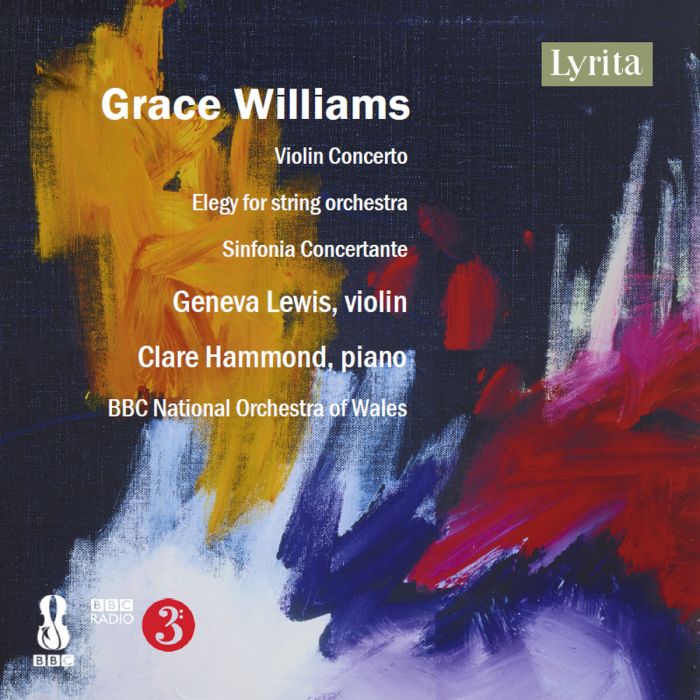
On Record – Geneva Lewis, Clare Hammond, BBC National Orchestra of Wales – Grace Williams: Violin Concerto, Elegy, Sinfonia Concertante (Lyrita)

Geneva Lewis (violin, Violin Concerto), Clare Hammond (piano, Sinfonia Concertante), BBC National Orchestra of Wales / Jaime Martin (Violin Concerto), Ryan Bancroft (Elegy), Jac van Steen (Sinfonia Concertante)

Grace Williams
Violin Concerto (1949-50)
Elegy (1936, rev. 1940)
Sinfonia Concertante (1941)

Lyrita SRCD447 [59’09”]
Producer Mike Sims Engineers Andrew Smilie, Simon Smith (Violin Concerto)

Broadcast performances at Hoddinott Hall, Cardiff on 12 February 2022 (Elegy) and 22 September 2022 (Sinfonia Concertante); live performance from Royal Albert Hall, London on 8 August 2023 (Violin Concerto)

Reviewed by Richard Whitehouse

What’s the story?

Lyrita continues its exploration of Grace Williams with this enticing collection of orchestral works dating from before, during and after the Second World War. All the pieces feature the BBC National Orchestra of Wales, which has championed this composer over nine decades.

What’s the music like?

Earliest here is the Elegy for strings that, evidently overhauled and re-scored after several hearings, falls within an extensive lineage of such miniatures (in length but not expressive scope) by British composers. Scored for muted violins and violas, the initial idea evinces a ruminative austerity such as persists to the main climax; after which, a heartfelt passage for solo strings presages the more conciliatory mood setting in near its end. Ryan Bancroft has the measure of a piece whose emotional depth is out of all proportion to its modest duration.

Although conceived prior to the above, Williams did not commence work on what became her Sinfonia Concertante until the turn of the next decade. With its compact dimensions and intensive integration of piano and orchestra, its title (actually suggested by pianist Michael Mullinar) is well chosen. If the opening Allegro never quite finds the right balance between its impulsive and yielding main themes, the central slow movement is Williams at her most characteristic with its unfolding as terraces of mounting intensity toward a powerful climax which subsides into pensive resignation; the final Alla Marcia duly maintaining its impetus through to a forceful if never hectoring close. Clare Hammond is at her inquiring best in an account as finds Jac van Steen handling some passing issues of balance with real adeptness.

For its part, the BBC National Orchestra of Wales is no less attuned to the very different ethos of the Violin Concerto, which it premiered with soloist Granville Jones almost 75 years back. New Zealand-born Geneva Lewis proves to be a sympathetic advocate – even if the opening Liricamenta surely requires a more purposeful sense of direction for its enfolding inwardness not to risk inertia. Not that her unforced manner and tonal elegance are other than appropriate, as is even more evident in the central Andante with its impressionist eddying of phrases and fastidious timbral shading. Following on attacca, the final Allegro sees the work’s only swift music in which Lewis’s deftness gains from her assured co-ordination with Jaime Martin. Its cadenza is incisively despatched, and the coda more satisfying for its teasing unexpectedness.

Does it all work?

Almost always. The Violin Concerto is a work with which its composer never seems to have been wholly satisfied, but such reservations as there are centre less on its actual content than on the difficulty – at least in its opening movement – of controlling overall momentum such that the music coheres overall. Lewis is by no means unsuccessful, though comparison with earlier performances that are available online suggests other soloists may have gone further in this respect. A reminder, moreover, that Williams’s music does not necessarily ‘play itself’.

Is it recommended?

Indeed. The Cardiff broadcasts benefit from the superb acoustic of Hoddinott Hall, while the Proms account of the Violin Concerto has far more immediacy than ‘on the night’. Typically informed and informative notes by Paul Conway round out what is a mandatory acquisition.

Listen / Buy

You can hear excerpts from the album and explore purchase options at the Lyrita website and the Presto Music website, and click on the names for more information on violinist Geneva Lewis, pianist Clare Hammond, conductors Jaime Martin, Ryan Bancroft and Jac van Steen, the BBC National Orchestra of Wales and composer Grace Williams

Published post no.2,808 – Tuesday 24 February 2026

On Record – Robert Saxton: Portrait (Métier)

Saxton
A Hymn to the Thames (2020)
James Turnbull (oboe), St Paul’s Sinfonia / Andrew Morley
Fantasy Pieces (2020)
Fidelio Trio [Darragh Morgan (violin), Tim Gill (cello), Mary Dullea (piano)]
Time and the Seasons (2013)
Roderick Williams (baritone), Andrew West (piano)
Suite (2019)
Madeleine Mitchell (violin), Clare Hammond (piano)

Métier msv28624 [69’40’’]
Producers / Engineers Adaq Khan, Stewart Smith (Time and the Seasons)

Recorded 12 March 2014 at King’s Hall, Ilkley (Time and the Seasons); 27 January 2020 at St John the Evangelist, Oxford (Suite); 7 November 2021 at Conway Hall, London (Fantasy Pieces); 28 January 2022 at St John the Evangelist, London (A Hymn to the Thames)

Reviewed by Richard Whitehouse

What’s the story?

Having issued several of his works on miscellanies, Métier now issues a release devoted to Robert Saxton – this Portrait comprising four pieces which, written during the past decade, make for a revealing overview of the composer’s musical and wider aesthetic convictions.

What’s the music like?

Earliest among these works is Time and the Seasons – a song-cycle to Saxton’s own poems, in which memories of the composer’s long attraction to the south-eastern Norfolk coast are elided with a seasonal traversal from then back to winter; and itself underpinned by a tonal evolution drawing the six songs into a musical continuity. A piano solo Summer Seascape provides a formal and expressive pivot, the baritone solo Autumn an entrée into the The beach in winter as foregrounds human activity against a backdrop of temporal permanence.

Although they likewise have descriptive titles, the five pieces that comprise Suite for violin and piano seem inherently abstract in their content. Following the cumulative activity then limpid evocation of the first two, the others play without pause – the visceral immediacy of Jacob and the Angel, then the ethereal interplay in Bells of Memory, leading into Quest with (as in the song-cycle) a sense of this music having come full-circle yet simultaneously setting out fresh possibilities – tonal and emotional – to be pursued in future compositions.

The composer himself notes that Fantasy Pieces for piano trio, despite its title and scoring, is not related to Schumann’s eponymous work in any formal or thematic sense. Instead of the latter’s four character-pieces, moreover, Saxton opts for six continuous items whose fluidity of content and intuitive follow-through readily point up the various connotations of the title. That the closing piece seeks to provide a definite resolution while imparting a sense of open-endedness to the sequence overall is merely the most arresting facet of this engaging work.

Closure and un-restrictedness are no less crucial in A Hymn to the Thames, a concertante for oboe and ‘Classical’ forces whose four movements outline the river’s journey from its source in the Cotswolds to its estuary at the North Sea. Allusions to places encountered on route are deftly inferred (notably choral works by Taverner and Tallis), with the soloist a ‘first among equals’ as it leads the orchestra on through these contrasted musical landscapes towards a heightened arrival as the river meets the sea and, in turn, a comparable sense of renewal.

Does it all work?

It does. Saxton observed several years ago his music had become both more serial and tonal in its preoccupations, as is evident from the works recorded here. An incidental fascination is how each section or movement, appealing in itself, yet leaves a sense of open-endedness that is only resolved through the context in which they appear. This will doubtless be evident on a larger scale when Saxton’s Scenes from the Epic of Gilgamesh is premiered by the English Symphony Orchestra in Oxford as part of its 21st Century Symphony Project on March 10th.

Is it recommended?

Very much so. Excellence of performers and performances is matched by sound which gives little indication of any disparity in venues or dates, and the composer provides informative booklet notes. Hopefully further releases of Saxton will be forthcoming from this source.

For purchase information on this album, and to hear sound clips, visit the Divine Art Recordings Group website. For more on the composer, visit Robert Saxton’s dedicated website – and for more on the performers, click on Clare Hammond, Madeleine Mitchell, Andrew Morley, James Turnbull, Andrew West, Roderick Williams, Fidelio Trio and St. Paul’s Sinfonia

In concert – Clare Hammond, CBSO / Michael Seal: Nielsen, Grieg & Sibelius

clare-hammond-grieg

Nielsen Helios Overture FS32 (1903)
Grieg
Piano Concerto in A minor Op. 16 (1868)
Sibelius
Symphony No. 1 in E minor Op. 39 (1898-9)

Clare Hammond (piano, above), City of Birmingham Symphony Orchestra / Michael Seal

Symphony Hall, Birmingham
Wednesday 9 March 2022 (2.15pm)

Written by Richard Whitehouse

A Scandinavian programme this afternoon from the City of Birmingham Symphony Orchestra, featuring music by the three most famous of this region’s composers (so no representation for Sweden), and presided over with his customary authority by CBSO’s associate conductor Michael Seal.

Unusual nowadays to have a programme consisting of overture, concerto and symphony – but Nielsen’s Helios is as fine a curtain-raiser as any, its ‘sunrise to sunset’ scenario captured with one of the most graphic crescendos and diminuendos in the literature. Seal ensured this gradual emergence, and its faster evanescence, were unerringly paced – the horns’ echoing sonorities enfolded into the orchestral texture; and if the intervening intermezzo and fugato rather tread water by comparison, their role within the formal scheme made for a cohesive overall entity.

Whether or not Grieg tired of hearing or at least playing his Piano Concerto, he would surely have appreciated Clare Hammond’s take on its solo part. The inedible opening gesture might have been less than usually arresting, but the opening movement proceeded methodically and often poetically so its structural seams were barely in evidence – culminating in a resourceful account of the cadenza with the composer’s motivic ingenuity much in evidence. Easy to pass off as a bland interlude, the Adagio had an appealing poise that opened into keen pathos at its height. Trenchant rather than impetuous, the outer sections of the finale were rarely less than engaging but it was the warm soulfulness at the centre that really struck home; its return for a triumphal apotheosis did not quite avoid portentousness, but it ensured a decisive conclusion.

A distinctive and, for the most part, convincing performance which Hammond followed with the caressing harmony of the eleventh from Szymanowski’s Op. 33 Etudes – music in marked contrast to the existential drama of Sibelius’s First Symphony which came after the interval.

The latter work’s emergence against a background of fraught self-determination has inevitably taken on far greater resonance during recent weeks, and it was to Seal’s credit that he played down any tendency to overt sentiment – rendering the first movement, its sombre introduction limpidly realized by Oliver Janes, as the striking and frequently innovative study in expressive contrasts it should be. Nor was there any lack of Tchaikovskian pathos in the Andante, whose whimsical passages were as vividly delineated as those eruptive outbursts towards its climax.

The ensuing Scherzo had the right rhythmic tensility and, in its central trio, enticing whimsy – but it was the Finale as set the seal on this performance. The ‘Quasi una fantasia’ marking can result in emotional overkill but Seal kept its prolix follow-through in focus at all times – whether with the anguished recall of the work’s initial theme, surging impetus of its swifter sections, or the heart-on-sleeve immediacy of its ‘big tune’; pervaded by an ambivalence to the fore in a peroration which (almost) avoided histrionics on the way to its fatalistic close.

A fine response from the CBSO, playing here with burnished eloquence and Matthew Hardy making the most of a timpani part that has structural as well as expressive significance. Few having heard it are likely to underestimate this work’s status in Sibelius’s symphonic output.

For more information on the CBSO’s current season, visit their website. Meanwhile for more information on the artists, click on the names to access the websites of Clare Hammond and Michael Seal

Playlist – Clare Hammond

It is with great pleasure that we welcome pianist Clare Hammond to the Arcana playlist section.

Clare has just released a new solo album, Variations. It is a typically thoughtful and inventive program of works from the 20th and 21st-centuries, ranging from  Adams to Birtwistle, Copland to Gubaidulina.

We invited Clare to complement her new album with a selection of her own favourite sets of variations, and she has obliged with some new discoveries. We begin with one of the greatest of all, the towering Passacaglia for organ by Bach, via Leopold Stokowski‘s colourful orchestration. Then we downsize for Louise Farrenc‘s Variations concertantes sur mélodie suisse, for violin and piano, before we hear from George Walker, the first African American to have won the Pulitzer Prize for Music, and only recently getting more exposure as a composer. Polish composer Grażyna Bacewicz, with her Theme with Variations, offers a strong contrast to the Farrenc, again for violin and piano.

A Decca recording from 1993 follows, an early bit of recognition for the craft of Coleridge-Taylor and his substantial Variations on an African Air for orchestra. We go to piano for Lili Boulanger‘s typically concise and expressive contribution, before the wonderfully humourous, wacky and brilliant Variations on America by Charles Ives, in the orchestration by William Schuman.

Make sure you have a listen to this as well as Clare’s album, to be reviewed on Arcana soon. Our grateful thanks to her for an invigorating hour of music:

You can read more about Clare Hammond’s Variations album on the BIS website, and to hear clips and purchase from Presto Classical, click here

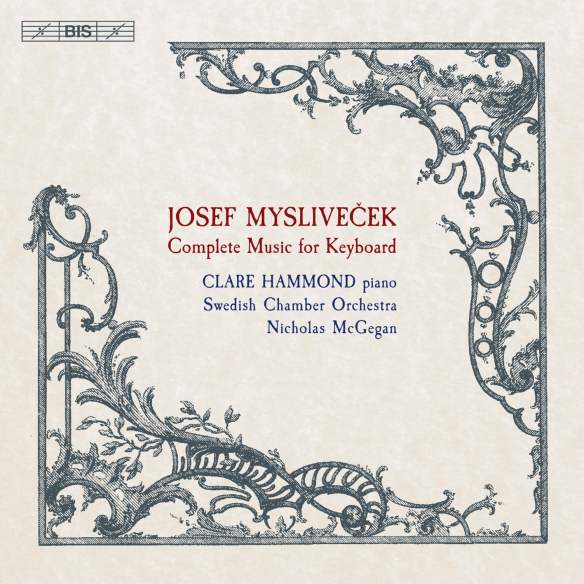
On record – Clare Hammond, Swedish Chamber Orchestra / Nicholas McGegan: Mysliveček: Complete Music for Keyboard (BIS)

Clare Hammond (piano), Swedish Chamber Orchestra / Nicholas McGegan

Josef Mysliveček (1737-1781)
Keyboard Concerto no.1 in B flat major (late 1770s)
Six Easy Divertimenti for Harpsichord or Piano-forte (1777)
Keyboard Concerto no.2 in F major (late 1770s)
Six Easy Lessons for the Harpsichord: Sonatas 1-6 (1780)

BIS BIS-2393 [74’22”]

Producer and Engineer Thore Brinkmann

Recorded March 2018 at the Örebro Concert Hall, Sweden

Written by Ben Hogwood

What’s the story?

Not many composers could claim to have influenced one of the greatest composers to have lived, but Il Boemo (The Bohemian) could do just that. Josef Mysliveček, to whom the nickname was applied, was a Czech composer of rare standing and a mentor to Mozart in the 1770s. He had a life of eyebrow-raising but ultimately tragic events, culminating with his death in great poverty in Rome in 1781, having nearly lost his nose a couple of years earlier to a botched operation.

Clare Hammond’s interview for this site puts more musical detail onto his fascinating tale. More importantly this disc for BIS serves notice of Mysliveček’s standing as an important musical figure and prodigiously talented composer. If you like Mozart, his music is a natural but essential step for further exploration.

What’s the music like?

Really enjoyable. The Piano Concerto no.1, where Hammond is joined by the Swedish Chamber Orchestra conducted by Nicholas McGegan, has a sparky personality, with plenty of vigour in its fast outer movements and elegance in the softly voiced central slow movement. There is an economy of thought, too – it finishes quickly with the minimum of fuss.

Clare Hammond clearly loves this music, and she plays with poise but also enjoys the instinctive nature of Mysliveček’s writing. The solo works are notable for their compressed construction, never threatening to outstay their welcome and on occasion producing unexpectedly dark undercurrents.

She is alive to these and handles the technical challenges really well. The Six Easy Divertimenti sound anything but unless they are in her hands! She makes the most of their tendencies to surprise, as in the mysterious pauses on some pretty exotic chords in the fifth piece.

The Piano Concerto no.2 has some notable syncopations in its first movement, as well as some adventurous harmonic diversions, before slipping into the minor key for a profound slow movement. Some of the music is contrary, staying away from big technical displays when you might expect them, but the third movement has a spring in its step nonetheless.

The Six Easy Lessons (again sounding pretty difficult!) bring parallels with the keyboard music of Domenico Scarlatti, and receive crisp and characterful performances. The second movement of the First Lesson reminds of the Czech composer’s tendency to spice up his melodies with chromatic movement, and this is one of many good tunes to be found throughout these spirited pieces.

Does it all work?

Yes. The structure of Mysliveček’s output from Hammond gives an ideally balanced disc, with the concertos complemented by the solo works. The clarity of her performance ensures it can be heard in the best possible light, and recording from the BIS engineering team is ideal.

Is it recommended?

Yes, and it fills a gap in the 18th century discography. Here is an important figure on whom the spotlight so rarely shines – and we are grateful to Hammond and McGegan for directing it to the right place.

Stream

Buy

You can buy this release directly from the BIS website