In concert – Ex Cathedra, CBSO / Robert Ames: Northern Lights

Ex Cathedra (George Parris, chorus-master), City of Birmingham Symphony Orchestra / Robert Ames

Arnalds arr. Geoff Lawson Momentary (2018)
Jóhansson arr. Robert Ames Kanguru (2016)
Guðnadóttir arr. Ames For Petra (2022) [UK Premiere]
Jóhansson arr. Anthony Weeden Arrival – Suite No.1 (2016)
Guðnadóttir arr. Ames Ascent (2009)
Arnalds Og Lengra (2009)
Jónsi & Somers arr. David Handler Boy 1904 (2009)
Björk arr. Ian Anderson Jóga (1997)
Sveinsson Der Klang Der Offenbarung des Göttlichen (2014) [UK Premiere]

Symphony Hall, Birmingham
Saturday 5 April 2025

Reviewed by Richard Whitehouse

Saturday’s concerts often ring the changes in the City of Birmingham Symphony Orchestra’s season and this evening proved no exception – Northern Lights comprising a programme by the younger generation of Icelandic composers that has come to the fore of European music.

Much has been made of the inclusivity and non-conformism of music in Iceland – spurred on, no doubt, by that country’s geographical isolation well into the 20th century with its lack of a classical tradition as regards composing or performance. Yet the main impression left by what was heard tonight was its overall lack of diversity in terms of sound and, as a consequence, its uniformity as regards expression. For a country which is synonymous with spectacular natural phenomena as well as its off-the-wall attitude, this was surprising and not a little disconcerting.

Any such trend was largely bucked by the late Jóhann Jóhansson, whose numerous film scores were represented by two extracts from that to sci-fi drama Arrival – the first enlivened with its quirky vocal syllabics, then the second building up an ominous and ever more menacing aura. They were preceded by a track from Ólafur Arnalds’s album Re:member that set the sombrely evocative scene, and each of them followed with music by Hildur Guðnadóttir – a simmering extract from the ambitious while overwrought film Tár, then a track from her album Without Sinking that ended rather less arrestingly than it began. An excerpt from Arnalds’ ballet score Dyad 1909 has atrophied even before its close, and the Jónsi / Alez Somers collaborative track from their album Riceboy Sleeps was appreciably less than the sum of its intriguing parts. At least the first half closed on a relative high with a track from Björk’s Homogenic – one of her finest achievements here given an arresting twist by Ian Anderson, whose album reworkings with his outfit Wooden Elephant should have garnered more attention in the classical domain.

Little of Björk’s bracing idiosyncrasy – let alone the eruptive physicality of Iceland’s musical ‘father’ Jón Leifs – was evident during Kjartan Sveinsson’s Der Klang Der Offenbarung des Göttlichen occupying the second half. A former member of that (over?) influential post-rock band Sigur Rós, his ‘opera’ inspired by Halldór Laxness’s seminal novel World Light eschews individual characters and specific actions, though its presumed scenario of acceptance within the midst of adversity feels vestigial at best. Admittedly its opening threnody unfolded with a Górecki-like eloquence, but the ensuing dialogue between choir and strings sounded akin to a Germanic liturgical setting by a forgotten composer of the later 19th century – far from those expressionist canvasses by Ragnar Kjartansson that formed a backdrop at its Berlin premiere.

It should be added that the members of Ex Cathedra gave their collective all for what was an all too rare appearance with the CBSO. As, moreover, did the orchestra itself when conducted with such expertise by Robert Ames who, as a violist with whom to reckon and founding co-director of the enterprising London Contemporary Orchestra, is nothing if not well-versed in this music. What a pity that the outcome as experienced tonight was music often uninvolving, sometimes dull and conformist in a way that contemporary Icelandic culture should never be.

For details on the 2024-25 season A Season of Joy, head to the City of Birmingham Symphony Orchestra website. Click on the names to read more about conductor Robert Ames and the choir Ex Cathedra

Published post no.2,498 – Tuesday 8 April 2025

On Record – Arnold Cooke: Complete String Quartets, Volume One (The Bridge Quartet) (Toccata Classics)

Arnold Cooke
String Quartet no.1 (1933)
String Quartet no.3 (1967)
String Quartet no.5 (1978)

Bridge Quartet [Colin Twigg, Catherine Schofield (violins), Michael Schofield (viola), Lucy Wilding (cello)]

Toccata Classics TOCC0696 [56’05”]
Producer and Engineer Michael Ponder

Recorded 21-22 November 2022, 5-6 March 2023, All Saints’ Church, Thornham

Reviewed by Richard Whitehouse

What’s the story?

Toccata Classics continues its coverage of Arnold Cooke (his organ music is on TOCC0659) with this first volume of his string quartets, performed by The Bridge Quartet and confirming him as a skilful practitioner of a genre such as found favour with many composers of his era.

What’s the music like?

Premiered by the Griller Quartet in March 1935, the First Quartet gained the praise of no less than Havergal Brian and helped to establish Cooke’s wider reputation. Completed a year after his return from study in Berlin, this undeniably shows the influence of Hindemith but offsets it with a lyrical poise as to suggest lessons well learned from an earlier generation of British composers. Although cast in four movements, the opening Lento is a fugue whose emotional austerity never seems unduly severe – with the ensuing Vivace and Allegretto a scherzo then intermezzo of respective impetus and suavity. The final Presto rounds off proceedings with a keen yet never wanton energy that sets the seal on a substantial and approachable work; one which should not have had to wait 84 years until its revival by the present ensemble in 2022.

First given by the English Quartet in May 1968, the Third Quartet is contemporaneous with Cooke’s Third Symphony – whose coupling on Lyrita with a suite from his ballet Jabez and the Devil doubtless introduced many to this composer. Here one senses the presence, rather than influence as such, of Bartók – specifically his Sixth Quartet, the underlying rhythm of whose Marcia informs the initial Allegro of this work, and whose recurrent Mesto theme proves hardly less pervasive in an Andante which none the less emerges as one of Cooke’s most thoughtful and revealing statements. The brief scherzo exudes a driving impetus that carries over into a final Allegro that, in its ongoing vivacity and affirmative close, confirms this as the most likely of these quartets to find its place in the repertoire of the 20th century.

By the time his Fifth Quartet received its premiere in March 1979, Cooke had evidently been eclipsed by a younger generation though there is nothing overtly reactionary about this piece. Unfolding as a single movement, it has three clearly defined sections (as on this recording) -thus, a tense if ambivalent Moderato leads into an Allegro which adeptly elides scherzo and slow movement with no loss of ongoing momentum, then a Presto whose sheer brevity does not preclude allusions to earlier ideas as it steers this compact work to a decisive conclusion.

Does it all work?

Pretty much. Cooke might never have had an overtly distinctive or even personal idiom, but his music has a technical rigour and a feel for communication as makes listening rarely less than pleasurable. It helps when, in the Bridge Quartet, it has exponents so well versed in the lineage of British quartet writing – not least the composer who provided this ensemble’s name – and as attentive to the wealth of contrapuntal invention as to the greater design with each of these pieces. Hopefully other such groups will be encouraged to include them in their recitals.

Is it recommended?

Indeed so. The recording has a focus and perspective which is ideal for such music, and there are succinctly informative annotations by Peter Marchbank. Hopefully the follow-up volume, featuring the Second and Fourth Quartets, will be appearing from this source before too long.

Listen & Buy

For purchase options, you can visit the Toccata Classics website. Click on the names to read more about The Bridge Quartet and composer Arnold Cooke.

Published post no.2,497 – Monday 7 April 2025

In concert – Alina Ibragimova, CBSO / Dinis Sousa: Sibelius, Dvořák & Arvo Pärt

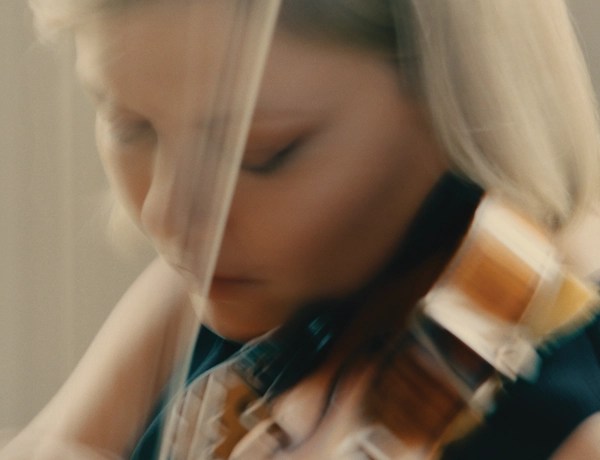
Alina Ibragimova (violin, above), City of Birmingham Symphony Orchestra / Dinis Sousa (below)

Pärt Our Garden (1959, rev. 2003)
Sibelius Violin Concerto in D minor Op.47 (1903-04, rev. 1905)
Dvořák Symphony no.8 in G major Op.88/B163 (1889)

Symphony Hall, Birmingham
Thursday 3 April 2025

Reviewed by Richard Whitehouse Picture of Alina Ibragimova (c) Joss McKinley; Dinis Sousa (c)

In what was an auspicious first appearance with the City of Birmingham Symphony Orchestra, Dinis Sousa presided over an appealing programme that featured repertoire staples by Sibelius and Dvořák alongside welcome revival of an uncharacteristic early choral piece by Arvo Pärt.

Uncharacteristic but highly enjoyable, Our Garden seems relatively untypical of the Estonian composer even in his mid-twenties – its winning an award at a Soviet-sponsored competition in 1962 bringing plaudits at a time when Pärt’s was very much an ‘unofficial’ presence on the new-music scene. Six decades on this can be enjoyed simply for what it is – an unpretentious celebration of youthful endeavour whose unaffected setting of four not overly polemical texts is as cohesive as it is sincere. Certainly, the CBSO Youth Chorus did justice to writing whose rhythmic unison was offset with some deft harmonic twists and enhanced by the resourceful contribution of a sizable orchestra. An obvious candidate for inclusion in music quizzes, Our Garden is never less than effective on its own terms and made for an attractive curtain-raiser.

Geographical proximity aside, there was little connection between Pärt’s cantata or Sibelius’s Violin Concerto, and while a performance of the latter rarely fails to impress it rarely catches fire as it did here. Alina Ibragimova has given some memorable performances in Birmingham over recent seasons, but this account got to the heart of a piece that, for all its indebtedness to Romantic-era virtuosity, is no less original in form or content than its composer’s symphonies and tone poems of this period. Most notable were Ibragimova’s fusing of the first movement’s central cadenza with developmental impetus, her building of cumulative momentum over the course of the Adagio or a final Allegro which, though this may all but have eschewed the ‘ma non tanto’ marking, exuded a drive and panache maintained through to the scintillating close.

A first-rate accompanist, Sousa (above) brought out much of interest from the orchestral texture – not least its writing for low woodwind and horns which frequently underpins the soloist in a way that could only be Sibelius. Such attention to detail was equally evident in his performance of Dvořák’s Eighth Symphony – music easy to take for granted in its warmth and affability, yet whose opening Allegro is a masterclass in formal innovation as benefitted from the incisive if never overdriven energy Sousa brought to this movement as a whole and its coda in particular.

Even finer was the Adagio, its pathos shot through with an ominous import which came to the surface at its brief if forceful climaxes and so confirmed this as music of rare eloquence. The intermezzo’s twin themes unfolded with an ideal lilt that made its boisterous pay-off the more fitting, while the finale made the most of Dvořák’s putting his trenchant folk-dance through a set of variations whose rapidly growing excitement could always be sensed even as the music subsided towards virtual stasis, from where the peroration made for a truly uproarious QED.

Those expecting Finlandia at the start of the second half (as indicated in this season’s guide) were disappointed, but Sousa did offer the second (in G) of Dvořák’s Legends as an apposite encore – its fluid interplay of poise and humour the ideal way to end this memorable concert.

For details on the 2024-25 season A Season of Joy, head to the City of Birmingham Symphony Orchestra website. Click on the names to read more about conductor Dinis Sousa, violinist Alina Ibragimova and the CBSO Youth Chorus

Published post no.2,496 – Sunday 6 April 2025

On Record – Myaskovsky: Vocal Works Vol. 2 (Ilya Kuzmin, Dzambolat Dulaev & Olga Solovieva) (Toccata Classics)

Myaskovsky
Six Poems of Alexander Blok Op. 20 (1920)
At the Decline of Day: Three Sketches to Words by Fyodor Tyutchev Op.21 (1922)
Three Sketches Op.45 (1938)
From the Lyric Poetry of Stepan Shchipachyov Op. 52 (1940) Songs of Many Years Op.87 (1901-1936, rev. 1950) – nos.1, 6, 7 & 10
Two Songs of Polar Explorers (1939)

Ilya Kuzmin (baritone, Op.20, Op.45), Dzambolat Dulaev (baritone, all other songs), Olga Solovieva (piano)

Toccata Classics TOCC0667 [62’44”] Russian (Cyrillic) texts and English translations included
Producer and Engineer Ilya Dontsov

Recorded 2018-2022

Reviewed by Richard Whitehouse

What’s the story?

Toccata Classics continues its estimable coverage of the songs by Nikolay Myaskovsky with a second volume devoted to those for baritone which, in term of its performances, sound and annotations, is no less successful as a demonstration of the composer’s prowess in this genre.

What’s the music like?

Myaskovsky composed some 120 songs, with roughly half written early in his career before the symphony was central to his thinking. The first two collections here emerged between his Fifth and Sixth Symphonies, a traumatic time personally and culturally with civil war having engulfed the Soviet Union. Hence that darkly fatalistic aura which pervades the Six Poems of Alexander Blok, its texts drawn from this poet’s early maturity at the tune of the 20th century and framed by two of Myaskovsky’s finest songs: the bittersweet A full moon has risen over the meadow and the speculative In the silent night. Written soon afterwards, At the Decline of Day features three ‘sketches’ after Fyodor Tyutchev whose brevity only accentuates their expressive acuity – notably the central setting ‘Your friendly voice prompts no living spark’.

Over a decade on and Three Sketches finds Myaskovsky tackling poetry with whose Socialist Realism he could have had little empathy, though his setting of Lev Kvitko’s A Conversation evinces a wistful poise hardly warranted by the text. This quality is more gainfully employed in From the Lyric Poetry of Stepan Shchipachyov, not least for the way the composer invests often wantonly propagandist texts with that sense of imaginative wonder that may have been their desired intention all along – as is evident from such as Mount Elbrus and the Aeroplane. Although published as Myaskovsky’s last opus, Songs of Many Years collates 15 songs which had been written often many years before. Of the four heard here, Thus yearns the soul finds the 20-year-old setting Aleksey Koľtsov’s text with due awareness of its aspirational ardency, while the baleful Sonnet of Michelangelo makes pertinent comparison with Shostakovich’s version 65 years on. The first two from Four Songs of Polar Explorers offer a distinctive take on the ‘mass song’, of which the rousing Song of the Polar Sailors audibly fulfils its remit.

Does it all work?

Yes, providing one accepts that Myaskovsky was not a composer of songs given to extremes of emotion or flights of fancy in those texts he chose to set. Such a tendency to introspection could easily have been over-emphasized through allotting this selection solely to the baritone register, and it is a tribute to Ilya Kuzmin and Dzambolat Dulaev that any risk of expressive uniformity is wholly avoided – the former as unforced in his eloquence as the latter renders his often more impersonal settings with a light and flexible touch. Both singers here benefit from Olga Solovieva’s perceptive accompaniment, confirming her once again as a pianist of no little finesse. The texts and translations for all of these 28 songs have been included, and though some may regret the absence of transliterations, they can mostly be accessed online.

Is it recommended?

Very much so, and not least as Patrick Zuk’s booklet note sets the scene so thoroughly yet evocatively. Warmly recommended and, with just over a third of Myaskovsky’s songs now recorded, this is hopefully a series that Toccata will be able to see through to its completion.

Listen & Buy

For purchase options, you can visit the Toccata Classics website. For information on the performers, click on the names to read more about Ilya Kuzmin, Dzambolat Dulaev and Olga Solovieva – and composer Nikolay Myaskovsky

Published post no.2,493 – Thursday 3 April 2025

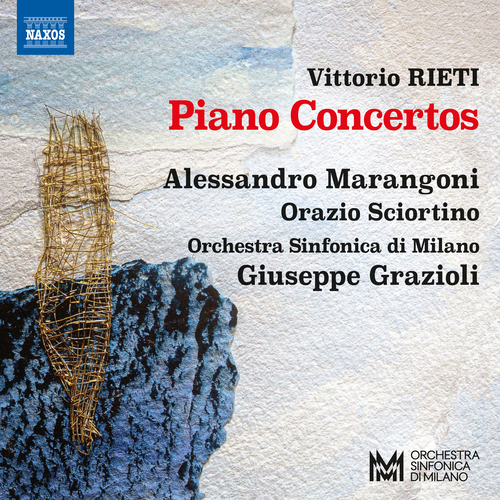
On Record – Alessandro Marangoni, Orazio Sciortino, Orchestra Sinfonica di Milano / Giuseppe Grazioli: Rieti: Piano Concertos (Naxos)

Rieti
Piano Concerto no.1 (1926)
Piano Concerto no.2 (1937)
Piano Concerto no.3 (1955)
Concerto for Two Pianos (1951)

Alessandro Marangoni, Orazio Sciortino (pianos), Orchestra Sinfonica di Milano / Giuseppe Grazioli

Naxos 8.564505 [80’27”]
Producer Stefano Barzan Engineer Cinzia Guareschi

Dates: 21-22 August 2022, 17-20 August 2023 (Piano Concerto no.3, Concerto for Two Pianos) at Auditorium di Milano

Reviewed by Richard Whitehouse

What’s the story?

Naxos continues its enterprising 20th Century Italian Classics with the concertante works for piano by Vittorio Rieti (1898-1994), the Egyptian-born Italian composer whose years in Paris then New York and Chicago afforded contact with a range of illustrious musicians and artists.

What’s the music like?

Dedicated to Poulenc and likely inspired by the success of Prokofiev’s Third Concerto earlier that decade, Rieti’s First Piano Concerto brings a deft touch to its ostensible neo-Classicism – whether in the martially-inflected playfulness of its initial Allegro, laconic but also beguiling ambivalence of its central Andantino, or the theatrical high-jinx of a final Allegro whose nod towards jazz rhythm marks this out as a piece decidedly yet always unaffectedly of its time. Seemingly forgotten following its premiere (by the composer?), its revival is well deserved.

Just over a decade on, the Second Piano Concerto emerged from material originally intended for a harpsichord concerto. On a similar scale to its predecessor, the opening Allegro has an impetus that denotes the uncertainty spreading throughout Europe at this time, and which is intensified by the central Adagio with its plangent discourse between soloist and orchestra; a quality the final Allegro (which follows with barely a pause) does not so much overcome as dismiss through an energetic repartee which brings about the nominally affirmative ending.

By the time of his Third Piano Concerto, Rieti was well established in the United States such that the present work is audibly in the lineage of American works for this medium of the post -war era. Any undue portentousness in the introductory Largo is dismissed with the vivacious Allegro that follows, then the central Andantino confirms that, while Rieti’s idiom might not have altered substantially over his career, it gained in subtlety and depth. Any more ominous expression is avoided in the final Allegro as it wends a capricious course to its decisive close.

Written in the wake of his relocation to the USA, the Two-Piano Concerto helped to establish Rieti’s reputation in a very different cultural climate. There is little moderate about either the tempo or character of the impetuous opening Allegro, then the central Allegretto comprises a set of variations’ which takes its unassuming theme through a diverse range of moods without losing focus on route to the pensive close. The final Allegro turns away from any encroaching inwardness with its energetic fugal interplay such as makes for an ending of pointed defiance.

Does it all work?

It does, provided one accepts Rieti as a product of his age rather than trailblazer or innovator. Stravinsky, Prokofiev and even Jean Françaix are prominent in the stylistic mix, with a more tensile aspect derived from Copland in the works of his American years. Not that this should offset enjoyment of music that feels never less than communicative and often engagingly so, particularly as regards the latter two pieces. Both of these were recorded way back in the LP era, but to have all four works rendered in such sympathetic readings is hardly to be gainsaid.

Is it recommended?

It is, not least when Alessandro Marangoni (alongside Orazio Sciortino) is so attuned to this music, while Giuseppe Grazioli obtains a committed response from the Milan orchestra. The succinct booklet notes are highly informative and further enhance the appeal of this release.

Listen & Buy

For purchase options, you can visit the Naxos website. For information on the performers, click on the names to read more about Alessandro Marangoni, Orazio Sciortino, Giuseppe Grazioli and the Orchestra Sinfonica Milano. An interview between Vittorio Rieti and Bruce Duffie can be read here

Published post no.2,492 – Wednesday 2 April 2025