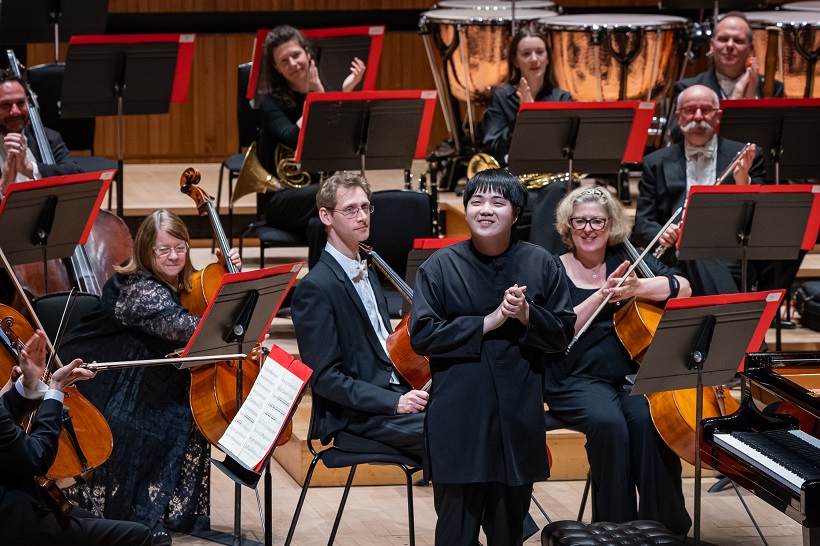
In concert – Philharmonia Chamber Players – Beethoven: Septet

Philharmonia Chamber Players [Maura Marinucci (clarinet), Zsolt-Tihamér Visontay (violin), Scott Dickinson (viola), Alexander Rolton (cello), Owen Nicolaou (double bass), Sarah Pennington (horn), Marceau Lefèvre (bassoon)

Beethoven Septet in E flat major Op.20 (1802)

Royal Festival Hall, London
Thursday 20 March 2025 6pm

Reviewed by Ben Hogwood Picture (c) Marc Gascoigne

Beethoven’s six-movement Septet is, to all intents and purposes, a Serenade for seven instruments. As such it was perfectly timed in this early evening slot, the ideal piece with which to entertain a relaxed and healthily-sized crowd.

Clarinettist Maura Marinucci introduced the work, and her love of the piece was clearly shared by her Philharmonia Orchestra friends as they went about a performance that was by turns vigorous and lyrical.

Beethoven’s scoring was highly original in 1802, and it is easy to see why the piece proved so popular, with its abundance of good tunes and colourful textures. These were evident right from the opening, the bassoon and double bass giving a lovely heft to the lower end of the sound. They supported the winsome tunes, divided largely between Marinucci’s clarinet and the violin of Zsolt-Tihamér Visontay. Marinucci especially enjoyed the soft-hearted second movement, while Visontay had an increasingly virtuosic role to play, sometimes pushing ahead of the tempo in his eagerness but relishing Beethoven’s technical challenges.

The Minuet, with its impudent theme thumbing a nose at the audience, was nicely done, while the theme and variations forming the fourth movement were especially enjoyable, notably the first variation, assigned to the upper string trio, and the mischievous final variation and coda.

Above all this performance was a great deal of fun, the players enjoying sharing the tuneful material with their audience, an approach capped by a quickfire finale and dazzling cadenza from Visontay. Just as affecting, mind, was the hushed chorale from the winds preceding this moment.

Ultimately the music matched the weather, bringing the vitality of early spring to the Royal Festival Hall stage.

For details on the their 2024-25 season, head to the Philharmonia Orchestra website

Published post no.2,480 – Friday 21 March 2025

In concert – Alisa Weilerstein, CBSO / Joshua Weilerstein: Dvořák, Rachmaninoff & Still

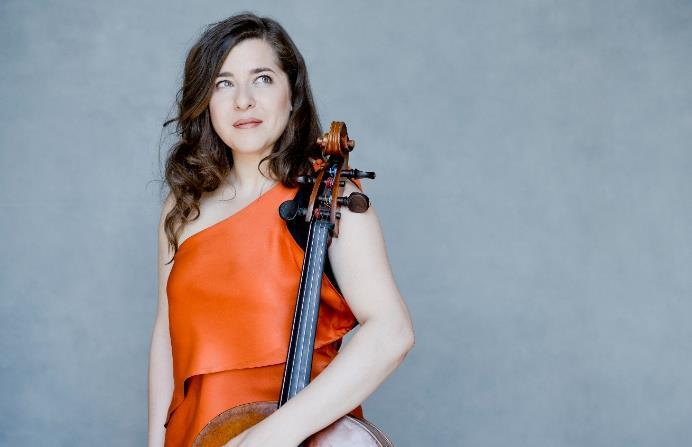
Alisa Weilerstein (cello, below), City of Birmingham Symphony Orchestra / Joshua Weilerstein (above)

Still Poem for Orchestra (1944)
Dvořák Cello Concerto in B minor, B191 (1894)
Rachmaninoff Symphonic Dances, Op. 45 (1940)

Symphony Hall, Birmingham
Wednesday 12 March 2025 (2:15pm)

Reviewed by Richard Whitehouse Picture of Joshua Weilerstein (c) Beki Smith

Joshua Weilerstein is always a welcome returning artist to the City of Birmingham Symphony Orchestra, invariably with artful programmes such as this afternoon’s interplay of American music with that by European composers finding themselves in temporary or permanent exile.

The music of William Grant Still has made a tentative re-emergence over recent years, Poem for Orchestra being typical of that from his maturity in its galvanizing a late-Romantic idiom with an emotional range of almost cinematic immediacy. Weilerstein steered a secure course through a piece whose darkness-to-light trajectory mirrors that of an accompanying poem by the composer’s wife Verna Avery, in which the foreseeable end of world war might yet bring a new unity and compassion as is reflected through the enfolding euphony of its final pages.

Joshua and his sister Alisa (above) have both appeared often with the CBSO, though Dvořák’s Cello Concerto seems to have been their first Symphony Hall collaboration. Hopefully not the last, their rapport manifest as soon as the opening Allegro’s orchestral tutti has run its purposeful course. Any marginal falling-off of momentum over the latter stages of the development was more than offset by the soloist’s thrilling ascent into the reprise of the easeful second theme, with the coda’s treacherous passagework assuredly negotiated prior to an affirmative ending.

The ensuing Adagio is the work’s emotional heard in all respects, but these siblings rightly refrained from milking the pathos of its ruminative main theme at all times, so throwing the drama of the central episodes then especially the confiding intimacy at its close into greater relief. Lunched directly, the Finale exuded an impetus as sustained this movement through to its extended coda which, more than usually, seemed to warrant a raptly inward outcome – though there was nothing contrived about the heady arrival of those exhilarating final bars.

Rachmaninoff’s Symphonic Dances is hardly a stranger to concert programmes these days, the CBSO having given several memorable accounts in recent seasons. That by Weilerstein was certainly among them, above all with an opening dance whose trenchant outer sections elided perfectly into then out of the central span characterized by Kyle Horch’s soulful alto saxophone. Nor did the Tempo di valse disappoint in its mingled stealth and malevolence, even if the closing pages perhaps dispersed their ominous aura just a little too temperately.

Much the most difficult movement to hold together, the final dance left a potent impression. Its outer sections never rushed and superbly articulated, Weilerstein made the most of that spellbinding transition into a central section where (uniquely with this composer) harmony or texture predominate over melody in defining this music’s expressive persona. From here he ratcheted up tension heading to a seismic confrontation of competing plainchants, then a denouement almost choreographed in its stillness as that final tam-tam echoed into silence.

Directing without a score, this is definitely a work with which Weilerstein feels an especial identity, and the CBSO was unstinting in its collective response. One can only look forward to further concerts between this orchestra and conductor, and hopefully in the coming season.

For details on the 2024-25 season A Season of Joy, head to the City of Birmingham Symphony Orchestra website. Click on the names to read more about conductor Joshua Weilerstein, cellist Alisa Weilerstein and composer William Grant Still

Published post no.2,472 – Thursday 13 March 2025

In concert – Westminster Philharmonic Orchestra / Jonathan Butcher: Bliss: A Colour Symphony

Westminster Philharmonic Orchestra / Jonathan Butcher (below)

Elgar In the South (Alassio) Op.50 (1903-4)
Bernstein On the Waterfront – Suite (1954-5)
Bliss A Colour Symphony (1921-2, rev. 1932)

St John’s Church, Waterloo, London
Saturday 1 March 2025

Reviewed by Richard Whitehouse

The Westminster Philharmonic Orchestra has given any number of well programmed concerts over the 53 years of its existence and tonight’s was no exception, featuring as it did a welcome revival of A Colour Symphony with which Arthur Bliss nonplussed first-night listeners 102 years ago.

Much has been written about the relationship between the colours as referenced in each of the movement headings with the music in question. In fact, the heraldic source from which these are derived was the means to focussing what could otherwise have remained the ‘Symphony in B’ of its working-title. The Purple of its opening movement evokes a processional whose emergence then retreat sets out the salient ideas in its wake, while that of Red is a scherzo with its two trios drawn into a sonata form whose unwavering impetus makes contrast with Blue more potent. Nor is this latter an archetypal slow movement – its expressive eddying an anticipation of that inexorable momentum with which Green traverses its double fugue, towards an apotheosis that sets the seal on the overall design with unmistakable conviction.

A Colour Symphony is not an easy work to make cohere – in which respect, this performance succeeded admirably. Jonathan Butcher ensured that Purple fulfilled its preludial function with sufficient gravitas to launch Red with an energy as amply underpinned its productive thematic elaboration; the work effectively becoming a tale of two halves, with the latter an extended and varied take on the ideas already established. The nervous energy that informs Blue was admirably conveyed, with the WPO giving of its collective best, while Butcher (rightly) did not rush the unfolding of Green – its respectively methodical then impetuous fugal subjects persuasively fused into a coda whose affirmation is far from that of a ‘‘mere paragraphist’’, as Elgar lamented, but of one able to refashion symphonic principals at will.

In the first half, Leonard Bernstein demonstrated a symphonic cohesion far greater than that of his actual symphonies in the suite from his score to Elia Kazan’s film On the Waterfront. For all its violent energy (and lessons well learned from Copland’s ballet Billy the Kid), this is music defined by its wind solos and it was to the credit of horn player Adrian Wheeler, oboist Tony Freer or alto saxophonist Bernie Hunt they were never less than plangently emotional. Whether or not Bernstein’s most ambitious orchestral work, this is by some way his finest.

Music by Elgar had opened the concert. His In the South might be as much a tone poem as a concert overture, but its effective overall design – anticipating those first movements of the symphonies to come – is its own justification. While he eschewed something of this music’s often scenic opulence, Butcher certainly had the measure of its formal ingenuity – with only the final peroration failing to deliver that necessary emotional frisson. Earlier on, Jonathan Welch’s viola playing brought pathos as well as tenderness to its exquisite ‘canto populare’.

Overall, a concert such as matched in execution what it had in ambition and which should equally be the case with the WPO’s next concert, where highly contrasted works by Barber and Tchaikovsky are to be followed by the mighty edifice of Bruckner’s Ninth Symphony.

For more information on the orchestra’s 2024-25 season, head to the Westminster Philharmonic Orchestra website Click on the names to read more about conductor Jonathan Butcher, and about Sir Arthur Bliss himself. You can also find out more about The Bliss Trust

Published post no.2,464 – Wednesday 5 March 2025

In concert – BBC Philharmonic Orchestra / Michael Seal: Discovering Bliss

BBC Philharmonic Orchestra / Michael Seal (above)

Sir Arthur Bliss
Miracle in the Gorbals (1944) – Overture
Things to Come (1934) – March
Metamorphic Variations (1972)

Royal Concert Hall, Nottingham
Wednesday 26 February 2025

Reviewed by Richard Whitehouse

2025 promises no mean retrospective of Arthur Bliss’s music in this 50th anniversary year of his death but no more significant revival than that of Metamorphic Variations, the composer’s late masterpiece that was heard live this evening for the first time in more than three decades.

Completed in December 1972 and premiered at Croydon’s Fairfield Halls the following April, Metamorphic Variations was the last while also the longest of Bliss’s purely orchestral works. Shorter than might have been, even so, as two of its sections were omitted at that first hearing (Leopold Stokowski having requested more rehearsal time for Tchaikovsky’s Pathétique after the interval) and given as an appendix in the published score; being excluded at later hearings as on the two commercial recordings. Tonight brought their reinstatement almost 52 years on.

First performed as ‘Variations for Orchestra’, this work only acquired its definitive title after considerable soul-searching on the composer’s part, though Metamorphic Variations is more accurate in terms of those ideas outlined in the initial Elements: an oboe cantilena, a phrase for horns then strings, and a cluster on woodwind – thereby setting up melodic, rhythmic and harmonic possibilities to be explored intensively over the ensuing 15 sections. The first five comprise a lively Ballet, a brusque Assertion and atmospheric Contrasts whose absence hitherto has been to the detriment of overall balance. Less crucial formally, Children’s March is of considerable fascination for its deft pivoting between innocence and experience, while Speculation marks a crucial expressive juncture through its renewed sense of anticipation.

Such anticipation is fulfilled by the starkness of Interjections then incisiveness of Scherzo I, before Contemplation yields further repose. Next come the two most elaborate sections – an increasingly energetic Polonaise being followed by Funeral Processions which builds to a wrenching, even anguished culmination. A lighter sequence moves from the dextrous Cool Interlude, via the angular Scherzo II, to the ingratiating Duet – an intermezzo prior to the final two sections. A brief yet potent Dedication makes explicit the work’s inscription to the artist George Dannatt and his wide Ann, then Affirmation draws each of the main elements into a sustained peroration thrown into relief through its ultimate subsiding into a return of the oboe cantilena from the opening and which, in its turn, brings a withdrawal into silence.

Scored with real virtuosity for sizable forces, Metamorphic Variations proves no less testing for the players as it is conceptually for the listener, though the BBC Philharmonic responded with assurance to Michael Seal who (given the unavailability of John Wilson) had not merely learnt the score in around 10 days but ensured an interpretation that was distinctively his own. Hopefully a recording from this source (how about it, Chandos?) will follow before too long: meanwhile, however, this performance is being broadcast by BBC Radio 3 in the near future.

Having provided the musical illustrations in Stephen Johnson’s introductory talk, Seal and the BBCPO had framed the first half with the fateful ‘Overture’ to Bliss’s wartime ballet Miracle in the Gorbals then the rousing ‘March’ from his inter-war score to the film Things to Come.

For more information on the orchestra’s 2024-25 season, head to the BBC Philharmonic Orchestra website Click on the names to read more about conductor Michael Seal, and about Sir Arthur Bliss himself. You can also find out more about The Bliss Trust

Published post no.2,463 – Tuesday 4 March 2025

In concert – Jong-Gyung Park, Tonbridge Philharmonic Orchestra / Oliver Cope: Tchaikovsky, Rachmaninov & Brahms

Jong-Gyung Park (piano, below), Tonbridge Philharmonic Orchestra / Oliver Cope (above)

Tchaikovsky Romeo & Juliet Fantasy Overture (1869, rev. 1880)
Rachmaninov Rhapsody on a Theme of Paganini Op.43 (1934)
Brahms Symphony no.4 in E minor Op.98 (1884-5)

Chapel of St Augustine, Tonbridge School, Tonbridge
Saturday 22 February 2025

Reviewed by Ben Hogwood Photos of Oliver Cope, Chapel of St Augustine (c) Ben Hogwood

This was the first concert for the Tonbridge Philharmonic Orchestra under their interim musical director Oliver Cope, in the position while current incumbent Naomi Butcher is on maternity leave. On this evidence he has quickly built a rapport with the orchestra, already in fine fettle under Butcher’s recent direction. On this occasion they responded with a memorable concert of Romantic favourites, given in the spectacular setting of the Chapel of St Augustine in Tonbridge School.

It is easy to take Tchaikovsky’s inspiration for granted, for his storytelling and melodic gifts are so abundant that his best music flows irrepressibly. Such is the case with the Romeo & Juliet Fantasy Overture, in spite of the two revisions required for its composer to be fully satisfied. Cope was an athletic presence on the podium as the orchestra responded with a dramatic account of the lovers’ story, the sword duel between Mercutio and Tybalt particularly vivid, while the soaring love theme tugged at the heartstrings. With fire and brimstone, and crisp ensemble playing, this performance lit the touch paper at the start of the evening.

If anything, Rachmaninov’s Rhapsody on a Theme of Paganini was even better. This was because Jong-Gyung Park (above), the popular rehearsal pianist with the Tonbridge Philharmonic Choir, delivered a sparkling account of the theme and its 24 variations. Cope threw down the gauntlet with a brisk tempo, yet Park rose to the challenge by taking control of even the quickest exchanges. There was an instinctive flow through the first six variations, the mood acquiring an appropriate chill as the Dies Irae was introduced in the seventh. From here the music travelled down darker roads, though still found time for a baleful sixteenth variation, before a shiver could be felt in the air as the seventeenth took hold. The famous eighteenth variation was lovingly delivered, before a flight to the finish that saw Park dazzle with her virtuosity, never losing sight of the whole picture.

To complete a challenging program, Brahms’s Symphony no.4 – and after initial hesitation, a convincing interpretation revealing this work’s unique bridges to the past – notably Bach – and the future, with Schoenberg on the horizon. There was an attractive open-air quality to much of the orchestra’s music making, with the second movement becoming a spring-like counterpart to the obdurate first. The scherzo built on this, dancing with a smile on its face. Flautist Rebecca Rees led a fine woodwind section in the second movement, where the horns, led by Paul Kajzar, were suitably fulsome. They were to prove critical to the success of the finale as the passacaglia developed, capping a performance with serious outlines but shot through with bursts of optimism suggesting Brahms still had a great deal to be thankful for later on in life. It put the seal on an extremely impressive concert.

For details on their 2024-25 season, head to the Tonbridge Philharmonic Society website. Click on the names to read more about pianist Jong-Gyung Park and conductor Oliver Cope

Published post no.2,456 – Tuesday 25 February 2025