Wigmore Mondays – Annelien Van Wauwe & Nino Gvetadze play Debussy, Poulenc & Brahms

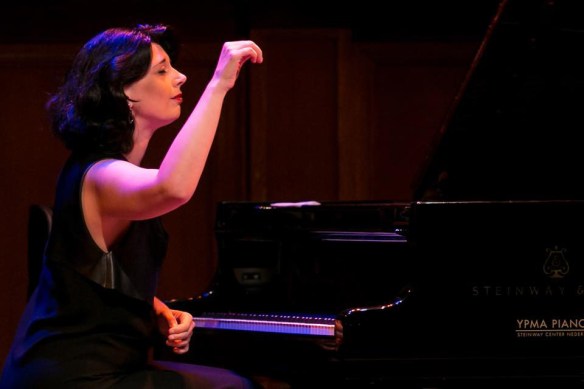
Annelien Van Wauwe (clarinet, above) and Nino Gvetadze (piano, below)

Debussy Première rapsodie (1909-10)

Poulenc Clarinet Sonata (1962)

Schumann Arabeske in C major, Op 18 (1838-9)

Brahms Clarinet Sonata in E flat, Op 120 No 2 (1894)

Wigmore Hall, London; Monday 20 March, 2017

Listen to the BBC broadcast here

Written by Ben Hogwood

The soft, languid tones of Annelien Van Wauwe’s clarinet were perfectly judged at the hushed start of Debussy’s Première rapsodie, the first piece in a nicely chosen set of music for clarinet and piano.

This piece is an elusive ten-minute train of thought, with two distinct ideas – the slow, sleepy opening paragraph (from 1:40 on the broadcast link) and another, spiky idea (around 3:42), begging for a jazz accompaniment. Gradually the two get closer together and the cumulative energy builds. Nino Gvetadze’s colourful piano accompaniment showed just how suitable the piece is for orchestra – which Debussy realised with a subsequent arrangement.

Poulenc’s Clarinet Sonata is one of his last published works, written in homage to fellow composer Arthur Honegger. Central to its success is the yearning theme of the central Romanza (16:36), where Van Wauwe’s tone and phrasing was beautifully observed. The first movement (beginning at 11:24) could have been a bit more mischievous, perhaps, but the brisk and largely upbeat finale (21:22) certainly hit the spot.

Following this was a chance for Gvetadze to take centre stage in Schumann’s lilting Arabeske (25:40), where wife Clara explicitly asked him to avoid making musical references to her. I’m not convinced he kept that bargain, because the music is very affectionate, and Gvetadze portrayed that too.

We then heard Brahms’ last published chamber work, the last part of an Indian summer instigated by the clarinettist Richard Mühlfeld, whose quality of tone directly inspired four pieces from the composer. This included a pair of sonatas published in 1894 as Brahms’s Op.120. These are lovely autumnal works, and both performers shaded the E flat work, the more positive of the two, with appropriate care. More authority could perhaps have been given to the second movement (marked Allegro appassionato, from 43:26 on the broadcast) but the outer movements had plenty to admire. The first movement (from 35:09) was largely contented, while the last, a theme and variations (48:50), was more changeable in mood and brilliantly played here, Brahms’ inspiration as keen as ever.

A final thought – what will Brexit mean for the non-English contingent the BBC choose for their excellent New Generations scheme? One of many questions classical music and the arts will face in the coming months and years.

Further listening

Brahms’s last works for clarinet are collected in the playlist below. They are autumnal in nature but have some wonderful lyrical writing for the instrument.

Wigmore Mondays – Nelson Goerner plays Debussy & Chopin

nelson-goerner

Nelson Goerner (piano) © Jean-Baptiste Millot

Chopin Polonaise in F# minor Op.44 (1841) (11 minutes)

2 Nocturnes Op.62 (1846) (12 minutes)

Polonaise in A flat major Op.53 (1842-3) (7 minutes)

Listen to the BBC Radio 3 broadcast here, until 23 November

Arcana’s commentary

For both Chopin and Debussy the piano became arguably their primary means of musical expression. Both used relatively traditional forms – studies, preludes for instance – but stretched them from conventional structures to suit their own means.

Here we heard seven of the twelve Préludes Debussy wrote as a book, the first of two, published in 1909 and 1910. These are character pieces where he was painting a picture or an impression, without always specifying his exact stimulus. Some were more obvious; others were left to the player for interpretation.

Nelson Goerner made each of these his own. The languid, humid atmosphere of Danseuses de Delphes (1:32 on the broadcast), with control and shading, set the scene and led to an enjoyable and mysterious La serenade interrompue (4:35). This was playful but wary too – dancing but not wanting to fully let itself go.

The ‘underwater rolling of pebbles’ from Verlaine’s poem could be sensed in Le vent dans la plaine (7:00), while the simplicity of La fille aux cheveux de lin (9:09) was rather moving. La danse de Puck (11:24) could have found the Midsummer Night’s Dream character in a more playful mood perhaps, while the thick atmospherics of Les sons et les parfums tournent dans l’air du soir (14:02) hung heavy on the air. Finally Les collines d’Anacapri (17:58) danced and shimmered, controlled but letting itself run wild too. The last four high notes were hammered out convincingly (20:37)

Goerner’s Chopin was rather different. The first of the Polonaises (22:14) was Chopin’s most ambitious work to use the dance form, using a Polonaise in its outer sections but a Mazurka in the middle (from 26:56). This central section had more charm but the outer sections were stern, almost obsessive – and brilliantly played. Their return after the Mazurka (30:05) was like two bolts of lightning, the mood almost that of a Tango from Goerner’s native Argentina.

The Nocturnes (33:40) and (40:12) could have done with a bit more air and relaxation; Goerner seemed rather anxious to push on with them. That said the trills of the first (from 37:55) were expertly managed, while the second was really nicely pointed.

The Polonaise (45:53) was heroic indeed, strutting its stuff but frequently dazzling, especially in Goerner’s white hot ostinato (49:02)

There was an encore to finish, an Impromptu of poise and grace (53:48), more of a Nocturne than the other two arguably.

Further listening

There is something rather special about Polish piano music – and to continue from the Chopin the Spotify playlist below offers up some lesser-heard treats in the form of piano concertos by Paderewski and Moszkowski, prefaced by a sprinkling of exotic Mazurkas from Szymanowski.

by Ben Hogwood

Wigmore Mondays – Doric String Quartet play Debussy and Bartók

doric-string-quartet

Doric String Quartet [Alex Redington & Jonathan Stone (violins), Hélène Clément (viola), John Myerscough (cello)]

Bartók String Quartet no.4 (1928) (26 minutes)

Debussy String Quartet in G minor (1893) (27 minutes)

Wigmore Hall, London; Monday 26 September

Listen to the BBC Radio 3 broadcast here, until 26 October

Arcana’s commentary

An intriguing clash of two of the twentieth century’s biggest composers, glimpsed at very different stages in their development. It was perhaps a surprise that the Doric Quartet chose to begin with the Bartók, with its more abrasive tones, rhythms and harmonic language, but it received an extremely fine performance here.

Bartók wrote the piece at a point where his use of ‘cyclical’ and ‘arch’ forms was prevalent in his work. The String Quartet no.4 works as an arch, its first and fifth movements big-boned compositions, while the second and fourth are flighty and elusive. The third is a typical example of the composer’s night music, supremely evocative and more than a little wary of the shadows.

If not perhaps as ‘rustic’ as some of the Hungarian quartets in performance, it was played with precision accuracy, the rhythms making themselves clear with plenty of cut and thrust. The rocking motion of the second idea in the first movement (from 3:50 on the broadcast) offered a nice contrast.

It was perhaps in the middle movements however where the Doric were strongest. The second movement, played with mutes (from 8:11) offered shadowy contours and elusive, silvery sounds – not forgetting the odd outburst – while the third, a slow movement (from 12:02), has lovely shady contours at the end (from 17:28). Best of all was the fourth movement (17:58), played pizzicato (plucked) and with some especially good snappy effects.

Bartók’s moments of simplicity were surprisingly moving, while the gritty determination on show elsewhere was very convincing – nowhere more so than the start of the last movement, a big ensemble section of terrific drive (21:08).

Debussy’s only String Quartet comes towards the start of his composing career, just as he was shaking off the overbearing influence of Wagner. It signals a conscious move towards the more ‘impressionist’ language he started using with orchestral works such as Prélude à l’apres-midi d’un faune, but remains packed with extremely catchy tunes, enjoyable humour and rich textures.

The Doric performance was a very good one but did on occasion lapse towards a bit of fussiness with tempo variations. It certainly started rather smoothly (30:31), blunting the edges of Debussy’s humour a bit, but lovingly played. The less witty approach could also be felt in the second movement (from 37:10) – which, incidentally, is receiving a lot of exposure at the moment thanks to the Apple advertisement below:

The slow movement (from 41:21) was a beauty, notable for some lovely, elegiac sounds from the viola of Hélène Clément (at 44:22) and a beautifully judged climax. The finale felt a bit episodic, and it was difficult to always hear Alex Redington’s line at the very top of the texture where I was sat at the end of the hall. That said, its exuberance (from 49:47) could hardly be faulted.

Further listening

If you like the music in this concert, Ravel’s only String Quartet is a logical piece to hear next. It bears many similarities to the Debussy but is if anything even more exquisitely formed. For something a bit fuller for strings from Bartók, the Music for strings, percussion and celesta is a terrific orchestral piece, full of atmosphere and drama – so much so that Stanley Kubrick turned to it as part of his horror film The Shining. The playlist can be found here on Spotify, together with the music from this concert:

Wigmore Mondays – Ailish Tynan & Malcolm Martineau in French song

ailish-tynan

Ailish Tynan (soprano, above), Malcolm Martineau (piano)

Wigmore Hall, London, 9 May 2016

written by Ben Hogwood

Audio (open in a new window)

http://www.bbc.co.uk/programmes/b079m13q

Available until 8 June

What’s the music?

Fauré Cinq mélodies de Venise (1891) (12 minutes)

Debussy Fêtes galantes Set 1 (1892) (7 minutes)

Hahn Fêtes galantes (1892) (2 minutes)

Ravel Sur l’herbe (1907) (2 minutes)

Fauré Clair de lune (1887) (3 minutes)

Hahn À Chloris (1916) (3 minutes)

Poulenc Fiançailles pour rire (1939) (13 minutes)

Spotify

Ailish Tynan has recorded some of the Fauré songs in this recital, and in case the broadcast cannot be heard they are on the playlist below – together with other versions of the songs by Debussy, Poulenc and Hahn:

About the music

The contrast between these Verlaine settings is fascinating. Fauré’s Venetian set is heady music that flows, melodically rich but harmonically even more so, its flowing nature reflecting his ‘barcarolle’ piano writing and the watery setting.

Debussy’s, written just a year later, could almost be from another planet, with deep blue colours invoked by the singer and piano as they explored the mysterious worlds of the poet.

The central selection of songs shows off the abundance of French song writing talent at the turn of the century, while Poulenc’s Fiançailles pour rire, a brief but intensely concentrated cycle and the composer’s most popular for the female voice, explores extremes of emotion. It is a classic example of Poulenc’s bittersweet but utterly compelling ways of word setting.

Performance verdict
malcolm-martineau

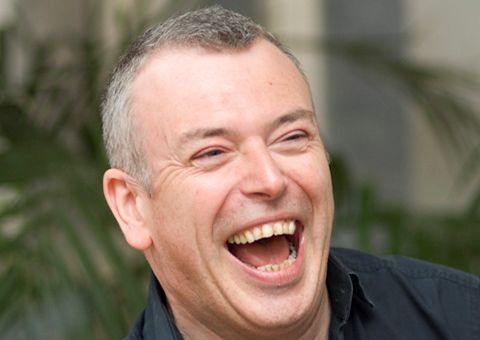
Malcolm Martineau (piano)

French song lends itself well to an hour-long recital program, and in Ailish Tynan and Malcolm Martineau’s Wigmore Hall lunchtime concert we explored the extraordinary poetry of Paul Verlaine through the musical eyes of Fauré, Debussy and Hahn.

You would not have known Tynan was standing on for the indisposed Angelika Kirschlagers, so surefooted was her partnership with Martineau, and with her compelling performances, aided by expressive gestures, she took us on an instinctive and fascinating tour.

Fauré’s Venetian songs were glorious, and Tynan’s ability to vary her vibrato was invaluable, while Martineau had the essential Fauré ‘flow’ at the piano.

Debussy’s Fêtes galantes had the requisite mystery, while Hahn’s celebrated A Chloris sparkled in this partnership, but it was in the Poulenc cycle Fiançailles pour rire where Tynan really shone. From the breathless Il vole to the sorrowful Dans l’herbe, where the darkness at the very edge of Poulenc’s music was drawn in, this was a compelling performance. A beautiful encore, Fauré’s Nell, was followed by a characteristically funny introduction to Dave Frishberg’s Another Song About Paris, where both performers’ humour sent the Wigmore Hall audience away smiling.

What should I listen out for?

Fauré

1:38 Mandoline A jaunty song describing the ‘gallant serenaders…beneath singing boughs’. The grey moon at the end is suitably evoked by the flowing piano.

3:32 En sourdine The hazy twilight is immediately obvious in this rather sensual song, with a full timbre from the soprano and an accompaniment typical of Fauré’s broad, flowing style.

6:35 Green A greater urgency to this song, a heady statement of devotion with a spring-like air.

8:25 A Clymène The piano introduction evokes the ‘mystical barcarolles’ of the opening line of this song, an exotic and heavily perfumed statement with some awkward gaps between notes for the singer!

11:05 C’est l’extase This song (translating as ‘It is rapture’) certainly has a rarefied air, the soprano in a higher register as she swoons of the ‘delicate, fresh murmuring’ and the ‘subdued lament’ of two lovers.

Debussy

15:10 En sourdine A very different setting of this poem from Debussy, with a distant, mysterious picture immediately evoked by the piano. The singer is subdued and the tempo is much more deliberate than the Fauré setting.

17:58 Fantoches The swirl of the piano transports us to a completely different world, with quick glances and urgent musical statements, the soprano sweeping up to a top ‘A’ and back towards the end.

19:20 Clair de lune Debussy was to write a more famous Clair de lune for piano alone, but this one is just as evocative of the moonlight, somehow evoking the dark blue colours in its lustrous beauty.

23:29 Hahn Fêtes galantes The clanging octaves of the piano introduce a song that has a similar stop-start feel to the first Fauré song in this concert. The end is brilliantly done.

25:30 Ravel Sur l’herbe This song (which translates as On the lawn) is a rather bizarre Verlaine poem, a conversation between an abbot and some shepherdesses. Ravel captures all the back and forth between the speakers over an elusive piano line.

27:43 Fauré Clair de lune Fauré’s setting of moonlight has more defined lines than Debussy’s, and a longer piano introduction to set the scene, but has an understated beauty, supported again by a flowing accompaniment.

30:47 Hahn À Chloris Hahn’s celebrated love song is clearly influenced by Bach in its stately introduction, after which the soprano sings of pure, unconditional happiness in love. Very much a case of ‘less is more’!

Poulenc

35:09 La Dame d’André A song of uncertainty, describing a man about to marry who worries about his wife and if he’ll love her in the future. Poulenc’s response is appropriately worrisome – but the softer chord at the end suggests he’ll be alright!

36:35 Dans l’herbe A sorrowful and tortured song, particularly in the second verse – though there is a lightness of texture also. This brings in the darkness Poulenc often has at the very edge of his music.

38:38 Il vole Some breathless observations from the soprano in this song, with happiness elusive but not too far away. ‘I want my stealer to steal me’, she concludes.

40:38 Mon cadavre est doux comme un gant Once again a shadow falls over the music, and this strange song of a corpse casts its spell. With long, high notes it is a particularly tricky one for the soprano. Her last note (43:02) is telling, as it resolves the whole song.

43:26 Violon A strange air is around this song, because both soprano and piano operate at the highs and lows of their ranges. There is dark humour, too, as the singer tells of how ‘I love those long wailings’ of the violin. The harmonic language is exotic but restless too, until a clipped chord at the end.

45:27 Fleurs A simple air is around this song, which shows how Poulenc can make beautiful sounds from apparently very little. The text is repeated very quietly to a soft but rather sad close.

Encores

49:02 Fauré Nell (1878) The flowing piano and floated soprano line indicate this is a song of adoration. It is the sort of song that flings the doors wide open, though Fauré’s rapture is always just a little reserved.

51:32 Dave Frishberg Another song about Paris (4 minutes) A classic cabaret song, brilliantly written with just the right amount of humour in text and performance!

Further listening

Ailish Tynan’s disc of Fauré comes highly recommended, and can be heard on Spotify here:

If however you’d like to hear her in the music of her homeland, Ireland, An Irish Album is self-recommending:

In concert – Dutilleux centenary concert at the Wigmore Hall

frank-braleyDutilleux 100th Anniversary Concert

Wigmore Hall, London, 24 January 2016

Dutilleux: Trois strophes sue le nom de Sacher; Trois preludes

Ravel: Piano Trio in A minor

Debussy: Violin Sonata in G minor

Dutilleux: Ainsi la nuit

Lisa Batiashvili, Valeriy Sokolov (violins), Gérard Caussé (viola), Gautier Capuçon (cello), Frank Braley (piano, above)

Written by Richard Whitehouse

Having marked his 95th birthday with a concert centred on his music, it was good to see the Wigmore Hall commemorating Henri Dutilleux’s centenary – and, even though the composer has been gone almost three years, the influence of his modest output seems greater than ever.

Interesting that the three works chosen were all conceived during the 1970s – a decade which saw some of Dutilleux’s most exploratory writing. Hence Trois strophes sur le nom de Sacher (1976/82), which grew from a 70th birthday tribute to the Swiss conductor and patron into a ‘sonatina’ of evident resource; one whose alternately combative and taciturn humour was not passed over by Gautier Capuçon in this focussed yet never too earnest account. Even longer in gestation, Trois préludes (1973/88) makes for a fluid distillation of pianistic practice and a culmination of Dutilleux’s involvement with the medium – but here the connection between pieces is more gestural than motivic; the music’s gliding between formal and technical puns obscured by the sheer allure of its pianism, as Frank Braley’s questing performance attested.

Ending the first half then opening the second were pieces by Ravel and Debussy, composer whose influences on Dutilleux were enduring if hardly straightforward. The expansiveness of Ravel’s Piano Trio (1914) betrays an emotional commitment only just held in check during the restive opening movement and quixotic scherzo – its rhythmic subtleties ably negotiated by Lisa Batiashvili, Capuçon and Braley, who pursued a seamless course across the searching passacaglia then drew the finale’s formal poise and expressive rhetoric into seamless accord.

Despite its proximity in time, Debussy’s Violin Sonata (1917) is far removed in its emphasis on a sardonic humour which, dominating the brusquely truncated opening Allegro, yields a measure of finesse in the central intermezzo such as Batiashvili and Braley conveyed in full. Not so much the sum of its preceding movements as the reconciling of its antagonisms, the finale achieves that far-reaching amalgam of lucidity and abandon which its ailing composer no doubt saw as inherently French, and which these performers captured in no small measure.

dutilleux-2Henri Dutilleux, who died aged 97 in 2013

The programme concluded with Ainsi la nuit (1973-6) – Dutilleux’s sole contribution to the genre of the string quartet, though one whose well-nigh seamless succession of movements and parenthetical interludes acknowledges Boulez as well as Carter through that imaginative freedom which is this composer’s alone. Whether or not Batiashvili, together with Valeriy Sokolov, Gérard Caussé and Braley, perform often as an ensemble, there was no mistaking the conviction and insight that lay behind this passionate yet always considered reading. The only proviso might be the several over-extended pauses (this being a single movement of 12 sections rather than one in six pairs of movements), though this did very little to undermine momentum over the heady accumulation towards that wickedly disintegrative final gesture.

A fitting tribute, then, to its featured composer. No place for the Piano Sonata, Figures de résonances or Les citations (to name his other main chamber or instrumental works), but if these were to feature in another Dutilleux-centred recital later this year, so much the better.

An appreciation of the music of Henri Dutilleux will follow soon on Arcana.