In concert – Pocket Ellington @ The Vortex

Alex Webb (piano, musical director), Tony Kofi (tenor saxophone), Alan Barnes (saxophones/clarinet), David Lalljee (trombone), Andy Davies (trumpet), Dave Green (double bass) and Winston Clifford (drums)

The Vortex, London, 14 December 2024

by John Earls. Photo credit (c) John Earls

One might think at first that the idea of a ‘Pocket Ellington’ – big band jazz played by a smaller ensemble – is something of a contradiction if not illogical. But then there’s the tunes and then there’s this particular group of musicians (under the musical direction of Alex Webb) and their love of the music.

Duke Ellington’s stature and influence as a pianist, composer and band leader is pretty much unsurpassed. Miles Davis is supposed to have said “At least one day out of the year all musicians should just put their instruments down, and give thanks to Duke Ellington”. So it was fascinating to see and hear this seven piece band interpret some of the best big band charts there are.

Three of the Ellington compositions played – Main Stem, What Am I Here For and Happy Go Lucky Local – feature on his Piano in the Background album which contains the following lines in Irving Townsend’s sleeve notes: “The piano used for this album has three more keys than regular pianos, allowing Duke to play ninety-one keys instead of eighty-eight. He wants you to know that he played them all madly”. I assume Alex Webb’s piano had the standard number of keys but I was reminded of this quote with some of his playing and the enthusiasm and respect for the music that was on display from the rest of the band.

Mood Indigo featured some raspy trumpet from Andy Davies and smoky tenor saxophone from Tony Kofi as well as Alan Barnes“more reeds than you can shake a stick at” according to Webb – playing saxophone and clarinet.

As well as compositions by Ellington there was also a nod to other artists influenced by him. Thelonious Monk’s Ruby, My Dear and Monk’s Dream were combined in a fantastic Ruby, My Dream medley and Charles MingusBoogie Stop Shuffle featured some terrific mute trombone by David Lalljee who also went full throttle on Gil EvansLas Vegas Tango. The rhythm section of Dave Green (double bass) and Winston Clifford (drums) were solid throughout.

It wasn’t just full-on swing either. Come Sunday (from Ellington’s Black, Brown and Beige suite) was smooth and gorgeous with the horns in lovely collective harmony and the ballad Day Dream enchanting.

Day Dream is a Billy Strayhorn composition and not surprisingly, given that Strayhorn was Ellington’s great songwriting collaborator and friend, there were a number of other Strayhorn tunes in the set. These included a moving Blood Count which was the last finished piece that Strayhorn wrote. It features on the terrific album of Strayhorn tunes by Ellington and his Orchestra …And His Mother Called Him Bill recorded in 1967 after Strayhorn’s death. On the album the saxophone is played by Johnny Hodges for whom Strayhorn often wrote – “We have our own Johnny Hodges” said Webb acknowledging Alan Barnes’ affecting rendition. (Apparently, Ellington never played the tune again after the recording session.)

The set finished with – what else? – the Ellington Orchestra’s signature tune Take the “A” Train (another Strayhorn composition). It was a great version of a great tune that has a great story (the title refers to the opening words with which Ellington gave Strayhorn directions to get his house by subway but there’s more to it than that). It was a fitting end to a wonderful night’s live music paying tribute to one of the greats.

John Earls is Director of Research at Unite the Union. He posts on Bluesky and tweets / updates his ‘X’ content at @john_earls

Published post no.2,395 – Monday 16 December 2024

Arcana at the Proms – Prom 35: BBC Scottish Symphony Orchestra / Ilan Volkov – Ellington, Braxton and Mary Lou Williams

Ellington orch. Gould Solitude (1934), Mood Indigo (1930), Sophisticated Lady (1932), Caravan (1936)
Mary Lou Williams Zodiac Suite (1944-6) [UK premiere]
Braxton Composition no.27 (+ nos. 46, 59, 63, 146, 147, 151 & Language Music) (1972-91) [Proms premiere]

Mikaela Bennett (soprano), Aaron Diehl (piano), James Fei (saxophone/conductor), Gregory Hutchinson (drum kit), Ingrid Laubrock (saxophones), Brandon Lee (trumpet), Chris Lewis (clarinet/saxophone), David Wong (double bass), Katherine Young (bassoon/conductor), BBC Scottish Symphony Orchestra / Ilan Volkov

Royal Albert Hall, London
Thursday 15 August 2024

reviewed by Richard Whitehouse Photos (c) Sisi Burn

Never a conductor to take the path of least resistance, Ilan Volkov centred his latest Prom with the BBC Scottish Symphony Orchestra (whose Creative Partner he remains) around jazz – not that there was anything orthodox about the repertoire or the follow-through in what was heard.

The four Duke Ellington numbers heard tonight became standards in the Depression era, their pioneering spirit stylishly offset in orchestrations by Morton Gould (the first three on 1957’s Blues in the Night and the fourth on 1956’s Jungle Drums). Solitude ranks among Ellington’s most affecting tunes, while his sultry Mood Indigo proved an inspired co-write with Barney Bigard. The present arrangement fully enhanced the teasing elegance of Sophisticated Lady, before the expressive impetus of the Juan Tizol co-write Caravan left its evocative imprint.

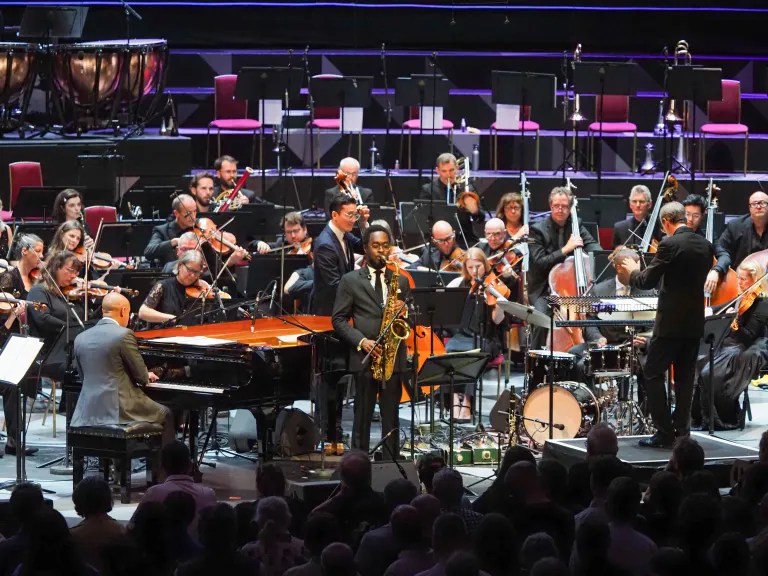
Pianist and arranger for artists from Ellington to Cecil Taylor, Mary Lou Williams’ music only posthumously came to the fore. She wrote nothing more ambitious than Zodiac Suite – a series of 12 tributes to musicians born under various star signs, as went through several incarnations at the end of the Second World War and remains a trailblazer for symphonic jazz. As realized here, each item left room for contributions by the assembled jazz or orchestral musicians: thus the incisiveness of Brandon Lee’s trumpet or mellifluousness of Chris Lewis’ clarinet and alto sax, besides stealthy interplay by the Aaron Diehn Trio (above) or a soulful violin solo by guest-leader Kate Suthers. The sequence concluded with Pisces and an agile vocal (lyrics not printed) by Mikaela Bennett – its manner (surprisingly?) redolent of mid-20th century American art-song.

From here to Anthony Braxton proved a fair conceptual leap, but a meaningful one within this context. One, moreover, for which Volkov has prepared painstakingly across almost a decade – working with several of Braxton’s longer-term collaborators (notably George Lewis), while performing several Braxton compositions duly rendered as the superimposed totality he openly encourages. What resulted was Composition No. 27 as a framework for this performance, into which elements from six later ‘Compositions’ were integrated – this whole entity underpinned by recourse to Language Music, collating 12 musical parameters in what is the codification of Braxton’s practice over six decades. The creative aspect arises at a point when the fullest extent of compositional systematization links with the furthest extent of improvisational spontaneity.

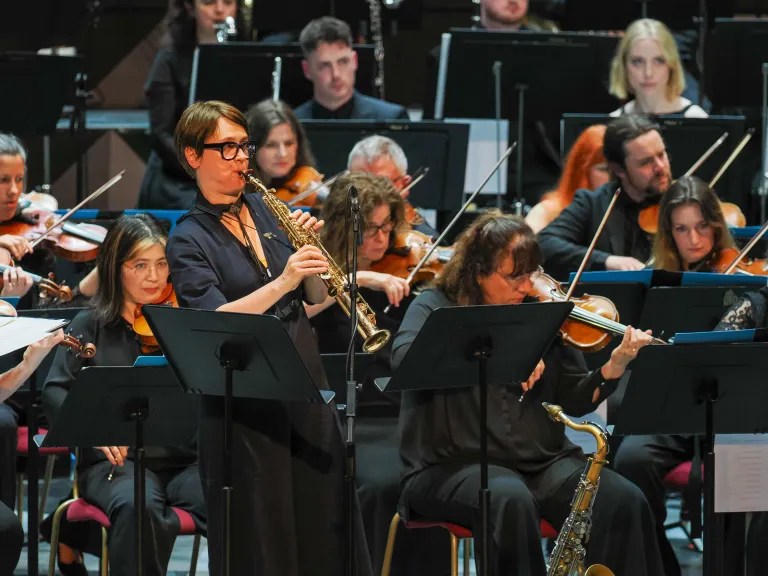
The interaction between jazz and orchestral musicians was intricate and unpredictable, so that saxophonist James Fel and bassoonist Katherine Young – but not the always inventive Ingrid Laubrock (above) – were often conductors next to Volkov in determining the overall trajectory. There were occasions when continuity felt tentative or uncertain, yet these were outweighed by the translucent allure in much of the ensemble playing as well as the resolve with which all those participating headed toward a culmination the more definite for its seeming inconclusiveness. Not that this performance commended itself to all those present, with several dozen exiting the auditorium as though insects under siege. Those who stayed were rewarded with music-making such as encouraged an active participation all too rare in present-day concertgoing.

For more on this year’s festival, visit the BBC Proms website. For further information, click on the artist names for more on Ilan Volkov and the BBC Scottish Symphony Orchestra, and on the composer names for information on Duke Ellington, Mary Lou Williams and Anthony Braxton.

Published post no.2,275 – Monday 16 August 2024

BBC Proms 2023 – NYO Jazz (USA) with Dee Dee Bridgewater

Prom 23 – NYO Jazz (USA) with Dee Dee Bridgewater

Dee Dee Bridgewater (vocals), NYO Jazz / Sean Jones (trumpet)

Duke Ellington trans. David Berger Braggin’ In Brass
Sean Jones The 29ers
Roy Hargrove arr. David Gibson Strasbourg/St. Denis
Duke Ellington arr. Slide Hampton Cottontail
Spencer Williams arr. John Clayton Basin Street Blues
Mongo Santamaría arr. Clayton Afro Blue
Newley / Bricusse Feeling Good
James Brown I Got You (I Feel Good)
Billie Holiday arr. Cecil Bridgewater Fine and Mellow
Leonard Lee arr. Frank Foster Let the Good Times Roll
Wycliffe Gordon We’re Still Here

Royal Albert Hall, London
Tuesday 1 August 2023, 10.15pm

by Richard Whitehouse photos by Chris Christodoulou / BBC

Jazz bands, battling or otherwise, have become something of a fixture for late-night Proms and this latest instance saw a debut at these concerts for NYO Jazz – together with a singer who has kept the role of jazz vocalist, long synonymous with big-bands, well and truly alive.

The latest incarnation of the jazz youth orchestras having emerged from Carnegie Hall over this past decade, NYO Jazz may have been relatively modest in numbers but lacked nothing in impact. That virtually all its members fell into the 18-25 category was duly belied by the sheer technical facility but also the versatility – whether individually or collectively – with which they ranged across the spectrum of styles as encompassed by the big-band medium, much of it suitably demonstrated by the 10 numbers that comprised this evening’s set-list.

The programme was launched in fine fashion with a sassy take on Duke Ellington’s Braggin’ in Brass, giving each of the orchestra sections its time in the spotlight. An energized presence as trumpeter and director, Sean Evans contributed a distinctive number in The 29ers, a tribute to jazzers born on the 29th of the month (not least Ellington); the prominence accorded brass and reeds complemented by limpid cameos for guitar and piano. Next was a smouldering take on Roy Hargrove’s Strasbourg / St Denis and notable for its intensive work-out on double bass.

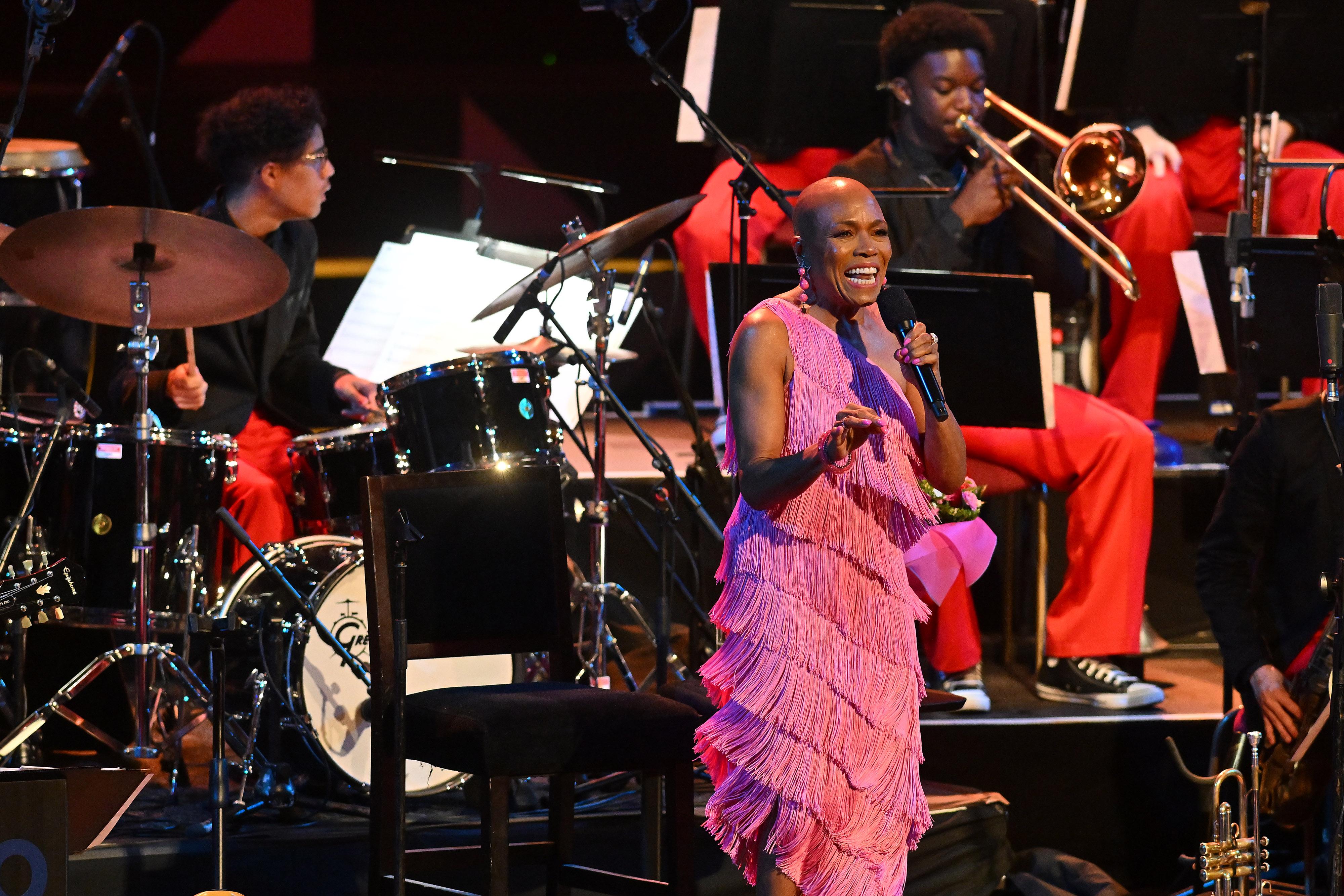
Dee Dee Bridgewater – singer, actor, magnetic stage-presence and one of a (surprisingly?) select handful of vocalists who have moved between the very different domains of jazz and pop – then took the stage for an animated take on Ellington’s Cottontail, her distinctive scat to the fore alongside the NYOJ’s reeds. This was followed by the sultry strains of Afro Blue by Mongo Santamaría, its Cuban antecedents evident through driving percussion and lyrics whose ‘shades of delight’ sentiment was everywhere apparent. It might have had a complex genesis but the Anthony Newley / Leslie Bricusse number Feeling Good, later immortalized by Nina Simone, segued effortlessly into the James Brown classic I Got You (I Feel Good) – this latter’s swaggering impetus abetted by a visceral solo contribution from baritone sax.

The tempo relaxed incrementally for a soulful take on Billie Holiday’s Fine and Mellow, its all-round looseness enhanced by contributions on double bass, drum-kit and piano. Spencer WilliamsBasin Street Blues is a breezy number whose homages to Ella Fitzgerald and Louis Armstrong were uncannily emulated by Bridgewater’s vocal. She rounded off her sequence with a roistering take on the Shirley Goodman / Leonard Lee number Let the Good Times Roll, made famous by B.B. King and whose roster of brass here featured a stentorian trumpet solo.

Throughout this set (evidently designed with the requirements of a late-night Prom in mind, and one where only a few punters were seen leaving before the close), the NYOJ musicians gave their all. Sean Jones took lead on vocal and trumpet for the fervent groove of Wycliffe Gordon’s We’re Still Here, notable for its contributions from piano and electric keyboard – which instruments partnered Jones in his calmly affectionate allusion to the Londonderry Air, just before the final moments let rip to the undoubted delight of those on and off stage.

For more on the 2023 BBC Proms, visit the festival’s website at the BBC. Click on the names for more information on NYO Jazz, Sean Jones and Dee Dee Bridgewater.

In concert – Simon Höfele, CBSO / Kevin John Edusei: Street Music – Stravinsky, Ellington, Zimmermann & Rota

Rota La Strada – Suite (1954, rev. 1966)
Zimmermann Trumpet Concerto ‘Nobody Knows de Trouble I See’ (1954)
Ellington (orch. Henderson) Harlem (1950-51)
Stravinsky Petrushka (1910-11, rev. 1947)

Simon Höfele (trumpet), City of Birmingham Symphony Orchestra / Kevin John Edusei

Symphony Hall, Birmingham
Thursday 1 December 2022

Reviewed by Richard Whitehouse

Tonight’s concert by the City of Birmingham Symphony Orchestra was one with a difference, Kevin John Edusei directing a programme which avoided the Austro-German mainstream with a vengeance as it surveyed music with a distinctly ‘alternative’ outlook.

Federico Fellini’s La Strada accords with the realism of post-war Italian film, yet its acutely emotional undertow makes it equally prophetic and Nino Rota’s score embodies both aspects with its heady dance-music but also a plangent inwardness in those passages for solo violin (eloquently rendered here by Philip Brett) where the tragic relationship between Gelsomina and Zampanò is made explicit. The suite Rota subsequently derived from the music’s later incarnation as a ballet remains among the most significant of his output for the concert hall.

While Rota looks to popular idioms, Bernd Alois Zimmermann utilizes jazz in his Trumpet Concerto, its (later appended) subtitle denoting the spiritual as underpins much of its content and comes to the fore at crucial junctures. The subtly varied orchestration – with saxophones, Hammond organ and ‘rhythm section’ featuring electric guitar – is complemented by that for the soloist with its range of mutes and a virtuosity new to the classical domain which Simon Höfele despatched with alacrity born of conviction. The respectively brooding and headlong initial sections created an expectancy fulfilled by a climactic episode which was taken a little too fast for its layering of jazz rhythms to come through unimpeded, though the final section lacked nothing in evocative power as it subsided edgily towards a close of muted anguish.

Duke Ellington’s Harlem may now have become relatively familiar in concert, but few such performances can have conveyed the sheer panache as was evident here. Edusei traversed the numerous brief sections of this ‘Tone Parallel’ (commissioned but never conducted by Arturo Toscanini) with innate appreciation of their musical as well as scenic potency that culminates with a rhythmic energy whose effect was undeniably visceral. A little audience participation, moreover, did not go amiss in the final pages where the orchestra duly gave its collective all.

From social, via racial and cultural to psychological alienation. Stravinsky may have intended Petrushka as a vehicle primarily for balletic or orchestral display, but the inner two of its four tableaux, defining the contrasting psyches of Petrushka and the Moor as they compete for the attentions of the Ballerina, provide acute character portraits delineated here with needle-sharp clarity (not least by pianist James Keefe – his crucial obligato contribution vividly embedded within the orchestral texture). Nor did the outer tableaux lack for atmosphere – the sights and sounds of St Petersburg’s Shrovetide Fair palpably in evidence, Edusei securing more poise and pathos than was usual from the relatively utilitarian orchestration as Stravinsky revised it. The closing stages of Petrushka’s death and apparition felt spine-tingling in their immediacy.

This resourceful reading concluded what is sure to prove a highlight of the orchestra’s current season. Other concerts might attract larger attendances, but the attentiveness of those younger listeners present confirmed this as precisely the kind of event the CBSO should be presenting.

You can read all about the 2022/23 season and book tickets at the CBSO website. Click on the artist names for more on Simon Höfele and Kevin John Edusei

On record – Peter Dickinson: Lockdown Blues (Somm Recordings)

lockdown-blues

Barber (arr. Dickinson) Canzonetta Op. 48 (1977-8)*
Berkeley
Andante Op.23/6 (1945)
Cage
In a Landscape (1948)
Dickinson
Blue Rose (1978); Freda’s Blues (2016); Lockdown Blues (2020)
Ellington (arr. Dickinson)
Twelve Melodies (1932-43)*
Gershwin
Three-Quarter Blues (c1925); Who Cares? (1931)
Goossens
Lament for a Departed Doll Op.18/10 (1917)
Lambert
Elegiac Blues (1927)
MacDowell
To a Wild Rose Op.51/1 (1896)
Poulenc
Pastourelle IFP69 (1927); Bal fantôme IFP64/4 (c1934)
Satie
Trois Gymnopédies IES26 (1888); Trois Gnossiennes IES24 Nos.1-3 (1889-90)

Peter Dickinson (piano)

SOMM Recordings SOMMCD0644 [68’24”]

Producer & Engineer Peter Newble

Recorded 16 and 17 April 2021 at Potton Hall, Westleton, Suffolk. * indicates first recordings

Written by Richard Whitehouse

What’s the story?

Peter Dickinson here turns the third phase of lockdown to his – and our – advantage with this collection of piano music touching on the blues and jazz which have long been a mainstay of his careers as performer and composer, and which also includes two notable first recordings.

What’s the music like?

The programme commences with the pensive sadness of Dickinson’s Freda’s Blues, written in memory of the widow of Lennox Berkeley, continuing with a poised and refreshingly non-mawkish take on MacDowell’s perennial To a Wild Rose – its blues and rag idioms made the basis of Dickinson’s Blue Rose. The empathetic feel of Lambert’s Elegiac Blues in memory of singer Florence Mills is affectingly caught, while Dickinson’s marrying of blues and Bach in Lockdown Blues recalls George Shearing’s pioneering such fusions. After the drollery of Poulenc’s Bal fantôme, Dickinson’s reworking of the Canzonetta which Barber intended for his unrealized Oboe Concerto proves a focal-point in its searching pathos. Such a quality is also to the fore in Berkeley’s limpid Andante, as is the alluring charm of Gershwin’s Three-Quarter Blues – and to which the whimsy of Poulenc’s Pastourelle provides a pertinent foil.

Whether as solo pianist or in recital with his sister Meriel, Dickinson has been unstinting in his advocacy of Satie and his reading of the original Gnossiennes (not those three published decades after the composer’s death) lacks for nothing in perception. Such is equally the case when, after the insinuating charm of Gershwin’s Who Cares? then the wistful eloquence of Goossens’s Lament for a Departed Doll, he renders Satie’s evergreen Gymnopédies with an objectivity that not unreasonably plays down the mystical aura often attributed to this music.

Perhaps the highlight here is Twelve Melodies that Dickinson has arranged from Ellington’s big-band numbers in what proved a veritable ‘golden age’ for such music and not previously recorded in this guise. Picking out a selection might hardly seem necessary, but the yearning of Solitude, eloquence of Lost in Meditation, questing emotions of Azure then the expressive warmth of Mood Indigo stand out in a sequence which concludes with the phlegmatic charm of Day-Dream then haunting atmosphere of Prelude to a Kiss. Moreover, Dickinson has one final trick up his sleeve with an elegant rendering of Cage’s In a Landscape – music in which this most recalcitrant of composers comes closest to his beloved Satie with its ineffable grace.

Does it all work?

Very much so, thanks not merely to the range of music covered but also through Dickinson’s insight. Into his 87th year when these recordings were made, his technique remains as fluent as his understanding and enjoyment are audible. Long able to accommodate the populist and the experimental within his own music, such inclusiveness extends to the idiomatic aspect of his interpretation and the deftness of his touch. Surely nothing can now prevent the Ellington set being taken up by pianists everywhere, with the numerous shorter pieces ideal as encores.

Is it recommended?

Indeed. The piano sound has a naturalness and clarity ideal for this music, while few writers other than Dickinson would be equally aware of technical details and chart standings. Here is looking forward to further releases by this always resourceful pianist in his ‘Indian summer’.

Listen & Buy

You can discover more about this release and listen to clips at the SOMM Recordings website, where you can also purchase the recording. For more information on Peter Dickinson, click here.