City of Birmingham Symphony Orchestra, CBSO Orchestral Residency Musicians / Edward Gardner
Varèse Ionisation (1929-31); Amériques (1918-21, rev. 1927)
Adams Harmonielehre (1985)
Symphony Hall, Birmingham
Friday 17 July 2026
Reviewed by Richard Whitehouse
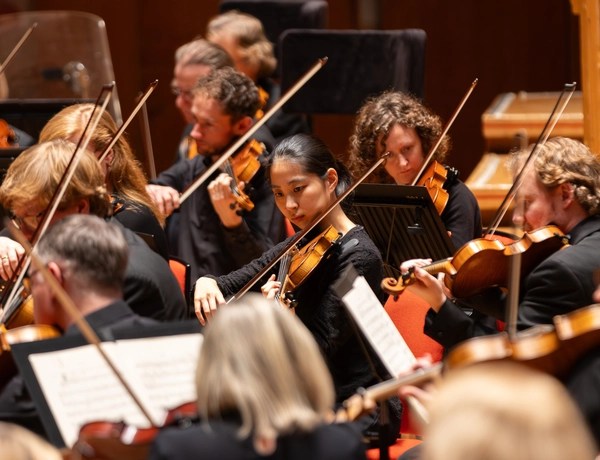
It was likely coming after the ‘official’ end of the City of Birmingham Symphony Orchestra’s season that brought a disappointingly low turnout for this concert, itself the culmination of the initial CBSO Orchestral Residency. This saw some five-dozen musicians, aged from 21 to 25, working alongside the orchestra’s musicians for an intensive week of rehearsals with Edward Gardner – principal guest conductor of the CBSO during 2010-16 and whose expertise across a broad range of repertoire was duly demonstrated by the ambitious programme heard tonight.
A first half devoted to Edgard Varèse ensured a testing workout for percussion in particular – 13 of them placed across the rear of the platform for the scintillating interplay of timbre and texture that is Ionisation; not the first such piece for the concert hall, but certainly the first of consequence. A pity that remarks by the conductor and Residency musicians did not precede rather than follow it, allowing the climactic entry of tuned instruments (chimes, glockenspiel and piano) to fade into the solo flute as commences Amériques with spellbinding immediacy.
Long notorious in terms of scale and impact, the latter work has now become something of a showpiece as this builds from post-impressionist musing, via passages alternately speculative and strident, to an apotheosis where jousting brass underpinned by a ‘walking bass’ uncannily anticipates symphonic jazz a generation hence. Under Gardner’s guidance, there was no risk of its losing focus – the players responding with discipline and no little relish to music as has lost none of that capacity to provoke and enthral just a century after its Philadelphia premiere.
The CBSO has an association with Harmonielehre stretching back more than 30 years to the recording (only the second) made with Simon Rattle. That this orchestra, with its Residency contingent, now brings greater freedom and flexibility says much about the development in orchestral playing over that time – along with the integration of John Adams’s work into the repertoire such that, far from being a polemic for reasserting the supremacy of ‘tonality’, it now yields all the attributes of a showpiece and may even be thought of as a crowd-pleaser.
Symphonic in aim if not necessarily intent, let alone attainment, this is music that can easily sprawl and it was to Gardner’s credit the un-titled first movement – with its alleged imagery of a super-tanker taking flight – maintained the impetus of those seismic opening chords, via music of expressive luxuriance, to a conclusion that fairly hit the ground running. Even finer was The Anfortas Wound, its brooding sombreness suffused with wrenching starkness on the way to a climax whose anguish references a comparable passage in Mahler 75 years on.
As with many symphonies actual or otherwise, the finale seems more a rounding-off than a resolution of the issues at stake, though there was no lack of purpose in Meister Eckhardt and Quackie as this imaginary encounter between a Medieval theologian and the composer’s infant daughter yielded unstoppable momentum prior to a headily affirmative close. Nor was there any doubting the conviction by which an expanded CBSO brought this work, and with it the whole concert, to its impressive conclusion. Roll on the Orchestral Residency for 2027.
To read more about the CBSO’s 2026/27 season, visit the CBSO website, and to read more about the CBSO Orchestral Residency. Click on the names to read more on conductor Edward Gardner, and composers John Adams and Edgard Varèse
Published post no.2,953 – Monday 6 July 2026