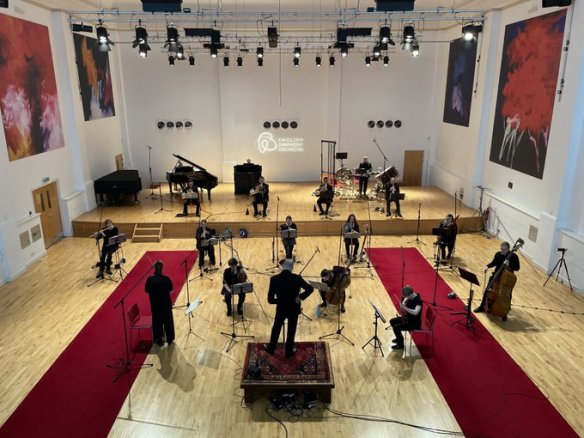
Live review – English Symphony Orchestra / Kenneth Woods: Mahler Symphony no.9

mahler-9-woods

Members of the English Symphony Orchestra / Kenneth Woods

Mahler arr. Simon Symphony no.9 in D major (1908-10, arr. 2011)

Wyastone Concert Hall, Monmouth
Recorded March 23-25 2021 for online broadcast, premieres 7 July 2021

Written by Richard Whitehouse

The chamber reductions of orchestral works, as pioneered by the Society for Private Musical Performances founded by Schoenberg after the First World War, has gained renewed impetus these past 15 months given the unfeasibility of full-scale performances. Few can have been as ambitious as Mahler’s Ninth Symphony – arranged by pianist and conductor Klaus Simon for an ensemble of single strings and woodwind (with doublings), two horns, trumpet, percussion (one player), piano and harmonium; its textural and motivic content thereby remaining intact.

This is evident in the opening Andante, arguably Mahler’s most perfectly realized symphonic movement, whose formal trajectory of interlocking arcs is made explicit so that its long-term expressive intensification and release become no less tangible. To this end, the roles of piano and harmonium are much more than the mere filling-out of texture – respectively articulating and reinforcing the harmonic profile through to a coda which more than usually clinches the overall tonal journey with a serenity the more poignant for its remaining, as yet, unfulfilled.

The ensuing Ländler was no less lucid in terms of its unfolding, Kenneth Woods resisting any temptation to play up the emotional contrasts across a movement whose deceptive blitheness of spirit is only gradually undermined (and a quality this music shares, doubtless unbeknown to the younger composer, with Ravel’s La valse). Equally significant is the way that Simon’s arrangement discreetly emphasizes disparities of timbre and texture, on the way to a closing section where the music only too audibly fragments into a bemused parody of how it began.

More questionable is the Rondo-Burleske – Woods’s underlying tempo for the outer sections, while enabling the music’s contrapuntal intricacy to emerge unimpeded, feeling too dogged to convey its frequently assaultive manner to the degree that the composer surely intended. This is less of an issue in a trio section whose aching regret was potently conveyed, with the stealthy regaining of tension no less in evidence. Animated and accurate, this final section again lacked that seething energy which propels the movement towards its anguished close.

No such questions affect the final Adagio – only equivocally conclusive now that the Tenth Symphony has all but been accepted into the Mahler canon, yet remaining a test of all-round cohesion such as this account rendered with unwavering conviction. Having thus gauged the balance between its alternate paragraphs, Woods assuredly controlled the winding down of tension towards a coda of inward rapture despite its sparseness of gesture – while affording the speculative dialogue between solo strings the necessary temporal and emotional space.

It hardly needs to be said that the playing of this 15-strong ensemble drawn from the English Symphony Orchestra was consistently attuned to the spirit of this music – as, too, is Simon’s methodical and apposite arrangement. Whether such reductions can continue to be relevant in the (presumed) aftermath of the pandemic, it would be a pity were these not to enjoy revival in their own right: revival, moreover, out of aesthetic rather than just didactic considerations, as this impressively conceived and executed rendition demonstrated to often moving effect.

You can watch the concert on the English Symphony Orchestra website here

Further information on Klaus Simon is here, while for further information on the Music from Wyastone series, you can click here. ‘Fiddles, Forests and Fowl Fables’ is now available from the English Symphony Orchestra Website.


Live review – English Symphony Orchestra / Kenneth Woods: Composer Portrait: Adrian Williams


English Symphony Orchestra / Kenneth Woods
Composer Portrait – Adrian Williams
Chamber Concerto ‘Portraits of Ned Kelly’ (1998)
Russells’ Elegy (2009/11)
Migrations (1998)
Wyastone Concert Hall, Monmouth
Recorded September 21 2020 and 8 April 2021 for online broadcast
Written by Richard Whitehouse. Photo credit (c) Keith Bramich / http://www.classicalmusicdaily.com

The English Symphony Orchestra’s latest online concert was devoted to the music of Adrian Williams (b1956), a composer whose long and wide-ranging career has resulted in an output -championed by the likes of cellist Raphael Wallfisch and the Amsterdam Sinfonietta – which covers almost all the major genres and with a stylistic diversity that does not preclude a more unified or personal manner from emerging. Such was evident from the three highly contrasted works featured in this programme which, between them, constituted a most revealing portrait.
A programme, moreover, which was launched ‘at the deep end’ with the Chamber Concerto ‘Portraits of Ned Kelly’. The artist Sidney Nolan was during his later years a neighbour of the composer, his powerfully imagist and pointedly un-romanticized evocations of the Australian outlaw directly influencing this music. Its pungent opening sets out the basic premises – not least the pitting of wind quintet (with doublings) against string quartet, with double-bass and harp adding subtle contributions as the piece unfolds. A more inward central section builds to a febrile culmination – after which, the wind and strings are gradually drawn into a monody that brings about a resigned if hardly serene close. Impressive, too, is Williams’s handling of often fractious material such that a clear formal and expressive trajectory is always evident.
Williams has already contributed several works as the ESO’s current John McCabe Composer -in-Association, Russells’ Elegy likely one of his most directly appealing as well as being a commemoration of the pianist-conductor John Russell and the director Ken Russell (thus the plural of the title). Audibly in a long lineage of British works for strings, it alternates between passages for the ensemble and those in which solo strings dominate with no mean subtlety or finesse – before culminating in a sustained tutti that fades longingly if inevitably into silence.
That the ESO’s music director Kenneth Woods should have described Migrations as ‘‘one of the very greatest works in the rich canon of string music’’ is not mere hyperbole. Scored for 22 solo strings and inspired by migratory patterns of birds in the environs of the composer’s Herefordshire home, this substantial piece unfolds with a seamlessness of purpose in which cluster-like outbursts of great emotional force are integrated into melodic writing of distilled poignancy. The textures are highly variegated while always consistent – not least in the final minutes when, after a fateful pause, solo strings exchange interjections of an intensity which gradually subsides into fatalistic acceptance. In conception if not in content, Migrations can be compared to Strauss’s Metamorphosen for the sheer precision and eloquence of its writing.
It helped, of course, that here (as throughout the programme) the ESO was so committed to this idiom, rendering the often dense and exacting nature of its writing with an unwavering commitment. All three works are to feature on a future release of the composer’s music, and Williams has recently completed a large-scale symphony that is scheduled for this orchestra’s 21st Century Symphony Project towards the end of this year. In the meantime, listeners yet to make the acquaintance of his distinctive and emotionally engaging music are urged to do so.
You can watch the concert on the English Symphony Orchestra website here
For more information on the English Symphony Orchestra you can visit their website here, and you can read about their latest recording, Fiddles, Forests and Fowl Fables, here. For more on Adrian Williams, click here

Live review – English Symphony Orchestra / Kenneth Woods: Elgar Reimagined Part 2

ElgarStringQuartet-Screenshot

English Symphony Orchestra / Kenneth Woods

Elgar, arr. David Matthews String Quartet in E minor Op.83 (1918)

Wyastone Concert Hall, Monmouth
Recorded September 22 2020 for online broadcast from Friday 14 May 2021

Written by Richard Whitehouse

Following its programme of miniatures – original and arrangements – for cello and strings in March, this latest online concert by the English Symphony Orchestra returned to Elgar for a reading of his String Quartet arranged by David Matthews for a full complement of strings.

This was the second in a triptych of chamber works composed in rural seclusion at Brinkwells in Sussex, Elgar having escaped the wartime disillusion of London for what was to be his last sustained period of creativity. Less introspective than the Violin Sonata that preceded it while less emotionally charged than the Piano Quintet that came after, the String Quartet is the most finely proportioned of the three – unfolding as a sustained sweep whose subtle transformation of thematic elements across and between its three movements make it among the finest of his later compositions. Heard in this guise, it follows on from the Serenade then Introduction and Allegro as the hitherto missing large-scale work for string orchestra of Elgar’s high maturity – which should hopefully commend it to an audience beyond that of the composer’s devotees.

Matthews has numerous arrangements to his credit (not least Schumann’s Piano Concerto as recast for marimba), and he has been mindful to balance the soloistic and ensemble potential of this music, so the result is neither straightforward transcription nor radical re-conception. The opening Allegro moderato discreetly emphasises an autumnal musing that sets the tone for much of what follows; even finer is the second movement – marked Piacevole – whose equability yields a main theme suffused with intensity, the extent of which is only revealed towards the close. If the emotional acuity of the final Allegro is marginally diffused when rendered for larger forces, there is no lack of rhythmic definition as the music proceeds to a coda whose terse decisiveness is far removed from the opulence of just a few years before.

Its idiomatic nature was enhanced by the ESO’s attentive playing under Kenneth Woods, a natural follow-on to their take on the Piano Quintet in Donald Fraser’s arrangement (Avie). Heard together, these two parts of Elgar Reimagined should make for a desirable recording.

You can watch the concert on the English Symphony Orchestra website here

For more information on the English Symphony Orchestra you can visit their website here

Live review – Kile Smith, Gemma Whelan, English Symphony Orchestra / Kenneth Woods: The Art of Storytelling – The Bremen Town Musicians

eso-bremen-town

Kile Smith (music), Gemma Whelan (narrator), English Symphony Orchestra / Kenneth Woods

Wyastone Concert Hall, Monmouth
Recorded 30 July 2020, available online from Friday 16 April 2021

Written by Richard Whitehouse

The English Symphony Orchestra reaches the concluding instalment of its series for virtual storytelling with one of the most appealing fairy tales – The Bremen Town Musicians, here given in a discreetly updated version which preserves its salient narrative and robust charm.

Maybe through its specifically German setting, what is among the more life-enhancing tales by the Brothers Grimm has never enjoyed the popularity of various other such stories (those who remember an enticingly illustrated version published by Ladybird in the 1960s would no doubt disagree!). The more reason, then, why it should not find renewed currency today – not least with the assistance of this online rendering, which has been vividly and imaginatively illustrated by students from Chadsgrove School in the Worcestershire town of Bromsgrove.

The story is breezily and resourcefully told by Gemma Whelan, assuming a variety of accents and intonations to differentiate those characters – donkey, dog, cat and cockerel – who defy imminent demise to become travelling musicians on a journey to Bremen that (at least in this version) they never reach. Their travails and unlikely victory over a band of rural robbers is underpinned with a score by Kile Smith whose echoes of Stravinsky, Hindemith and lesser-known but worthwhile figures such as Walter Piston is effectively geared to events at hand

The ESO musicians play with style and assurance, while Kenneth Woods ensures poise and humour – not least in several meaningful ‘wrong entries’. The overall presentation is sure to win this story new friends and, as usual, a range of sundry material enhances the experience.

You can watch the concert on the English Symphony Orchestra website here

For more information on the English Symphony Orchestra you can visit their website here

For information about Auricolae, visit Kenneth Woods’ website here

Live review – Thomas Kraines, Henry Goodman, English Symphony Orchestra / Kenneth Woods: The Art of Storytelling – Hansel and Gretel

eso-hansel

Thomas Kraines (music), Henry Goodman (narrator), Members of the English Symphony Orchestra / Kenneth Woods

Wyastone Concert Hall, Monmouth
Recorded 20 July 2020, available online from Friday 9 April 2021

Written by Richard Whitehouse

The English Symphony Orchestra reaches the penultimate instalment of its series for virtual storytelling with one of the most enduring among fairy tales – Hansel and Gretel, here given in the more abrasive version such as leaves little or no room for sentimental embellishments.

Although it has always been a parable for the playing-off of good against evil, the intensified recent concern about the exploitation of children has given this story a more ominous undertow. Little of that was emphasized here, yet the scenario remains one where the brutal corrupting of innocence is foremost; whether in the guise of the stepmother, rendered here in scarifying Irish, or that of the witch whose tendency to caricature is judged to a nicety. That neither children nor woodcutter exudes much in the way of persona may itself be significant.

As will have been realized, Henry Goodman is an animated and appealing narrator as he leads the listener through a story where incident likely counts for more than the ultimate destination. The score itself shows Thomas Kraines’s knack for moving across genres and styles with real sureness of touch, alighting on elements of German romanticism and expressionism to inflect those highpoints of the narrative. That the theme for the stepmother and the witch is a 12-note row brings a fresh perspective to a conceit whose lineage stretches back over nearly a century.

As in previous instalments the ESO musicians play with skill and sensitivity, Kenneth Woods ensuring clarity and balance even in the densest textures. The presentation is sure to provoke children of all ages and, as usual, a range of sundry material enhances the overall experience.

You can watch the concert on the English Symphony Orchestra website here

For more information on the English Symphony Orchestra you can visit their website here

For information about Auricolae, visit Kenneth Woods’ website here