In concert – Sarah Aristidou, Ensemble Intercontemporain / Pierre Bleuse @ BBC Proms: Boulez & Berio: 20th-Century Giants

Sarah Aristidou (soprano), Jérôme Comte (clarinet), Lucas Ounissi (trombone), Yann Brécy (IRCAM electronics), Sylvain Cadars (IRCAM sound diffusion), Ensemble Intercontemporain / Pierre Bleuse

Berio Sequenza V (1966)
Boulez Dialogue de l’ombre double (1982-5)
Berio Recital I (for Cathy) (1972)

Royal Albert Hall, London
Wednesday 23 July 2025 (10.15pm)

Reviewed by Richard Whitehouse Photos (c) BBC / Chris Christodoulou

It is a salutary thought that events such as this evening’s later concert were once a ubiquitous feature at the Proms, and it required an anniversary such as the centenaries of both composers heard here to make it possible once again. Not that any of those present would have objected.

The jury might still be out on the precise nature of Luciano Berio’s achievement, but not on the intrinsic value of those works as Sequenza V. One of 14 such pieces that emerged across 44 years, it is arguably the most compact and communicative – not least for its pronounced degree of theatricality. His attire more readily evoked Harpo Marx than Grock the clown, but Lucas Ounissi (above) was fully alive to this music’s extended trombone technique serving a routine humorous though pathos-laden – his exclaimed ‘Why?’ defining the performance as a whole.

Although he eschewed such theatrics, Pierre Boulez was rarely averse to the extra-musical. Inspired by a scene in Paul Claudel’s play Le soulier de satin and the offshoot of work on his major 1980s project Répons, Dialogue de l’ombre double is typical of Boulez’s later thinking with its interplay of live and pre-recorded elements so that the musicians become engaged in a performance with themselves. Here the music proceeds as a continuum between Strophes and Transitions – clarinettist Jérôme Comte as tangible by his presence during the former as he was intangible by his absence during the latter, with all the contrast in perception that this implies. The presence of lighting proved as effective as it was immediate – not least in those framing sections of Sigle initial and Sigle final which act as processional then recessional.

Next to such expressive concreteness, Berio’s Recital I (for Cathy) could feel beholden to its era, but this music-theatre for the composer’s former wife and ongoing collaborator touches on salient aspects of existence as surely as those of performance. As with the more familiar Sinfonia (also revived this season), the plethora of quotations of and allusions to other music – ranging over three centuries from Monteverdi to Berio himself – is absorbed (if not always integrated) into an extended monologue during which the singer evolves from touchy prima-donna to solitary protagonist whose search for meaning in her artistic endeavour has become (and maybe always had been?) elusive. It has to be said that previous Proms hearings, at the Roundhouse then Kensington Town Hall, were better suited to this piece’s relative intimacy than the expanse of the Royal Albert Hall; moreover, for all the eloquence of her assumption, Sarah Aristidou (above) was not wholly suited to a role which requires a singer-actor in the lineage of Cathy Berberian to convey the intensifying emotional meltdown played out during its course.

What could hardly be denied was the alacrity of the instrumental response; the musicians of Ensemble Intercontemporain never less than committed under assured guidance from Pierre Bleuse, who has clearly galvanized this organization in the two seasons since he became its artistic director. Hopefully they will be invited back to the Proms at the earliest opportunity, and not just on the basis of commemorating those composers whose centenaries underscore their significance to a post-war musical culture whose passing has not made less relevant.

You can listen back to this Prom concert on BBC Sounds until Sunday 12 October.

Click on the artist names to read more about Sarah Aristidou, Jérôme Comte, Lucas Ounissi, the Ensemble Intercontemporain, their conductor Pierre Bleuse – and for more on the BBC Proms

Published post no.2,607 – Saturday 26 July 2025

In concert – Ensemble intercontemporain – Boulez 100 @ The Barbican

Ensemble intercontemporain / Nicolò Umberto Foron, NikNak (turntables), tyroneisaacstuart (choreographer & dancer), Julien Creuzet (visuals), Nathan England-Jones (electronics technical support)

Hannah Kendall shouting forever into the receiver
Cassie Kinoshi [untitled]
Pierre Boulez Sur Incises

Barbican Hall, London, 27 May 2025

by John Earls. Photo credits (c) John Earls

Billed as part of the Boulez 100 series* to celebrate what would have been Pierre Boulez’s 100th birthday year, it was exciting to see a concert by Ensemble intercontemporain, the group the great iconoclast founded in France in 1976 (I can’t help but also tell you that this was with the support of the then French Secretary of State for Culture).

Recognising Boulez’s championing of new voices, the programme combined a classic Boulez piece with new works by two younger generation British composers. First up was Hannah Kendall’s shouting forever into the receiver. The title comes from Ocean Vuong’s novel On Earth We’re Briefly Gorgeous and refers to the description of a tiny plastic toy soldier yelling into its handheld radio transceiver. In this piece, spoken extracts, initially from the Book of Revelation and then verses from Ezekiel, are passed back and forth between two performers using walkie-talkie radios and sat on opposite sides of the stage. This is combined with arresting musical accompaniment including pre-programmed music boxes playing familiar works such as Beethoven’s Ode to Joy, dampened piano and a contemplative harmonica chorale. It was a fascinating opening 15 minutes.

Second on the programme was the world premiere of composer, arranger and saxophonist Cassie Kinoshi’s [UNTITLED]. Inspired by Boscoe Holder, the Trinidadian artist, dancer, choreographer and musician it “pays tribute not only to historic Caribbean artforms…but also to the continued evolution of these forms in modern diasporic contexts”. This is reflected in this multi-disciplinary piece combining music, choreography, improvisation, technology and visual art “embracing the kind of fluid creativity that Boscoe Holder explored throughout his lifetime”.

At the very start choreographer and dancer tyroneisaacstuart circles the stage before literally passing on the baton to conductor Nicolò Umberto Foron (currently Assistant Conductor of the London Symphony Orchestra). Throughout the evening Foron’s angular gestures complemented the music perfectly. Something of a dance in itself.

tyroneisaacstuart’s own dancing involved spins, weaving through sections of the orchestra, running on the spot and at one point appearing to hit a forcefield during a dramatic build-up of repetitive beats. Rhythm featured strongly throughout the piece including beats from NikNak on turntables (Nathan England-Jones provided electronics technical support) and we were frequently never far from an albeit eclectic dancefloor.

The dancer was all dressed in white contrasting with the fiery red visuals (by Julien Creuzet) on a large screen featuring the slower movements of blurred figures. Kinoshi’s intention is that the “on-stage presence invites the audience to not only hear but to see rhythm”. I don’t know whether when the orchestra, dancer and visuals are on stage together it makes it difficult to focus properly, but at times it felt a bit too busy. That said it is a stimulating and brave piece.

[left to right: Cassie Kinoshi, Nathan England-Jones, NikNak, Nicolò Umberto Foron, tyroneisaacstuart]

After the interval, nine members of the Ensemble performed Pierre Boulez’s Sur Incises (1996-1998) for three pianos, three harps and three percussion parts (including vibraphone, marimba, glockenspiel, steel drums, and tubular bells).

The stage setting alone with the instrumentalists set some distance apart (a bit like Covid times) with the harps centre stage was striking. It’s quite a sonic experience too. Heavy percussion and lustrous harmonies combine in an ebb and flow of crashes and trills that both comfort and have a sense of foreboding. Boulez’s music has a reputation for being difficult, but when played like this it is utterly captivating.

John Earls is Director of Research at Unite the Union. He posts on Bluesky and tweets / updates his ‘X’ content at @john_earls

*It was a bit strange, not to say disappointing, that the concert programme labelled this as part of the Boulez 100 series but contained nothing on Boulez himself or the piece of his being performed. The notes on the other two pieces, written by the composers themselves, were, not least for this reviewer, very useful.

For more on the ensemble, visit the Ensemble Intercontemporain website

Published post no.2,547 – Wednesday 28 May 2025

On Record – Ensemble Intercontemporain / George Jackson – Steve Reich: Reich/Richter (Nonesuch)

reviewed by Ben Hogwood

What’s the story?

Reich/Richter was originally written to be performed with German visual artist Gerhard Richter and Corinna Belz’s film Moving Picture (946-3). The film is based on Richter’s book, Patterns, where the author took a photo of one of his abstract paintings and scanned it into a computer. He cut the scan in half, then cut each half in two, and then reversed two of the four resultant quarters into mirror images. This process – ‘divide, mirror, repeat’ – was repeated all the way through from a half to a 4096th.

Belz helpfully described the film in terms of pixels, beginning with two-‘pixel’ stripes, while the music started with a ‘two-sixteenth’ oscillating pattern. The music then shadows the film as it moves to four, eight and sixteen stripes, at which point Reich introduced longer notes, expanding the music in response. As he then describes, the music returns to more rapid movement as the pixel count starts to diminish.

The match of visual artist and composer could hardly be more appropriate, and their resultant work was performed more than one hundred times at The Shed in New York during 2019. This recording, with the Ensemble Intercontemporain under George Jackson, was made in Paris at the Philharmonie.

What’s the music like?

One of Steve Reich’s many endearing qualities as a composer is the ability to take what sounds like a very complicated mathematical process and make it incredibly easy on the ear – and Reich/Richter repeats that trick.

As with the best ‘minimalist’ works it rewards attentive listening greatly, the ear drawing out shorter phrases and colour combinations, which prove to be every bit as vivid as the cover implies. Yet background listening works equally well, the ear and moreover the mind able to appreciate Reich’s hazy, impressionistic shades which recall earlier works such as Music for Mallet Instruments, Voices and Organ from 1973. Here, though, it is possible to appreciate Reich’s mastery of writing for wind instruments, incorporating them into the texture.

Unsurprisingly, Reich/Richter works best when experienced in its unbroken span of 37 minutes. There is some busy activity at all times but Reich’s sustained notes really stand out, giving the piece a broad scope that arches almost overhead. The ever-changing texture benefits from the lines afforded to brightly-toned violins, or crisp clarinets, but when these instruments retreat to make up the broad brushed colours in the middle background, a lovely haze ensues. This makes the piece one of Reich’s easiest to listen to, though by the time we get to the third part, Crossfades, the stretching of the notes introduces a notable tension not dissimilar to that experienced in the early Reich piece Four Organs. As the tempo recovers in Ending, the feeling is strangely exhilarating, like a flower opening out again in the sunlight.

Does it all work?

It does, achieving a very interesting blend of movement and stasis. The performance is excellent too, and intriguing that Ensemble Intercontemporain, the Parisian ensemble founded by Pierre Boulez, should now be recording his music! Boulez, it is safe to say, was not a fan of the so-called ‘minimalists’, and it would be fascinating if we could somehow know his thoughts on the recording.

Is it recommended?

Yes, enthusiastically – a compelling listen. The slightly short running time of the album release means that if you’re a Reich completist, it is worth bearing in mind that Nonesuch plan to release a collection of the composer’s complete works in 2023. Now that is definitely something for the diary!

Listen

Buy

You can explore purchase options for this album at the Nonesuch website

BBC Proms – BBC Singers & Ensemble Intercontemporain: Boulez, Elliott Carter & Bartók

prom-65_cr_bbc-chris-christodoulou_4

Baldur Brönnimann conducts the Ensemble Intercontemporain at the BBC Proms on Friday 2 September, in a Prom also featuring violinist Jeanne-Marie Conquer, IRCAM computer music artists Andrew Gerzo, Carlo Laurenzi and Jérémie Henrot, and the BBC Singers. (c) Chris Christodolou

Prom 65; Royal Albert Hall, Friday 2 September 2016

Bartók Three Village Scenes (1926); Boulez Anthèmes 2 (1997); Carter Penthode (1985); Boulez Cummings ist der Dichter (1970)

Listen on the BBC iPlayer here

Tonight’s late Prom suggested a certain nostalgic element in that the composers performed were at the forefront of these concerts from the late-1960s to the early 1990s, since when the evolution of contemporary music has increasingly become divorced from notions of progress.

Not least in the case of the Three Village Scenes that Bartók wrote in response to a hearing of Stravinsky’s Les noces, and that essentially freed his music from any vestige of late-romantic rhetoric. Not heard at the Proms for over three decades, these concise pieces alive with vitality and (in the second of them) pathos responded well to the poise and precision accorded by the Ensemble Intercontemporain (who gave this piece with Pierre Boulez in 1974 and ’79) – with the BBC Singers conveying the abrasiveness and humour of the vocal writing in like measure.

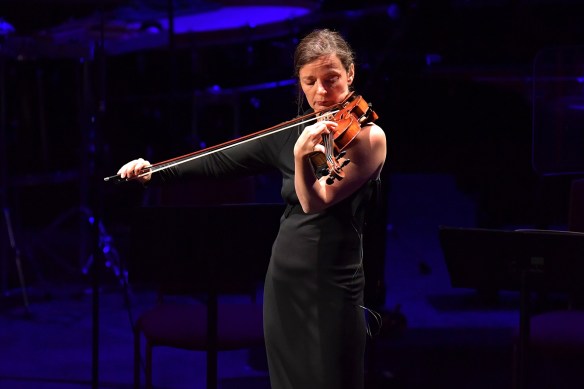
Although among his late works, Boulez’s Anthèmes 2 looks back via a brief solo predecessor to the Stravinsky memorial tribute a quarter-century earlier. Less encompassing in its musical scope than his other electro acoustic pieces, it brings to a head Boulez’s preoccupation with a cumulative s verse-and-refrain format unfolding as continuous variations in sound and space. Ably as the three IRCAM engineers facilitated this latter, it was the playing of Jeanne-Marie Conquer (below) – a world-class soloist if she chose to be – which took centre stage in every respect.

prom-65_cr_bbc-chris-christodoulou_6

A rather different side of Boulez’s composing was evident with Cummings ist der Dichter – a work which, for all that its title came about by accident, represents an oasis of conviction from an era beset by creative uncertainty. How much of this is due to harmonic enrichment brought about by the 1986 revision is arguable, though the manner in which the text emerges out of its syllabic and parenthetical austerity to assume unexpected textural richness and intricacy was inherent from the outset, and the present account left little doubt as to this music’s eloquence.

Between these works came Elliott Carter’s Penthode, not heard at these concerts since being premiered here 31 years ago and that could not then have been heard as merely an instalment in a creative odyssey still having over two decades to run. The five paths of its title taken by five ‘broken’ ensembles, the piece unfolds as a single-movement chamber symphony whose slow underlying pulse is increasingly overridden by music of a quizzical and often humorous demeanour; not least when directed with evident verve and assurance by Baldur Brönnimann.

An increasingly familiar figure in the UK, Brönnimann is in a line of conductors – stretching back to Boulez and beyond – as ensures this music retains its relevance for later generations, such that tonight’s Prom could never be mistaken for a nostalgic look back to a lost future.

Richard Whitehouse