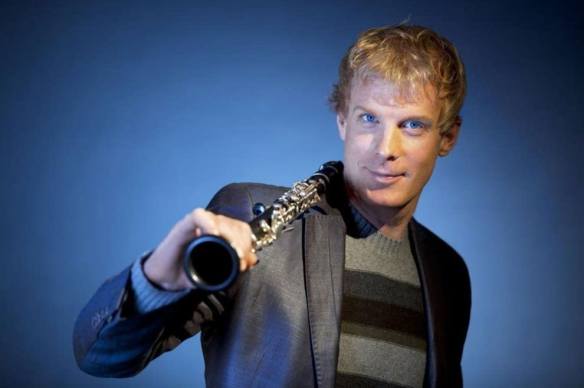
In Concert – Martin Fröst, Roland Pöntinen & Sébastien Dubé @ Wigmore Hall: Night Passages – A Musical Mosaic

Martin Fröst (clarinet), Roland Pöntinen (piano), Sébastien Dubé (double bass)

Debussy Première rhapsodie (1909-10)
Chausson Andante and Allegro (1881)
Poulenc Sonata for clarinet and piano (1962)
Night Passages – A musical mosaic (with arrangements by the performers)
Domenico Scarlatti Sonata in D minor Kk32
Chick Corea Children’s Song no.15 (1978)
Rameau Les Indes galantes: Air pour les Sauvages (1735-6)
Purcell Incidental music for Oedipus, King of Thebes Z583: Music for a while (1692)
J.S. Bach Sinfonia no15 in B minor BWV801 (c1720)
Chick Corea Armando’s Rumba (1976)
Purcell Hornpipe in E minor Z685
Handel Menuet in G minor (1733)
Traditional Polska från Dorotea
Göran Fröst Klezmer Dance no.2 (2011)

Wigmore Hall, London
Wednesday 21 December 2022

Reviewed by Ben Hogwood

In 2019, Arcana was at the Wigmore Hall to see Martin Fröst and Roland Pöntinen give a concert of largely French music for clarinet and piano. Their encore hinted at an intriguing sequence of arrangements exploring connections between classical music and jazz. Three years on, that sequence has grown in stature, realised in recorded form as the Sony Classical album Night Passages, and given meaningful content by personal and world events.

Through lockdown, Fröst experienced intense bouts of Ménière’s disease, whose symptoms include unexpectedly severe bouts of vertigo and tinnitus. The clarinettist experienced one such bout while driving his car, which he thankfully negotiated without injury, but which bred a number of accompanying fever dreams. Expressed in the program notes, they lent a vivid written complement to the music.

Since 2019 the double bass of Sébastien Dubé has been added to the instrumental thinking, an essential musical component taking the arrangement style towards Jacques Loussier without ever resorting to parody. Unexpectedly, the group’s colourful arrangements did not always include the piano, allowing Fröst and Dubé the chance to explore the rewarding combination of clarinet and double bass through imaginative techniques and compelling improvisation.

The course of Night Passages led from a solemn sonata by Domenico Scarlatti to a Klezmer dance from Fröst’s brother Göran, by way of arrangements exploring the versatility of Baroque music. These were matched by jazz-inflected work from Chick Corea, with Armando’s Rumba presenting some vibrant syncopations, along with a celebration of the Swedish polska.

Frost’s artistry was almost beyond criticism, the clarinettist able to make even the most demanding technical passages appear nothing more than a walk in the park, airily improvising or running through sharply edged cadenzas. Dubé was no less impressive, and a remarkably wide range of colours issued from the double bass, whether bowed or plucked. His chemistry with Fröst was compelling, and the occasional use of vocals added to the mix. Roland Pöntinen also made the most of his chances to shine, providing the rhythmic verve to the dances but also a welcome, cleansing clarity which ran through the Baroque arrangements, tastefully and affectionately realised.

Prior to the interval we heard three short pieces by French composers for clarinet and piano. Debussy’s Première rhapsodie tells its story through a set of contrasting thoughts, initially set out in a humid atmosphere but becoming more outward facing as it gains in confidence. Fröst and Pöntinen had its many twists and turns instinctively under their fingers, finishing each other’s sentences as they did in the romantic, lyrical writing of Chausson’s Andante and Allegro, played with evident affection.

Yet it was Poulenc’s Sonata for clarinet and piano, completed in the year before his death, that made the most lasting impression. What a profound work this is, paying tribute to his friend and fellow composer Arthur Honegger. The slow movement holds the emotional centre of the work, with melancholy on occasion spilling over into outright sadness. Fröst’s quieter asides encouraged the audience to lean closer to the music, but these intimate thoughts were swept away by the exuberant finale, throwing caution to the winds. Fröst and Pöntinen played with great feeling throughout, typifying the approach of a concert that may not have been generous in length but which amply compensated through musical quality.

In concert – Dame Sarah Connolly, CBSO / Gustavo Gimeno: Humperdinck, Chausson & Tchaikovsky

gustavo-gimeno

Humperdinck Hänsel und Gretel – Prelude (1891-2)
Chausson
Poème de l’amour et de la mer Op.19 (1882-92)
Tchaikovsky
Symphony no.6 in B minor Op.74 ‘Pathétique’ (1893)

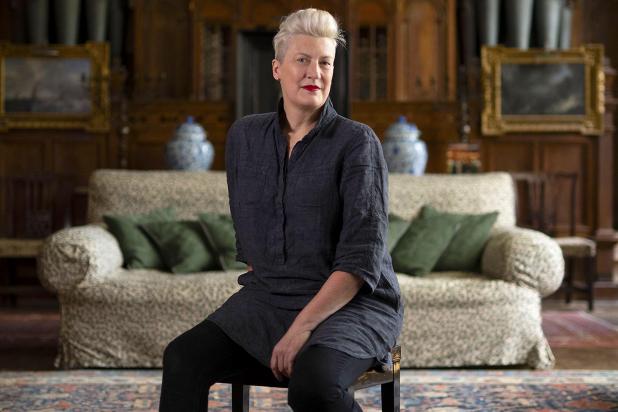
Dame Sarah Connolly (mezzo-soprano, below), City of Birmingham Symphony Orchestra / Gustavo Gimeno

Symphony Hall, Birmingham
Thursday 23 September 2021

Written by Richard Whitehouse

This afternoon’s programme (repeated from yesterday) by the City of Birmingham Symphony Orchestra saw a welcome reappearance from Dame Sarah Connolly for a relatively rare hearing, at least in the UK, of Ernest Chausson’s probable masterpiece Poème de l’amour et de la mer.

Often described as a song-cycle, Poème is closer to a scena with its unfolding over two large parts separated by an orchestral interlude. Drawing on texts by Maurice Bouchor, these evoke what is ostensibly the protagonist’s ill-fated affair but whose deeper resonance suggests more that disillusion afforded when revisiting the past. Such a trajectory could easily have resulted in indulgence or even self-pity, avoided through Chausson’s unerring formal control over his subject-matter as well as a thematic resourcefulness sustained across the near half-hour span.

Following in a distinguished lineage of mezzos (among them Dame Janet Baker), Connolly brought out the playfulness of La fleur des eaux as it conveys the burgeoning of love against a heady seascape – doubt only creeping in towards the close as the passing of a year is contemplated. This is represented by the Interlude in which first appears a theme dominant by the close, and while the opening of La mort de l’amour brings a renewed anticipation of arrival, the anguish occasioned by forgetfulness is transmuted into a brooding fatalism – the composer drawing on an earlier song for this sombre final stage. Connolly’s eloquence came into its own here, abetted by a soulful response from cellist Eduardo Vassallo among an orchestral response abounding in soloistic finesse. A powerful reading of a still underestimated piece.

Chausson lived a further six years after its premiere in 1893, whereas Tchaikovsky lived just nine days after the premiere that year of his Pathétique before his still-contested demise. Here again, there was no undue emoting thanks to Gustavo Gimeno’s firm grip over the complex formal and emotional trajectory of the first movement – not least its explosive development culminating in an anguished yet also consoling reprise. The ensuing intermezzo had charm but also a purposeful underlying tread – not least in its wistful trio, then the scherzo amassed no mean impetus through to an explosive second half whose orchestral response evinced no mean virtuosity. Heading straight into the finale, Gimeno sustained expressive tension right through to the closing bars as here faded into a silence born of resignation rather than defeat.

The close of that year brought the premiere of Humperdinck’s ‘fairy-tale’ opera Hänsel und Gretel – then, as now, the work by which this undervalued composer is best remembered and whose prelude encapsulates the essence, though not the totality, of the drama while proving equally effective as a concert-overture. Gimeno paced this unerringly, thereby allowing its animated central phase to merge unobtrusively out of then back into the confiding warmth either side. At least one major work written in 1893 can be said to have a ‘happy ending’.

Next week’s concert brings pieces from very different eras – Brahms’s First Symphony and Rachmaninov’s Third Piano Concerto being preceded by another of the CBSO’s Centenary Commissions, an evidently celebratory overture by Mark-Anthony Turnage called Go For It.

For more information on next week’s concert, click here for tickets. You can find information on the new CBSO season here, and for more on Symphonic Sessions click here

Watch: Chausson’s Poème

With isolation in mind, here is a bit of musical indulgence for a Monday evening – for no reason other than it’s a lovely piece of music that Arcana was reminded of today!

Ernest Chausson‘s Poème was written in 1896, in response to the great Belgian violinist Eugène Ysaÿe, who was keen for him to write a violin concerto. Although Chausson was capable of writing in longer forms – he wrote a fine Symphony and several substantial chamber works – he found this a daunting request.

Instead he produced this single movement work, fifteen minutes for violin and orchestra which beautifully reflect his Italian surroundings, for the composer was on holiday in Florence.

In this performance Vadim Repin is the soloist, with the Israel Philharmonic Orchestra conducted by Zubin Mehta.


In concert – Martin Fröst & Roland Pöntinen at Wigmore Hall

Martin Fröst (clarinet), Roland Pöntinen (piano)

Wigmore Hall, Monday 16 December 2019

Review and guide by Ben Hogwood

A concert that was relatively short on music but extremely high on musicianship and virtuosity. Martin Fröst is one of the finest clarinettists at work today, and fellow-Swede Roland Pöntinen, with whom he has enjoyed a musical partnership for 25 years, is an extremely highly respected pianist either in a solo capacity or here as a chamber music ally. Both delighted their young Wigmore Hall audience – yes, that can be a thing at this venue’s concerts! – who were on their feet at the end.

The two gave us ‘French Beauties and Swedish Beasts’, a concert based on their first disc for BIS made 25 years ago. The beauties were first, in the shape of Debussy and Poulenc. The former’s Première rapsodie was written as a competition piece for the Paris Conservatoire, and later orchestrated in a form revealing its stylistic parallels with the composer’s ballet Jeux. There was a balletic feel to this interpretation too, Fröst’s languorous tone complemented by the stop-start rhythms of Pöntinen’s piano part. Initially the music was happy to indulge in its warm, lush surroundings but gradually it grew more agitated until Fröst’s final, bluesy solo.

Poulenc’s Clarinet Sonata, a late work, is dedicated to the composer Arthur Honegger and received its first performance in the hands of no less a duo than Benny Goodman and Leonard Bernstein. It is difficult to imagine a better account than here, with Fröst’s tone in the quieter and reflective passages simply sublime, layered with emotion. This was complemented by a sparky finale, where the music flew out of the gate like a horse let into an open field. The performers finished each other’s musical sentences in a performance of wit, charm and sensitivity.

The first of the ‘Swedish Beasts’ followed, a piece from Anders Hillborg written for the partnership before his breakthrough work, the Clarinet Concerto which Fröst recorded some seven years later. This was a piece of two extremes, flitting between reflective slow phrases and sharp retorts where the clarinet used the outer limits of its register. It was effective and a concentrated piece showing off Fröst’s technical prowess.

The second Swedish Beast was much more benign, but Roland Pöntinen’s own Mercury Dream showed an affinity with the blues. Nocturnal New York seemed to be its focus, especially in the easily paced piano introduction and postlude, but when Fröst joined the music became more animated.

Prior to that the pianist (above) gave us two substantial chunks from Ravel’s Miroirs. His account of Une barque sur l’océan was highly pictorial, and his Alborada del gracioso had swagger, even if some of the initial phrases were clipped. Pöntinen has not yet recorded Ravel and it would be interesting to set alongside his many BIS recordings of earlier music.

The partnership finished with Chausson’s Andante and Allegro, a discovery from the composer’s Bayreuth period in his mid-twenties, before Wagner’s spell exerted itself on his music. This was an enjoyable piece, full of melodic grace in the flowing Andante before turning slightly darker for the passionate Allegro.

We had two superb encores from the duo, playing pieces Fröst has previously given with orchestra. BrahmsHungarian Dance no.1 in G minor surged forward passionately, while Göran Fröst, the clarinettist’s brother, contributed the hugely entertaining Klezmer Dance no.2, full of good tunes and musical banter between clarinet and piano. Given the technical expertise on show, the standing ovation that followed was inevitable.

Repertoire

This concert contained the following music:

Debussy Première rapsodie (1909-10)
Poulenc Clarinet Sonata (1962)
Hillborg Tampere Raw (1991)
Ravel Miroirs: Une barque sur l’océan; Alborada del gracioso (1904-5)
Pöntinen Mercury Dream (1994)
Chausson Andante and Allegro (1881)

Encores
Brahms Hungarian Dance no.1 in G minor ()
Göran Fröst Klezmer Dance no.2

Further listening

You can hear the music from this concert on the Spotify playlist below:

You can hear the album French Beauties and Swedish Beasts in its entirety on Spotify below. Alongside the items from this concert it includes the rather wonderful Saint-Saëns Clarinet Sonata:

Meanwhile Anders Hillborg’s Clarinet Concerto Peacock Tales’ written for Fröst, can be heard in its premiere recording here:

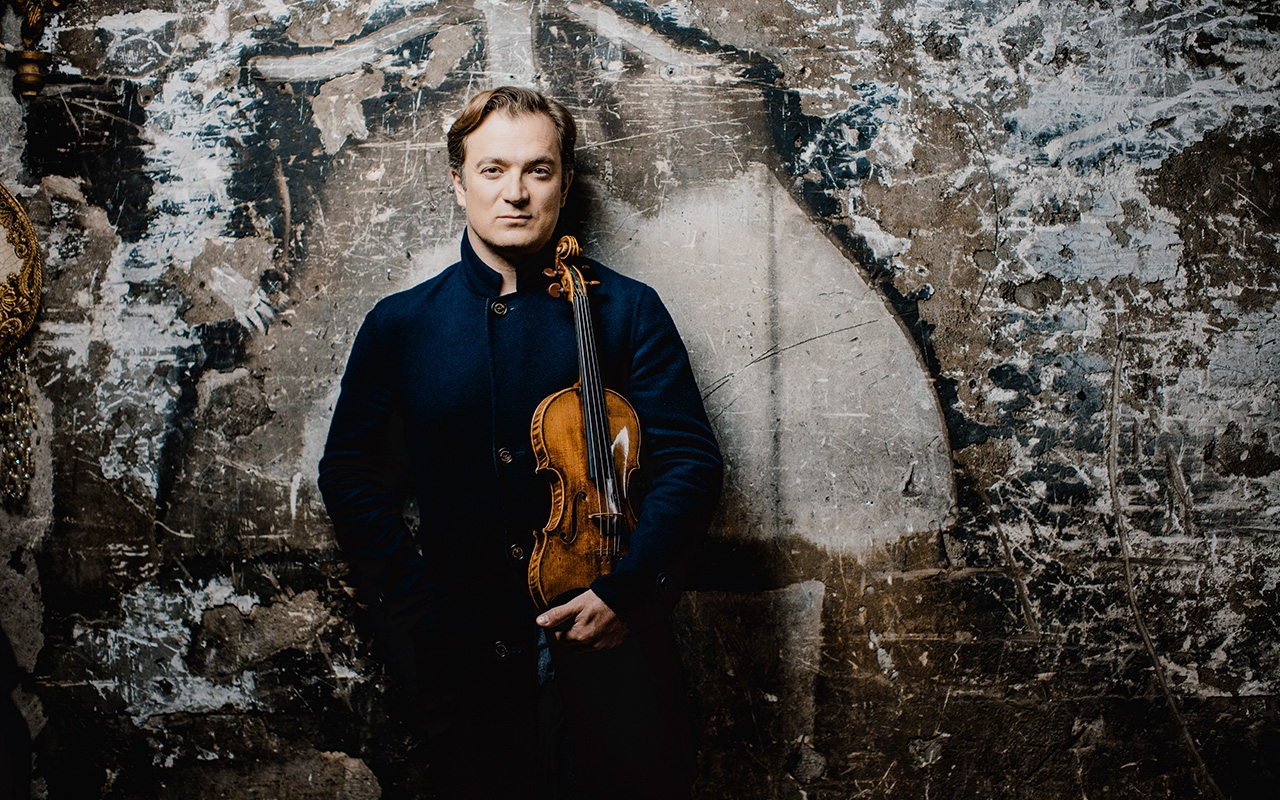
Live review – Renaud Capuçon, CBSO / Anja Bihlmaier: Dvořák, Ravel, Chausson & Bizet

Renaud Capuçon (violin), City of Birmingham Symphony Orchestra / Anja Bihlmaier

Symphony Hall, Birmingham
Wednesday 30 October 2019 (2.15pm)

Bizet arr. Hoffman Carmen Suite no.2 (1887)
Chausson Poeme Op.25 (1896)
Ravel Tzigane (1924)
Dvořák Symphony no.7 in D minor Op.70 (1885)

Written by Richard Whitehouse

This afternoon concert by the City of Birmingham Symphony Orchestra brought a welcome appearance from German conductor Anja Bihlmaier, presiding over an unlikely yet appealing programme as juxtaposed French and Russian music of the late 19th and early 20th centuries.

Bizet‘s Carmen has maintained its hold on the operatic repertoire such that individual items are seldom encountered in concert other than as encores. As arranged by Fritz Hoffmann, this Second Suite astutely alternates entr’actes with vocal numbers. Thus the purposeful Marche des contrebandiers (akin to an offcut from Elgar’s Wand of Youth) precedes the smouldering Habanera, then a Nocturne which is Micaela’s third act aria with its vocal line transferred to violin and soulfully rendered by guest leader Tamas Kocsis. That of the evergreen Chanson du toreador is similarly heard on trumpet, which instrument is duly partnered by flutes in the infectious La garde montante, before wind instruments variously come to the fore during the Danse boheme which rounded off the present selection in appropriately exhilarating fashion.

Renaud Capuçon then joined the orchestra for an unlikely coupling of concertante pieces that is highly effective in concert. It may have been inspired by a Turgenev story, but Chausson‘s Poème is an autonomous entity whose rhapsodic impulses are balanced by formal rigour and an organic evolution as elides between the introspective and ecstatic – a trajectory conveyed with due eloquence by Capuçon, his fastidious tonal shading deftly reinforced by Bihlmaier’s nuanced direction. What is so often an elusive work left a powerful and enduring impression.

As, albeit in its rather more demonstrative way, did Ravel‘s Tzigane. Effectively the result of a bet with violinist Jelly d’Aranyi that this composer could come up with a rhapsody inspired by Hungarian gypsy music, the piece wears its Lisztian antecedents lightly while pointing the way toward the similarly conceived rhapsodies of Bartók. Capuçon teased out the high-drama of its unaccompanied initial section, then – with harpist Alma Klemm – made a breath-taking transition into its heady medley of gypsy-inflected themes prior to the rousing final flourish.

After the interval, Dvořák’s Seventh Symphony came almost as a corrective in its seriousness of purpose and powerful formal logic. Bihlmaier directed a performance as left no doubt as to such qualities, at its best in a thoughtful while never staid account of the slow movement – its brief yet elated climax ideally judged – then a scherzo whose underlying furiant rhythm was suffused with Brahmsian trenchancy (one reason this piece displeased the anti-Dvořák faction decades hence). Not that there was much lacking with the outer movements, though the coda of the initial Allegro was a little too deadpan for its ominousness fully to register, and that of the finale felt too reined-in emotionally; those granitic cadential chords marginally failing to clinch what is surely the most fatalistic of any major-key ending in the symphonic repertoire.

Even so, this was a finely realized account of a work as can all too often misfire. Bihlmaier will hopefully return before long: next week, the CBSO’s principal guest conductor Kazuki Yamada directs a performance of Mendelssohn‘s Elijah, premiered in this city 173 years ago.