In concert – Chaos String Quartet @ University of Birmingham: Haydn, Wallen & Bartók

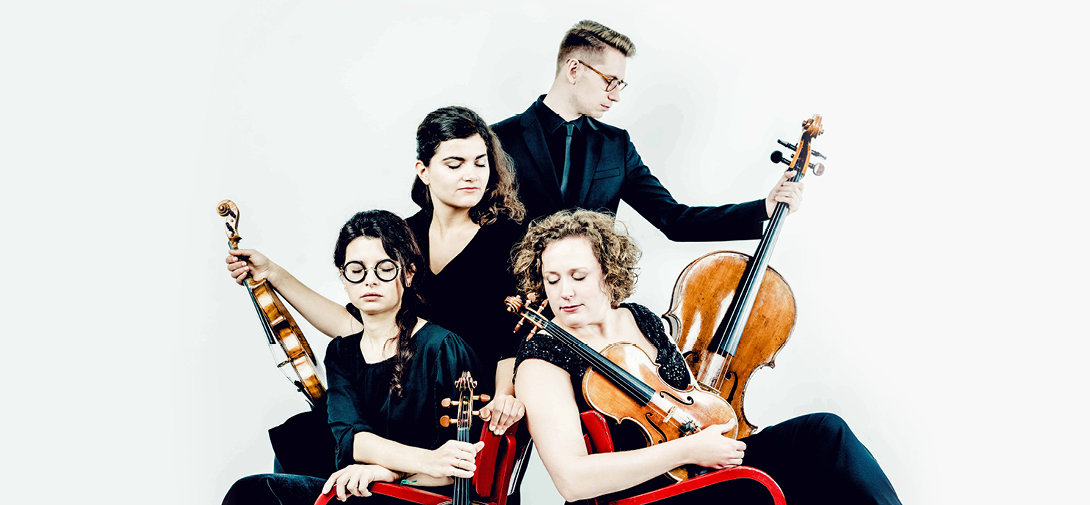
Chaos String Quartet [Susanne Schäffer & Eszter Kruchió (violins), Sara Marzadori (viola), Bas Jongen (cello)]

Haydn String Quartet in E flat major Op.20/1 (1772)
Wallen Remembering 2012 (2025) [BBC commission: World premiere]
Bartók String Quartet no.3 BB93 (1927)

Elgar Concert Hall @ Bramall Music Building, University of Birmingham
Friday 12 December 2025 (1pm)

Reviewed by Richard Whitehouse

Birmingham University’s regular series of lunchtime recitals came to its close for 2025 with one postponed from earlier this year – the Chaos String Quartet (based in Vienna) being heard in a programme that played to the strengths of this most enterprising among younger ensembles.

Its warmly received debut release having featured the fifth of Haydn’s Op. 20 quartets, it was good to hear this group as persuasive in the first work from that groundbreaking set. Certainly its initial Allegro moderato found the right balance between an underlying elegance with that inquiring spirit such as informs all six of these pieces, and was duly abetted by the deceptive playfulness of its ensuing Minuet. The slow movement was as ‘sustained and affectionate’ as its marking indicates it should be, with the final Presto propelled along on its buoyant course.

There have been numerous commissions in BBC Radio 3’s ’25 for 25’ series, with this latest being by Errollyn Wallen (currently Master of the King’s Music). Howsoever its title might be interpreted, Remembering 2012 packs considerable emotion into its five-minute duration – such that the composer might consider extending it or adding further movements. It hardly needs adding that the year in question, coming mid-way between the world financial crash and Brexit, now seems harbinger of a more positive era which manifestly failed to happen.

The recital ended with a performance of Bartók’s Third Quartet which hopefully commended to those present what is the most difficult to grasp of this cycle – not least given the ingenuity of its formal design, along with its innovative if always constructive use of extended playing techniques. Having pursued a suspenseful course across its ‘Prima parte’, the Chaos ensured a visceral impact to its ‘Second parte’ before securing palpable eloquence from the former’s ‘Recapitulazione’, prior to a ‘Coda’ as carried all before it in an outburst of unbridled energy.

A memorable conclusion to an impressive recital, the Chaos returning with the Minuet from the fourth of Haydn’s Op. 20 quartets as teasing encore. Its sophomore recording scheduled early next year, hopefully this most questing ensemble will be back in the UK before long.

Published post no.2,753 – Friday 19 December 2025

For more on the Barber Lunchtime Concerts, head to the Barber Institute website, and click on the links to read more about the Chaos String Quartet and composer Errollyn Wallen

In Concert – PRS Presents – Classical Edition: Manchester Collective @ LSO St Luke’s

Manchester Collective [names not given in the programme but assumed to be Rakhi Singh (violin, director), Jonathan Martindale (violin), Alex Mitchell (viola), Christian Elliott (cello)]

Mason Muttos from Sardinian Songbook
Finnis String Quartet no.2
Wallen Five Postcards
Campbell 3AM
Mason Eki Attar from Tuvan Songbook
Tabakova Insight
Hamilton In Beautiful May
Glass String Quartet no.4 ‘Buczak’ (2nd movement)
Meredith Tuggemo

Wigmore Hall, London
Wednesday 25 September 2024

Reviewed by Ben Hogwood

This inspiring concert, the first in a series presented by the enterprising team at the Performing Rights Society (PRS), revealed the innovation afoot even in the most traditional classical music forms. The string quartet has been an established medium for close on 300 years, but the four players assembled by the Manchester Collective showed where future possibilities lie.

Christian Mason’s work reproduces throat singing for the medium, often with vocal contributions from the players themselves – and the Collective’s performances of Muttos and Eki Attar were gripping and rhythmically vital.

Grabbing the attention in a very different way were quieter works by Edmund Finnis and Jocelyn Campbell. The former’s String Quartet no.2 inhabited the rarefied atmosphere that Finnis seems able to conjure at will, with interlocking phrases and melodies given an unexpectedly tender accent. The Manchester Collective played with beautiful sonority, enhanced by microphones – which in the case of Jocelyn Campbell’s 3AM was an asset, portraying the streets of London in the hour of the day where they are at their most deserted. The slights of hand, the nocturnal rustlings, the shadows we couldn’t quite make out – all were beautifully rendered and sculpted by a composer whose painting in sound is uncommonly vivid.

This was before the elephant in the room – Andrew Hamilton’s In Beautiful May – was dealt with. A piece for solo violin and electronics, it was delivered with great virtuosity by Rakhi Singh, who warned us ahead of the performance that it would be a ‘marmite’ piece. She was absolutely right, playing music that was definitely not for everyone’s enjoyment – and certainly not this reviewer. Hamilton’s collage of jarring violin phrases and pop song snippets meant we jumped between Singh and snatches of Shalamar’s I Can Make You Feel Good, Take That’s Back For Good and Will Young’s Evergreen. The short attention span of the music was infuriating, its cut and paste approach chopping the music into small bits and spitting it against an unforgiving wall. Yet personal feelings should be qualified, as Hamilton’s piece got one of the strongest reactions of the night!

Perhaps surprisingly the second movement from Philip Glass’s String Quartet no.4, Buczak, provided some much-needed balm, with an elegance not normally associated with the American composer. The Manchester Collective gave a beautiful legato performance allowing time for reflection.

Meanwhile Dobrinka Tabakova’s Insight made a strong impression, its folk melodies and rhythms winningly played and melded into an extremely convincing whole, offering further proof of the Bulgarian composer’s assured and compelling writing for strings in particular.

Errollyn Wallen’s Five Postcards, for violin and viola, were given a brilliant performance by Singh and Alex Mitchell. These were a lot of fun, ranging from bluesy musical chats to intimate asides, and a reminder that the combination of violin and viola – used so effectively by Mozart but surprisingly few composers since – is well worth revisiting.

Finishing the concert was Tuggemo by Anna Meredith, using the old English word for a swarm of birds or flies. It made for a suitably hedonistic note on which to finish the concert, with its driving four to the floor beat and jagged quartet riffing. While meant to be loud, the beat swamped the quartet on this occasion, its ultimate destination the middle of a dancefloor before the piece broke off and left us hanging.

This was, however, another example of Manchester Collective’s remarkable virtuosity and further evidence of their clever programming. Both elements combined to make this a memorable and highly stimulating concert.

Published post no.2,313 – 26 September 2024

New Music at the BBC Proms

For our UK readers, a nod in the direction of BBC4 tonight – where there is a chance to experience some of the standout new music heard during this year’s BBC Proms festival.

There is a chance to experience more of one of today’s standout orchestral composers, Andrea Tarrodi – her Birds Of Paradise is featured, inspired by footage from David Attenborough’s Planet Earth and performed by the Deutsche Kammerphilharmonie Bremen, conducted by Pekka Kuusisto (above, photographed by Mark Allan).

From the first night comes Let There Be Light, by Ukrainian composer Bohdana Frolyak, while the National Youth Orchestra perform The Whole World, a heady new work from Errolyn Wallen.

You can watch from 8pm here

BBC Proms at Birmingham – Claire Barnett-Jones & Simon Lepper in songs by Horovitz, Smyth, Clarke, Vaughan Williams & Wallen

BBC Proms at Birmingham – Claire Barnett-Jones (mezzo-soprano), Simon Lepper (piano)

Horovitz Lady Macbeth – a scena (1970) [Proms premiere]
Smyth Fünf Lieder, Op. 4 (c1877) [Proms premiere]
Clarke The Seal Man (1921-2) [Proms premiere]
Vaughan Williams Four Last Songs (1954-8) [Proms premiere of original version]
Wallen Lady Super Spy Adventurer (2022) [BBC commission: World premiere]

Bradshaw Hall, Royal Birmingham Conservatoire

Monday 29 August 2022, 1pm

Reviewed by Richard Whitehouse Photo (Claire Barnett-Jones) (c) Benjamin Ealovega

The series of regional lunchtime Proms this afternoon reached Birmingham for a song recital by Claire Barnett-Jones, whose success at last year’s Cardiff Singer of the World and having studied at Royal Birmingham Conservatoire made her appearance doubly apposite. Equally so the initial item by Joseph Horovitz, after his death in February at 96. Lady Macbeth – a scena revealed his more serious side – with monologues from the first, second and fifth acts of ‘The Scottish Play’ charting the anti-heroine’s journey from aspiration via ambition to desperation.

The music of Ethel Smyth has been a recurrent feature this season – the present set of Lieder a reminder that, before she achieved fame with The Wreckers and notoriety as a suffragette, she had received a thoroughly Teutonic musical education in Leipzig. Fluent and idiomatic, these five settings are fluent and idiomatic: the enervation of Büchner’s Tanzlied followed by the wistfulness of Wildenbruch’s Schlummerlied and eloquence of Eichendorff’s Mittagsrum, then the assertiveness of Groth’s Nachtreiter and transcendence of Heyse’s Nachtgedanken.

Barnett-James rendered them with sensitivity and insight, with Simon Lepper (above) no less attuned to those most often intricate accompaniments. Qualities equally evident in Rebecca Clarke’s luminous setting of Masefield’s evocative if rather prolix The Seal Man as well as Four Last Songs that Vaughan Williams set to texts by his second wife, the poet Ursula Wood. From the fatalism of The Death of Procris, via the acceptance of Tired and the poise of Hands, Eyes and Heart, to the fulfilment of Menelaus – these are songs which speak of a life well-lived.

A very different take on the journey from innocence to experience is proffered by Lady Super Spy Adventurer, written by Errollyn Wallen for this recital and which might be described as a ‘concert aria’ in that its highly visual – and often visceral – rendering of the composer’s own text is balanced by a sure formal sense as to where these deceptively superficial observations are headed. Barnett-James despatched them with suitable aplomb such that Wallen, listening from home, must have been well satisfied.

Vaughan Williams’ Silent Noon, the second song from his cycle of Rossetti poems House of Life, made for an affecting encore.

Click on the artist names for more information on Claire Barnett-Jones and Simon Lepper. For more information on this year’s BBC Proms, head to the festival website

In concert – London Chamber Ensemble & Madeleine Mitchell: A Century of Music by British Women (1921-2021)

London Chamber Ensemble [Madeleine Mitchell (violin, director), Joseph Spooner (cello), Sophia Rahman (piano), David Aspin (viola), Gordon Mackay (violin), Lynda Houghton (double bass), Peter Cigleris (clarinet, bass clarinet), Nancy Ruffer (flute), Alec Harmon (oboe), Bruce Nockles (trumpet), Ian Pace (piano)

Rebecca Clarke Piano Trio (1921)
Judith Weir Atlantic Drift: Sleep Sound ida Mornin’ (1995), Atlantic Drift (2006), Rain and Mist are on the Mountain, I’d Better Buy Some Shoes (Movements I-IV, 2005)
Helen Grime Miniatures (2005)
Judith Weir The Bagpiper’s String Trio (1985)
Cheryl Frances-Hoad Invocation for cello & piano (1999)
Thea Musgrave Colloquy (1960)
Ruth Gipps Prelude for bass clarinet (1958)
Errollyn Wallen Sojourner Truth (2021, world premiere)
Grace Williams Suite for Nine Instruments (1934)

St John’s Smith Square, London
Monday 9 March (review of the online broadcast)

Written by Ben Hogwood

Classical music still has an awfully long way to go before female composers are an integral part of its make-up, but the celebration of International Women’s Day is helping the cause considerably, gaining more traction with each passing year.

One of the highlights of the 2021 celebrations was this concert from St John’s Smith Square, masterminded by Madeleine Mitchell, who led the London Chamber Ensemble in a very satisfying hour-and-a-half of music.

In a concert celebrating eight women composers, the common threads of America and the Royal College of Music were also explored. The latter organisation is where Rebecca Clarke, Grace Williams and Helen Grime all studied, and where Errollyn Wallen and Mitchell herself are now professors. Wallen wrote a new piece, Sojourner Truth, for the occasion.

The concert began however with a terrific performance of Rebecca Clarke’s Piano Trio. Completed in 1921, this substantial piece begins with a passionate outpouring, but it also has its elusive, mysterious moments. The trio of Mitchell, cellist Joseph Spooner and pianist Sophia Rahman caught these elements, getting off to a terrific start but pulling back to allow the enchanting slow movement room to breathe. At times Clarke’s music hints at influences from France – particularly Ravel but also Franck – which Spooner caught in his high intonation in the second movement. The spirit of the dance inhabited the finale, a more obviously English statement, but there was still room for more fervent thoughts when the trio united.

There was a sudden transition on the broadcast to the refreshing open air of Judith Weir’s Atlantic Drift, a compilation of three pieces for two violins proving an invigorating contrast to the denser textures of the Clarke. Weir’s incorporation of folk material into her music is enchanting, especially in the four-part last piece, Rain and mist are on the Moutain, I’d Better Buy Some Shoes. Using a Gaelic song as its inspiration, Weir’s adaptation worked really well in these open air accounts from Mitchell and Gordon Mackay, the empty St John’s providing the ideal acoustic. Weir appeared later with The Bagpiper’s String Trio, a similarly folk-powered work from 1985. Based on a Scottish pipe tune this too lifted the listener away to the great outdoors, with excellent teamwork from Mitchell, Spooner and viola player David Aspin.

Helen Grime’s trio of Miniatures for oboe and piano were next, studies in compressed expression from the pale harmonics of the first to the jagged edges of the second. The third was an effective summation of Grime’s thoughts, panning out for a wider perspective from the piano. Alec Harmon and Sophia Rahman were fully responsive to the virtuoso demands.

Cheryl Frances-Hoad’s Invocation for cello and piano followed, a late teenage piece offering an immediate chance to appreciate the probing line given to Joseph Spooner’s fulsome cello. As the composer’s response to Edvard Munch’s painting Melanchola reached its apex there were clangorous chords from Rahman, capping a compact but powerful utterance.

Thea Musgrave’s Colloquy was next, another model of economy – four short pieces for violin and piano packed with sharp, expressive statements. There were some challenges to performance here – such as the quick interchange between pizzicato and bowing in the second movement – which Mitchell took in her stride. The third piece was a touch more playful but still assertive, but the fourth was the most effective, a private train of thought gracefully prompted by Ian Pace’s piano.

The most striking piece of the evening – for its sound, its soul and its warmth – was Ruth GippsPrelude for bass clarinet. Gipps’ centenary falls this year, and her slightly baleful writing for the instrument was beautifully captured by Peter Cigleris, a model of control. After watching this I was struck by two questions – why do we not hear the music of Gipps more, and why are there not more pieces for solo bass clarinet?

Errollyn Wallen’s Sojourner Truth followed, written not just for Madeline Mitchell but for International Women’s Day – and taking us back to violin and piano. Based on a spiritual, O’er the crossing, it features intense dialogue between the two instruments, but when the melody is heard unaccompanied on the violin the ear is pulled firmly towards the centre of the music, a striking feature of another piece with more traditional inspirations.

To finish, we heard the 75-year-old Suite for Nine Instruments by Grace Williams. Scored for piano quintet, double bass, flute, clarinet and trumpet, it is a vivacious piece, quite modal and with hints of Stravinsky’s Septet for a similar instrumental combination – and equally driven in the outer movements, bringing the interval of a tritone right to the front. The London Chamber Ensemble played with flair, commitment and virtuosity, bringing a very impressive program to a close.

The concert is available to watch until 8 April on the link below – with some spoken introductions by Mitchell herself. On occasion the gaps between pieces are very short, but there are helpful markers to make viewing easier. Do make sure you watch, as some of the best chamber music from British women composers in the last 100 years is right here.

A Century of Music by British Women (1921-2021) on International Women’s Day, directed by Madeleine Mitchell from St John’s Smith Square on Vimeo.

Meanwhile, Madeleine and the London Chamber Ensemble’s album of works by Grace Williams can be heard here: