
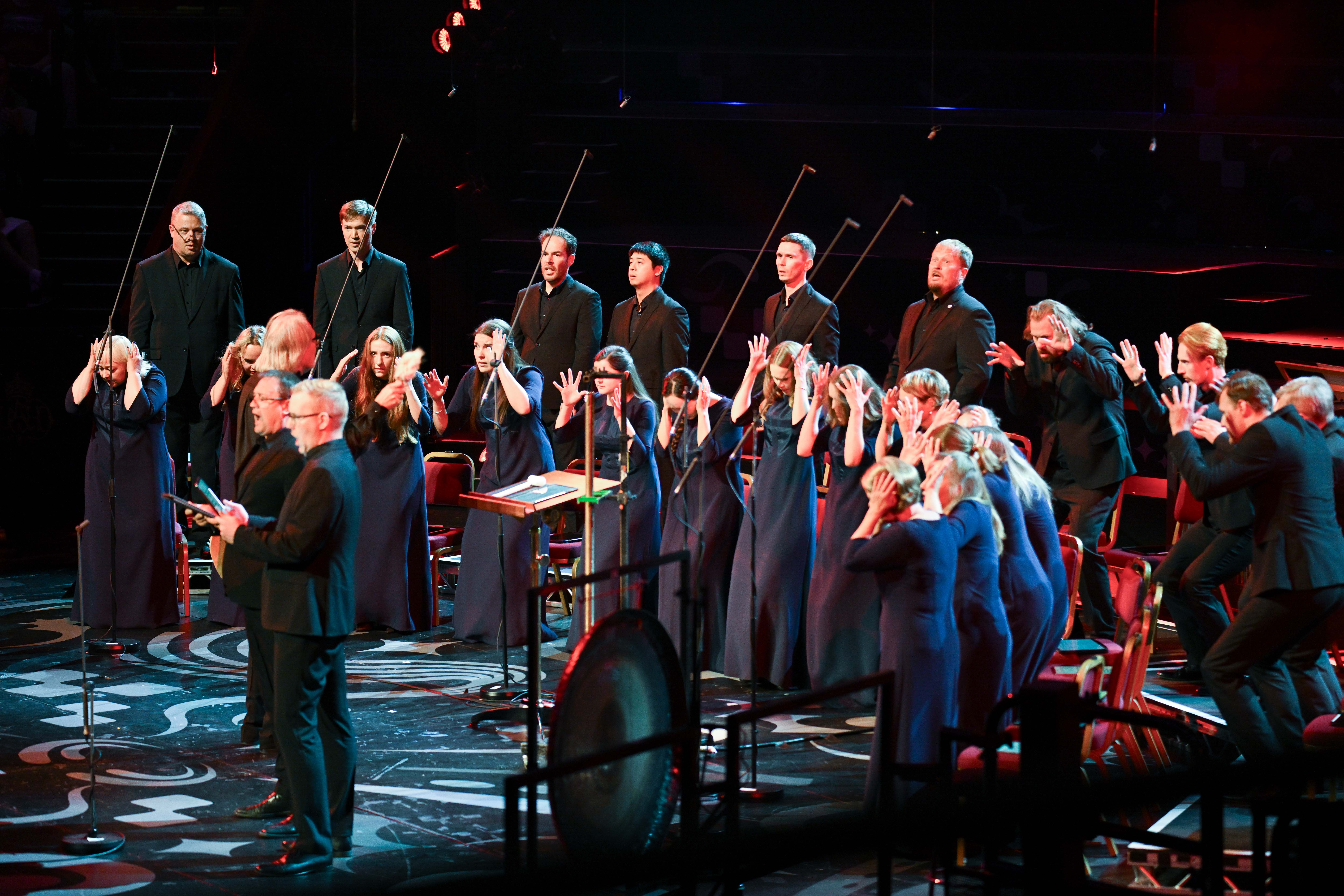
Annika Lõhmus, Yena Choi (sopranos), Toomas Tohert (tenor), Geir Luht (bass), Estonian Philharmonic Chamber Choir, Kadri Toomoja (organ) / Tõnu Kaljuste
Arvo Pärt Da pacem Domine (2004/6); Veni creator (2006); Magnificat (1989); The Deer’s Cry (2007); Für Jan van Eyck (2020) (UK premiere)
Galina Grigorjeva Svyatki – ‘Spring is Coming’ (2004)
Rachmaninov All Night Vigil (Vespers) Op.37 (1915): Slava v vyshnikh Bogu; Bogoroditse Devo
J.S. Bach Motet: Ich lasse dich nicht, BWV Anh.159 (1713)
Arvo Pärt Peace upon you, Jerusalem (2002); De profundis (1980)
Tormis Curse upon Iron (1972, rev. 1991)
Arvo Pärt Vater unser (2005/11); encore: Estonian Lullaby (2002)
Royal Albert Hall, London
Thursday 31 July 2025 (late night)
Reviewed by Ben Hogwood Photos (c) BBC / Chris Christodoulou
The music of Arvo Pärt is ideal for the special atmosphere of a late-night Prom. Yet this was no ordinary concert, being a celebration of the Estonian composer’s forthcoming 90th birthday in September, given by his close friend and collaborator Tõnu Kaljuste, conducting the Estonian Philharmonic Chamber Choir.
This combination of performers have been mainstays of the Pärt discography, forming a celebrated partnership with the ECM label that began with the landmark Tabula Rasa album of 1984, a cornerstone for Pärt’s critical and commercial success.
Pärt is often referred to as a ‘holy minimalist’, to which the response should be that his music is not ‘wholly minimal’. The substantial orchestral works attest to that, though here we heard much slighter but equally meaningful pieces for choir, most given unaccompanied by the 25-strong Estonian ensemble. The Proms audience were commendably quiet, leaning in to appreciate both the delicacy and crystal purity of the voices. The program was well-thought, realising the expressive potential of Pärt’s music alongside that of Bach, Rachmaninov and fellow Estonians, Veljo Tormis and Galina Grigorjeva.
The solemn Da pacem Domine and open-air Veni creator made an ideal opening couplet, the choir projecting with striking clarity rather than volume. For silence, too, plays a critical role in Pärt’s music, and Kaljuste ensured the spaces between the notes were every bit as expressive.
The Magnificat revealed its hidden power, while The Deer’s Cry was perfectly phrased, Pärt’s lilting cadences casting a spell. Für Jan Van Eyck, setting the text of the Agnus Dei, found the ideal balance between the reduced choir and Royal Albert Hall organ, where Kadri Toomoja had the ideal registration. Peace Upon You, Jerusalem, for female voices, contrasted silence with brightly voiced choral statements, while the solemn De profundis, for male voices, began from a small cell, maintaining rapt concentration while punctuated by organ and percussion.
Galina Grigorjeva’s Svyatki was a beautiful meditation, led by the heavenly voice of soprano Yena Choi, her voice with a remarkable bell-like clarity. Bach’s motet, previously attributed to his son Johann Christian, was impeccably voiced and phrased, but while the two excerpts from Rachmaninov’s All-Night Vigil were arguably less successful, they reflected a familiarity with listening to big choirs perform this music, rather than the subtleties of a chamber choir. Purity proved ample compensation for volume here.
This was emphatically not the case in Curse upon Iron, a remarkable setting from Veljo Tormis, of words from the Finnish national epic, the Kalevala, translated into Estonian. Describing the horrors of war, it sends a chill down the spine right from the primal call to arms of the shaman drum, struck by Kaljuste himself, then from the restrained urgency of the choir, like a coiled spring. While listening it was impossible not to think of the current plight of Ukraine and by extension in fear for the Baltic states, especially as Tormis’ writing was brought to a horrific climax. This was realised through the elemental power of tenor Toomas Tohert, bass Geir Luht and the choir, turning from side to side with watchful dread but then erupting in barely concealed anger. It was a remarkable performance, which will live long in the memory.
After this emotionally shattering encounter, the balm of Vater unser, Pärt’s German setting of The Lord’s Prayer for Pope Benedict, was just what was needed, its simplicity all the more affecting for what went before. As an encore, Kaljuste found just the right complement in the choir and piano version of Estonian Lullaby, its pauses near the end the musical equivalent of drooping eyelids. It was a most effective end to a special concert, Arvo Pärt’s musical essence distilled for a most appreciative audience.
You can listen back to this Prom concert on BBC Sounds until Sunday 12 October.
Click to read more about the BBC Proms
Published post no.2,608 – Sunday 27 July 2025


 Arcana.fm