Online Concert: Vision String Quartet play Shostakovich & Mendelssohn @ Wigmore Hall

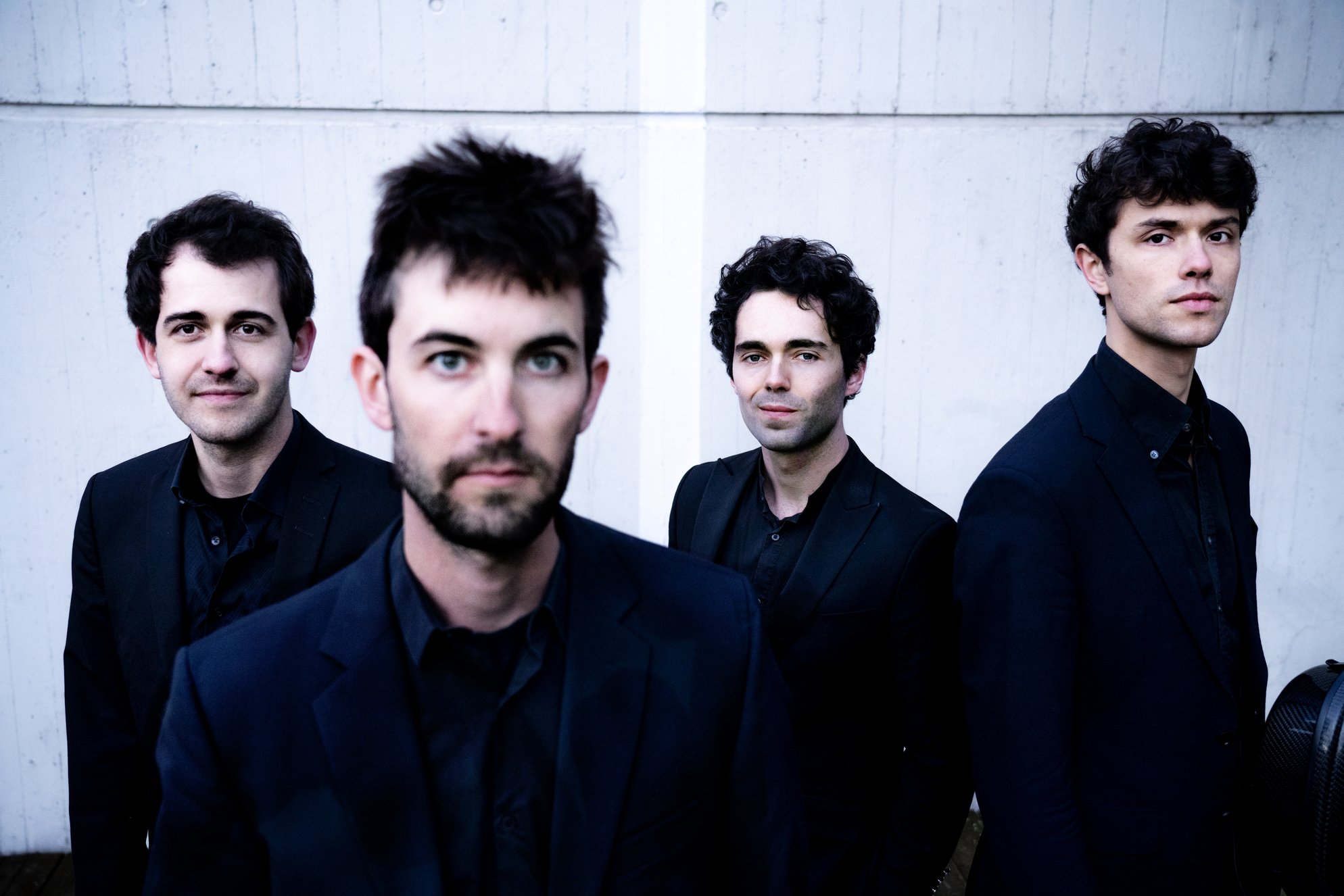
Vision String Quartet [(Florian Willeitner, Daniel Stoll (violins), Sander Stuart (viola), Leonard Disselhorst (cello)]

Shostakovich String Quartet No. 8 in C minor Op. 110
Mendelssohn String Quartet No. 2 in A minor Op. 13

Wigmore Hall, Monday 27 February 1pm

by Ben Hogwood

Vision String Quartet are a dynamic young ensemble based in Berlin, who play with great freedom – foregoing printed music and playing standing up (save for the cello of course). Neither of these attributes are gimmicks, for they suit an ensemble who have a charismatic presence and gave two performances of substantial minor key string quartets with passion and attention to detail. The program presented an interesting juxtaposition, the pieces written in very different circumstances but using the string quartet medium to air very private thoughts.

The String Quartet no.8 is the most played in Shostakovich’s canon of 15 string quartets – and arguably receives a disproportionate coverage when compared to the other fine works in the cycle. Yet in a good performance it makes an extremely powerful connection with its audience, as they learn the circumstances in which the composer wrote it.

In 1960 Shostakovich was in fear of his life, and the Eighth Quartet was his unofficial epitaph. An autobiographical work, it contains quotes from some of his most successful and important earlier works, including the Piano Trio no.2, the First and Fifth Symphonies and the recently completed Cello Concerto no.1. It begins with a sombre Largo, which the ensemble played with great sincerity. It is sometimes argued that it takes a Russian quartet to fully understand these works, and certainly the Borodin String Quartet interpretations loom large over whoever dares to take them on, but this performance took the plunge with impressive surety.

Technically the quartet were superb, the lower parts of viola and cello driving the faster passages with obdurate figures. Meanwhile first violinist Florian Willeitner found a suitably plaintive tone over the held drone from the other three instruments when the music almost came to a standstill, a most moving part of the first movement. The torrid second movement gritted its teeth, while in the chilling fourth movement, the rat-a-tat motion (thought to depict gunfire or the Russian authorities knocking on the door) left a lasting impression. The Vision players were keen to emphasise the dissonances throughout, and this approach carried all the way through to the final resolution, which was all the more telling as a result.

After this performance Mendelssohn’s String Quartet no.2 in A minor was warm in comparison, yet this is not one of the composer’s sunniest works, written as it was in the grip of an unrequited love.

Affectionately played, the first movement caught the right tension between major and minor key, with an airy outlook from Willeitner’s first violin, but with the increasing incursion of the minor key something of a shadow fell over the music. The temperature warmed appreciably for the second movement, its figures delicately sung and balanced  with attractive countermelodies from around the quartet.

The third movement was a subtle charmer, its subject responding well to an unfussy presentation and subtle rubato, the Vision happy to manipulate the lilting dance rhythms rather tastefully. A skittish end cut to a vigorous, almost violent set of tremolos ushering in the presto finale, which fizzed with energy and enthusiastic interplay. The Vision Quartet secured a really nicely paced finish, winding down to a seraphic major key coda which was thoughtful and radiant.

As an encore the quartet delved into their new album Spectrum for Copenhagen, a collaborative work penned by the four instrumentalists themselves. A persuasive rhythm took shape over a cello ostinato figure, given out by the quartet with drive and passion. The piece had a rustic air which spoke of the outdoors, offering a promise of spring after two wintry works.

For more livestreamed concerts from the Wigmore Hall, click here – and for more about the artists, visit the Vision String Quartet website

In concert – Alice Coote, Philharmonia Orchestra / John Eliot Gardiner: The Sea and the Land: Mendelssohn, Elgar & Dvořák

Mendelssohn Hebrides Overture Op.26 ‘Fingal’s Cave’ (1830, rev. 1832)
Elgar Sea Pictures Op.37 (1899)
Dvořák Symphony no.5 in F major Op.75 (1875, rev. 1887)

Alice Coote (mezzo-soprano), Philharmonia Orchestra / John Eliot Gardiner

Royal Festival Hall, London
Thursday 16 February 2023

Reviewed by Ben Hogwood Picture credits – John Eliot Gardiner (c) Sim Canetty-Clarke; Alice Coote (c) Jiyang Chen

This was an ultimately invigorating concert, using a cleverly constructed programme to look at how composers respond to the earth itself.

We began off the west coast of Scotland, the Inner Hebrides to be exact – and the uninhabited island of Staffa. Here it was that Mendelssohn saw Fingal’s Cave (above) in the summer of 1829. His musical response has become one of the composer’s best-loved pieces, an early and remarkably vivid example of the symphonic poem. Under John Eliot Gardiner, the Philharmonia Orchestra recounted the scene with remarkable accuracy, capturing the unusual, organ-like appearance of the landmark as well as the sea spray crashing around it. Gardiner steered a sure-footed and clear course through the water, aided by a wonderful clarinet duet from Mark van de Wiel and Laurent Ben Slimane in the second theme.

Alice Coote (above) then joined the orchestra, transporting us to the rarefied waters of Elgar’s Sea Pictures, the mezzo-soprano bringing to life five carefully chosen gems that took the composer far from his desk in Malvern in 1899. It took a while for singer and orchestra to achieve the optimum balance, so the words on the screen above were helpful as Coote found her feet. She did so quickly, and the somnambulant atmosphere of Sea Slumber-Song was cast, the strings lapping at the edges of Coote’s beautifully placed words. As she grew into the role so the gently rocking In Capri was attractively weighted and subtly intense.

Sabbath Morning At Sea was solemn yet soon reached for the heights, Coote’s innate grasp of the text matched by Gardiner’s control and shaping of the melodic line from the orchestra. The celebrated Where Corals Lie was perhaps inevitably the highlight, but The Swimmer ran it close, running all the way to a richly coloured high register from the singer at the end. Support came from the depths, too, with Alistair Young’s sensitive contribution on the Royal Festival Hall organ one to savour.

We returned to land for Dvořák’s Symphony no.5, the work with which he ‘rebooted’ his career as an orchestral composer in 1887, his publisher having spotted an opportunity to re-promote a piece finished in 1875. In this concert the parallel with the seasons was irresistible, the symphony’s first movement in particular resembling the flourishing of flowers in spring. Fleet footed strings were complemented by fresh faced woodwind, headed by the burbling clarinets who shone once again in the opening theme.

The Fifth is a sunny work, sitting in the shadow of the last three symphonies (nos.7-9) where live performances are concerned. As this concert revealed, however, it is a descendant of Beethoven’s Pastoral symphony, a work with considerable depth of its own and many different orchestral colours in which to revel. After a vivacious first movement, where Dvořák’s themes were given the best possible chance to shine, the cellos took the lead in their burnished opening to the romantic slow movement. This serious, minor key theme – surprisingly similar to the main tune of the Mendelssohn – was supplemented by an attractive, triple-time dance in the major key.

The slow movement segued effortlessly into the Scherzo, where the flurry of violins conjured up a vision of dancers trying to find their feet on the floor. The give and take between orchestral sections was a delight both to hear and to watch, as it was in the finale. The material here turns a little sour initially, Dvořák struggling manfully to regain the positive demeanour of the first movement. In Gardiner’s hands this was a compelling argument, ultimately won with the help of the superb Philharmonia brass, trombones punching out their melodies to thrilling effect. Once the ‘home’ key was reached the winter storms retreated and we basked in glorious musical sunshine, capping a fine evening where spring really did seem within touching distance.

You can read all about the 2022/23 season and book tickets at the Philharmonia Orchestra website.

In concert – Kathryn Rudge, English Symphony Orchestra / Kenneth Woods – Across The Sea: Mendelssohn, Elcock, Britten & Elgar

Mendelssohn Calm Sea and Prosperous Voyage Op.27 (1828)
Elcock Wreck Op.10 (1998) [World Premiere]
Britten Four Sea Interludes from Peter Grimes Op.33a (1945)
Elgar Sea Pictures Op.37 (1899)

Kathryn Rudge (mezzo-soprano), English Symphony Orchestra / Kenneth Woods

Malvern Theatres, Great Malvern
Saturday 15 October 2022

Reviewed by Richard Whitehouse

This first full-length concert in the English Symphony Orchestra’s new season focussed on the sea in all its varied qualities, taking in four works whose encompassing a span of almost two centuries also identified crucial aesthetic differences as to what music itself can express.

Not least as it comes between masterpieces of the early Romantic era (A Midsummer Night’s Dream and The Hebrides), Mendelssohn’s Calm Sea and Prosperous Voyage has often been overlooked on its own merits. Yet this concert overture, as inspired by two of Goethe’s best- known poems, is a fine example of the still-teenage composer’s prowess – Kenneth Woods securing a rapt intensity in its introductory phase, then steering its characterful continuation through to a grand while not unduly bathetic peroration with the sea accorded the final word.

From here to Steve Elcock’s Wreck is to encounter more elemental, even existential forces – what the composer refers to as a ‘‘symphonic allegory’’ portraying a ship’s struggle against intemperate weather at sea. This unfolds as a constantly evolving design, juxtaposing music of unchecked aggression with that of fraught serenity, while highlighting Elcock’s mastery of large-scale formal and expressive contrasts, toward a seismic culmination whose gradual subsidence makes possible the sustained closing section. Here, off-stage mezzo sings in an invented (hence unknown) language what he describes as ‘‘a message of salvation beyond despair, of consolation beyond grief’’ but even this is tempered by encroaching doubt. The ESO gave its all in a piece as demonstrably commended itself to the appreciative audience.

Marine vignettes rather than epics came after the interval. Woods had an audible grasp of the diverse moods in the Four Sea Interludes that Britten drew from his opera Peter Grimes, but more notable was his successful segueing between them – the keening plangency of Dawn leading into the equivocal assurance of Sunday Morning, emergent tonal and emotional blur of Moonlight, then the visceral conflict of Storm with its yearning oasis of calm and brutal closing onslaught. A few failings of ensemble hardly offset the intent continuity of the whole.

The ESO previously recorded Elgar’s Sea Pictures in an arrangement with chorus by Donald Fraser, but it was good to hear this song-cycle as Elgar realized it for mezzo – not least when Kathryn Rudge (taking her customary place at front of stage) proved so eloquent an exponent. The troubled pathos drawn from Roden Nole’s Sea-Slumber-Song was duly complemented by the whimsical charm of Alice Elgar’s In Haven (Capri) – tension rising accordingly for Elizabeth Barrett Browning’s Sabbath Morning at Sea, its larger emotional contrasts well defined. Expressive nuances in Richard Garnett’s Where Corals Lie might have been more subtly pointed, but there was no doubt as to Rudge’s identification here or in Adam Lindsay Gordon’s The Swimmer with its anxious though determined progress to certain affirmation.

It set the seal on a rewarding programme and fine start to what will hopefully be an eventful season for the ESO. More concerts will be announced soon, but for now the recent release of Adrian Williams’s First Symphony (Nimbus NI6432) confirms this as an orchestra on a roll.

For more information on the artists in this concert, click on the links to read about Kathryn Rudge, Kenneth Woods and the English Symphony Orchestra. For more on composer Steve Elcock, click here

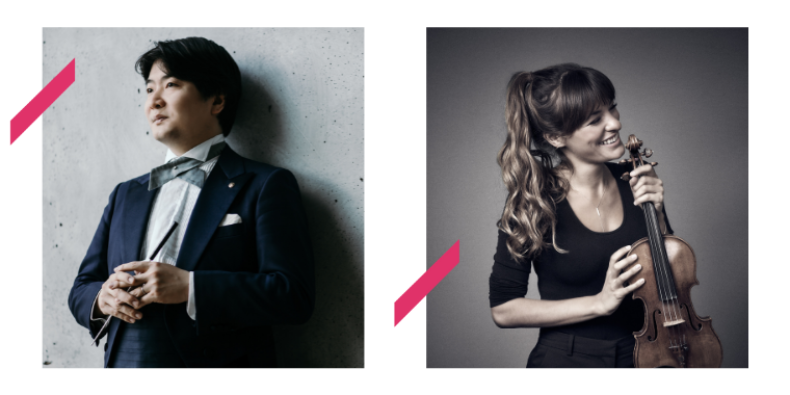
In concert – Nicola Benedetti, CBSO Chorus and Symphony Orchestra / Kazuki Yamada: Dvořák, Mendelssohn & Grigorjeva

Dvořák Carnival Overture, Op. 92 (1892)
Mendelssohn Violin Concerto in E minor, Op. 64 (1844)
Grigorjeva In Paradisum (2012)
Dvořák Symphony no.9 in E minor Op.95 ‘From the New World’ (1893)

Nicola Benedetti (violin), CBSO Chorus, City of Birmingham Symphony Orchestra / Kazuki Yamada

Symphony Hall, Birmingham
Tuesday 20 September 2022

Reviewed by Richard Whitehouse

It may have been a largely mainstream programme, but tonight’s concert by the City of Birmingham Symphony Orchestra drew a capacity house at the beginning of a season in which Kazuki Yamada takes on the reins for what looks an eventful new era near the start of the orchestra’s second century. The CBSO’s response in Dvořák’s Carnival Overture more than confirmed it was ready for the challenge – Yamada ensuring the nocturnal evocation at its centre worked its evocative spell, then building an irresistible momentum going into the thrilling final bars.

Mendelsohn’s Violin Concerto cannot have been absent from many of the CBSO’s previous 102 seasons and made its appearance this evening, Nicola Benedetti tackling a piece she must herself have played on many occasions. Not that there was anything routine about a reading such as abounded in subtle touches – especially the opening Allegro’s cadenza, which more than usually fulfilled its role as this movement’s structural fulcrum. In the Andante, Benedetti pointed up the expressive contrast between its main themes; the second of which was notable for a tonal astringency that brought out its plangency in full measure. If there was nothing so arresting in the finale, the interplay of soloist and orchestra was astutely judged through to the effervescence of the closing bars. Certainly, a performance to make one enjoy the piece anew.

Introducing the second half, Yamada requested the audience remain silent during the pause between pieces – the first a setting of In Paradisum by Ukrainian-born Galina Grigorjeva (b 1962), its lucid harmonies and heady culmination bringing the best out of the CBSO Chorus.

From here to the New World Symphony was no great step. Once again, a work rarely absent from the CBSO’s schedule seemed largely revitalized. Not that all of Yamada’s interpretative decisions came off – after an introduction of no mean gravitas the opening Allegro unfolded a little fitfully, though so interventionist an approach might have gained from the exposition repeat to place these in greater context. There were similar touches in the Largo, yet here the focus of Yamada’s conception and the raptness of the player’s concentration were their own justification – not least towards the close, with the front desks combining to poignant effect. Without being driven as ruthlessly as is often the case, the Scherzo has the requisite impetus and, throughout its trio, a whimsical elegance which proved as engaging as the charged coda.

Heading into the final Allegro with minimal pause, Yamada brought out its inherent force but also the ruminative eloquence of its second theme; the transition to which, in the reprise, was ideally judged. Nor did the apotheosis lack for drama as those closing bars melted into silence.

Prior to the start of this concert, a minute’s silence was observed then (most of) the audience joined in possibly its first rendering of God Save the King. A more localized farewell was paid later in the evening to Colin Twigg, first violinist for over 31 years and whose retirement will hopefully see more of his own compositions as have featured in Centre Stage recitals over the years. A miscellany is featured on a Toccata Classics release and worth anyone’s investment. The CBSO will be back in action on Saturday with a major new commission from Brett Dean.

You can read all about the 2022/23 season and book tickets at the CBSO website. For further information on the night’s artists, click on the names for composer Galina Grigorjeva, and for artists Nicola Benedetti and Kazuki Yamada

In concert – Daishin Kashimoto, CBSO / Kazuki Yamada: Prokofiev, Bruch & Mendelssohn

kazuki-yamada-2

Prokofiev Symphony no.1 in D major Op.25 ‘Classical’ (1916-17)
Bruch
Violin Concerto no.1 in G minor Op.26 (1866-8)
Mendelssohn
Symphony no.3 in A minor Op.56 ‘Scottish’ (1829-42)

Daishin Kashimoto (violin, below), City of Birmingham Symphony Orchestra / Kazuki Yamada (above)

Symphony Hall, Birmingham
Wednesday 4 May 2022, 2.15pm

Written by Richard Whitehouse

Just under a year before he becomes chief conductor, Kazuki Yamada was back with the City of Birmingham Symphony Orchestra for a programme of well-established favourites, which no doubt accounted for the gratifyingly full house that duly greeted his arrival on the podium.

There was humour aplenty in this account of Prokofiev’s Classical Symphony – not least with Yamada almost acting out the initial Allegro’s whimsical second theme, but the highlight was a Larghetto whose sometimes disjunct episodes came together effortlessly. The outer sections of the ensuing Gavotte seemed a little too mannered to be convincing, but the Finale found conductor and orchestra at one in conveying the scintillating wit but also winsome pathos of its main themes, with a pointing of incidental detail then audible ‘lift off’ to the closing bars.

His decade as first concert-master of the Berlin Philharmonic likely accorded him less profile as a soloist, but his take on Bruch’s First Violin Concerto confirmed Daishin Kashimoto as a force to be reckoned with. Determined not to undersell the Prelude, he and Yamada brought out this music’s sombreness as keenly as its lyricism and, at its climax, a tempestuous energy that found the CBSO at its collective best. Nor was there any lack of emotional gravitas in the Adagio, Kashimoto drawing out its rapturous lyricism without neglecting those more intimate asides which resonate long after the music ceases. Emerging with real anticipation, the final Allegro had no lack of underlying impetus and, in its second theme, a high-flown eloquence that set the seal on this movement, and this piece overall, going into the decisive closing bars.

If the second-half performance of Mendelssohn’s Scottish Symphony was not so consistently satisfying, it reaffirmed just why this work (and this composer) has remained a favourite of Birmingham audiences over the decades. Many latter-day accounts tend toward a decidedly Classical brusqueness, but Yamada chose never to rush the opening movement such that the poignancy of its introduction (rightly) persisted through those agitated contrasts of its main Allegro – the absence of an exposition repeat barely detracting from the music’s emotional weight. Effervescent without being overdriven, the scherzo provided ideal contrast between this and an Adagio whose alternate fervour and rhetoric never skirted that sentimentality as was once all too familiar – with Yamada ensuring clarity through even the densest textures.

As in the Bruch, this performance adhered to the ‘attacca’ indications by which Mendelssohn helps to maintain long-term cohesion. That into the finale launched this movement in bracing fashion and if impetus marginally faltered over the latter stages, the pathos at the outset of its coda made for an ideal transition into the peroration which, uplifting or grandstanding as one hears it, ensures a rousing conclusion that seldom fails to bring the house down. Which it did at the close of a reading that found the burgeoning CBSO/Yamada partnership in fine fettle.

Yamada will be back with this orchestra for the start of the 2022/23 season (details of which have just been announced), while next week brings the season’s last appearances with Mirga Gražinytė-Tyla for a brace of programmes that feature Tchaikovsky, Bruckner and Brahms.

For more information on the CBSO’s 2021/22 season, visit their website, and for details on the newly announced 2022/23 season click here. Meanwhile for more information on the artists, click on the names to access the websites of Kazuki Yamada and Daishin Kashimoto