
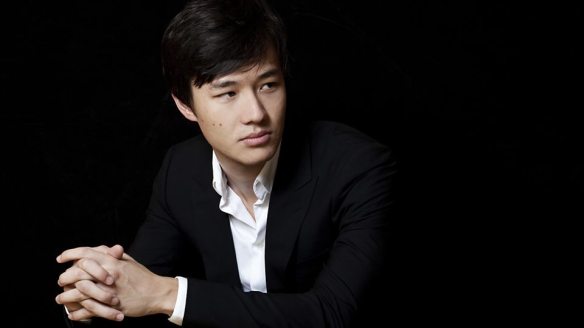
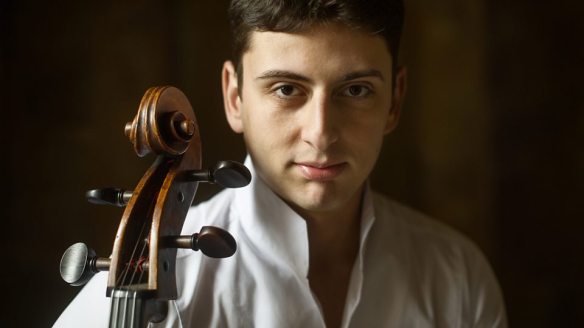
Louis Schwizgebel (piano, above), Benjamin Beilman (violin), Narek Hakhnazaryan (cello, both below)
Shostakovich Piano Trio no.1 Op.8 (1923) (from 2:14 on the broadcast link below)
Rachmaninov arr. Gayane Hakhnazaryan Vocalise Op.34/14 (1915)
Mendelssohn Piano Trio no.1 in D minor Op.49 (1839)
Wigmore Hall, London
Monday 1 April 2019
To hear the BBC broadcast through BBC Sounds, please follow this link
Commentary and Review by Ben Hogwood
A piano trio of exciting soloists gave this memorable concert at the Wigmore Hall as part of BBC Radio 3’s Lunchtime Concert series.
Pianist Louis Schwizgebel, violinist Benjamin Beilman and cellist Narek Hakhnazaryan are all making a name for themselves on their own terms, but by uniting for chamber music performances illustrate the very first principles of why this music was written.
Before their stylish performance of Mendelssohn’s Piano Trio no.1, we heard them in early Shostakovich – his first of two works in the popular form. The Piano Trio no.1 is not a typical work in the context of the composer’s full output, however – but it does show a prodigiously talented 17-year old student making formal innovations and writing heartfelt music, in this case pointing towards the work’s dedicatee, Tatyana Glivenko.
Shostakovich’s teacher Maximilian Steinberg perceived his increased ‘enthusiasm for the grotesque’, documented in Anthony Burton’s excellent notes for this concert, but looking back in the context of the composer’s full output this fascinating work revealed more of a debt to Russian romanticism than could initially be expected.
Beilman and Hakhnazaryan picked up this connection in their ardent melodies, while the steely piano of Schwizgebel gave some clues as to the source of Steinberg’s displeasure. Here though they put the seal on an outstanding account of music full of energy but with its excesses curbed through Shostakovich’s compact design. A captivating performance which is well worth experiencing from 2:14 on the broadcast link.

The inclusion of Rachmaninov’s Vocalise (from 17:50) made good sense in the context of the Shostatkovich. Made by Gayane Hakhnazaryan, mother of Narek, this arrangement illustrated the versatility of Rachmaninov’s original, more familiar to us in orchestral guise or for solo instrument with piano. Violin and cello dovetailed beautifully here, the trio managing the balance with an appropriate blend of nostalgia and poise.
Mendelssohn’s Piano Trio no.1 is perfectly suited to a recital such as this, a piece with virtuoso demands that would appeal to the soloists but also a work whose close integration brings a special intimacy to its more reflective moments. This was a terrific performance, the darker colours of the first movement established immediately in Hakhnazaryan’s heartfelt cello subject (27:02). A doleful second movement Song without words was lighter but also touching (37:04), before the twinkling right hand figures of Louis Schwizgebel led a sparkling account of the Scherzo (44:20).
The finale fused all these qualities, starting in relative seriousness and darkness (48:04) but finding bright light as the music transferred subtly but gloriously to the major key (55:16).
As an encore the Scherzo twinkled again, completing a concert notable for its fresh, enthusiastic and virtuosic qualities. Catch it if you can!
Further reading and listening
The music in this concert can be heard in the best available recordings on Spotify here:


 The bright voices of the ladies of the Scottish Chamber Orchestra Chorus helped, too – and Ye spotted snakes received a charming account, especially with the clarity and control of soloists Rowan Pierce (above) and Jessica Gillingwater, both of whom sang beautifully. The Nocturne and Wedding March were charming too, the latter briskly dispatched, but if anything the lesser known Dance of Clowns and choral finale Through this house made an even stronger impression.
 The lean strings were quite a shock, as were the striking sonorities with the composer imaginatively doubling horn and bassoon. The tension went up a notch when the chorus joined, singing with real vehemence in the Chorus of the Druid Guards and Heathen People. The three soloists were excellent, too – the probing tone of tenor Martin Mitterutzner complemented by the fuller sound of Huw Montague Rendell (above), whose baritone carried effortlessly to the corners of the hall, and the rounded, velvety quality of Hilary Summers’ contralto.

 Arcana.fm