
In concert – Carolin Widmann, CBSO / Nicholas Carter: Haydn, Ligeti & Brahms

Carolin Widmann (violin, below), City of Birmingham Symphony Orchestra / Nicholas Carter

Haydn Symphony no.96 in D major Hob.1/96 ‘Miracle’ (1791)
Ligeti Violin Concerto (1989-93)
Brahms Symphony no.3 in F major Op.90 (1883)

Symphony Hall, Birmingham
Wednesday 1 November 2023

Reviewed by Richard Whitehouse

Tonight’s concert by the City of Birmingham Symphony Orchestra saw a collaboration with the well-regarded Nicholas Carter – former chief conductor of the Adelaide Symphony, now holding that position with Bühnen Bern alongside guest appearances in Europe and the US.

Few conductors would nowadays begin a programme with a Haydn symphony, and Carter’s take on no.96 did not lack for conviction. The Miracle of a falling if harmless chandelier may have taken place at the premiere of no.102 but does not lessen the quality of this work, its slyly portentous Adagio introducing an Allegro whose motivic unity is most evident in a tensile development and agile coda. With felicitous writing for oboe (rendered so by Helena Mackie) and violin (a welcome ‘guest lead’ from Zoë Beyers), the Andante is the highlight – Carter making the most of antiphonal violins where the gains in clarity or incisiveness were never in doubt. Steady but with a lilting grace then a piquant trio, the Minuetto was a perfect foil to the final Vivace – its energetic interplay duly capped by a coda of uninhibited verve.
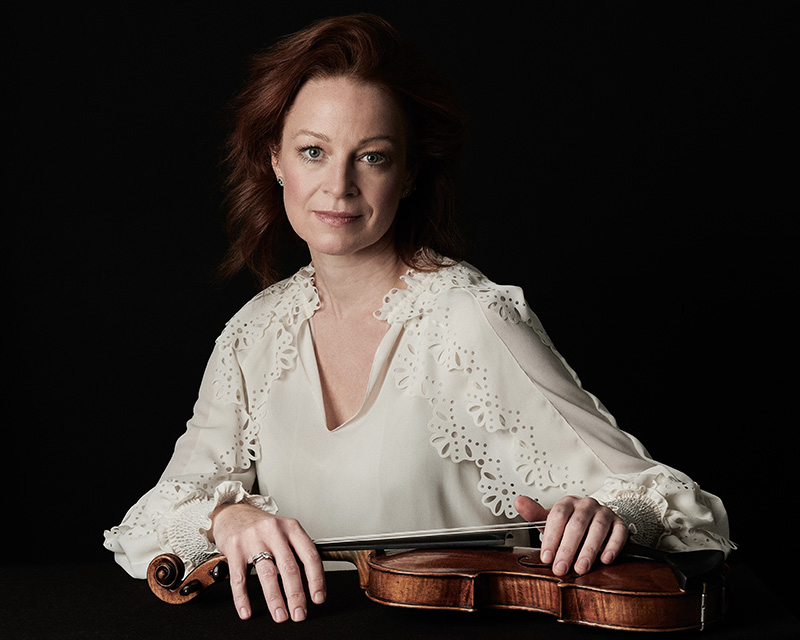
Good that the CBSO marked György Ligeti’s centenary with his Violin Concerto, combining the composer’s love of polyrhythms and varied tunings with a heady recall of his Hungarian heritage. No stranger to this piece, Carolin Widmann emphasized the teasing reticence of its Praeludium and found aching nostalgia in the folk inflections of its Aria-Hoquetus-Choral. The coruscating build-up of its Intermezzo and finely wrought intensity of its Passacaglia were well judged, Carter bringing out the strangeness of orchestral writing with its extremes of register and an array of unorthodox instruments. The final Appassionato was trenchantly done, and while Widmann’s overly matter-of-fact cadenza robbed the closing ensemble bars of their barbed humour, it proved a small blemish on this otherwise captivating performance.

BrahmsThird Symphony has done well by the CBSO in recent seasons, and Carter’s reading was no exception. Any hint of stolidity at the outset of the initial Allegro had gone during the exposition’s repeat, then the development accrued a momentum such as carried through to the end of this movement. The coda’s transfigured poise (Brahms’ riposte to Tristan?) was no less evident in the Andante, its melodic simplicity belying an emotional ambiguity as was implied by its ruminative asides before suddenly being made explicit during the confiding final pages.

The Poco allegretto was (rightly) taken not as an extra slow movement, rather an intermezzo of a pathos which was accentuated by its deft forward motion. The final Allegro then brought a culmination in all respects – Carter alive to its stark contrasts between the speculative and the combative, with a thrilling transition into the reprise then a coda that recalled the work’s defining motto with mingled aspiration and benediction on its way to an ending of perfectly judged repose. Never the easiest symphony to bring off, this was a Brahms Three to savour.

Carter will hopefully be working with this orchestra again soon. Next Wednesday’s concert brings Cristian Macelaru in a programme with Sibelius and Mendelssohn, while Thursday’s Centre Stage recital has a welcome revival of the Clarinet Quintet by Elizabeth Maconchy.

You can read all about the 2023/24 season and book tickets at the CBSO website. Click on the artist names for more information on violinist Carolin Widmann and conductor Nicholas Carter, and for more about composer György Ligeti

Published post no.1,998 – Friday 3 November 2023

Online Concert: Jean-Efflam Bavouzet plays Haydn @ Wigmore Hall

Jean-Efflam Bavouzet (piano)

Haydn
Piano Sonata in D major Hob.XVI:24 (c1773)
Piano Sonata in A flat major Hob.XVI:46 (c1767-8)
Piano Sonata in E flat major Hob.XVI:49 (1789-90)

Wigmore Hall, Monday 20 February 1pm

by Ben Hogwood

Haydn’s piano sonatas remain an underappreciated corner of his output as a composer. This is understandable on one hand, given the sheer volume and consistency of his output in other forms. The symphonies, string quartets and piano trios all enjoy higher billing, but gradually the sonatas are coming up on the rails.

This is in part due to recent recordings from pianists such as Jean-Efflam Bavouzet, Marc-André Hamelin and Peter Donohoe. Bavouzet, however, has gone further, completing a cycle of the sonatas in eleven instalments for Chandos. If they are all as stylishly played as this BBC Radio 3 Lunchtime Concert, then many treats await.

First of three works in this recital was a D major sonata full of vim and vigour. Bavouzet enjoyed its brightly voiced start, securing a lovely articulation to the right hand while bringing the historical connections through. The energy of Domenico Scarlatti was in evidence, while in the aria-like slow movement there was an operatic air. With an expressive right hand and softly alternating left, Bavouzet found Haydn’s soft centre, before enjoying the florid right hand and the playful nature of in the finale.

In the second work we enjoyed classic, ‘exploratory’ Haydn, the composer experimenting with different forms and far flung keys – such as the D flat major chosen for the slow movement. Here the influence is more C.P.E. Bach, heard in a captivating Allegro, adorned with ornaments in the right hand. Bavouzet once again showed off a bright, clear sound and lightness of touch, with sleights of humour visible at every turn. The slow movement did indeed travel further afield, creating an air of mystery, with exceptional playing in the upper reaches of the right hand. The finale was crisp and clear.

Proof that Haydn sonatas are starting to make themselves better known came with the third work. This was not the E flat sonata placed 52 in Haydn’s output – often chosen as an example sonata in a concert programme. Instead we had a winsome and deeply personal work, written for the composer’s personal friend and confidant, Maria Anna von Genzinger at the turn of 1789 and 1790. As the musicologist Daniel Heartz notes, we know more about the composition of this piece than any other in Haydn’s output, due to the correspondence between the pair, where the composer gives uncharacteristic outpourings of feeling and loneliness.

Bavouzet’s performance immediately took on a conversational air, wit and underlying tenderness lying just beneath the relatively grand gesture of the opening. The intimate, thoroughly enjoyable dialogue between the hands spoke of two people enjoying a one-on-one rapport, before the first movement ended with a flourish and an exclamation mark. The second movement had a lovely disposition to its main theme but then a darker tint to the central section, moving to such ‘un-classical’ keys as B flat minor. The finale also stressed the importance of the silences between the notes, Bavouzet observing these just as closely in the overall phrasing.

This was a wonderful recital, a reminder that Haydn’s importance and influence within the piano sonata medium should not be overlooked. The music had an endearing freshness throughout, communicated with persuasion by a pianist on top of his game.

As an encore, Bavouzet switched styles to Massenet, dedicating his performance of the French composer’s whirlwind Toccata to his dear friend Paul Westcott, a much-missed presence with whom he worked in the beginnings of his career with Chandos, and through to the Haydn itself. Paul would have loved the pizzazz of this version, and Bavouzet’s virtuosity and brilliance would have been appreciated from afar – of that there is no doubt!.

For more livestreamed concerts from the Wigmore Hall, click here. Meanwhile the Spotify playlist below contains recordings made by Jean-Efflam Bavouzet of all the repertoire in this concert:

Online Concert: Doric String Quartet & Brett Dean @ Wigmore Hall – Haydn & Beethoven

Doric String Quartet [Alex Redington, Ying Xue (violins), Hélène Clément (viola), John Myerscough (cello)], Brett Dean (viola)

Haydn String Quartet in F major Op.50/5 ‘The Dream’ (1787)
Beethoven String Quintet in C major Op.29 (1801)

Wigmore Hall, Monday 23 January 1pm

by Ben Hogwood

Is there a better musical tonic on a grey Monday in January than a Haydn string quartet? Not in this case, as the Doric String Quartet built on the solid foundations of their recent recordings of the composer’s music for Chandos with a well-crafted and nicely weighted account of one of the composer’s middle-period works.

Haydn wrote so many symphonies, string quartets and piano trios – to name just three disciplines in which he was prolific – that nicknames are helpful in identifying the works. Some of them can be quite spurious, but in the case of The Dream the label describes the serene slow movement of the quartet, and its carefree violin fantasies. The work is placed fifth work in a set of six quartets written for King Frederick William II of Prussia, and finds Haydn making further strides in the development of this new form.

The Doric captured that sense of discovery, although they took just a little while to settle, with a couple of relatively coarse moments at the start. This was however a beautifully played account, with an enjoyable lightness of touch in the outer movements and an airy account of the ‘dream’ movement itself. The players were clearly sticking to the first principles of chamber music, enjoying the conversational exchanges between the instruments but bringing the audience in on their enjoyment too. This was most evident in a lively third movement Menuetto and Vivace finale.

Brett Dean is one of the most-performed living composers, but he also has a formidable CV as a viola player, playing in the Berlin Philharmoniker for 14 years. While composing is his primary discipline these days he remains active as an instrumentalist. The Doric Quartet’s current tour includes his String Quartet Hidden Agendas, while welcoming Dean as a notable addition to the ensemble for Beethoven’s String Quintet.

The five have an easy musical chemistry, Dean effortlessly slotting in to play a work that is beginning to get the recognition it deserves, both within Beethoven’s output and in context as a fine continuation of Mozart’s innovations in the form. This performance got to the heart of Beethoven’s energetic writing in a flowing first movement, enjoying the melodic exchanges, while the second movement explored the richer mid-range colours available in music of elegiac quality, as well as enjoying the composer’s excursions to further flung keys.

In the third movement Scherzo there was a notable raising of the stakes, and an upsurge in kinetic energy. The demands were comfortably matched by the five players here, who built on this with a finale of high drama and stormy countenance.

For more livestreamed concerts from the Wigmore Hall, click here

In concert – April Fredrick, English Symphony Orchestra / Kenneth Woods – The Journey Home: Haydn, David Matthews, Barber & Mozart

Haydn Symphony No. 45 in F sharp minor, Hob.I:45 ‘Farewell’ (1772)
David Matthews Le Lac Op.146 (2018)
Barber Knoxville: Summer of 1915 Op.24 (1947)
Mozart Symphony no.36 in C major K425 ‘Linz’

April Fredrick (soprano), English Symphony Orchestra / Kenneth Woods

Great Malvern Priory, Malvern
Wednesday 23 November 2022

Reviewed by Richard Whitehouse

The English Symphony Orchestra’s season really hit its stride this evening with a programme featuring two major vocal works of the 20th and 21st centuries, heard alongside two notable while very different symphonies from near the start and towards the end of the Classical era.

As Kenneth Woods indicated, Haydn’s ‘Farewell’ Symphony would have been determinedly avant-garde to early listeners, and much of that innovative quality came over here. Not least in the initial Allegro, its jagged course and disjunctive tonal shifts only nominally countered by the Adagio’s increasingly fraught introspection. With its stark alternations in motion and phrasing, the Menuetto proved a telling foil to a finale where a turbulent Presto precedes an Adagio whose eloquence was sustained as the music subsides and musicians vacate the stage.

Whether or not this symphony would have been better placed at the end of this concert, it set up productive contrast with David Matthews’s Le Lac. Remembered more as statesman than poet, Alphonse de Lamartine was a crucial figure in French literature of the early Romantic period – his lengthy 1820 poem a remembrance of lost love comparable to verse by Shelley and Heine, and one whose slowly intensifying rapture is to the fore in this evocative scena. Two orchestral interludes aside, its formal and emotional progress is essentially determined by the vocal line; with which April Fredrick was at one in conveying the wistfulness but also anguish inherent of this music. The fastidious textures were no less finely delineated by the ESO, Woods sustaining a cohesive overall trajectory from earlier promise to ultimate loss.

Evidently it was Fredrick who had suggested juxtaposing this piece with Barber’s Knoxville: Summer of 1915, which pairing succeeded admirably in terms of underlining conceptual and expressive links between them. Its sense of loss may be psychological rather than personal, but an emotional force comes over tangibly for all this music’s overt restraint: James Agee’s poetic reportage summoning a response the more affecting for its restraint and in whose vocal part Fredrick was never less than attuned. Woods brought no mean sensitivity or character to orchestral writing such as eschews the rhetoric found in many of Barber’s earlier scores and so foreshadows the subtlety of those two decades hence. This is a work with few significant precursors or successors, and the present reading made the most of its singular atmosphere.

The evening concluded with the relative extroversion of Mozart’s ‘Linz’ Symphony – a piece whose having been written in four days doubtless occasioned its technical brilliance, yet also a formulaic quality to its actual substance. Not, however, in an Andante whose gentle pathos was to the fore, or a Menuetto whose brevity belies its resourceful use of woodwind. Woods found a winning effervescence in the initial Allegro, and if the second-half repeat in the final Presto may be one such too far, this music’s Haydnesque wit was never less than appealing.

It set the seal on a well-conceived and finely executed concert that, in pivoting between the established and unfamiliar (not only between but also within works) typifies thr resourceful approach to programming with which Woods and the ESO have now become synonymous.

For more information on the artists in this concert, click on the links to read about April Fredrick, Kenneth Woods and the English Symphony Orchestra. For more on composer David Matthews, click here