Proms premiere – Tansy Davies – Re-greening

tansy davies composer

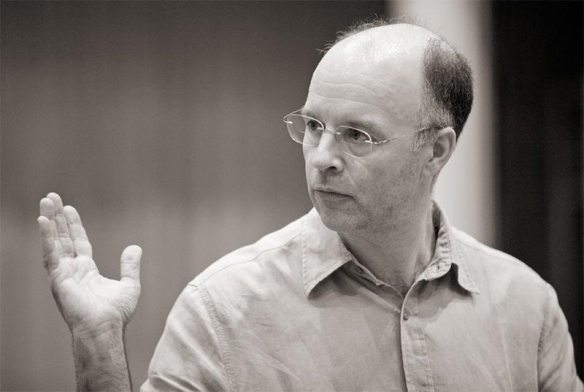
Tansy Davies

National Youth Orchestra of Great Britain – without a conductor (Prom 31)

Duration: 9 minutes

BBC iPlayer link

http://www.bbc.co.uk/events/e8r2mb

What’s the story behind the piece?

In an interview for Arcana, Tansy Davies detailed how Re-greening, written for all 164 players of the National Youth Orchestra without a conductor, is essentially an introduction to Mahler’s Symphony no.9, the piece they performed without a break afterwards.

In the interview, which can be read in full here , Davies explains how “the way the music is layered to me suggests a forest like quality; interweaving arpeggio-type figures bubbling or erupting up from the cold earth in winter, and scales or lines reaching up to the light”.

Did you know?

Before making her way as a composer, Davies sang and played guitar in a band. That was probably until she won the BBC Young Composers’ Competition in 1996!

Initial verdict

Re-greening begins with bright sounds like a forest coming to life – the opening percussion stroke, a bright, metallic sound, feels like the first sun of the day.

Then we hear the rustling of the orchestra, with harmonics from the stringed instruments and shrill woodwind that sound like the birds, sonorous brass. A song is sung by the orchestra, the popular and ancient song Sumer is icumen in, essentially a hymn that glorifies in the arrival of a new season or a new day. The chant continues, surrounded by a large orchestral sound that is used economically. The brass are prominent, Davies making great use of a big space with percussion and a huge string section.

Davies layers the sounds, so that it feels like several chords are piled up on top of each other in a full bodied texture. Then towards the end the orchestra sing again, this time a canon from English Renaissance composer Thomas Tallis, set like the earlier song in C major,. This proves an unusual and moving experience when set among the excited cacophony from the rest of the instruments.

Second hearing

tbc!

Where can I hear more?

There are a couple of excellent Tansy Davies discs in circulation, partly because her music seems to be very aware of its surroundings, i.e. it is aware of the culture – both popular and classical – in which it is written. So far she has tended towards chamber pieces that are of manageable length but considerable intensity. That much is very clear from her Troubairitz disc for Gabriel Prokofiev’s Nonclassical label, which includes the excellent Neon for chamber ensemble – and from the Spine disc for NMC, which includes the Saxophone Concerto with Simon Haram:

https://open.spotify.com/album/6RZsGqMpOm3D9Kgx3YH1l3

https://open.spotify.com/album/1lr0MOXLf5xc1nLmER9EGY

Under the Surface at the Proms – About Schmidt

Prom 73, 10 September 2015 – Vienna Philharmonic Orchestra / Semyon Bychkov at the Royal Albert Hall

schmidt
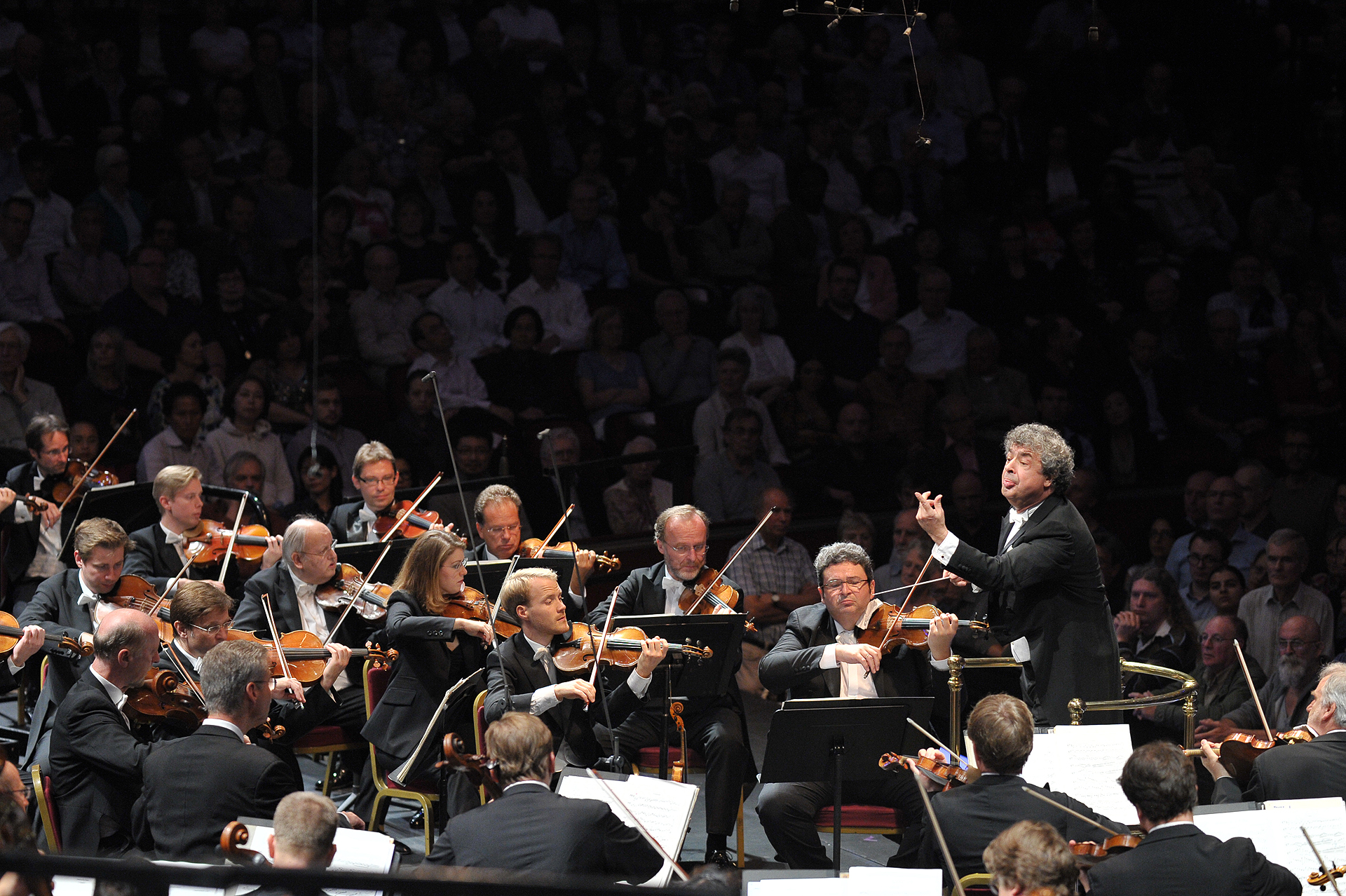
Semyon Bychkov conducts the Vienna Philharmonic Orchestra in Schmidt at the Royal Albert Hall. Photo (c) Chris Christodoulou

Symphony no.2 in E flat major
http://www.bbc.co.uk/events/ewbfxj#b068tnhg

‘Some music has to wait before it finds its place in the sun.’

This standout quote comes from an interview in the Proms program with conductor Semyon Bychkov, who conducted the Vienna Philharmonic Orchestra in this concert of two late Romantic symphonies. The work to which he referred was not BrahmsThird Symphony, which received an occasionally beautiful but ultimately rather lethargic performance in the first half, but the Second Symphony of Franz Schmidt, completed in 1913.

Schmidt’s music has only visited the Royal Albert Hall in full on two previous occasions. The Fourth Symphony, which experienced a revival when Frans Welser-Möst and the London Philharmonic Orchestra won a Gramophone Award for a recording of it in 1996, was heard at the festival in 1998. The relative success of this was followed by the massive sacred piece Das Buch mit Sieben Siegeln (The Book of the Seven Seals), which followed a similar path, recorded by Welser-Most in 1996 and performed by the same conductor in 2000.

Schmidt was a wholly suitable choice of composer for the Vienna Philharmonic, who have been revisiting important works in their history this year. Unlike the Brahms third they did not give the premiere of the Schmidt, but the connections with the composer are close. He became a member of the orchestra in 1896, where he played as a cellist – though he did not get on with Gustav Mahler, conductor at the time. Bychkov has championed the Second Symphony with other orchestras, so it made sense to finally bring it to the Vienna Philharmonic. From what I could tell this was their first season performing this or any of his symphonies. So what of the piece itself?

Written on a large scale, the Second clocks in at around 50 minutes. It is in three movements, the large second movement dominating at around half the length of the piece – and it was the centrepiece here. A colourful and richly layered set of variations on a theme, it delights in exploring a number of completely contrasting moods, drawing unusual textures from the orchestra that reveal Schmidt the organ composer. A few of the variations sound uncannily like right hand keyboard figures played at speed, with amazing clarity of colour.

There were clear influences from Bach, Beethoven, Mahler, Richard Strauss and Bruckner – yet the music was nothing like a copy of any of these composers. Instead Schmidt managed to stamp his own personality on the piece, shying away from obvious statements so that the mood was at times strangely elusive, on occasion reluctant to commit to emotion with obvious meaning.

It had operatic qualities, for sure, which could be felt in the ebb and flow of the drama and in the swell of the melodies – but the unusually luminous colours dominated, Schmidt using the orchestra in his own individual way. Here he wrote especially taxing parts for violins and violas, but the crowning glory was the massive brass chorale that appeared towards the end and was resolved without fuss.

Only the Proms could have presented this combination of orchestra and music, and should be congratulated for doing so. It was expertly performed and well received, and should go a long way to giving Schmidt’s music the chance of a revival it deserves. It will be interesting to come back in five years and see if anyone else has taken up the baton from Bychkov.

Want to hear more?

A playlist combining the Second and Fourth Symphonies can be heard here:

Meanwhile for the massive Das Buch mit Sieben Siegeln (The Book of the Seven Seals), in a recent recording made for Chandos under conductor Kristjan Jarvi, click on the link below:

This is the last Under the Surface feature of this year’s Proms. There will be more explorations of rare repertoire on Arcana in the coming months, both through recordings and concerts. Stay tuned!

Proms Interview: Tansy Davies – Re-greening

tansy-davies
Tansy Davies Photography by Rikard Österlund

For the annual appearance of the National Youth Orchestra of Great Britain at the BBC Proms, listeners will be treated to a performance of Mahler’s farewell to life, the Symphony no.9.

Prior to this, however, they will hear a new piece of music all about bringing new life to proceedings. Re-greening was written by composer Tansy Davies as a complementary piece to the Mahler, and in a short notice and generously arranged interview with Arcana the composer gave a guide to her new work and her Proms history:

Do you remember your first encounter with the Proms?

I must have been aged around 15. I just turned up with a couple of friends, not having planned or looked at what was on. We prommed of course, and I know that the programme included Debussy’s Prélude à l’après-midi d’un faune. The atmosphere was palpable, and I loved every second.

What was your first Prom as a composer?

In 2010, when I wrote Wild Card for the BBC Symphony Orchestra.

Have you written for the National Youth Orchestra before?

No.

Where did the idea for Re-Greening come from?

The concept emerged out of a collaboration between the NYO, Sir Mark Elder and myself. It’s a celebration of youthful exuberance and Spring. The commission brief, which was flexible, included the following ideals: references to old English melodies, singing in the orchestra, no conductor, and the orchestra would consist of upwards of 165 musicians. And it should create a feeling of freedom within the orchestra, before Mark Elder enters the stage as the voice of experience, to lead them through Mahler 9.

Did you have a particular location in mind when writing it?

I see the piece as being rather like a journey around a forest. The place I was thinking of is Earth (Re-greening the Earth…); and an old English forest.

What is it about an old English forest that you have represented in the piece, or were you looking to capture the overall atmosphere more?

That was really just part of my inspiration; drawing on ideas about reaching back to our roots as humans with a deep connection with nature (the structure is loosely based on a shamanic wheel of the year). But I think the way the music is layered to me suggests a forest like quality; interweaving arpeggio-type figures bubbling or erupting up from the cold earth in winter, and scales or lines reaching up to the light.

As you are writing a piece to complement Mahler’s Ninth Symphony, was it important to write a piece with a lot of opposite elements?

It was important to find something unique, performable and right for the group and the occasion, within the given constraints.

What do you like about Mahler as a composer?

The epic film-like quality of his vision.

How do you portray the colour ‘green’ in classical music?

That’s not something I’ve tried to do, although green is the colour of the heart-chakra, and my music mostly comes out of this part of me.

Neon for chamber ensemble of 7 players

Is it fair to say that through your career as a published composer you have tended to work with smaller ensembles, working gradually up to orchestral composition?

No – I think it has been more haphazard than that! It’s true that I wrote for smaller groups in most of my early music, but I’ve actually written quite a lot of orchestral music over the years. You can include chamber orchestra music in that, and my Requiem As with Voices and with Tears, which is for chorus, string orchestra and electronics.

Were you pleased with the production of your opera Between Worlds, and the reception it got?

Over the moon!

Tansy Davies and Deborah Warner talk about their operatic collaboration, Between Worlds, staged at the Barbican Centre recently

What else are you working on at the moment?

My next piece is for symphony orchestra, I’m very excited about it, but I can’t say any more just yet. I’m thrilled to have had so many opportunities to write for orchestra; I never planned it that way, but I absolutely love getting a feel for how to work with the medium.

If you could see one other Prom this season, which one would it be?

There are many and some wonderful things that I sadly can’t get to. But I hope to attend the BBC Scottish Symphony playing Sibelius and Michael Finnissy (16 Aug), and then Esa-Pekka Salonen and the Philharmonia in Bartók and Shostakovich (24 Aug). After that I am also attending the next two Proms – the BBC Symphony Orchestra and Edward Gardner (Prom 54, Nielsen Flute Concerto and Janáček Sinfonietta) and the SWR Symphony Orchestra with François-Xavier Roth (Prom 55, Bartók Concerto for Orchestra and Boulez …explosante fixe…

Tansy DaviesRe-greening will be performed at the Proms by the National Youth Orchestra of Great Britain under their conductor Sir Mark Elder, on 8 August 2015. For more information about the composer head to her website, where you can hear http://www.tansydavies.com/works/ excerpts from her catalogue of works.