Last week the British conductor Sir Simon Rattle celebrated his 70th birthday. Since the 1980s Rattle has played a hugely important part in classical music in the UK, with important conducting posts at the City of Birmingham Symphony Orchestra, Berliner Philharmoniker and London Symphony Orchestra. In 2023 he returned once more to Germany, as principal conductor for the Bavarian Radio Symphony Orchestra.
In that time, Rattle has made a huge range of recordings, from Haydn to Adès via Beethoven, Grainger and Schoenberg. Resisting temptation to compile a playlist of snippets, I have opted for a small number of heavyweight recordings, including Adès‘ Asyla, Schoenberg‘s Chamber Symphony no.1 and Stravinsky‘s Le Sacre du Printemps, his first recording on starting with the LSO in 2017. Topping the bill, however, is his CBSO recording of Mahler‘s Second Symphony, the Resurrection, the piece with which he opened Birmingham’s Symphony Hall in 1991. You can listen to the playlist on Tidal below:
Having just extended his contract with the BBC Symphony Orchestra until 2030, which at 17 years will make him its longest serving chief conductor after Sir Adrian Boult, Sakari Oramo began the new season with this frequently impressive account of Mahler’s Sixth Symphony.
Impressive but equally unpredictable – not least in an opening movement whose tensility and even terseness was emphasized by mostly swift tempos and the nowadays rare omission of its exposition repeat, which predicated martial aggressiveness over any more yielding expression. There was no lack of deftness in the central interlude, for all that the off-stage cowbells were distinctly unevocative in their tinkling, yet the developmental passages either side exuded an unwavering purposefulness so that the arrival of the reprise more than usually made its mark. Stealthily launched, the coda duly emerged rather than burst forth though this was audibly in accord with the ambivalence of its affirmation as Oramo perceived it. Those closing bars had no lack of finality, for all that there was more of ruthlessness than joyousness in their arrival.
Speaking recently, Oramo stated his conviction in the revised order of the central movements with the Scherzo placed second. He might profitably have headed into this without pause, as to underline the consistency of rhythmic profile with what went before, but there was no hint of inflexibility here or in the trio sections which effortlessly elided between the winsome and sardonic. Equally in evidence was that fatalistic sense pervading the music as it unfolds, and so made possible a coda whose evanescent poise could not conceal more ominous portents.
From this vantage, the Andante provided if not balm to the soul, then a measure of unforced pathos. Enticingly rendered with some notably felicitous playing by the BBCSO woodwind, it was shaped by Oramo with unerring rightness through to a climax whose emotional force was the greater for its being held in check. Surprising that this movement has never attained the popularity of the Adagietto from the Fifth Symphony: then again, its salient qualities are conveyed even more completely when experienced within the context of the work as a whole.
By a similar token, it arguably matters less in what order the middle movements are played if the finale proves a culmination in all respects. That it certainly was here – Oramo imbuing its lengthy introduction with acute expectancy balanced by the visceral impact of what followed. Nor did tension fall off in those quiet but eventful interludes, strategically placed between the larger formal sections, and in which cowbells are overlaid by tubular bells for what became a haze of resonance as affecting as any more demonstrative expression elsewhere. Oramo also restored that third hammer-blow which does not so much alter the course of this movement, as confirm its resignation before fate in even more graphic terms. Nothing could have sounded more matter of fact than the baleful rumination of brass prior to that explosive closing gesture. While not the most inclusive performance, this was undoubtedly one to renew admiration in the audacity of Mahler’s conception or his conviction in bringing it off. It also gave notice of continued rapport between Oramo and the BBCSO as they begin their 12th season together.
Bavarian Radio Symphony Orchestra / Sir Simon Rattle
Royal Albert Hall, London Friday 6 September 2024
reviewed by Ben Hogwood Photos (c) Chris Christodoulou (taken from the previous night’s Prom)
This was Sir Simon Rattle‘s fifteenth encounter with the music of Gustav Mahler at the BBC Proms – and a third outing under his baton for the Sixth Symphony, which he first conducted in charge of the National Youth Orchestra of Great Britain 40 years ago.
This time he was visiting, having returned to Germany to take charge of the Bavarian Radio Symphony Orchestra, a feeling for the concertgoers akin to welcoming a distant relative and hearing about their latest job. The Munich ensemble have formidable Mahler credentials, no doubt introduced by Eugen Jochum from their founding in 1949 but notably honed by Rafael Kubelík, with whom they recorded all the symphonies for Deutsche Grammophon. This account of the Sixth proved them to be the ideal foil for Rattle, the Liverpudlian welcomed with great cheers around the hall.
Sir Simon knows his Mahler better than arguably any other living conductor, and the breadth and depth he brought to his interpretation was breathtaking. So too was the sheer audible spectrum, for which we have to thank Mahler, for this is one of those works that has simply everything, from the tiniest murmur from bass strings to the thunderous hammer strokes of the finale. Some way between that lies the tender theme he wrote for his wife Alma, a glowing light in the first movement under the tender caress of its beautiful wind choir. Around this and in the last movement were fleeting glimmers of sunshine from the cowbells, an unusual addition to the percussion section that charmed from their offstage position, evoking the open meadows but with shivers of cold wind from the rest of the orchestra, outlines icily drawn by strings and brass.
These moments were welcome respite from the tumult of Mahler’s marching music, obsessively hammered home in the fast movements, the orchestra turning this way and that at quick speed. The marching music, so virulent in the first movement, quickly develops a sour taste, and Rattle was alive to that in the scherzo – placed third. This is a time-honoured practice for him, in accordance with Mahler’s order of performance when conducting but not his initial order of composition. The controversy continues to follow the work around, and although many (this author included) prefer the scherzo placed second – ratcheting up the tension – Rattle’s shaping of the piece overall made his own choice a convincing one.
The orchestra were simply stunning. The strings – rarely given due credit in big symphonic performances such as this – were united beyond criticism, the violins in remarkable unison – and particularly beautiful in the serene opening to a magical slow movement. Brass were also as one in their clarion calls, but turned vulgar when they needed to. The wind section was beautifully shaped and coloured, with an appropriately plaintive oboe solo in the trio section of the scherzo. Underpinning the performance were the rolling timpani, the thunder to the lightning strikes of the percussion, whose power was simply brutal at times, The hammer blows, struck twice in the finale, were terrifying strokes of fate and delivered with appropriately cold theatre.
This was a performance that will stick in the memory for years, one from which my ears are still ringing. Mahler’s ghastly premonitions of later existence were brought to life in shocking technicolour, though Rattle revelled at the same time in its beautiful evocations of nature. These were ultimately swept aside, with red-blooded highs and cold-blooded lows, all blended into the same intoxicating musical cocktail. For sheer emotional power, this symphony – and this performance – had it all.
You can listen to the Bavarian Radio Symphony Orchestra and Sir Simon Rattle in their recent live recording of the Sixth symphony below:
Published post no.2,294 – Saturday 7 September 2024
Mahler Symphony no.1 in D major (1887-8, rev, 1898) Mahler arr. Schoenberg Lieder eines fahrenden Gesellen (1884-5, arr. 1920) Mahler Blumine (1884, rev. 1889)
Colorado MahlerFest 195269164287 [79’02”] Live performances on 18 May 2019 (Lieder eines fahrenden Gesellen), 19 May 2019, Macky Auditorium, Boulder, Colorado
Reviewed by Richard Whitehouse
What’s the story?
Recorded representation of the current MahlerFest era continues to grow with this release on CD (previously available as a download) of the First Symphony with related pieces, given at its 32nd edition and what was the fourth such event with Kenneth Woods as artistic director.
What’s the music like?
What was doubtless intended to inaugurate a chronological traversal began in 2019 with this performance of the First Symphony, the first to be heard in the critical edition published that year by Breitkopf & Härtel. Woods has written about this extensively at his website [Ken on the Great Mahler Debate of 2019 | Kenneth Woods – conductor]: suffice to add the numerous corrections and textural amendments enhance that fuller and more stratified orchestral sound such as Mahler favoured in 1899 when compared with earlier versions from 1889 and 1893.
Interpretatively, this performance is a satisfying one with few overt surprises but no obvious idiosyncrasies. Any lack of atmosphere during the first movement’s mesmeric introduction is offset by its easeful if never uneventful continuation – thus a subtly differentiated exposition repeat, then stealthy marshalling of expressive tension to a coda whose joyousness is rightly kept within limits. The scherzo is robust yet propulsive and the trio even finer in its unforced suavity, while the funeral march never over-inflects its Klezmer elements unfolding from the ominous and ironic, via gentle repose, to a closing fatalism. Woods succeeds better than most in holding together the unwieldy finale, allowing due emotional space for the recall of initial ideas that is its sure highlight, and the ensuing apotheosis lacks nothing in blazing affirmation.
Included as an encore is Blumine, the ‘romance’ salvaged from earlier incidental music which formed part of this symphony until being jettisoned in 1894 – here emerging with its elegance and pathos devoid of wanton sentiment. The actual concert continued with Korngold’s Violin Concerto then Beethoven’s Third Leonora Overture reorchestrated by Mahler, but the present release opens with a performance from the previous day’s concert of Lieder eines fahrenden Gesellen. This is heard in a chamber arrangement as supervised by Schoenberg for the 1920 season of his Society for Private Musical Performances, its textural transparency underlining the soulfulness then buoyancy of its opening two songs. If the (over-wrought?) drama of the third song is under-projected, the wistful radiance of its successor comes across unimpeded.
Does it all work?
Indeed it does, overall. Mahler symphonies may have been performed and recorded by a host of international orchestras, but that of the Colorado MahlerFest lacks nothing in commitment or tenacity; any lack of atmosphere and finesse owes more to the clear if confined acoustic of Macky Auditorium than absence of quiet playing or overriding of dynamics. Joshua DeVane is a thoughtful exponent of the song-cycle, at his best in the restrained inwardness of its outer numbers, while the ensemble drawn from the CMO makes a persuasive case for this reduction.
Is it recommended?
It is. The orchestral playing may have grown in conviction with each new instalment, but this is a notable statement of intent for MahlerFest under Woods’s direction. That the 33rd edition had to be scaled down then presented online had little effect on the resolve of those involved.
Buy
For further purchase options, visit the MahlerFest website – and for more information on the festival itself, click here. Click on the names for further information on conductor Kenneth Woods and soloist Joshua DeVane
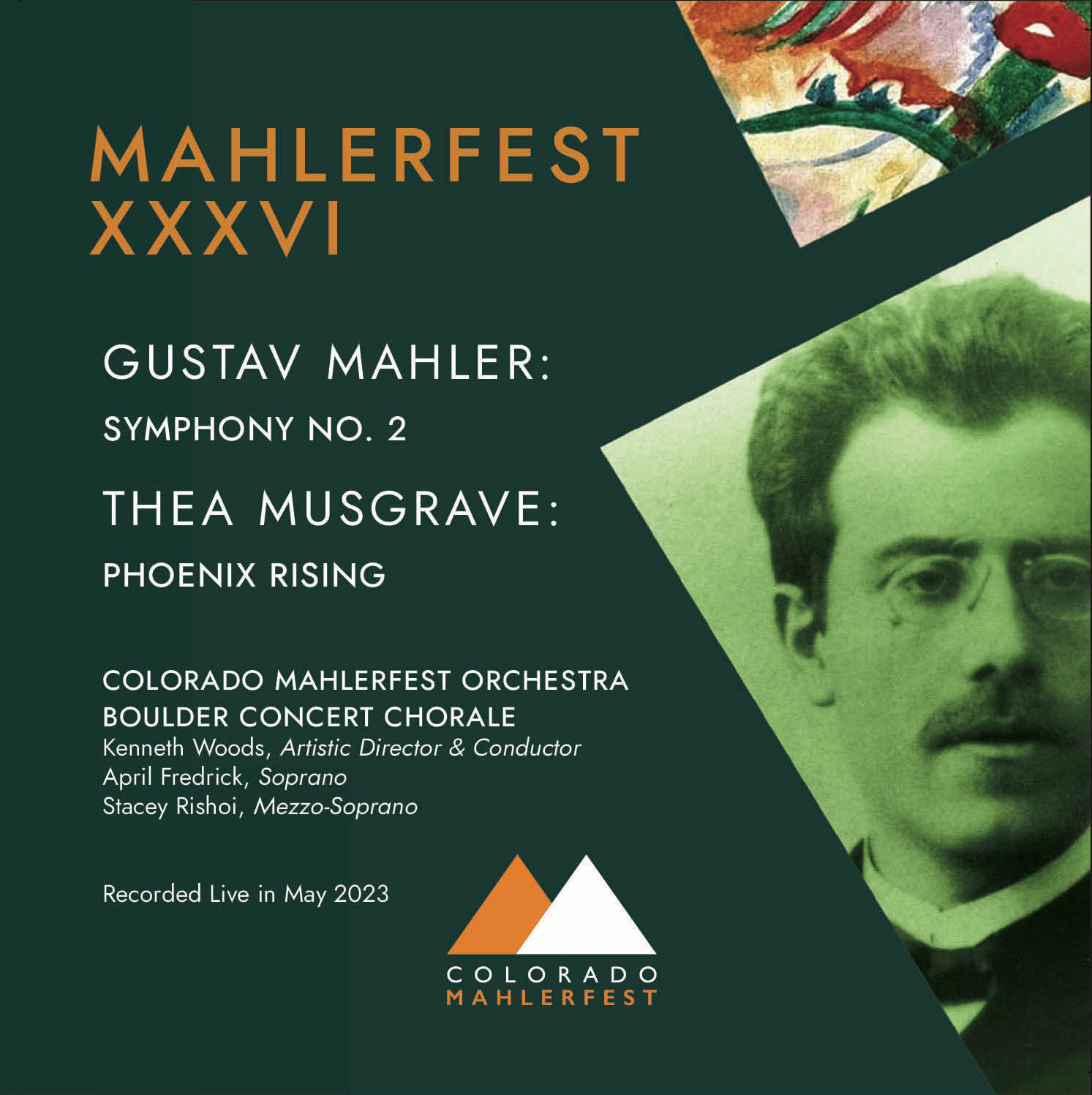
Musgrave Phoenix Rising (1997) Mahler Symphony no.2 in C minor ‘Resurrection’ (1888-94)
Colorado MahlerFest 195269301194 [two discs, 104’02”] Live performances on 21 May 2023, Macky Auditorium, Boulder, Colorado
Reviewed by Richard Whitehouse
What’s the story?
Last year’s edition of MahlerFest continued its latest, not-quite-chronological traversal of the symphonies with the Second – appropriately coupled on this release (as in the concert) with a work such as considers ‘resurrection’ from a very different while no less relevant perspective.
What’s the music like?
Six years in the writing, Mahler’s Second Symphony fairly laid the basis for his reputation as a composer at its Berlin premiere in 1895. It is a measure of this performance that it captures something of the shock or excitement no doubt in evidence back then, not least in an opening movement with Kenneth Woods notably more interventionist tempo-wise as compared to that of the Third Symphony a year before. What emerges is imposing but never diffuse, at its most gripping in that baleful lead-in to a development whose terseness duly accentuates its impact, with the pathos of the second subject on its reprise making the coda’s sardonic recessional the more acute. After which, the second movement feels the more enticing through its alternation of warm sentiment with capering animation while heading to a conclusion of beatific repose.
There is no lack of incident in a scherzo whose glancing irony is leavened yet not lessened by its trios, the first as soulful with its lilting trumpets as the second is ominous in its import; but not before Stacey Rishoi has characterized the Urlicht setting with rapt inwardness. What to say about the finale other than, while this may not be the most overwhelming take on its vast fresco, it is matched by relatively few as regards an organic unfolding that sees the movement whole. Its contrasting elements here fuse with unforced cohesion to a fervent rendering of the chorale episode then on to a surging Toten-marsch – the kinetic momentum carried through to a methodical reprise of earlier ideas, then a rendering of Klopstock’s text (much altered by the composer) as only grows in intensity before the majestic affirmation of its closing pages.
As the ‘first half’, Thea Musgrave’s Phoenix Rising provides an ideal complement. The much esteemed (latterly more in the US than the UK) nonagenarian has written often for orchestra, but seldom with such immediacy than in a piece whose formal and expressive trajectory feels nothing if not symphonic in its progress. Comparison with the 2016 studio recording by BBC National Orchestra of Wales and William Boughton (Lyrita SRCD372) confirms that, passing tentativeness in ensemble excepted, Woods’s reading demonstrably makes more of this aspect.
Does it all work?
Yes, pretty much always. As on previous releases in this ongoing Mahler cycle, the Colorado MahlerFest Orchestra punches appreciably above its weight in music which should never fall prey to wanton virtuosity. The unyielding acoustic of Macky Auditorium is less an issue than before, with the finale’s offstage brass adeptly managed. April Fredrick brings her customary eloquence to bear on this movement, and the Boulder Concert Chorale – as prepared by Vicki Burrichter – rises to the occasion with notable fervency as this work reaches an ecstatic close.
Is it recommended?
It is. There have been too many superfluous Mahler cycles, but this traversal is shaping up as one of the most worthwhile and more than the memento of a memorable occasion. Hopefully such standards will be maintained by the Sixth Symphony as part of next year’s 37th edition.



 Arcana.fm