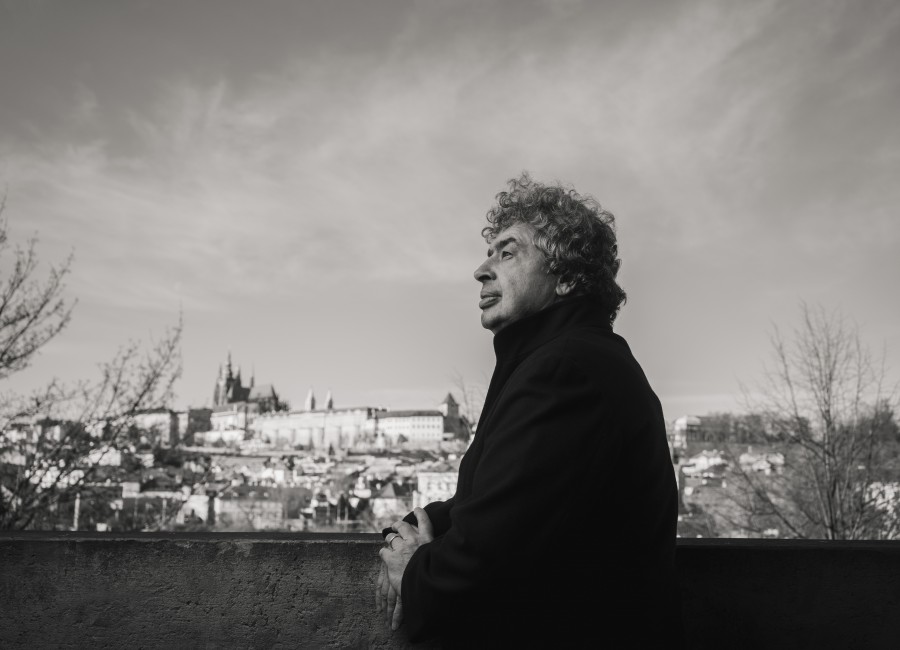
Semyon Bychkov turns 70 today…and in recognition of one of our finest living conductors, here is a link to watch this most erudite musician conducting the WDR-Sinfonieorchester Köln in William Walton’s First Symphony:
Here too is a playlist gathering together some of his finest recordings, from the early days with Philips to his most recent release, an account of Mahler’s Symphony no.5 with the Czech Philharmonic Orchestra for Pentatone. Along the way we hear excerpts or complete works by Tchaikovsky, Prokofiev, Mendelssohn, Dutilleux and Rachmaninoff. It is a wonderful listen, I’m sure you’ll agree!
Two years ago, in the midst of the pandemic, I wrote a piece for Arcana FM on ‘Mahler’s Eighth and coming out of COVID-19’. I concluded by saying that I wouldn’t get to see a performance of this epic ‘Symphony of a Thousand’ – and complete my personal Mahler live symphony cycle – any time soon, but that when I did it would have a very particular significance.
I certainly didn’t know that the performance would be by the Royal Philharmonic Orchestra conducted by Vasily Petrenko at the Royal Albert Hall on a Sunday afternoon in late October 2022, a concert that was itself rescheduled due to the pandemic.
And what a performance it was. The Royal Albert Hall could be said to be purpose built for this work, accommodating not just an expanded orchestra (including seven off-stage brass players in the gods) but three choirs, two boys’ choirs, eight soloists and a huge concert organ (the Royal Albert Hall’s was once the largest instrument in the world).
You get the full blast of the organ from the off with the tumultuous opening of Part 1’s Veni Creator Spiritus. It’s quite a ride from there on in, and Petrenko and the RPO handled it superbly all the way through to the powerful finale of Part 2’s setting of the end of Goethe’s Faust. This was not just about the big sections, the delicate moments were deftly done too.
But this work is really all about the singing, and the assembled choirs of the Philharmonia and Bournemouth Symphony Choruses and City of London Choir, as well as the Tiffin Boys’ Choir and Schola Cantorum of the Cardinal Vaughan Memorial School were magnificent.
And it wasn’t just the massed voices, as glorious as they were. The soloists – and let’s name them (above): Sarah Wegener (Magna Peccatrix), Jacquelyn Wagner (Gretchen), Regula Mühlemann (Mater Gloriosa), Jennifer Johnston (Mulier Samaritana), Claudia Huckle (Mary of Egypt), Vincent Wolfsteiner (Doctor Marianus), Benedict Nelson (Pater Ecstaticus) and James Platt (Pater Profundus) – were excellent too.
I made the point in my earlier piece that there is something about the combination of the mass assembled forces performing together and being joined by an audience in an even bigger collective. I think the standing ovation from the near sell-out crowd at the end was testimony to this.
Mahler’s Eighth is definitely one of those pieces that you need to see performed live. I’m so glad that I finally did.
John Earls is Director of Research at Unite the Union and tweets at @john_earls
Paul Lewis (piano), City of Birmingham Symphony Orchestra / Christoph König
Mozart Piano Concerto No. 27 in B flat major, K595 (1788-91)
Mahler Symphony No. 5 in C sharp minor (1901-02)
Symphony Hall, Birmingham Wednesday 21 April 2022, 2.15pm
Written by Richard Whitehouse
Back from a first European tour since the pandemic and following the Easter break, the CityofBirminghamSymphonyOrchestra hit the ground running with a programme of contrasts featuring Mozart’s last piano concerto and what is likely Mahler’s most popular symphony.
It may have been finished early during his final year, but Mozart’s27thPianoConcerto was drafted several years earlier, while its relative inwardness as compared to those from 1785-6 need not be read as fatalistic; still less be taken for valediction. This was certainly how PaulLewis approached it with a poised but never flaccid opening Allegro – its subtle contrasts of themes and dynamics creating their own, discreet momentum with an eloquent rendering of the development then a lucid cadenza such as brought the whole movement deftly full circle.
Might it be that this concerto is only as good as the best performances? Thanks to Lewis the central Larghetto never risked seeming plain spun or uniform, piano dovetailing into strings and woodwind to ingratiating effect. In the closing Allegro, ChristophKönig pointed up the dance-like robustness of its rondo theme with a lilting impetus as never faltered. This is one of Mozart’s few concertos where his own cadenzas survive; Lewis’s probing manner in the finale setting the seal on a reading as thoughtfully conceived as it was insightfully realized.
His recent recordings of Louise Farrenc having gained widespread praise, König is evidently a conductor in demand and his account of Mahler’sFifthSymphony provided a decisive, no-nonsense take on this much-played piece. Not least an initial FuneralMarch whose bracing objectivity did not preclude a more visceral response to its frenzied climax or ominous close. Its successor’s competing strands of violence and resignation were purposefully juxtaposed, through to the as-yet provisional emergence of the chorale then a tellingly speculative coda.
Time and again the central Scherzo fails to fulfil its role as this work’s formal or expressive crux, and if König’s approach fell short of the ultimate conviction, it was more than usually cohesive – whether in the discursive unfolding of its ländler-informed sections or the central trio with its rustically evocative overtones. Equally persuasive were those transitions either side, thereby endowing the movement with a cohesive follow-through which paid dividends during a coda whose unalloyed ebullience more than usually indicated what was to follow.
Most conductors now make the famous Adagietto a soulful interlude rather than full-blown slow movement, König going further by making it an extended introduction to the closing Rondo. This evolved almost seamlessly through the gradual intensification of ideas already heard towards the re-emergence of that chorale, here blazing forth with an affirmation that did not pre-empt those final bars in their almost nonchalant affirmation. Mahler might have written deeper finales, but not one whose triumph over adversity was so potently achieved.
An impressive demonstration, too, of the CBSO’s collective prowess (while not neglecting that of trumpeter MatthewWilliams) for what is well worth catching in Saturday’s repeat performance; before this orchestra offers ‘something completely different’ next Thursday.
For more information on the CBSO’s 2021-22 season, click here
Meanwhile for more information on the artists, click on the names to access the websites of Paul Lewis and Christoph König
Pejačević Verwandlung, Op. 37b (1915), Liebeslied, Op. 39 (1915), Zwei Schmetterlingslieder, Op. 52 (1920) Sibelius Violin Concerto in D minor Op. 47 (1903-04, rev. 1905) Mahler Symphony no. 1 in D major (1899 version)
Marija Vidović (soprano), Tamsin Waley-Cohen (violin), Zagreb Philharmonic Orchestra / Jan Latham-Koenig
Cadogan Hall, London Thursday 13 April 2022
Written by Richard Whitehouse. Photos (c) Patrick Allen (Tamsin Waley-Cohen), Paul Persky (Jan Latham-Koenig)
Visits from overseas orchestras are only now getting into their stride following the abeyance caused by the pandemic, so credit to the Zagreb Philharmonic for having undertaken its first UK tour in over half a century with a programme whose challenges were not to be gainsaid.
A recent BBC performance of her Symphony confirmed the significance of Dora Pejačević (1885-1923) in European music of the early 20th century, and it was a pleasure to encounter these four orchestral songs from her maturity. A setting of Karl Kraus’s Transformation won grudging admiration of Schoenberg; here, even more so in that of Rainer Maria Rilke’s Love Song with its winsome violin solo and fervent orchestral interlude, the influence of Strauss is directed towards audibly personal ends. Marija Vidović (above) gave them with no mean eloquence and did comparable justice to those charms of Karl Henckell’s verse in Two Butterfly Songs – the elegance of ‘Golden stars, little bluebells’ then the poise of ‘Flutter by, butterfly, flutter away’, each of them benefiting from especially deft contributions by the Zagreb musicians.
Tamsin Waley-Cohen duly joined the orchestra for Sibelius’s Violin Concerto – likely more popular than ever these days, here receiving a confident and forthright account that was at its most persuasive in a trenchant and cumulative take on the developmental cadenza toward the centre of the first movement, then an Adagio more than usually restive and even ominous as it unfolded. The soloist’s astringent tone might not be to all tastes, but it effectively banished any risk of expressive blandness while maintaining an impulsive interplay with the orchestra – not least in that opening Allegro’s combative coda or a finale which, while its Allegro was not ideally ‘non tanto’, generated an impressive momentum which carried through to a truly visceral close. Some solo Bach enabled Waley-Cohen to demonstrate a more inward touch.
A pity Jan Latham-Koenig (above) rarely appears in the UK, as his engagements seldom disappoint. For all its rawness and passing inelegances, this was as gripping an account of Mahler’s First Symphony as one is likely to encounter. Its opening movement was evocatively launched, the sounds of nature gradually admitting of a human presence such as filters through in its lilting exposition (not repeated) then comes to the fore with joyous immediacy in the coda. Robust and forthright, the scherzo’s outer sections found contrast in the ingratiating charm of its trio.
A symphony with a complex gestation (admirably set out in Timothy Dowling’s programme notes), its ensuing fantasy on a well-known children’s song is shot through with elements of klezmer and art-song in a portrayal of a huntsman’s funeral vividly ironic in its tragicomedy. Latham-Koenig was almost as persuasive in the lengthy finale – its Dante-esque contrasts of violence and supplication channelled convincingly to the spellbinding recollection of earlier motifs which made way for a chorale-dominated apotheosis of notably unsparing immediacy.
Few countries have yet had a composer for president, but Ivo Josipović served Croatia during 2010-15 and the encore of his Prelude to the Millenium sounded redolent of early Ligeti or Lutosławski in its uninhibited verve. The Zagreb musicians gave their collective all – to his evident pleasure.
For further information on the Zagreb Philharmonic Orchestra, click here – and for information on the artists, click on the names to find out more about Marija Vidović, Tamsin Waley-Cohen and Jan Latham-Koenig. Meanwhile for more on composer Dora Pejačević, click here
Richard Strauss Don Juan, Op. 20 (1888) Mozart Vado, ma dove?, K583 (1789) Mozart La Clemenza di Tito, K621 (1791) – Non più di fiori Mahler Symphony No. 4 in G major (1899-1900)
Fatma Said (soprano), City of Birmingham Symphony Orchestra / Kazuki Yamada
Symphony Hall, Birmingham Wednesday 19 January 2022
Written by Richard Whitehouse
It may still be over a year before Kazuki Yamada becomes chief conductor and artistic advisor of the City of Birmingham Symphony Orchestra, but concerts such as tonight’s afford ample indication of just what can be expected from this already engaged and productive partnership.
If there any ongoing theme to this programme, it was one of transcendence – admittedly, one of negation in Richard Strauss’s Don Juan, though Yamada relished those encounters chivalrous and amorous during its course. The ‘carnival’ episode drew some especially incisive playing from woodwind and brass, and while the climactic restatement of the horns’ aspiring theme lacked nothing in grandiloquence, it did not detract from the starkness of a coda whose fatalism was to be encountered within this composer’s tone poems more regularly than might be supposed.
Strauss’s lifelong devotion to Mozart made two of the latter’s arias an appealing complement. Written as a replacement number for a long-forgotten opera by Vicente Martín y Soler, Vado, me dove? enjoys frequent revival as a standalone aria and, when elegantly rendered by Fatma Said, it was not hard to hear why. One of the (relatively few) highpoints from Mozart’s final opera La Clemenza di Tito, Vitellia’s aria makes greater expressive challenges to which Said rose accordingly – the trajectory of its ‘Ecco il punto’ recitative subsiding from anguish into that resignation from where the aria itself proceeds unerringly to the resolve at its close. All of which was eloquently conveyed, and while a further aria – the mellifluous Nehmt meinen Dank? – would have been welcome, there was more to come from this impressive singer.
Namely the finale of Mahler’s Fourth Symphony – hardly the rarity it was when Adrian Boult introduced it to Birmingham audiences 95 years ago, but easy to underestimate in the context of this composer’s overall output. As ‘unhurried’ as its heading indicates, the first movement exuded no little ambiguity – Yamada pointing up those myriad timbral and textural shadings that permeate the development and so make possible the heightened equanimity of the reprise. Sardonic but not unduly malevolent, the scherzo was tangibly evocative (Eugene Tzkindelean switching adeptly from his violin to its retuned doppelganger) – with breath-taking change of tonal perspective at the arcadian vision near its end. Visionary was no less apt to describe the slow movement, its variations alternating between fervour and anguish with seamless accord.
Felicitous playing from CBSO woodwind informed its progress on the way to its climax, with ‘heaven’s door’ briefly yet thunderously ajar prior to the transfigured calm of the closing bars. Stealing in just before, Fatma Said was an appealing guide to the setting of ‘Das himmlische Leben’ with its not always blissful recounting of the joys awaiting those who arrive there. Of particular note was the easefulness that spread across the final pages, when the singing ceases and the orchestra withdraws stealthily while raptly to leave just the harp’s pulsing resonance.
A lucid, often captivating performance of a work whose enticements Yamada realized in full measure. Anyone who can make it along to Symphony Hall for tomorrow afternoon’s repeat should certainly do so, while Kazuki Yamada will be back with the CBSO during this spring.
For more information on this concert visit the CBSO website. Meanwhile click on the links for information on the artists Fatma Said and Kazuki Yamada.